Visiting Baalbek, Lebanon: Top Sights on Foot
Things to do in Baalbek: Roman temples and ancient stones
The best things to do in Baalbek centre on its extraordinary archaeological site, where some of the Roman world’s most imposing temples still rise above the Beqaa Valley. The city also reveals a later layer of history through the Umayyad Mosque, built beside the Temple of Jupiter. Neywo offers a free audio guide for Baalbek with 4 narrated places, available in 11 languages.
Baalbek is one of the essential places to visit in Lebanon for anyone interested in ancient architecture, engineering and the meeting of Roman and Islamic history.
What to see in Baalbek
Umayyad Mosque of Baalbek
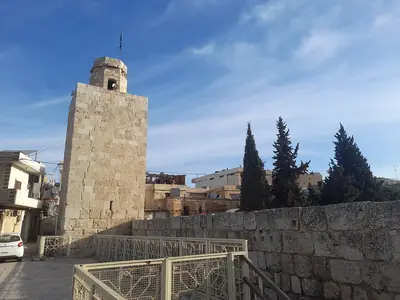
The Umayyad Mosque of Baalbek stands close to the Roman ruins and is one of the oldest and largest mosques in the city. It was built around 714 by Caliph Al-Walid ibn Abd al-Malik, during the Umayyad period.
Its location beside the Temple of Jupiter was deliberate. The mosque’s setting expresses a change of power while also preserving the importance of the site as a centre of monumental architecture. Its design combines Byzantine influence with early Arab Islamic elements, making it one of the few surviving Umayyad-era monuments in Lebanon.
Temple of Jupiter
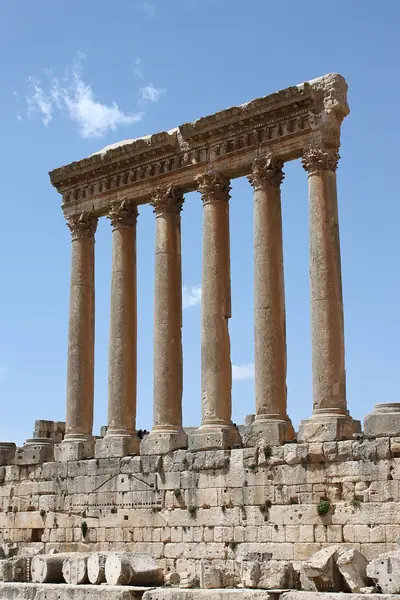
The Temple of Jupiter was the monumental centre of ancient Baalbek. It was dedicated to Jupiter Heliopolitanus, a fusion of the Roman king of the gods and the local solar deity.
Only six columns remain standing, but their scale is extraordinary: each rises nearly twenty metres and measures two and a half metres in diameter. They stand on a huge platform raised seven metres above a foundation of megalithic blocks.
Construction probably began in the first century BCE and continued for three centuries. The temple’s original commission and design remain unknown, and parts of its outer walls were never completed. Its foundation includes the famous Trilithon: three enormous stones, each weighing around 800 tonnes. Their transport and placement remain among the great engineering mysteries of antiquity.
Temple of Bacchus
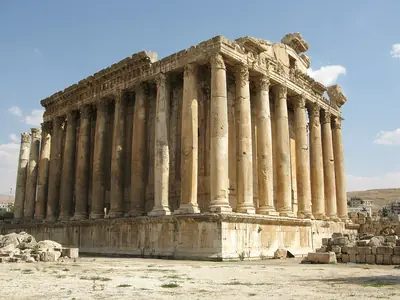
The Temple of Bacchus is one of the best-preserved Roman temples in the world. Built around 150 CE during the reign of Emperor Antoninus Pius, it retains much of the grandeur of Imperial Roman architecture.
The temple was surrounded by 42 Corinthian columns, each 19 metres tall. Nineteen remain standing, with intricately carved capitals supporting an elaborate entablature. The decoration led scholars to associate the building with Bacchus, the Roman god of wine, known to the Greeks as Dionysus, although that identification is not certain.
The temple forms part of the Baalbek archaeological site, which has held UNESCO World Heritage status since 1984. Its relatively complete structure makes it possible to appreciate the scale and detail of a Roman sanctuary far more clearly than at many other archaeological sites.
Baalbek Stones
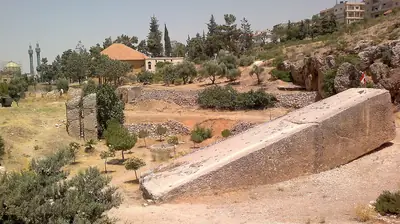
The ancient quarry offers another way to understand the ambition behind Baalbek’s temples. Six colossal Roman blocks are found in and around the quarry: three were transported to the Temple of Jupiter, while three others remained where they were cut.
The Trilithon stones, now forming part of the temple podium, weigh between 750 and 800 tonnes each. Because the quarry stands on slightly higher ground than the sanctuary, the Romans could move them along temporary earthen ramps using wooden cylinders rather than lifting them vertically.
Three even larger stones never left the quarry. The Stone of the Pregnant Woman, known locally as Hajar al-Hubla, weighs roughly 1,000 tonnes. Nearby, the Stone of the South weighs 1,242 tonnes. These blocks make the quarry an essential stop for anyone interested in how Baalbek’s monumental architecture was built.
A Baalbek self-guided walking tour
The main sights are close enough to experience on foot in a focused visit. A Baalbek self-guided walking tour can connect the Umayyad Mosque, the Temple of Jupiter, the Temple of Bacchus and the Baalbek Stones, moving from the city’s Islamic monument to its Roman sanctuaries and ancient quarry.
Baalbek also makes a compelling historical stop when exploring Lebanon beyond the coast. If you are travelling through the country, you can combine it with time in Beirut, or continue towards Byblos for a different encounter with Lebanon’s long archaeological history.
Explore Baalbek with Neywo
Download Neywo and follow the Giants of Heliopolis walking tour through Baalbek. It covers 1.6 km in 46 minutes and includes 4 narrated stops: the Umayyad Mosque of Baalbek, the Temple of Jupiter, the Temple of Bacchus and the Baalbek Stones.
The app tells the story of each place as you reach it, at your own pace, with no group and no schedule. It is a free walking tour Baalbek experience designed for independent exploration: put on your headphones, follow the route and discover the city while moving from one monument to the next.
Places with an audio guide in Baalbek
4 places in Baalbek with a Neywo audio guide. Each one starts telling its story as you reach it.
Self-guided tours in Baalbek
1 tour in Baalbek, free in the Neywo app. Each stop tells its story as you reach it.
- Walk
Giants of Heliopolis
Walk from an Umayyad mosque into the Roman sanctuary of Heliopolis, past the tallest columns of the classical world and the best-preserved temple in Lebanon, then on to the quarry where the largest stones ever cut still lie. A compact half-day in a UNESCO site that makes ordinary scale feel small.
Umayyad Mosque of Baalbek · Temple of Jupiter · Temple of Bacchus · Baalbek Stones
Open this tour: Giants of Heliopolis
Walk Baalbek with Neywo
Neywo turns Baalbek into a self-guided audio tour. Stories arrive as you reach the place they belong to, and the route reshapes when you wander off it.

