Budva, Montenegro: Self-Guided Walking Tour
Things to Do in Budva, Montenegro
The best things to do in Budva are concentrated around its medieval Old Town, Venetian fortifications, historic churches, archaeological remains, and Adriatic coastline. Walk through Stari Grad, climb the Citadel for views over the Riviera, then follow the coast to Mogren Beach and its ruined fortress. Neywo has a free audio guide for Budva with 16 narrated places, available in 11 languages.
What to See in Budva
Stari Grad and Budva’s fortifications
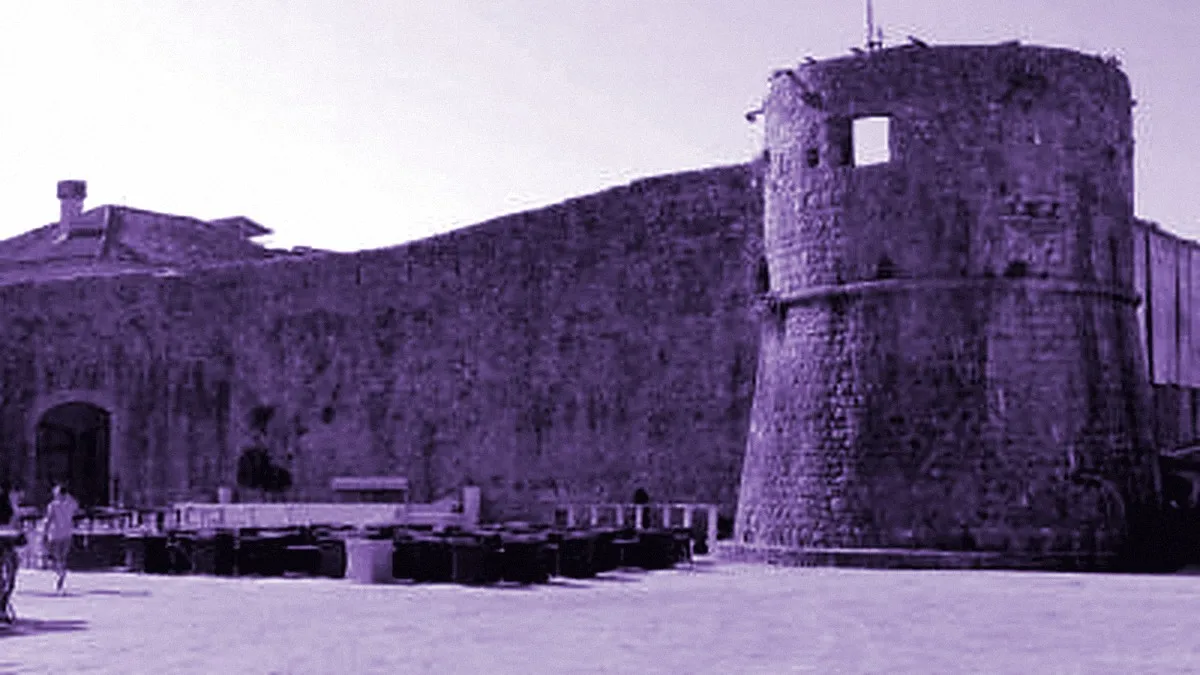
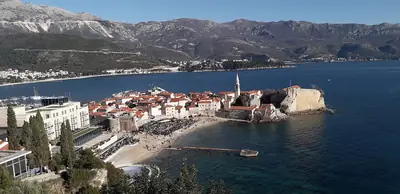
Stari Grad, Budva’s Old Town, is a well-preserved medieval urban complex and an important cultural monument on Montenegro’s Adriatic coast. It began as a fortress on an island just offshore, before a strip of land connected it to the mainland.
The Old Town is still lived in, so its stone streets and houses have an everyday character alongside their historic atmosphere. The 1979 earthquake badly damaged the town, but the walls and buildings were repaired, preserving the character of the historic center.
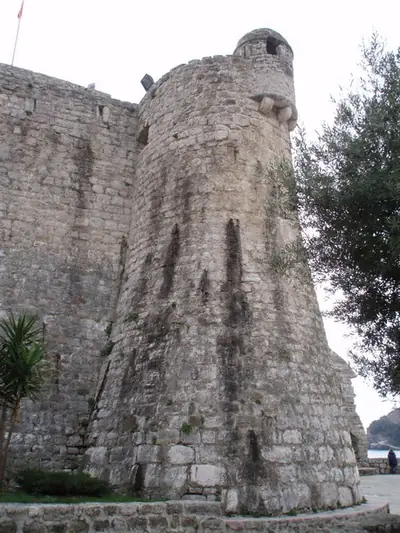
The surrounding fortifications largely reflect Venetian influence, especially from the fifteenth century. Their towers, gates, stairways, narrow passages, brickwork, and loopholes recall Budva’s defensive past. The walls form a horseshoe rather than a complete circle, but they still offer views over the Old Town, the Adriatic, nearby cliffs, and the Budva Riviera.
Porta di Terra Ferma
Porta di Terra Ferma, also known as the Mainland Gate, is the grand western entrance to the walled Old Town. Njegoševa Street leads from here into the town’s main thoroughfare.
Above the doorway, the coat of arms of Stara Budva combines three eight-pointed stars with the winged lion of Venice. Inside the entrance, a mosaic icon of the Virgin and Christ recalls an older religious tradition associated with the gateway.
Other historic entrances include Vrata kod Kapetanije, Vrata od fratara, Vrata od Murava, and Vrata od Pizane. Along Njegoševa Street, stone façades and ornate balconies stand beside shops, cafés, and restaurants.
Budva Citadel
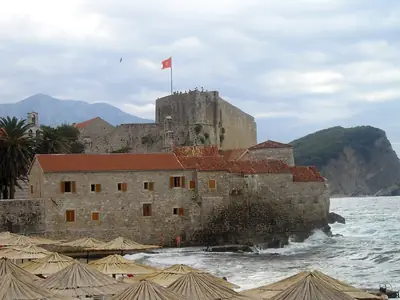
The Budva Citadel, or Citadela, combines medieval defenses with wide views across the Budva Riviera and the Adriatic Sea. Its history reaches back to ancient times: the site is believed to have been established by the Illyrians and later developed by the Romans.
The visible medieval fortifications took shape during Venetian rule in the fifteenth century. Walls, bastions, and towers reveal the citadel’s strategic role, including the protection of Budva from pirate attacks.
Inside the fortress stands the small Church of Saint Ivan, also known locally as Crkva Sv. Ivana. Climbing the citadel walls brings the Old Town, sea, and surrounding landscape into view.
Church of St. Ivan
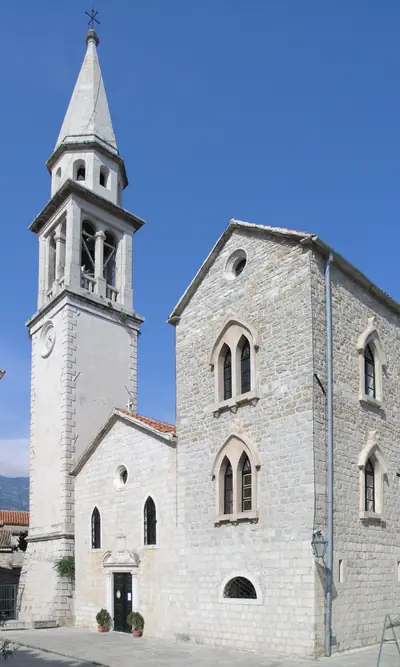
The Church of St. Ivan stands on the foundations of an earlier building dating from the seventh century. The present church has an unusual three-transept basilica plan, with Gothic elements on its façade. Its belfry was added in 1867.
Inside, the church preserves Budvanska Bogorodica, the Holy Mother of God of Budva. Legend attributes the icon to Saint Luke, while experts date it to the thirteenth century. The church also contains Greek icons, a Venetian-school painting of Saint Peter and Paul, and a painting of Saint Luke by Anastas Bocaric.
Nearby, the Church of the Holy Trinity dates from the beginning of the nineteenth century. Austrian authorities permitted its construction after the decline of the Venetian Republic in 1797, following a request from the Orthodox community.
Church of Saint Sava the Sanctified and Santa Maria in Punta
In the southwestern part of the Old Town, near the city walls, stands the small Church of Saint Sava the Sanctified. This Romanesque, single-nave building dates from the twelfth century and has a semicircular apse facing east.
Its exact origins have long been debated, including whether it was first used for Orthodox or Catholic worship. During Venetian rule, both Catholic and Orthodox rites were celebrated there. Restoration after the 1979 earthquake uncovered an inscription dating the church to 1141, as well as damaged frescoes probably painted in the Byzantine style.
Nearby, Santa Maria in Punta adds another historic church to this part of the Old Town.
Budva City Museum and the ancient necropolis
The Budva City Museum preserves artifacts, documents, and exhibitions connected with the town’s long history. Its archaeological collection includes around 1,200 objects, some dating as far back as the fourth and fifth centuries BC.
Jewelry, ceramics, mosaics, glassware, and other objects reveal Budva’s Greek and Roman heritage. Many discoveries came from the remains of the ancient necropolis.
The Roman-era necropolis was uncovered during construction of the Avala Hotel between 1936 and 1938. Its cemetery has two principal layers: a Hellenic section dating from the fourth to the first centuries BC, and a Roman section from the first to the second centuries AD. Archaeologists found gold and silver jewelry, coins, dishes, glassware, pottery, ceramics, and weapons. Most of these objects are now displayed in the City Museum.
Mogren Beach
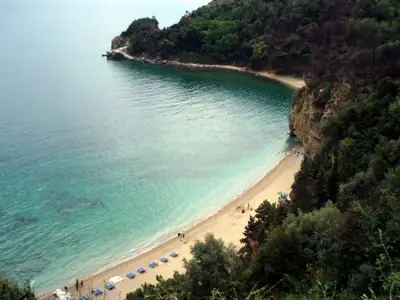
A short walk from the Old Town, Mogren is one of the best-known beaches on the Budva Riviera. Its partly concealed setting combines fine gravel, rocky shorelines, Mediterranean greenery, and clear coastal scenery.
Mogren consists of two beaches, Mogren I and Mogren II, linked by a short tunnel through natural rock. Together, they stretch for about 350 metres. The approach from Hotel Avala follows a concrete path of around 350 metres.
The beach is protected as a Category Three Nature Monument, while Spas Hill above it has the same protected status as a special natural landscape. If a southerly wind brings strong waves, the path to the beach is not safe.
Mogren Fortress
Above the coast stands the ruined Mogren Fortress, a viewpoint over the Budva Riviera. From the site, you can look towards Budva’s Old Town, Sveti Nikola Island, and Jaz Beach.
The fortress was built by the Austrian Empire in 1860 and was originally called Fort Jaz. Its rectangular military design included high walls and a tower at each corner, with the structure standing 110 metres above the beach. It was later renamed Mogren Fortress after nearby Mogren Cape.
During the Second World War, the site was used to store weapons and ammunition, and some bunkers from that period remain visible. After the war, the fortress fell into disrepair, with further damage caused by the 1979 Montenegro Earthquake.
Podmaine Monastery
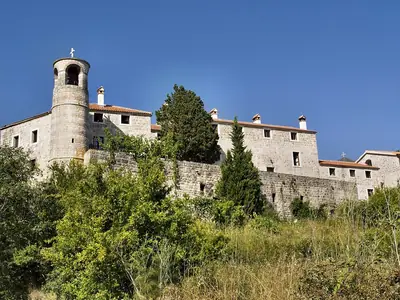
North of Budva, on a gentle rise above the Budva field, Podmaine Monastery—also known as Podostrog—is a Serbian Orthodox monastery with two churches.
The smaller and older church, dedicated to the Presentation of the Mother of God, was established in the fifteenth century by the Crnojević noble family. A second, larger church was built in 1747. The Church of Saint Paraskeva contains frescoes created that year by Rafail Dimitrijević from Risan and Nicholaos Aspioti from Corfu.
The monastery suffered a fire in 1869 and serious damage in the 1979 earthquake before being completely rebuilt in 2002. New frescoes were then painted in the smaller church, including a modern interpretation of the Last Judgment known as “Sinful Bishops and Emperors.”
Explore Budva with Neywo
For a Budva self-guided walking tour, download Neywo and explore without a group or schedule. Budva has one walking tour: “Budva’s Venetian Old Town and Mogren Cove”, covering 0.82 km in about 35 minutes and including 5 narrated stops: Stari Grad, the Church of St. Ivan, Citadela, City beach, and Mogren.
The app tells the story of each place as you reach it, at your own pace. There is no group and no schedule, so you can explore Budva independently. When you are ready to discover more of Montenegro, Neywo also covers Kotor, Cetinje, Herceg Novi, Podgorica, and Sveti Stefan.
Places with an audio guide in Budva
6 places in Budva with a Neywo audio guide. Each one starts telling its story as you reach it.
Self-guided tours in Budva
1 tour in Budva, free in the Neywo app. Each stop tells its story as you reach it.
- Walk
Budva's Venetian Old Town and Mogren Cove
Walk the horseshoe ramparts that kept pirates out of a Venetian-era island town, climb the citadel for views over the Riviera, and visit the two Orthodox churches on Church Square. End with a short stroll along the rock tunnel path to Mogren, one of the Adriatic's best-known beaches.
Stari Grad · Church of St. Ivan · Citadela · City beach (Budva) · Mogren
Open this tour: Budva's Venetian Old Town and Mogren Cove
Walk Budva with Neywo
Neywo turns Budva into a self-guided audio tour. Stories arrive as you reach the place they belong to, and the route reshapes when you wander off it.

