Cetinje, Montenegro: Self-Guided Walking Tour
Things to Do in Cetinje: Montenegro’s Former Royal Capital
The best things to do in Cetinje are concentrated around its historic centre, where former royal residences, monasteries, museums and theatres tell the story of Montenegro’s political and cultural development. Set on a small karst plain beneath Mount Lovćen, Cetinje was founded in the fifteenth century and served as Montenegro’s capital until 1918; today, it is also known as the country’s honorary capital.
A walk through the city feels like exploring an open-air museum, with historic buildings and religious monuments close together. Neywo offers a free audio guide for Cetinje with 16 narrated places, so you can discover the city’s history while walking.
What to See in Cetinje
National Museum of Montenegro and the Art Museum
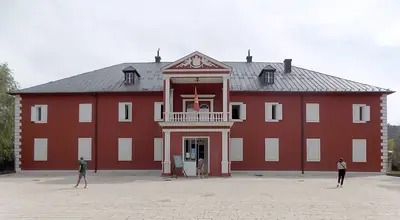
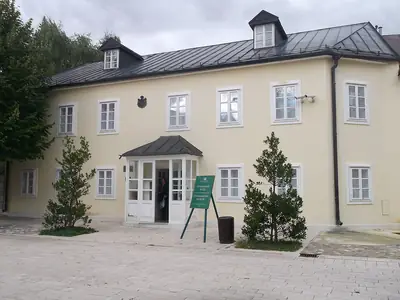
The National Museum of Montenegro is the country’s largest museum and brings together collections connected with Montenegro’s history, culture, traditions and national memories. Its administrative centre is Government House, or Vladin dom, built in 1910.
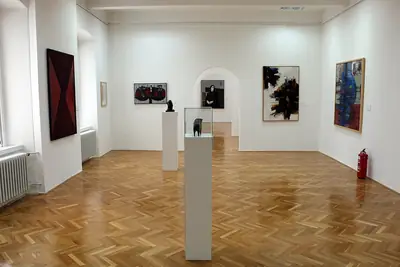
Government House also houses the permanent exhibitions of the Historical Museum and the Art Museum of Montenegro. The art collection forms one part of a wider museum complex whose holdings document Montenegro from the middle of the fifteenth century to the present day.
Cetinje Monastery
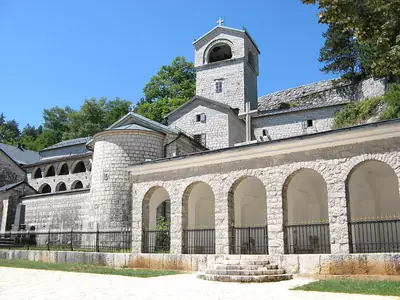
Cetinje Monastery, or Cetinjski Manastir, is one of the most important monasteries of the Serbian Orthodox Church. It stands at the foot of Orlov Krš hill and was founded around 1484 by Prince Ivan Crnojević of Zeta as the cathedral monastery of the Zeta Metropolitanate.
The monastery is dedicated to the Nativity of the Most Holy Mother of God. From 1493 to 1496, it was also home to the famous Cetinje printing house, regarded as the oldest printing house in the Serbian lands.
The original monastery was destroyed by the Venetians in 1692 during the Morean War. Metropolitan Danilo Petrović-Njegoš built a new complex between 1701 and 1704 on the site of Ivan Crnojević’s former court. Among the sacred treasures preserved there are the remains of Saint Peter of Cetinje, the right hand of John the Baptist, particles of the True Cross and Saint Peter of Cetinje’s bishop’s crown.
Biljarda and the Njegoš Museum
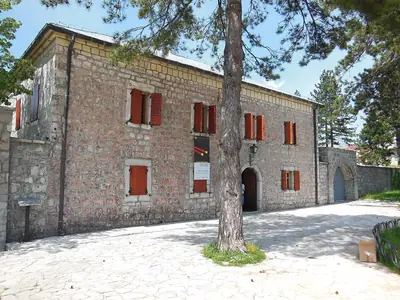
A short walk from Cetinje Monastery, Biljarda is a former royal residence associated with Petar II Petrović Njegoš. It now houses the Njegoš Museum.
The long stone building was designed to resemble a medieval castle, with high walls, round corner towers and gates on each side. Completed on March 29, 1838, it was first called the New House. Its later name, Biljarda, refers to billiards, Njegoš’s favourite game.
The building contained rooms for Njegoš, the Senate, guards, state institutions and distinguished guests. It also served as a residence for his successors before taking on several public roles.
King Nikola’s Palace
King Nikola’s Palace, also known as the Cetinje Royal Palace or the Museum of King Nikola I Petrović, offers a direct link with Montenegro’s royal past. For more than fifty years, it was the seat of the Montenegrin royal family.
The palace became a museum in 1926 and has been one of the departments of the National Museum of Montenegro since 1980.
The Court Church in Ćipur
The Court Church in Ćipur, or Crkva na Ćipuru, stands in the old centre of Cetinje on a site connected with the city’s earlier religious history. King Nikola I Petrović Njegoš built the present Serbian Orthodox church in 1890.
Dedicated to the Nativity of the Mother of God, it occupies the site of an earlier monastery founded in the fifteenth century by Ivan Crnojević in honour of the Virgin Mary.
Ethnographic Museum of Montenegro
The Ethnographic Museum of Montenegro, known locally as the Etnografski muzej Crne Gore, focuses on the country’s ethnographic heritage. It adds another perspective to Cetinje’s museum landscape, complementing the collections devoted to art, political history and the royal past.
Royal Theatre Zetski Dom
Near the main town square, the Royal Theatre Zetski Dom is one of the best-known symbols of Montenegrin culture and art. It is also the country’s oldest state theatre.
The building was completed in 1888. That year, the Cetinje Reading Room moved inside, and the first performance followed before the end of the year. The play was Balkan Empress, written by Prince Nikola. Since June 29, 1961, the theatre has been registered as an immovable cultural property of national importance.
Vlah Church
The Vlach Church, or Vlaška crkva, stands in Donji Kraj on the Cetinje field and is dedicated to the Nativity of the Virgin Mary. Tradition places the first church here in 1450, when Vlach herders built a structure from woven branches covered with mud.
The building visible today took shape in the seventeenth or early eighteenth century and was altered and enlarged in 1864. Archaeological research has found the remains of a smaller church beneath the present floor. The churchyard is particularly distinctive: around 150 medieval stone tombstones, known as stećci, were found here during a nineteenth-century restoration, and the surrounding fence was made from rifle barrels left from the wars of 1858 and 1876 to 1878.
Places Around Cetinje
Lovćen and Jezerski Vrh
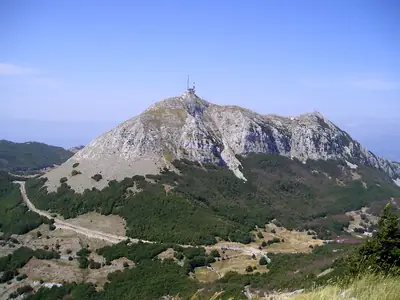
Lovćen is a mountain and national park between the Adriatic basin and Montenegro’s mainland, rising behind Kotor and near the winding bays of Boka Kotorska. Its limestone and dolomite landscape is marked by rocky slopes, fissures, pits and deep depressions.
The mountain has two main peaks: Štirovnik, at 1,749 metres, and Jezerski Vrh, at 1,657 metres. The landscape of the dark, forested mountain is also linked symbolically with the names Montenegro and Crna Gora, both meaning “Black Mountain.”
Mausoleum of Njegoš
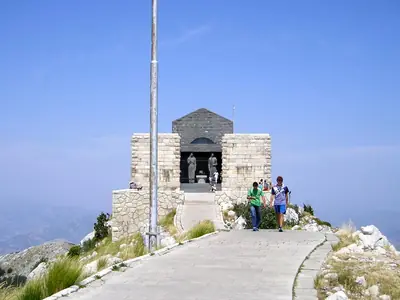
The Mausoleum of Njegoš stands on Jezerski Vrh, at 1,657 metres on Mount Lovćen. It is dedicated to Petar II Petrović-Njegoš and occupies the site of the Testament Church he had built around 1845 in honour of Saint Peter of Cetinje.
From Cetinje, an asphalt road leads 21 kilometres towards the mausoleum. The final approach involves 461 steps and a tunnel cut into the mountain. The present monument was built in 1974 after the earlier chapel had been damaged during both World Wars and demolished.
The low stone mausoleum was created from an idea by the sculptor Ivan Meštrović. Two female figures mark the entrance, while inside stands a 28-ton granite monument to Njegoš.
Žabljak Crnojevića
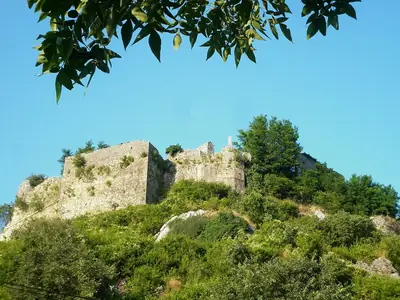
Žabljak Crnojevića, commonly called Žabljak, is an abandoned medieval fortress at the confluence of the Morača River and Lake Skadar. It was once an important stronghold and the capital of the Crnojević family.
The fortress is thought to have been founded in the tenth century, although its first known written records date from the middle of the fifteenth century. The Ottomans captured it in 1478. Its remains include strong walls, towers and a single entrance; inside were once the Crnojević palace, the Church of Saint George, homes, military buildings, storage spaces and a water cistern.
Kom Monastery
Kom Monastery stands on the small island of Odrinska gora, close to Žabljak Crnojevića where the Crnojević River flows into the western part of Lake Skadar. Built between 1415 and 1427 as an endowment of Đurađ and Aleksa Đurašević, it is closely connected with the Crnojević family.
Four members of the family are buried here, including Stefan Crnojević and his wife, Mara Kastrioti. The monastery’s oldest frescoes date from the second half of the fifteenth century.
Explore Cetinje with Neywo
Download Neywo for a free audio guide to Cetinje and follow the walk at your own pace. The city has one walking tour: Cetinje, the Old Royal Capital, covering 1.81 km in around 79 minutes, with 10 narrated stops. It includes Vlah Church, the National Museum of Montenegro, the Governorate of Montenegro, Cetinje Monastery, Biljarda, the Ethnographic Museum of Montenegro, King Nikola’s Palace, the Court Church in Cetinje, the Blue Palace and the Royal Theatre Zetski Dom.
The app tells the story of each place as you reach it, at your own pace, with no group and no schedule. Narration is available in 11 languages. After Cetinje, continue exploring Montenegro, or discover nearby Budva, Kotor and Podgorica.
Places with an audio guide in Cetinje
8 places in Cetinje with a Neywo audio guide. Each one starts telling its story as you reach it.
Self-guided tours in Cetinje
1 tour in Cetinje, free in the Neywo app. Each stop tells its story as you reach it.
- Walk
Cetinje, the Old Royal Capital
Cetinje was Montenegro's capital for centuries, and its small centre still feels like a royal court. Walk from a 15th-century Vlach church ringed by medieval tombstones to the monastery, the billiard-named Biljarda castle, King Nikola's palace and the grand Zetski Dom theatre. Flat, easy and packed with national history.
Vlah Church · National Museum of Montenegro · Governorate of Montenegro · Cetinje Monastery · Biljarda · Ethnographic Museum of Montenegro …
Open this tour: Cetinje, the Old Royal Capital
Walk Cetinje with Neywo
Neywo turns Cetinje into a self-guided audio tour. Stories arrive as you reach the place they belong to, and the route reshapes when you wander off it.

