What to See in Kotor, Montenegro: Free Audio Guide
Things to Do in Kotor: Historic Gates, Churches and Fortifications
Kotor is a fortified historic city at the heart of Montenegro’s Bay of Kotor, where medieval streets meet steep mountain slopes and the Adriatic. Its UNESCO-listed heritage, churches, palaces, museums and defensive walls make it one of the most rewarding places to explore on foot. Neywo has a free audio guide for Kotor with 20 narrated places, available in 11 languages.
What to See in Kotor’s Old Town
Kotor’s Old Town is best explored slowly, moving between its squares, gates, churches and historic buildings. These are some of the most important places to include in your visit.
Sea Gate and Arms Square
The Sea Gate is the main entrance to Kotor’s fortified city. Built in 1555 during Venetian rule, it opens onto Arms Square, also known as Trg od Oružja, the largest square inside the walls and a historic civic and military center.
Above the entrance, the winged lion of Saint Mark recalls Kotor’s Venetian past. The gate also preserves a fifteenth-century relief of the Madonna and Child, flanked by Saint Tryphon and Saint Bernard of Clairvaux. Later layers of history appear in the red communist star and the postwar inscription associated with Josip Broz Tito.
Kotor Cathedral
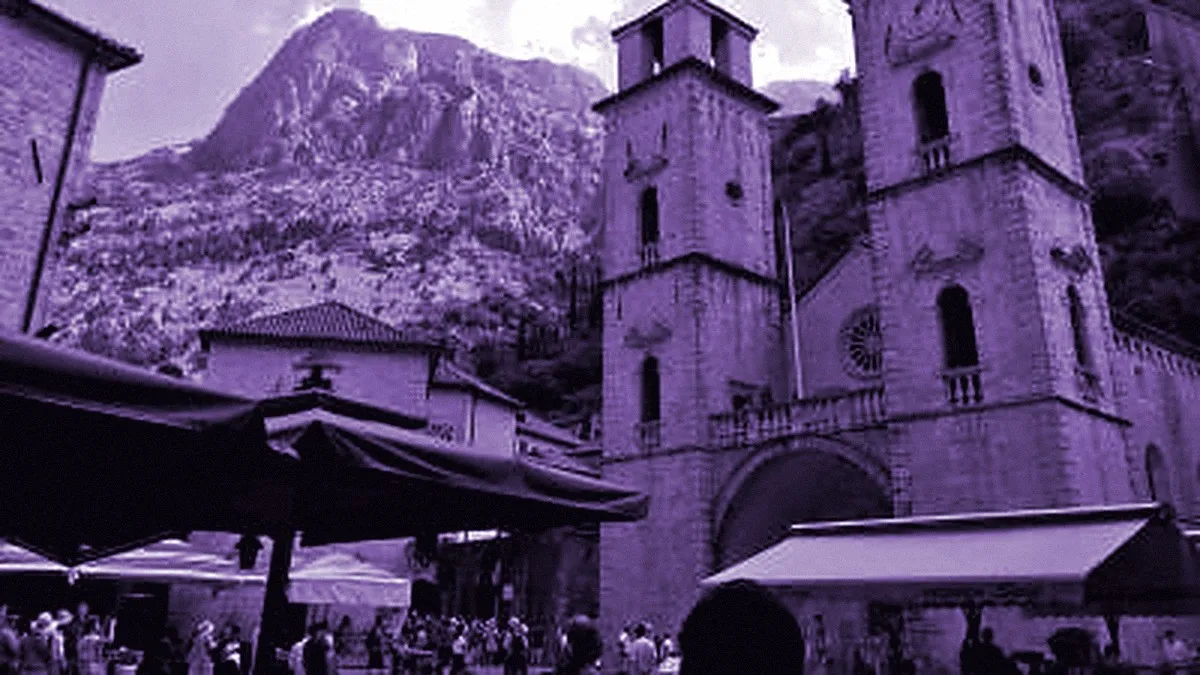
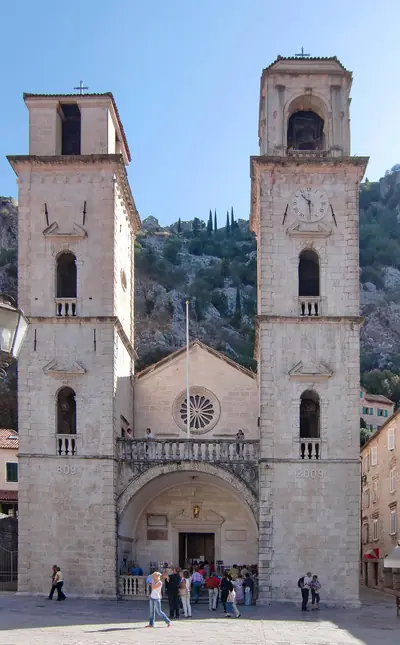
On Saint Tryphon Square stands the Cathedral of Saint Tryphon, one of Kotor’s defining landmarks and the seat of the Roman Catholic Diocese of Kotor. Dedicated to the city’s patron saint, it was solemnly consecrated on June 19, 1166, after construction began in 1124.
The cathedral is a three-nave Romanesque basilica with Byzantine elements. Its western façade has two bell towers, rebuilt after the earthquake of 1667, while the interior is organized around apses, columns and monolithic pillars. The building occupies the site of an earlier church constructed in 809, when Andrea Saracenis financed the church and acquired Saint Tryphon’s relics from Venetian merchants.
Drago Palace
Also on Saint Tryphon’s Square, Drago Palace stands out because its northern and southern sections belong to different architectural periods. The northern part reflects the Gothic style of the fourteenth to sixteenth centuries, with carefully carved windows and portals. The southern section, built in the seventeenth century, combines Renaissance and Baroque influences.
The dragon motif connects the palace with the Drago family, an influential Kotor family whose role extended across the city’s culture, art, economy and politics. The Dragos owned the building from the fourteenth century until the early nineteenth century.
Church of Saint Luke
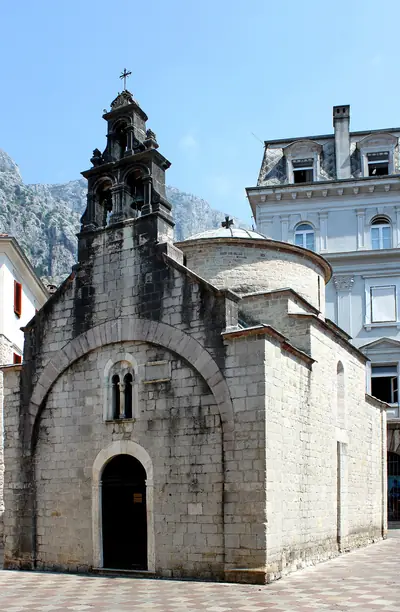
Built in 1195, the Church of Saint Luke is one of Kotor’s most distinctive places of worship. Its compact form combines Romanesque, Byzantine and Gothic features, with a simple single nave, a rounded dome and a Baroque bell tower.
The church has both Catholic and Orthodox traditions. It was originally Catholic, but Orthodox refugees from Grbalj were allowed to worship there in the seventeenth century. Services of both rites continued for many years before the church became exclusively Orthodox during the period of French administration from 1807 to 1814. Inside, fragments of medieval frescoes survive along the southern wall.
Church of St Nicholas
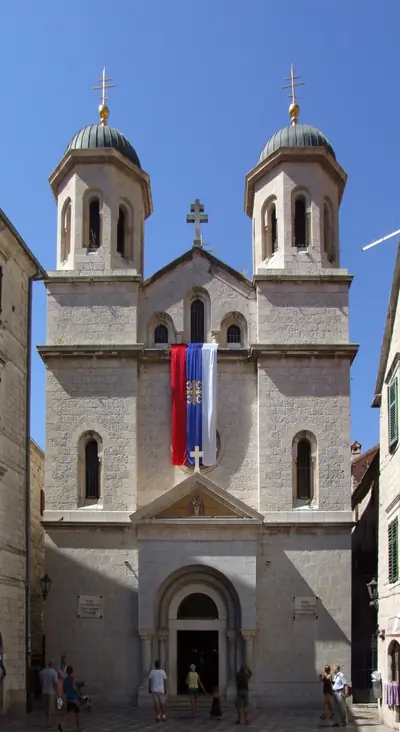
The Church of St Nicholas is the main Orthodox church in Kotor. Its two tall bell towers, topped with black domes and gilded crosses, are especially prominent in the Old Town. The crosses were donated by Imperial Russia, reflecting the Orthodox connections of the period.
The present church was built between 1902 and 1909 and consecrated in 1909, replacing an earlier Serbian Orthodox church destroyed by fire in 1896. Its Neo-Byzantine interior is centered on a richly carved iconostasis completed in 1908. The church also holds icons, religious books, liturgical objects and artworks donated by families from Kotor and the surrounding region.
Saint Clare
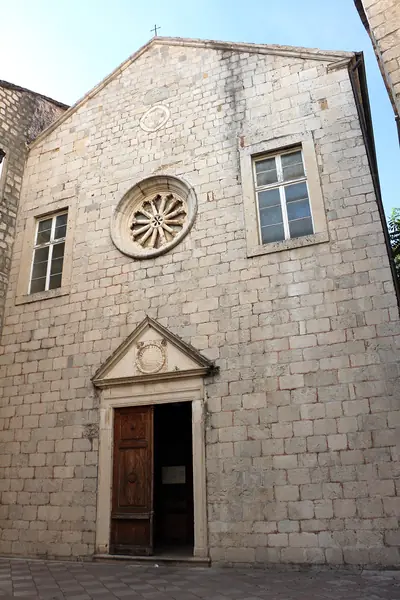
The Church of Saint Clare has a plain exterior of stone and brick, but its interior is richly Baroque. The main altar, made from white and red marble, was created by Francesco Cabianca in 1708. Venetian paintings decorate the side altars.
The site originally contained a Benedictine monastery. From the fourteenth to the sixteenth century, the complex was associated with the nuns of Saint Clare before later being entrusted to the Franciscans. The church’s present appearance dates from the eighteenth century and combines Renaissance-inspired spatial design with a dramatic Baroque interior.
St. Michael’s Church and the Lapidarium
St. Michael’s Church reaches back through several layers of Kotor’s history. The present Romano-Gothic church was built at the end of the thirteenth century on the foundations of a twelfth-century Romanesque church and an earlier sixth-century basilica.
Today, the church also houses the Kotor Lapidarium, where stone artifacts from different historical periods are displayed. Archaeological excavations uncovered pre-Romanesque fragments, including parapet slabs, columns and altar partitions. Inside, remnants of fifteenth-century frescoes show Christ Pantocrator and the Assumption of Christ.
Maritime Museum of Montenegro
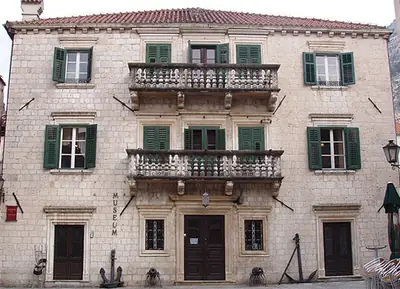
Housed in the early eighteenth-century Baroque Grgurina Palace, the Maritime Museum of Montenegro explores Kotor’s long relationship with the sea. Its collection began with objects belonging to the Boka Navy brotherhood, opened to the public in 1900 and established as the Maritime Museum in 1938.
Across three exhibition floors, visitors can see photographs, paintings, uniforms, weapons, navigational instruments and detailed ship models. Together, these objects preserve the memory of sailors, captains, shipbuilders, craftsmen, artists, politicians and diplomats connected with the Adriatic, the eastern Mediterranean and Western Europe.
Galerija Solidarnosti and Pima Palace
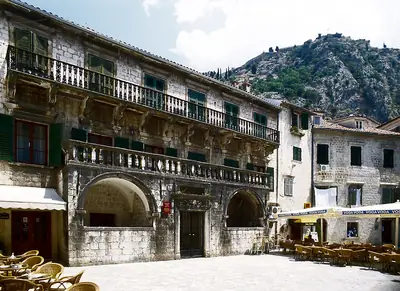
Galerija Solidarnosti occupies Pima Palace, a seventeenth-century noble residence facing Flour Square. The gallery presents changing exhibitions of contemporary art by artists and sculptors from former Yugoslavian countries, the United States, Poland, Romania and elsewhere.
The palace combines Renaissance balance with Baroque decoration. Its most distinctive feature is the long stone balcony across the main floor, above which two carved angels hold the Pima family coat of arms. The building was rebuilt after the earthquakes of 1667 and 1979.
Galerija Nives
Galerija Nives occupies a late-Baroque building with an unusually elaborate façade. Above the portal, stucco angels surround a Baroque frame bearing the Vrachien family coat of arms, marked by a swallow.
Inside, the original character of the building remains remarkably well preserved. The staircase hall has wall paintings and marble work created in the al secco technique by Napoleon d’Este, while the main salon retains its original mosaics and terrazzo flooring. The adjoining rooms preserve original doors made from several varieties of fine wood.
Pušti me proć and the Northern Defenses
Beside Kotor’s northern city gates, Pušti me proć—“Let Me Pass”—brings together a historic palace, a passage toward the city walls and symbols of the Venetian period. A winged lion appears above the red and gray portal, alongside a Latin inscription referring to the main road to the fortress in the mountain.
Nearby, the seventeenth-century palace associated with the Grubonja family carries a striking coat of arms showing skeletal bones, a skull, a snake, a turtle and a lizard. The emblem is widely regarded as the symbol of Kotor’s first pharmacy, established in 1326.
St. Mary Church and the River Gate
St. Mary Church, also known as Santa María de la Salud or Svete Marije Koleđate, has stood here since 1221 on the site of a sixth-century basilica. Its bronze doors date from the twentieth century, while fragments of sixteenth-century frescoes and a large crucifix survive inside.
The church is closely associated with Blessed Osanna of Cattaro, who lived as an anchoress in a cell attached to a church and was regarded by the people of Kotor as a saint and protector of the city. Nearby, the River Gate forms the smaller northern entrance to the city and offers another view of Kotor’s defensive design.
Saint Paul’s Church
Tucked behind the apse of Saint Tryphon’s Cathedral, Saint Paul’s Church was commissioned in 1263 by Pavle Bari, a prominent citizen of Kotor. It began as a male Dominican monastery and later became a female monastery.
The church is closely connected with Blessed Ossana, who spent her final days there in 1565. Its later history has been more varied: during Napoleon’s occupation it served as barracks, and in the twentieth century it became a prison during World War Two and later conflicts.
Fortifications of Kotor
The Fortifications of Kotor climb the rocky slopes above the Old Town toward the Fortress of Saint John. The defensive system includes walls, towers, gates, bastions, forts, citadels, cisterns and a castle, reflecting several periods of military architecture and influences from Illyria, the Byzantine Empire, Venice and Austria.
Together with the Old Town and its natural surroundings, the fortifications formed part of the Natural and Culturo-Historical Region of Kotor inscribed on the UNESCO World Heritage list in 1979. They were also included in UNESCO’s Venetian Works of Defence listing in 2017.
The South Gate
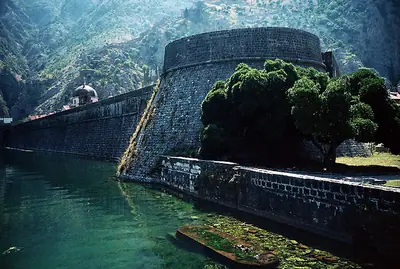
The Gurdić Gate, or South Gate, marks the point where the fortified town meets the mountain slope and the bay. Built in the sixteenth century, it once included several successive gates and enclosed passages designed to slow attackers. A drawbridge crossed the watercourse beside the entrance.
The gate takes its name from the Gurdić River, which flows around the southern edge of the fortifications. Its water level changes with the karst spring: after heavy rain, water surges toward the bay, while in dry summer months seawater can flow back inland.
Explore Kotor with Neywo
For a Kotor self-guided walking tour, download Neywo and explore the city at your own pace. The app offers two walking tours:
- Saints and Sanctuaries of Kotor: 0.61 km, 52 minutes and 8 narrated stops.
- Venetian Gates, Palaces and the Walls Above: 0.93 km, 58 minutes and 9 narrated stops.
Neywo tells the story of each place as you reach it, so you can walk without a group and without a schedule. The free Kotor audio guide includes 20 narrated places, with narration available in 11 languages.
Kotor is part of Montenegro, making it easy to combine with other destinations such as Budva, Herceg Novi, Cetinje or Podgorica.
Places with an audio guide in Kotor
8 places in Kotor with a Neywo audio guide. Each one starts telling its story as you reach it.
Self-guided tours in Kotor
2 tours in Kotor, free in the Neywo app. Each stop tells its story as you reach it.
- Walk
Saints and Sanctuaries of Kotor
Kotor packs Catholic and Orthodox churches into a few lanes. Start at St Mary, where Blessed Osanna lies in a glass coffin, then pass Venetian-lion portals and Romanesque chapels on the way to the 12th-century cathedral of Saint Tryphon.
St. Mary Church · Saint Anne (Kotor) · Church of Saint Luke in Kotor · Serbian Orthodox church of St Nicolas in Kotor · Saint Clare (Kotor) · St. Michael church in Kotor …
Open this tour: Saints and Sanctuaries of Kotor - Walk
Venetian Gates, Palaces and the Walls Above
Enter through the Sea Gate, once Venice's front door to Kotor, and wander past noble palaces, a Gothic portal and the dragon of the Drago family. Visit the cathedral and the Maritime Museum, then look up at the fortress walls and end at the quiet South Gate.
Trg od Oružja · Kotor Town Hall · Palata Beskuća · Galerija Solidarnosti · Pjaca Svetog Tripuna (Kotor) · Kotor Cathedral …
Open this tour: Venetian Gates, Palaces and the Walls Above
Walk Kotor with Neywo
Neywo turns Kotor into a self-guided audio tour. Stories arrive as you reach the place they belong to, and the route reshapes when you wander off it.

