Things to Do in Novi Sad, Serbia: Walking Guide
Things to do in Novi Sad, Serbia
Novi Sad is the administrative centre of Vojvodina and Serbia’s second-largest city, known for its churches, museums, cultural institutions, memorials and Danube setting. The city’s layered history is especially visible in its religious buildings and public spaces, while its museums offer a broad introduction to the art, history and heritage of the region. Neywo has a free audio guide for Novi Sad with 35 narrated places.
What to see in Novi Sad
Nikolajevska Church
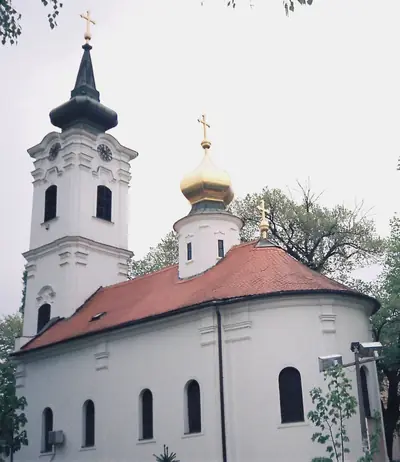
Nikolajevska Church stands at the meeting point of Nikola Pašić Street and Maria Trandafil Square. Consecrated in 1730, it is widely regarded as the oldest surviving Orthodox church in Novi Sad. Its two gilded domes, designed in a Russian imperial style reminiscent of churches in Kyiv and Saint Petersburg, make the modest building easy to recognise.
The church was built by Nedeljko Bogdanović, which explains its former local name, Nedeljko’s Church. Today, it is protected as an immovable cultural monument of great importance in Serbia.
Almaš Church
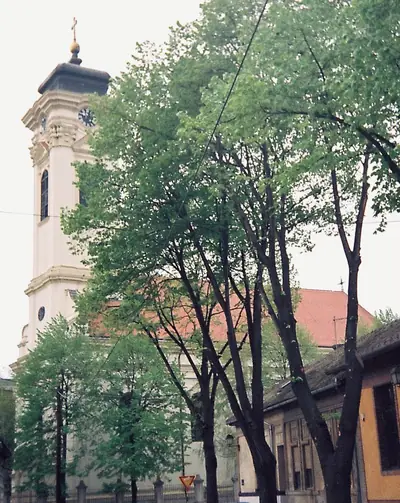
In Novi Sad’s Almaš neighbourhood, the Serbian Orthodox Temple of the Three Holy Hierarchs preserves the form of the church consecrated in 1797. Serbian settlers from the nearby village of Almaš founded the first church on this site in 1718, using earth, branches, reeds and boards.
That first structure was replaced by an unfired-brick church in 1733, followed by the stronger building that still stands. The upper part of the bell tower was damaged during the bombardment of 1849.
Saint George Cathedral
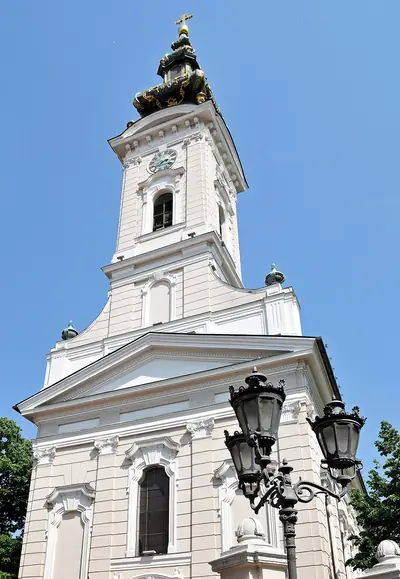
Saint George Cathedral, or Saborna crkva Svetog velikomučenika Georgija, is the cathedral church of the Eparchy of Bačka and stands near the Bishop’s Palace. An earlier church on the site, dating from 1734, was destroyed in 1849.
The present cathedral was designed in 1851 and built between 1860 and 1880 on the remains of the earlier building. It was completed in 1905 under the supervision of architect Mitrofan Šević. Its bells came from Budapest, while the cross in front of the cathedral was moved there from Freedom Square in 1956.
The Name of Mary Church and Freedom Square
The Name of Mary Church is the largest church in Novi Sad and one of the defining buildings on Freedom Square. This Roman Catholic parish church was designed by Georg Molnar and completed in 1894. Its tower reaches 72 metres.
An earlier church on the site was damaged during the revolutionary events of 1848 and removed in 1893. A fire damaged the present church in 1904, after which its roof was completely restored. The church is dedicated to the feast of the Most Holy Name of the Blessed Virgin Mary, celebrated on 12 September.
Serbian National Theatre
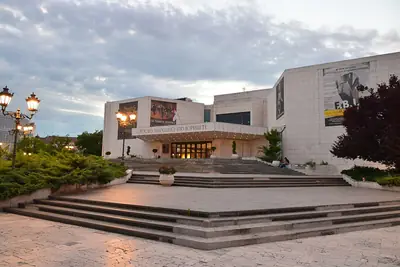
Founded in 1861, the Serbian National Theatre is one of Novi Sad’s major cultural landmarks. It is known as the oldest professional theatre of the Serbian people and is regarded as one of the largest theatres in Serbia. Its foundation marked the beginning of a long theatrical tradition in the city.
Novi Sad Synagogue
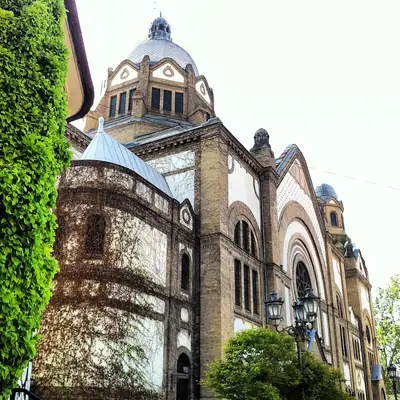
The Novi Sad Synagogue on Jevrejska Street was completed in 1909 and now serves as a cultural venue. Designed by Hungarian architect Lipot Baumhorn, it was built between 1906 and 1909 on the site of an earlier synagogue from 1826.
The building belonged to the Ashkenazi tradition and followed the Neolog movement. Its architecture combines several styles and strongly resembles the synagogue in Szeged. The synagogue once accommodated 900 worshippers. Two related buildings stand beside it: a former Jewish primary school, now a secondary ballet school, and the former building of the Jewish community.
Museum of Vojvodina
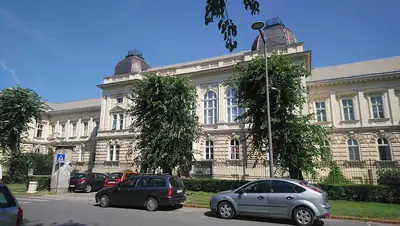
The Museum of Vojvodina at 35 Dunavska Street explores the region through art, natural history, archaeology, history and ethnology. Its collections contain more than 400,000 specimens, supported by a library of over 50,000 volumes.
Created in Pest in 1847, the museum was formally established as an independent institution on 30 May 1947. Its permanent displays at Dunavska 35 focus on archaeology, history up to 1867 and ethnology. A second building at Dunavska 37 presents modern history, including a permanent exhibition covering the twentieth century up to May 1945.
The Gallery of Fine Arts – Gift Collection of Rajko Mamuzić
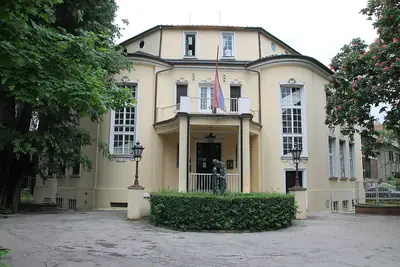
The Gallery of Fine Arts – Gift Collection of Rajko Mamuzić presents Serbian art created during the first decades after the Second World War. It occupies a family villa built in 1923 to designs by architect Filip Smith.
The gallery was founded in 1972 after Rajko Mamuzić donated his collection and opened to the public in 1974. What began with 438 works later grew to more than 800 paintings, sculptures, drawings, graphics and tapestries. The gallery also hosts lectures, artist seminars and concerts.
Nearby, the Gallery of Matica Srpska traces its beginnings to 14 October 1847, when it was established within Matica Srpska, described as the oldest Serbian cultural and educational institution. It is one of Serbia’s oldest and largest galleries, with paintings from different periods of the country’s art history.
Museum of Contemporary Art of Vojvodina
Across from Dunavski Park, the Museum of Contemporary Art of Vojvodina focuses on contemporary art from the second half of the twentieth century and the twenty-first century, with particular attention to Vojvodina.
Its collection contains more than 4,000 works, including painting, drawing, graphic art, sculpture, installations, conceptual art, film, video, photography, digital art and design. The museum began in 1966 as the Gallery of Contemporary Art, became the Museum of Contemporary Art in Novi Sad in 1996, and adopted its present name in 2004.
Monument to the Victims of Fascism
On Sunčani kej beside the Danube stands the Monument to the Victims of Fascism, also known as the Monument to the Victims of the 1942 Raid or The Family. Erected in 1971, the memorial commemorates the victims of the raid in Novi Sad. It is recognised as an immovable cultural asset of great importance.
Novi Sad railway station canopy memorial
The canopy above the main entrance of Novi Sad railway station marks the site of the collapse on 1 November 2024. The tragedy killed sixteen people, including three children, and left one young person severely injured.
The station building dates from 1964. It underwent renovation from 2021 until the middle of 2024, with support connected to China’s Belt and Road Initiative. The collapse occurred only months after the renovation was completed.
University of Novi Sad
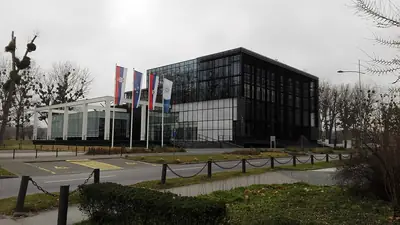
The University of Novi Sad is a major Serbian centre of education and research and the flagship higher-education institution in Vojvodina. Founded on 28 June 1960, it is Serbia’s second-largest university after the University of Belgrade.
FK Vojvodina
FK Vojvodina is one of Novi Sad’s best-known sporting institutions. Founded on 6 March 1914, the club is also known as Vojvodina or, informally, Voša. It won the former Yugoslav First League in 1966 and 1989, the UEFA Intertoto Cup in 1976, the Mitropa Cup in 1977, and the Serbian Cup in 2014 and 2020.
Explore Novi Sad with Neywo
Neywo’s free Novi Sad audio guide includes 35 narrated places. Its two walking tours cover 2.36 km in 101 minutes with 11 stops, and 3.36 km in 99 minutes with 9 stops. There is also one bus route covering 1.8 km in 8 minutes with 4 stops.
The walks include churches, palaces, theatres, museums, galleries, Freedom Square and the Monument to the Victims of Fascism. The bus route connects the Museum of Vojvodina with the Rusyn Church. The app tells the story of each place as you reach it, at your own pace, with no group and no schedule. Narration is available in 11 languages.
Download Neywo and explore Novi Sad while walking or riding through the city. To continue discovering the region, see Vojvodina, or compare Novi Sad with Sremski Karlovci, Subotica and Vršac.
Places with an audio guide in Novi Sad
8 places in Novi Sad with a Neywo audio guide. Each one starts telling its story as you reach it.
Self-guided tours in Novi Sad
3 tours in Novi Sad, free in the Neywo app. Each stop tells its story as you reach it.
- Bus ride
Line 3: Museum of Vojvodina to the Rusyn Church
A city bus (GSP Novi Sad line 3) from Petrovaradin through the centre: get off for the Museum of Vojvodina on Dunavska Street, Menrath Palace, the Hungarian-language theatre and the Greek Catholic church of Saints Peter and Paul.
Museum of Vojvodina · Menrath Palace · Theatre building in Novi Sad · Saints Peter and Paul Church
Open this tour: Line 3: Museum of Vojvodina to the Rusyn Church - Walk
Secession Palaces, Golden Domes and Freedom Square
Cross the historic centre of Novi Sad from a Rusyn Greek Catholic church to the synagogue, passing the oldest Orthodox church, the cathedral and the square where a Meštrović statue stands. Hungarian Secession façades by Baumhorn line the way.
Saints Peter and Paul Church · Theatre building in Novi Sad · Tomin Palace (Novi Sad) · Nikolajevska crkva, Novi Sad · Saint George Cathedral (Novi Sad) · The Name of Mary Church …
Open this tour: Secession Palaces, Golden Domes and Freedom Square - Walk
Museums, Modern Art and Republic Square
A culture walk from the Pavle Beljanski collection and the Mamuzić gift to the Museum of Vojvodina with its Late Antique helmets. Finish in Republic Square with the statue of King Peter I and the Youth Theatre, Serbia's oldest puppet stage.
The Gallery of Fine Arts – Gift Collection of Rajko Mamuzić · Pavle Beljanski Memorial Collection · Museum of Natural History - Provincial Institute for Nature Protection · Monument to the Victims of Fascism in Novi Sad · Museum of Vojvodina · Museum of Contemporary Art Vojvodina …
Open this tour: Museums, Modern Art and Republic Square
Walk Novi Sad with Neywo
Neywo turns Novi Sad into a self-guided audio tour. Stories arrive as you reach the place they belong to, and the route reshapes when you wander off it.

