What to See in Vršac, Serbia: Free Audio Guide
Things to Do in Vršac, Serbia: Historic Churches, Museums and a Hilltop Fortress
Looking for things to do in Vršac? This compact city in Vojvodina, northern Serbia, combines Austro-Hungarian-era architecture, important Orthodox and Roman Catholic churches, museums, theatre, and a medieval fortress above the town. Neywo has a free audio guide for Vršac with 9 narrated places, making it easy to explore the city’s history as you walk.
What to See in Vršac
The main sights are concentrated around the city centre and Vršac Hill, so the city is well suited to a self-guided walk. These are the places to look for.
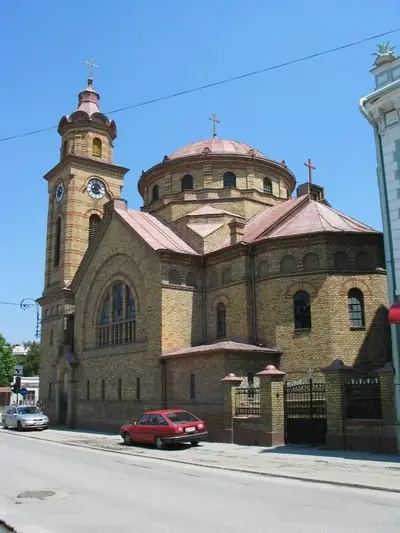
Romanian Orthodox Cathedral
The Romanian Orthodox Cathedral, also known as the Cathedral of the Ascension of the Lord, serves the Banat Romanians, the largest national minority in the Banat region. It is the cathedral church of the Diocese of Dacia Felix of the Romanian Orthodox Church.
The building was constructed between 1910 and 1912, during the final years of Vršac’s time under Austro-Hungarian rule, and consecrated on May 23, 1913. Its interior paintings were created by Virgijie Simionescu, while the woodcarving was made by the brothers Nistor and Josif Bosiok.
Church of St. Nicholas
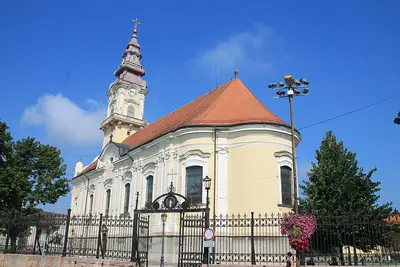
Church of St. Nicholas is the main and largest Orthodox church in Vršac. Known locally as Saborna crkva Svetog Nikole, it is the central church of the Eparchy of Banat of the Serbian Orthodox Church.
The cathedral stands beside the Vladika Palace, the bishop’s residence, and serves as the seat of the Eparchy of Banat. Together, the church and palace form one of the city’s most important religious landmarks.
National Theater “Sterija”
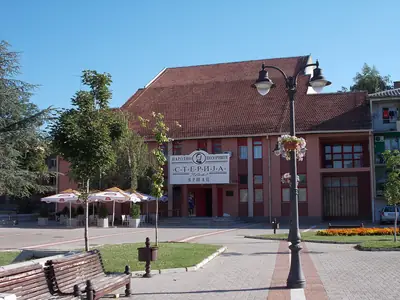
The National Theater “Sterija” is one of the central institutions of Vršac’s cultural life. Its professional theatrical tradition has continued for more than two centuries, while the building itself is protected as a cultural monument.
The theatre hall also functions as a multifunctional cultural centre, giving the building a role beyond its stage productions.
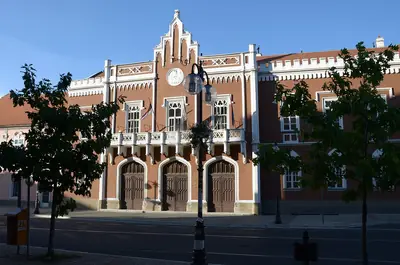
Vršac City Hall
Vršac City Hall, locally known as the Magistrat, stands on Trg pobede, or Victory Square. Completed in 1860 for the city administration, it is now home to the Municipal Assembly of Vršac and is one of the city’s most important cultural monuments.
Its Neo-Gothic façade is especially distinctive. The central section projects forward above three ground-floor entrances, with a balcony, Gothic consoles, and a stone railing. Higher up, a Gothic-shaped gable contains the city’s coat of arms in a circular panel. Gothic arcades and tracery decorate the side sections and attic.
Vršac City Museum
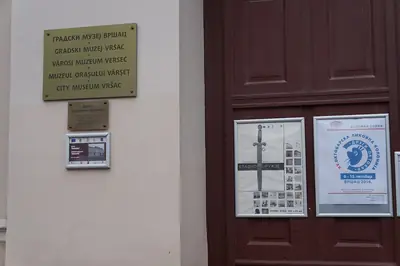
The Vršac City Museum began as an institution dedicated to the history of the city, but its collections now cover the wider South Banat region. The museum includes archaeology, numismatics, ethnology, art, and natural sciences.
The building itself is also significant: it is listed as a cultural monument of great importance in the Republic of Serbia. A visit therefore combines the history of the collections with the story of the building that houses them.
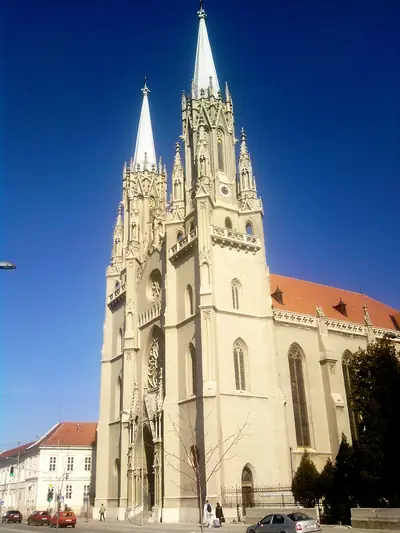
Saint Gerhard the Bishop and Martyr Roman Catholic Church
In the heart of Vršac, the Church of Saint Gerhard de Sangredo is the largest Catholic church in Serbia and a protected cultural monument of the republic. It was built between 1860 and 1863, probably to a design from Vienna, although the architect’s name is unknown.
The original terracotta finish on the façade deteriorated quickly. In 1902, the church was renovated and partly clad in stone, with stone used for the architectural details. The restoration was carried out by the Vienna architects Knotgen and Bach.
Church of the Assumption of the Theotokos
The Church of the Assumption of the Theotokos is known locally as the Little Church or Aleksa’s Church. Built between 1761 and 1768 and consecrated in 1775, it belongs to the Serbian Orthodox Diocese of Banat.
Its interior is notable for the work of several artists. Arsenije, known as Arsa Teodorović, created the iconostasis between 1792 and 1809. Art historians regard the icons above the north doors, depicting the Passion of Christ and the Nativity of the Theotokos, as among his finest works. The church also holds two historically important Gospels, including one printed in Moscow in 1762.
Church of Saint Theodore of Vršac
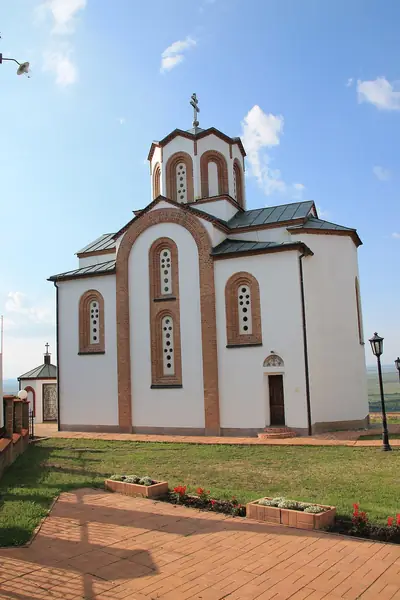
The Church of Saint Theodore of Vršac stands on Vršac Hill. Construction began in 1997, and its foundation stone was brought from the Serbian imperial monastery of Hilandar on Mount Athos. The church was solemnly consecrated on October 12, 2003.
Inside, the frescoes were created by icon painters from the Žica school, led by the monk Miodrag Tomić. The solid-oak iconostasis was modelled on the one in the Church of Saint Demetrius in Thessaloniki, and its icons were painted by Tomić and his students. The choir stalls follow the design of those at Mount Athos.
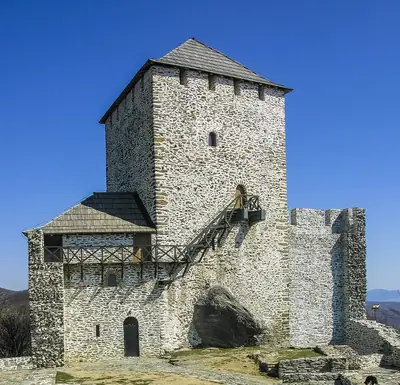
Vršac Castle
Vršac Castle, also called Vršačka kula or Vršac Tower, is a medieval fortress on the hill above the city. It first appears in historical records from the 14th century and stands at about 399 metres above sea level.
Repeated conquest and destruction, particularly during the 16th and 17th centuries, left much of the fortress in ruins. The best-preserved section is the Donjon, or main keep. Archaeologists also uncovered and restored parts of the ramparts, a palace, a semicircular tower, and furnaces, as well as a large collection of movable artefacts.
Conservation and restoration work in the late 20th and early 21st centuries restored and partly rebuilt the Donjon, sections of the ramparts, and other towers. The fortress is the natural high point of a visit to Vršac, combining the city’s medieval history with its hilltop setting.
Exploring Vršac and Vojvodina
Vršac’s sights bring together several layers of regional history: Orthodox and Catholic traditions, the city’s Austro-Hungarian past, South Banat heritage, and the remains of a medieval fortress. Its compact centre makes it practical to move between the cathedral, City Hall, museum, theatre, and churches before continuing uphill to Vršac Castle.
If you are travelling through Serbia, Vršac can also be paired with other destinations in the country, including Novi Sad, Subotica, or Sremski Karlovci.
Explore Vršac with Neywo
Download Neywo for a Vršac self-guided walking tour that connects the city’s main landmarks in one narrated route. The walk, “Vršac: Neo-Gothic Squares, Cathedrals and a Hilltop Fortress,” covers 3.85 km in about 115 minutes and includes 8 narrated stops.
The app tells the story of each place as you reach it, at your own pace, with no group and no schedule. Narration is available in 11 languages, so you can explore Vršac independently while moving from its cathedrals and historic squares to the hilltop fortress.
Places with an audio guide in Vršac
8 places in Vršac with a Neywo audio guide. Each one starts telling its story as you reach it.
Self-guided tours in Vršac
1 tour in Vršac, free in the Neywo app. Each stop tells its story as you reach it.
- Walk
Vršac: Neo-Gothic Squares, Cathedrals and a Hilltop Fortress
Vršac sits where the Banat plain meets the Vršac Hills, and its centre shows the mix of Serbs, Romanians and Catholics who built it. Walk past two cathedrals, the Neo-Gothic city hall and the theatre, then climb Vršac Hill to a modern Serbian church and the medieval tower that overlooks the whole plain.
Romanian Orthodox Cathedral, Vršac · Church of St. Nicholas, Vršac · National Theater "Sterija" (Vršac) · Vršac City Hall · Vršac City Museum · Saint Gerhard the Bishop and Martyr Roman Catholic Church, Vršac …
Open this tour: Vršac: Neo-Gothic Squares, Cathedrals and a Hilltop Fortress
Walk Vršac with Neywo
Neywo turns Vršac into a self-guided audio tour. Stories arrive as you reach the place they belong to, and the route reshapes when you wander off it.

