Tacoma, United States: Self-Guided Walking Tour
Things to do in Tacoma
Tacoma is a midsized city on Washington’s Puget Sound, shaped by its maritime legacy, glass‑art museums, and historic neighborhoods. Visitors are drawn to the waterfront, the striking Museum of Glass cone, and a mix of cultural sites that tell the story of industry, innovation, and community. Neywo offers a free audio guide for Tacoma with 46 narrated places.
What to see in Tacoma
Fireboat No. 1
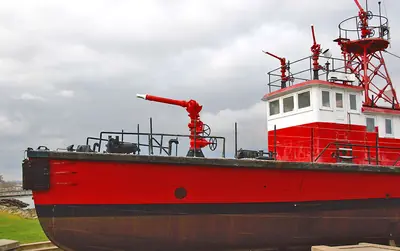
Fireboat No. 1 sits as a permanent land installation along Tacoma’s waterfront in the Old Town area. Built in 1929 for the Port of Tacoma, it served as the port’s sole firefighting vessel for more than fifty years before retiring in 1983. Designated a National Historic Landmark, the boat features a bow‑mounted Big Bertha cannon capable of pumping about 6,500 gallons of water per minute and projecting it up to 475 feet. While the interior is not open to the public, the exterior conveys the scale of its firefighting role.
America’s Car Museum
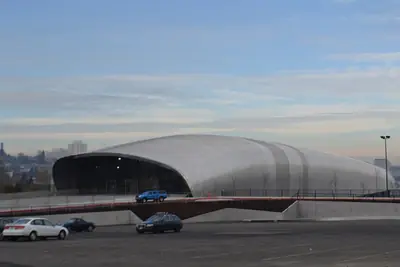
Located beside the Tacoma Dome, America’s Car Museum opened in 2012 with a collection largely donated by the family of Harold LeMay, who assembled what is described as the world’s largest private car collection. The museum displays vehicles for their beauty, speed, technology, and cultural significance across 1.53 hectares of exhibit space that can accommodate up to 350 cars. In addition to galleries, the complex includes restoration shops, lecture halls, gift shops, a banquet room, and a café, with views that stretch over downtown Tacoma, the Thea Foss Waterway, Commencement Bay, and the Olympic Mountains.
Children’s Museum of Tacoma
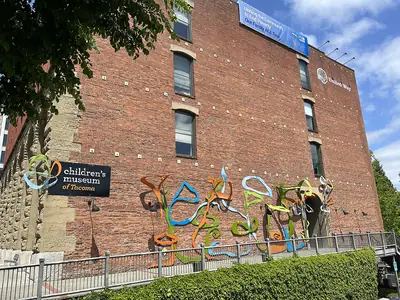
The Children’s Museum of Tacoma provides a hands‑on environment for children from birth to age twelve, turning play into learning. Originating in a small downtown alley storefront in 1985, it opened formally in 1986 and moved to a 10,000‑square‑foot facility in 2012. Operated by Greentrike, its playscapes follow the Reggio Emilia approach, encouraging movement, sound, light, water, and pretend play. Highlights include a mirror‑filled cave, light‑drawing stations, talking tubes that connect levels, and a water playscape featuring an Archimedes screw and a transparent vortex basin.
Museum of Glass
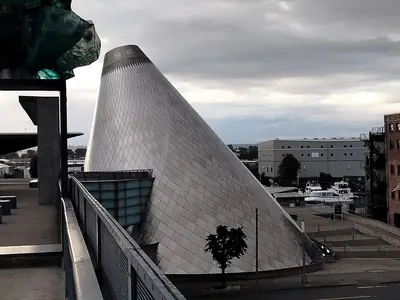
The Museum of Glass, opened in 2002, is devoted entirely to glass as a creative medium. Designed by Canadian architect Arthur Erickson, its most striking element is a ninety‑foot tilted cone leaning at a seventeen‑degree angle, clad in diamond‑shaped stainless steel panels that also serve as an industrial chimney for furnace heat. Inside the cone, the Hot Shop amphitheatre lets visitors watch artists shape molten glass in furnaces exceeding 2,000 °F, with cameras and overhead screens providing close‑up views of the process.
Puget Sound Museum of Natural History
This museum preserves the biodiversity of the Pacific Northwest for research, education, and public learning, housing more than 115,000 specimens of animals, plants, fossils, rocks, and minerals. Linked closely to the University of Puget Sound’s Biology Department, its exhibits explore regional topics such as familiar flora and fauna, salmon ecology, urban wildlife, and forest ecology. The institution traces its origins to 1946, building on the early collections of biology faculty member James R. Slater, who began gathering local reptiles and amphibians in 1926.
Tacoma Art Museum
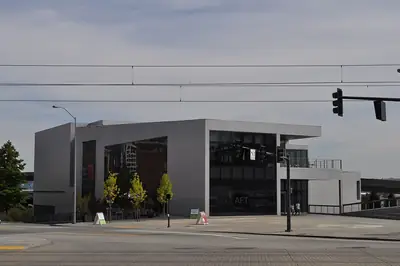
Founded in 1935 as the Tacoma Art Association, the Tacoma Art Museum today emphasizes art from the Pacific Northwest and western United States, with a notable strength in studio glass. After years in a former bank building, it opened its first purpose‑built facility in 2003 and now anchors the university and museum district downtown. The collection extends beyond regional focus, including medieval manuscripts, late Soviet avant‑garde works, pieces by Pablo Picasso, over 300 Japanese woodblock prints, and works on paper by artists such as Georgia O’Keeffe, Mary Cassatt, Edgar Degas, and Edward Hopper. The building, designed by Antoine Predock, uses light, open space, and angular forms to reflect Tacoma’s materials, industry, and landscape.
Washington State History Museum
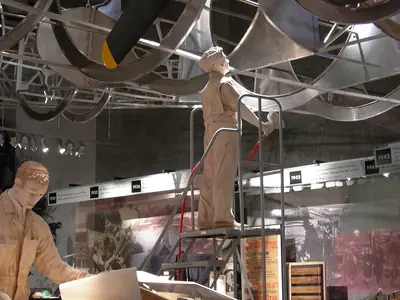
Situated downtown beside historic Union Station, the Washington State History Museum opened on August 10, 1996 and is operated by the Washington State Historical Society. Its 42‑million‑dollar building covers 106,000 square feet and features a sweeping circular ramp that evokes a Cascade Mountains switchback and an outdoor amphitheatre seating over 200 that suggests Puget Sound. Designed by postmodern architect Charles Moore, the museum’s permanent exhibitions use objects, photographs, recreated settings, and large displays to connect Washington’s landscapes with the lives shaped by them, including a 360‑exhibit that spans the state from its eastern borderlands to the Pacific coast.
Working Waterfront Maritime Museum
Set on the Thea Foss Waterway as part of Foss Waterway Seaport, this museum explores Tacoma’s maritime heritage through trade, boatbuilding, Indigenous knowledge, and industrial work. The building occupies the last surviving section of the former Balfour Dock, a timber warehouse completed in 1900 where grain moved between the Northern Pacific Railway and ocean‑going ships. Its heavy interior trusses reflect railroad‑bridge engineering ideas, illustrating how rail transport, shipping, architecture, and waterfront labour once intersected. The museum is named for Thea Foss, a Norwegian immigrant who bought a used rowboat in 1889, a venture that launched Foss Maritime and inspired the fictional Tugboat Annie. Exhibits include a suspended humpback whale skeleton, vintage diving equipment, brass and copper helmets, and gear linked to ocean exploration.
North 21st Street Bridge
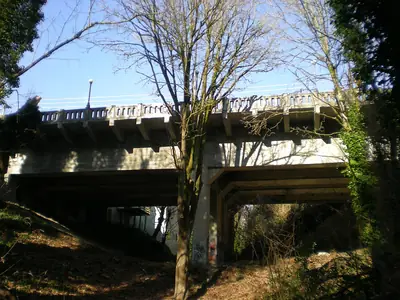
Built in 1910, the North 21st Street Bridge is one of the earliest examples of a continuous concrete rigid‑frame girder bridge. Designed by Waddell and Harrington, it consists of three reinforced‑concrete spans each 60 feet (about 18 meters) long, supported by four continuous girders resting on concrete columns and abutments. The bridge’s slabs are 9 feet (2.7 meters) deep, with beams ranging from 4 to 7 feet wide and 9 to 11 feet deep. At 48 feet wide, it originally accommodated trolley tracks down the centre. The bridge was added to the National Register of Historic Places in 1982.
Union Depot – Warehouse Historic District
This historic district encompasses part of Tacoma’s Union Depot and surrounding warehouse area, reflecting the city’s railroad and commercial development. While the source notes provide only its location within Washington State and the United States, the district remains a tangible reminder of Tacoma’s early 20th‑century growth.
Fort Nisqually
Located within Point Defiance Park, Fort Nisqually is a reconstructed 19th‑century fur‑trading post that offers a glimpse of life on Puget Sound before Washington became a state. The original fort was established in 1833 by the Hudson’s Bay Company as the first European trading post on the sound. It later served as a centre for fur trading and farming and became part of the Puget Sound Agricultural Company. Although the fort originally stood near present‑day DuPont, several structures were moved and preserved here in the 1930s. The Factor’s House and the Granary are the only surviving Hudson’s Bay Company buildings in the United States; the Granary, built in 1843, is a National Historic Landmark and is described as the oldest building in Washington state.
Job Carr Cabin Museum
The museum presents a full‑size replica of Job Carr’s 1865 log cabin, shedding light on the area’s earliest settlement. Carr, a Union Army veteran from Indiana, arrived by canoe and chose a sloped waterfront site hoping the Northern Pacific Railroad would make it the line’s western terminus. Though the railroad selected a location about two miles away, Carr’s claim helped spark the community. For nine months he lived in a cedar‑bark shelter with his yellow cat, Tom, before building the cabin. The current museum opened in December 2000 after local fundraising and the use of Gene Grulich’s scale model to reconstruct the story; the original cabin was moved in 1900, relocated again in 1917, and finally dismantled in 1988 after long‑term damage.
East 21st Street Bridge
Completed in January 1997, the East 21st Street Bridge is a cable‑stayed crossing of the Thea Foss Waterway that links downtown Tacoma with the Port of Tacoma. Its two striking towers rise 180 feet above the deck, giving the bridge its most recognizable silhouette. The structure carries four lanes of State Route 509 and was built as part of a $165.3 million Washington State Department of Transportation project that also created a single‑point urban interchange connecting State Route 509 with Interstate 705 west of the bridge. The crossing is sometimes referred to as the Foss Waterway Bridge, although the nearby Murray Morgan Bridge spans the same waterway.
Fisherman’s Daughter
Situated in Wright Park, the Fisherman’s Daughter sculpture is one of the park’s traces of local culture. Wright Park began in 1886 after a land donation required at least 300 ornamental shade trees be planted within four years, shaping the park as a place for shade, recreation, and public gathering. The park also features the W. W. Seymour Botanical Conservatory, a Victorian‑style glasshouse opened in 1908 with a 12‑sided dome and roughly 3,500 panes of glass, housing palms, orchids, ferns, flowering plants, a Ponderosa lemon tree known for its oversized fruit, golden dart frogs, and hand‑carved stone sculptures. Some trees were damaged by the Columbus Day Storm of 1962, but the surviving collection continues to give Wright Park its strong botanical identity, offering lawns, play areas, shaded paths, and a quiet place to pause while exploring Tacoma.
Bethany Presbyterian Church
Bethany Presbyterian Church is a church building located in Tacoma, Washington, United States. The source notes provide no further details about its architecture or history, but it stands as part of the city’s religious landscape.
Explore Tacoma with Neywo
Neywo’s free audio guide for Tacoma includes 46 narrated places and offers three walking tours, one bus route, and one bike route. The “Opera Alley to the Glass Cone” walk covers 2.49 kilometres in about 83 minutes with 10 stops, including Old City Hall, the Children’s Museum of Tacoma, Tacoma Art Museum, Union Station, Washington State History Museum, and the Museum of Glass. The “Castle on the Hill: The Stadium District” walk is 1.54 kilometres long, lasts roughly 49 minutes, and visits six stops such as Landmark Convention Center, First Presbyterian Church, Fisherman’s Daughter, Stadium High School, and Stadium Bowl. The “Timber Dome, Steel Towers and Classic Cars” walk stretches 2.84 kilometres, takes about 65 minutes, and includes five stops: Holy Rosary Church, America’s Car Museum, Tacoma Dome, East 21st Street Bridge, and the Museum of Glass. The bus route “Route 1: Theaters and Museums Along 6th and Pacific” runs 1.9 kilometres in about eight minutes with five stops: Broadway Center for the Performing Arts, Pantages Theater, Children’s Museum of Tacoma, Tacoma Art Museum, and Washington State History Museum. The bike route “Ruston Way Waterfront Ride” covers 1.6 kilometres in approximately eight minutes, stopping at St. Peter’s Episcopal Church, Puget Creek, and Fireboat No. 1. As you reach each location, the app tells the story of that place, allowing you to explore at your own pace without a group or a fixed schedule. Narration is available in 11 languages.
Places with an audio guide in Tacoma
8 places in Tacoma with a Neywo audio guide. Each one starts telling its story as you reach it.
Self-guided tours in Tacoma
5 tours in Tacoma, free in the Neywo app. Each stop tells its story as you reach it.
- Bike ride
Ruston Way Waterfront Ride
Ride the shoreline trail of Commencement Bay from Old Tacoma's 1873 church to a preserved fireboat, with a salmon creek ravine on the way.
St. Peter's Episcopal Church · Puget Creek · Fireboat No. 1
Open this tour: Ruston Way Waterfront Ride - Bus ride
Route 1: Theaters and Museums Along 6th and Pacific
Pierce Transit Route 1 runs from Tacoma Community College through downtown along 6th Avenue and Pacific Avenue. Ride it between the Broadway theaters and the museum quarter at Union Station.
Broadway Center for the Performing Arts · Pantages Theater · Children's Museum of Tacoma · Tacoma Art Museum · Washington State History Museum
Open this tour: Route 1: Theaters and Museums Along 6th and Pacific - Walk
Opera Alley to the Glass Cone
Start where Tacoma's boom-era city hall still tells time, pass the vaudeville palaces of Broadway, then drop down the hill to the museum quarter around Union Station. It ends at a tilted glass-making cone on the Thea Foss Waterway.
Old City Hall station · Elks Temple · Pantages Theater · Rialto Theater · Broadway Center for the Performing Arts · Children's Museum of Tacoma …
Open this tour: Opera Alley to the Glass Cone - Walk
Castle on the Hill: The Stadium District
A leafy walk through Tacoma's Stadium District: a Masonic temple with an Egyptian theatre, a Romanesque church tower, a Victorian park and a failed luxury hotel that became a high school. The route ends in the hollow of an old gulch, now a football bowl.
Landmark Convention Center · First Presbyterian Church · Fisherman's Daughter · First Church of Christ, Scientist · Stadium High School · Stadium Bowl
Open this tour: Castle on the Hill: The Stadium District - Walk
Timber Dome, Steel Towers and Classic Cars
Tacoma's south-end landmarks: a Catholic church dubbed the city's Notre Dame, a car museum, the giant wooden Tacoma Dome and a cable-stayed bridge over the waterway. Finish at the glass museum.
Holy Rosary Church · America's Car Museum · Tacoma Dome · East 21st Street Bridge · Museum of Glass
Open this tour: Timber Dome, Steel Towers and Classic Cars
Walk Tacoma with Neywo
Neywo turns Tacoma into a self-guided audio tour. Stories arrive as you reach the place they belong to, and the route reshapes when you wander off it.

