Florence, Italy: Self-Guided Walking Tour
Things to Do in Florence: What to See in the Renaissance City
Florence is a historic Tuscan city known for its Renaissance architecture, churches, palaces, bridges and museums. From the Cathedral and Baptistery to the Arno, Oltrarno and the Medici landmarks, the city rewards exploration on foot. Neywo offers a free audio guide for Florence with 91 narrated places, so you can discover the city as you walk.
Florence is the capital of Tuscany, in Italy, and its historic centre brings many major sights close together. The best way to understand it is to move between its squares, churches and palaces while paying attention to the details of the buildings around you.
What to see in Florence
Florence Cathedral and the Baptistery
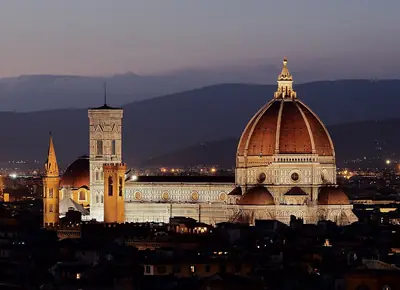
Florence Cathedral, known as the Duomo, is one of the city’s defining landmarks. Construction began in 1296 and was structurally completed in 1436. Its enormous masonry dome was engineered by Filippo Brunelleschi, and the cathedral follows a basilica plan with three naves and a large triconch structure supporting the dome.
Inside, the cathedral contains one of the largest fresco surfaces ever decorated, covering 3,600 square metres. The building was dedicated to Santa Maria del Fiore in 1412, and its completion was marked by a dedication by Pope Eugene IV on 24 March 1436.
Beside it, the Florence Baptistery is dedicated to John the Baptist. Its octagonal Romanesque structure was built between 1059 and 1128. The building is especially famous for its three sets of bronze doors: the south doors by Andrea Pisano and the north and east doors by Lorenzo Ghiberti. Ghiberti’s eastern doors are known as the “Gates of Paradise”. Inside, mosaics cover the ceiling.
Basilica of San Lorenzo
Basilica of San Lorenzo is one of Florence’s oldest and most historically significant churches. It was consecrated in 393 AD and served as the city’s cathedral for three hundred years, before the bishop’s seat moved to Santa Reparata.
The present Renaissance building began in 1419, when Giovanni di Bicci de’ Medici commissioned Filippo Brunelleschi to design a new church. Its interior is marked by clean lines, grey-and-white columns and marble details leading towards the altar and the tomb of Florence’s first Medici ruler.
Palazzo Strozzi
Palazzo Strozzi is one of Florence’s most representative Renaissance civil buildings. Construction began in 1489 and ended in 1538. Fifteen buildings were demolished to make space for the palace, whose three grand identical portals face the surrounding streets.
The palace is also worth seeing from within: its courtyard is open to the public without an admission fee. The scale and freestanding design make it possible to appreciate the building from all four sides.
Palazzo Vecchio and Piazza della Signoria
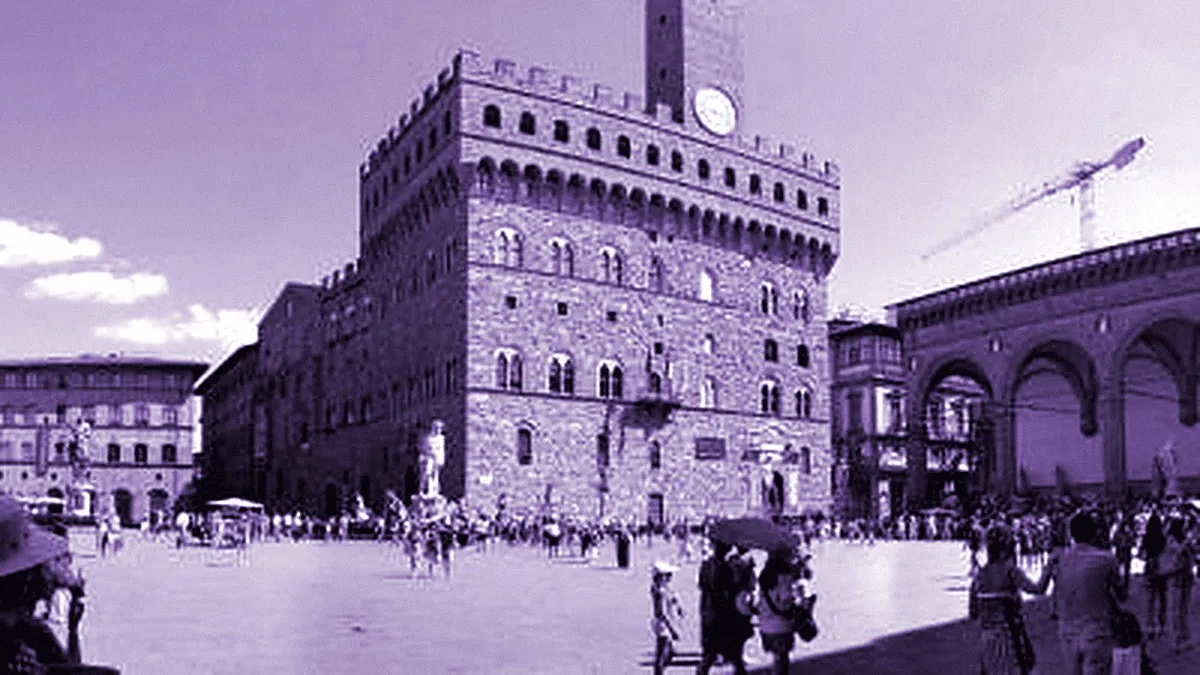
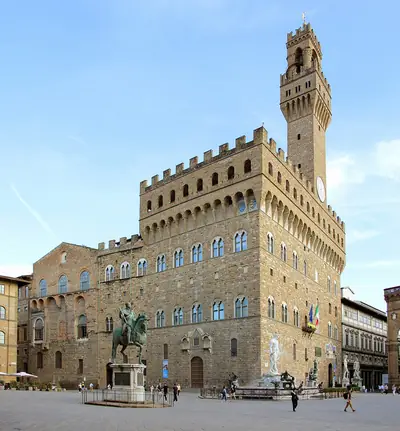
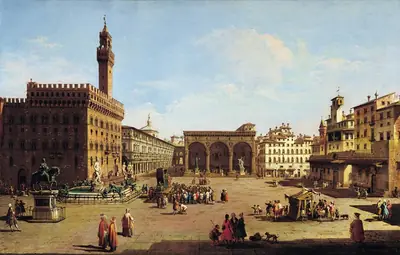
Palazzo Vecchio is Florence’s town hall, standing beside Piazza della Signoria. It was first known as the Palazzo dei Priori, then as the Palazzo della Signoria. In 1540, Cosimo I de’ Medici made it his residence and it became the ducal palace. It took its present name in 1565, when the ducal residence moved to Palazzo Pitti.
The building still houses municipal offices and a museum. Inside are rooms where artists including Agnolo Bronzino, Ghirlandaio and Giorgio Vasari worked. Its medieval structure was gradually expanded until it occupied an entire block, while the main façade is distinguished by rustic stonework.
Ponte Vecchio and the Vasari Corridor
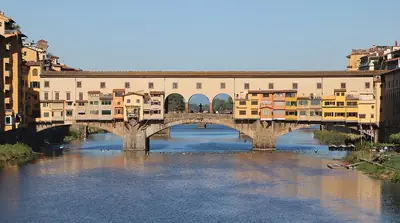
Ponte Vecchio is Florence’s historic bridge over the Arno and one of the city’s most recognizable sights. It connects Via Por Santa Maria with Via de’ Guicciardini and is lined with shops. The covered bridge rests on three arches: the largest measures 30 metres, while the other two measure 27 metres.
Above and around this part of the city runs the Vasari Corridor, an elevated enclosed passage connecting Palazzo Vecchio with Palazzo Pitti. It begins near Palazzo Vecchio, passes through the Uffizi, follows the north bank of the Arno and crosses the river at Ponte Vecchio. On the Oltrarno side, it continues above houses before joining Palazzo Pitti, with the Boboli Gardens nearby.
Bargello National Museum
The Bargello National Museum occupies the Palazzo del Bargello, a medieval public building that later served as a prison. Since 1865, it has housed a national museum devoted especially to Italian Renaissance sculpture and Florentine decorative arts.
The collection includes works by Michelangelo, Donatello, Ghiberti, Cellini, Giambologna and Ammannati. The building also contains the Cappella della Maddalena, whose extensive but damaged frescoes are attributed to Giotto. They are said to include a full-length portrait of Dante.
Basilica of Santa Croce
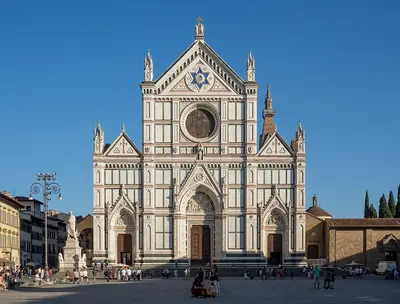
The Basilica of Santa Croce stands on Piazza di Santa Croce and is one of Italy’s major Gothic Franciscan churches. Construction began on 3 May 1294, on the foundations of a smaller Franciscan church built in 1252.
The basilica has 16 chapels, many decorated with frescoes by Giotto and his students, as well as numerous funerary monuments. Its cloisters include the Pazzi Chapel. Santa Croce is also described as an Italian national monument and a minor basilica.
Basilica of Santa Maria Novella
The Basilica of Santa Maria Novella is a major Dominican landmark and a World Heritage Site. Construction began in 1290, and the church was consecrated in 1420. Its façade combines white and green marble in geometric patterns, while the upper section was designed by Leon Battista Alberti and completed in 1470.
The basilica, cloister and chapter house contain important works of art and funerary monuments. Highlights include Giotto’s Crucifix and Masaccio’s Holy Trinity, noted for its use of linear perspective. The Cappella Strozzi di Mantova contains frescoes inspired by Dante’s Divine Comedy.
Palazzo Pitti and the Boboli Gardens
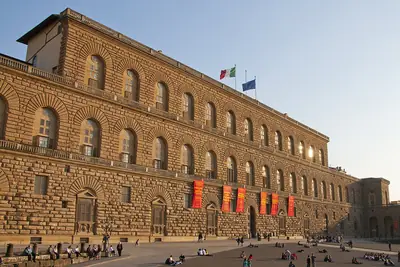
Across the Arno, Palazzo Pitti anchors Florence’s Oltrarno district. The palace began as the residence of the banker Luca Pitti in 1458. The Medici family bought it in 1549, after which it became the main residence of the ruling family of the Grand Duchy of Tuscany.
The palace expanded into a repository of paintings and luxury possessions, while the Boboli Gardens grew behind it. Palazzo Pitti later served as a power base for Napoleon and, for a short period, as the principal royal palace of united Italy under the House of Savoy. In 1919, King Victor Emmanuel III donated the palace and its contents to the Italian people, turning it into a state museum.
The Boboli Gardens form an open-air combination of landscape design, architecture and sculpture. Created and expanded between the 16th and 19th centuries by the Medici, the Habsburg-Lorraine and the House of Savoy, they include Roman antiquities, fountains, grottoes, nymphaeums and small temple-like structures. The long perspective walk known as the viottolone leads through the gardens, while the Kaffeehaus offers a rare Rococo-style presence in Tuscany and views over the city.
San Miniato al Monte
San Miniato al Monte stands at one of Florence’s highest points and is known for its view over the city. The Romanesque basilica is dedicated to Saint Minias, regarded as Florence’s first martyr.
Construction of the present church began in 1013 under Bishop Alibrando. It was founded as a Benedictine monastery and is now home to Olivetan monks. The adjacent Olivetan monastery adds to the setting above Florence.
Villa La Petraia and Belvedere
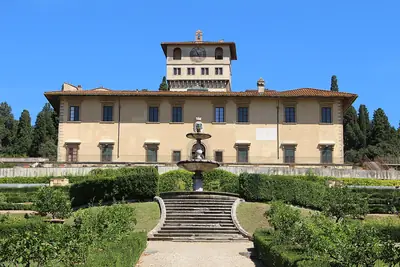
Villa La Petraia is one of the Medici villas in Castello, on the hills around Florence. Its 19th-century belvedere occupies the upper east terrace and is aligned with the view of the city. The villa has been a state museum since 1984.
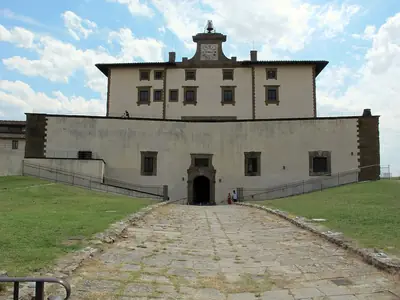
Belvedere, also called Forte di Belvedere, combines Renaissance elegance with a military purpose. Built at the end of the 16th century by Grand Duke Ferdinando de’ Medici, it was designed to protect Florence, display Medici power and wealth, safeguard the treasury and provide refuge during unrest or siege. Hidden passageways connected it with Palazzo Vecchio, Palazzo Pitti and the Boboli Gardens.
Explore Florence with a self-guided audio guide
Download Neywo and explore Florence independently with 8 walking tours and 1 bus route, covering 91 narrated places in total. The walks range from 1.11 to 2.51 km and from 66 to 184 minutes, with between 4 and 15 narrated stops. The bus route covers 2.9 km in 12 minutes and has 8 stops.
Choose a route through the Duomo and San Lorenzo, Piazza della Signoria and the Uffizi, Santa Croce and the Bargello, Oltrarno, San Marco, the Medici villas, Santa Maria Novella or the city’s central landmarks. There is also a route on Linea C1, Florence’s little electric bus through the centre.
Each story plays as you reach the place, at your own pace: no group and no schedule. The narration is available in 11 languages, making Neywo a practical Florence audio guide for discovering the city independently.
Places with an audio guide in Florence
8 places in Florence with a Neywo audio guide. Each one starts telling its story as you reach it.
Self-guided tours in Florence
10 tours in Florence, free in the Neywo app. Each stop tells its story as you reach it.
- Bus ride
Linea C1: Florence's Little Electric Bus Through the Centre
A public electric minibus that threads the historic centre where cars cannot go. Ride from Fra Angelico's convent at San Marco past San Lorenzo, Santa Maria Maggiore and the Duomo to the Bargello and the Galileo Museum, for the price of a city bus ticket.
Museum of San Marco · Palazzo Medici Riccardi · Basilica of San Lorenzo · Chiesa di Santa Maria Maggiore · Gilli · Florence Cathedral …
Open this tour: Linea C1: Florence's Little Electric Bus Through the Centre - Bus ride
Line C1 · the electric minibus through the centro storico
Board at Cavour Guelfa, alight at Galleria degli Uffizi. 8 narrated places along the way: Museum of San Marco, Palazzo Medici Riccardi, Basilica of San Lorenzo, Museo di Casa Martelli, San Gaetano, Florence Cathedral, Bargello National Museum, Museo Galileo.
Museum of San Marco · Palazzo Medici Riccardi · Basilica of San Lorenzo · Museo di Casa Martelli · San Gaetano · Florence Cathedral …
Open this tour: Line C1 · the electric minibus through the centro storico - Walk
The Duomo, the Baptistery and San Lorenzo
Brunelleschi's dome, Ghiberti's bronze doors, Giotto's campanile and the cathedral museum that holds the originals of everything outside — then north to San Lorenzo, the Medici parish church, and Michelangelo's New Sacristy.
Florence Baptistery · Giotto's Campanile · Museo dell'Opera del Duomo · Santa Reparata, Florence · Florence Cathedral · Palazzo Medici Riccardi …
Open this tour: The Duomo, the Baptistery and San Lorenzo - Walk
Piazza della Signoria, the Uffizi and the Ponte Vecchio
The civic and artistic centre: the Palazzo Vecchio, the open-air sculpture of the Loggia dei Lanzi, the Uffizi's Botticellis, Galileo's instruments, and the goldsmiths' bridge with the Vasari Corridor running over it.
Santa Felicita · Ponte Vecchio · Vasari Corridor · Museo Galileo · Galleria degli Uffizi · Piazzale degli Uffizi …
Open this tour: Piazza della Signoria, the Uffizi and the Ponte Vecchio - Walk
Santa Croce, the Bargello and the House of Dante
Michelangelo, Galileo and Machiavelli are buried in Santa Croce; Brunelleschi's Pazzi Chapel is in its cloister; Donatello's David is in the Bargello a few streets away. The best sculpture walk in the city.
Casa Buonarroti · Basilica of Santa Croce · Pazzi Chapel · Palazzo dell'Antella · Museo Horne · Complex of San Firenze …
Open this tour: Santa Croce, the Bargello and the House of Dante - Walk
Oltrarno: Palazzo Pitti, the Boboli and the Brancacci
Across the river — the Pitti's picture galleries and the Boboli gardens behind, the Santo Spirito quarter, and the Brancacci Chapel, where Masaccio's frescoes taught the next century how to paint.
Boboli Gardens · Palazzo Pitti · Casa Guidi · Università di Firenze Museo Zoologico "La Specola" · San Felice church · Piazza Santo Spirito …
Open this tour: Oltrarno: Palazzo Pitti, the Boboli and the Brancacci - Walk
San Marco, the Accademia and the Innocenti
The quietest of the great Florence walks. Fra Angelico's frescoes in the friars' cells at San Marco, the David in the Accademia, Brunelleschi's foundling hospital loggia, and the Etruscan collection in the archaeological museum.
Santissima Annunziata · National Archaeological Museum · Hospital of Innocents · Galleria dell'Accademia · Museum of San Marco · Cloister of the Scalzo …
Open this tour: San Marco, the Accademia and the Innocenti - Walk
The Medici villas at Careggi and Castello
Two and a half kilometres in the northern suburbs, linking four Medici country houses — Careggi, where Lorenzo the Magnificent died, and La Petraia with its terraced garden. Well outside the tourist city.
Villa Medici at Careggi · Villa La Quiete · Villa Corsini in Castello · Villa La Petraia
Open this tour: The Medici villas at Careggi and Castello - Walk
Santa Maria Novella and the Palazzo Strozzi
West of the centre: Alberti's marble facade and Masaccio's Trinity inside, the perfume workshop the Dominicans have run since 1612, the central market, and the Palazzo Davanzati, a merchant house kept as it was lived in.
Piazza del Limbo · Basilica of the Holy Trinity · Palazzo Corsini · Palazzo Rucellai · San Gaetano · Officina di Santa Maria Novella …
Open this tour: Santa Maria Novella and the Palazzo Strozzi - Walk
The Ultimate Florence: San Lorenzo to the Palazzo Strozzi
Two kilometres and arguably the greatest concentration of art anywhere: the Baptistery, the Duomo, Orsanmichele, the Palazzo Vecchio, the Uffizi and the Ponte Vecchio. Weeks of looking on a twenty-minute walk.
Basilica of San Lorenzo · Florence Baptistery · Santa Reparata, Florence · Florence Cathedral · Museo dell'Opera del Duomo · Palazzo dell'Arte della Lana …
Open this tour: The Ultimate Florence: San Lorenzo to the Palazzo Strozzi
Walk Florence with Neywo
Neywo turns Florence into a self-guided audio tour. Stories arrive as you reach the place they belong to, and the route reshapes when you wander off it.

