Seville, Spain: Self-Guided Walking Tour
Things to Do in Seville: What to See in the Andalusian Capital
Seville is a city of royal palaces, former mosques, medieval walls, exhibition architecture and riverside landmarks. Its historic centre brings together Islamic, Christian, Mudéjar, Gothic, Renaissance and Baroque heritage, while areas such as Santa Cruz and the Guadalquivir waterfront offer very different ways to experience the city. Neywo has a free audio guide for Seville with 212 narrated places.
What to See in Seville
Reales Alcázares
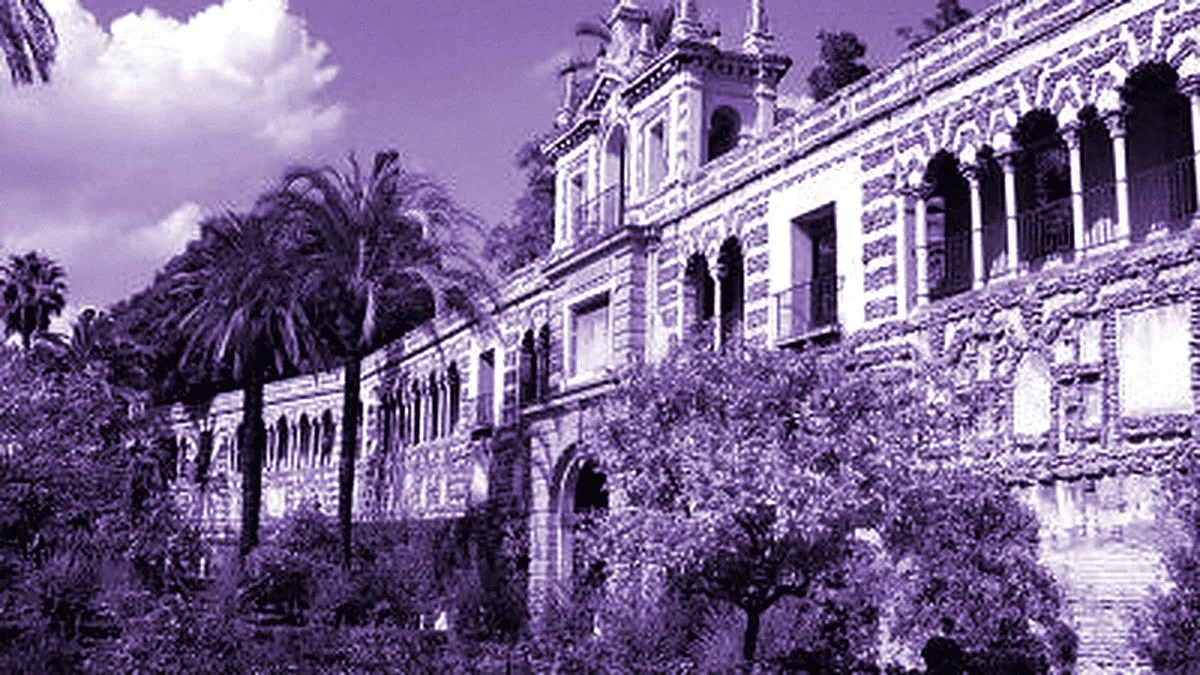
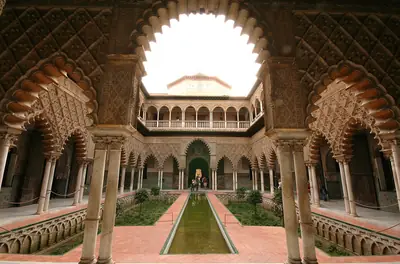
The Reales Alcázares, also known as the Alcázar of Seville, is a royal palace complex enclosed by walls and shaped by successive periods of history. It began as an Islamic-era citadel under the Umayyads and was later enlarged by the Abbadid dynasty and the Almohads.
After the Castilian conquest of Seville in 1248, new palaces and gardens were added over time. Among the most important spaces is the Mudéjar palace built by Pedro I during the 1360s, considered a leading example of Mudéjar architecture in the Iberian Peninsula. Islamic art appears alongside Gothic, Renaissance, Mannerist and Baroque elements, making the complex a record of several architectural traditions rather than a single style.
Seville Cathedral and the Giralda
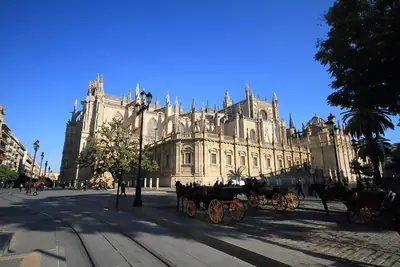
Seville Cathedral, also known as the Cathedral of Saint Mary of the See, stands on the site of the city’s former main mosque. Its most recognizable feature is the Giralda, the former Almohad minaret that became the cathedral’s bell tower after the Christian reconquest.
The cathedral’s Gothic section is 126 metres long and 76 metres wide, with a central nave 36 metres high. It is celebrated as the largest Gothic cathedral in the world, and its surface area was recognized by the Guinness Book of Records in 1988.
The Giralda rises 94.69 metres and preserves the character of an Almohad minaret in its lower section. Its sixteenth-century upper section was added to house the bells. At the summit, the bronze Giraldillo represents the Triumph of Faith. Together with the Alcázar and the General Archive of the Indies, the cathedral and tower form part of Seville’s UNESCO World Heritage Site, declared in 1987.
Plaza de Santa Cruz
Plaza de Santa Cruz lies in the historic Santa Cruz district, on the site of the former Santa Cruz church. Several streets and squares meet here, including Nicolás Antonio Street, Mezquita Street, Santa Teresa Street and Plaza de Alfaro.
At the centre stands the Cruz de la Cerrajería, or locksmiths’ cross. This wrought-iron cross was donated by a brotherhood of locksmiths at the end of the seventeenth century. The gardens of Santa Cruz Square form part of the same setting.
Casa de Pilatos
Casa de Pilatos is an aristocratic palace belonging to the House of Medinaceli. Its patios and gardens bring together Spanish Mudéjar forms, Gothic details and Italian Renaissance influences, reflecting changes made from the final third of the fifteenth century through the seventeenth century.
The palace is particularly known for its azulejos, or glazed Spanish tiles. Around 150 different designs were produced here in the 1530s by the brothers Diego and Juan Pulido, forming one of the largest early-modern collections of its kind in the world.
Palacio de San Telmo
The Palacio de San Telmo is one of Seville’s finest examples of Sevillian Baroque. It now serves as the seat of the Presidency of the Andalusian Government, but it was originally built for the University of Navigators, which educated orphaned children and trained them as sailors.
Construction began in 1682 outside the city walls, on land belonging to the Tribunal of the Holy Office. The palace’s façade reflects its maritime purpose: the entrance includes colourful sculptural decoration, while the balcony above is framed by twelve allegorical figures connected with navigation. Its original features also include a main courtyard and chapel.
Plaza de España
Set inside María Luisa Park, Plaza de España was created as the main building of the Ibero-American Exposition of 1929. Designed by Seville architect Aníbal González, it was built between 1914 and 1929 and became the largest construction project of the exposition.
The vast semicircular ensemble combines Baroque Revival, Renaissance Revival and Moorish Revival influences. A canal follows the curve of the building and is crossed by four bridges. Forty-eight tiled benches represent Spain’s provinces, adding a strong regional element to the architecture.
Lope de Vega Theatre
The Lope de Vega Theatre is a Neo-Baroque landmark created for the 1929 Ibero-American Exposition. It shares its building with the Exhibition Casino and was designed as part of Seville’s pavilion, alongside the casino and its Grand Hall of Festivities.
Its history includes fire and flood damage, periods of closure and partial restoration. The building has also served as a hospital and a trade-show venue, adding further chapters to its life beyond the theatre.
Torre del Oro
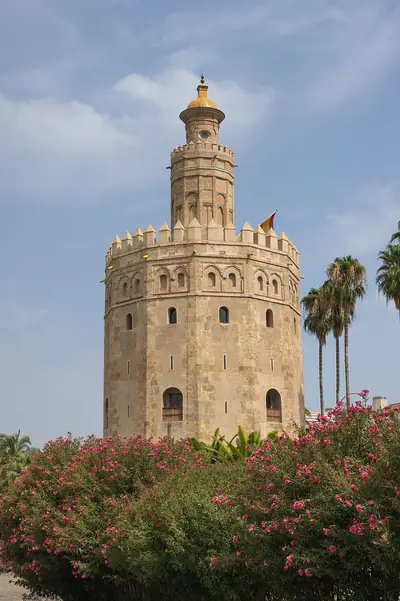
On the Guadalquivir, the Torre del Oro remains one of Seville’s most recognizable landmarks. Built under Almohad rule between 1220 and 1221, it served as a military watchtower controlling access to the city by river and formed part of the fortifications around the historic centre and the Alcázar.
The tower has three distinct sections. Its twelve-sided lower section measures 15.20 metres in diameter, while the complete structure reaches about 36.75 metres. A second Mudéjar section was added during the reign of Pedro I, and the upper section was built in 1760. The lower two sections are polygonal; the upper body is cylindrical and ends in a dome.
The name Torre del Oro refers to the golden glow reflected onto the river. Restoration work showed that this effect came from lime and pressed straw in the building materials, rather than from a covering of tiles. The tower also served as a prison during the Middle Ages.
Postigo del Aceite
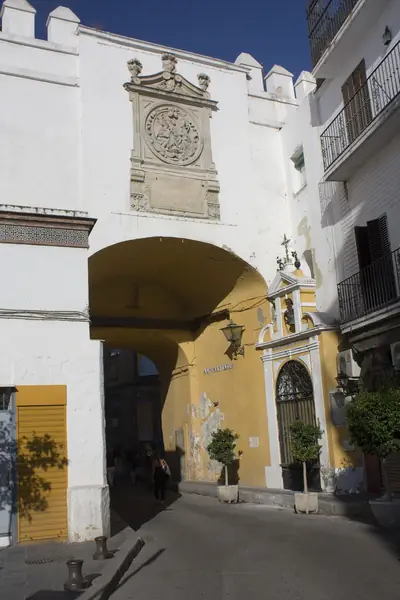
The Postigo del Aceite, also called the Arco del Postigo, is one of only three surviving entrances through Seville’s old walls, together with the Puerta de la Macarena and the Puerta de Córdoba. Its present appearance reflects alterations made in 1573 by Benvenuto Tortello, which gave the former medieval gateway a classical character.
Its name, meaning “Gate of the Oil”, refers to the oil warehouses that once stood nearby. The gateway was also known as the Gate of the Dockyards, the Gate of the Water Carriers and the Gate of the Olives. Rails beneath the arch were once used to secure wooden boards during floods of the Guadalquivir. On the inner side, an eighteenth-century chapel contains a Baroque altarpiece with the statue of the Pura y Limpia Concepción del barrio del Arenal, popularly called the Virgencita del Postigo.
Puerta de Córdoba
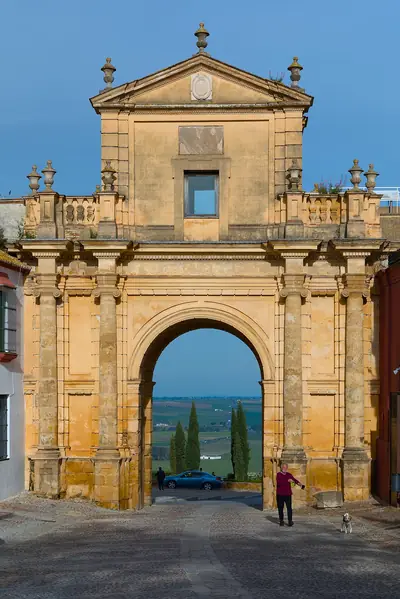
The Puerta de Córdoba is a surviving gateway of Seville’s old walled city, beside the Church of San Hermenegildo. Its bent, angled passage created a more enclosed and defensive entrance than a straight opening, and the gate also served as a military observation tower.
The gate is of Almohad origin, while its name appears in records from the thirteenth century after the Christian reconquest. It escaped the nineteenth-century demolitions that removed much of the city’s other walls and was the only gate left untouched by the major reforms of the sixteenth century. A chapel was added in 1569, and in 1600 the gate became part of the façade of the newly built Church of San Hermenegildo.
Pabellón de la Navegación and Pabellón de Hungría
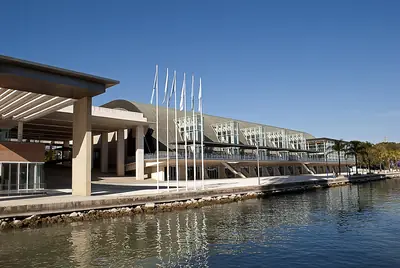
The Pabellón de la Navegación was created for Seville’s 1992 Universal Exhibition. Since 2012, the former exhibition pavilion has served as a museum dedicated to the evolution of Atlantic navigation.
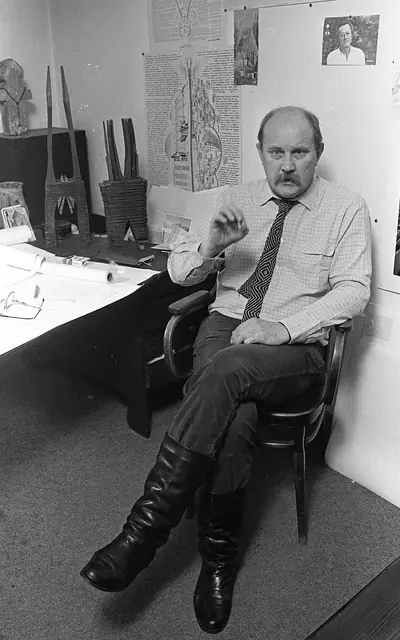
The Pabellón de Hungría, also known as the Hungarian Pavilion of Expo 92 or the Makovecz Pavilion, reflects the work of Hungarian architect Imre Makovecz. His organic architecture sought to work with natural surroundings rather than dominate them, while drawing on Hungarian national archetypes and traditions.
Humilladero de la Cruz del Campo and Teatro Central
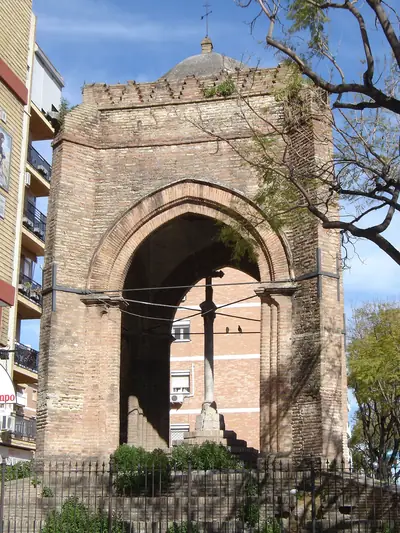
The Humilladero de la Cruz del Campo, also known as the Templete de la Cruz del Campo or El Templete, is a medieval religious roadside monument on Avenida Luis Montoto. Its survival preserves a link with Seville’s medieval past.
Teatro Central belongs to a much more recent chapter. Located on the grounds of the former exhibition precinct on Isla de la Cartuja, it opened in 1992 as part of the transformation of the site after the Universal Exposition.
Explore Seville with a Free Audio Guide
Neywo offers a Seville audio guide with 212 narrated places and eight self-guided ways to explore the city: six walking tours, one bus route and one bike route. Narration is available in 11 languages, and each story plays as you reach the place, at your own pace, with no group and no schedule.
The walks include:
- Three Empires, One Square: Alcázar, Cathedral and Giralda — 1.47 km, 106 minutes and 12 narrated stops.
- Santa Cruz Stories: Murillo, Flamenco and a Palace of Tiles — 1.99 km, 94 minutes and 12 stops.
- Along the Guadalquivir: Gold Tower, Bullring and Triana — 2.2 km, 100 minutes and 12 stops.
- Expo 1929: San Telmo, Plaza de España and María Luisa Park — 2.76 km, 103 minutes and 11 stops.
- Gates, Convents and Towers: Seville’s Northern Walls — 3.07 km, 108 minutes and 11 stops.
- Palaces, Mosaics and Mushrooms: Seville’s Northern Old Town — 2.13 km, 76 minutes and 8 stops.
There is also the C4 Inner Circle bus route, covering 5.8 km in 25 minutes with 10 narrated stops, and María Luisa Park by Bike, a 1.6-km route taking 8 minutes with 7 stops.
Download Neywo and explore Seville while the app tells the story of each place as you reach it. For more ideas in the region, browse Andalusia and Spain.
Places with an audio guide in Seville
8 places in Seville with a Neywo audio guide. Each one starts telling its story as you reach it.
Self-guided tours in Seville
8 tours in Seville, free in the Neywo app. Each stop tells its story as you reach it.
- Bike ride
María Luisa Park by Bike: Expo Pavilions and Gardens
A flat, shaded ride through Seville's main park, where bike hire is common. Start at the queen's mini-castle, roll past the Lope de Vega Theatre to Plaza de España, then follow the park to the tiled playwrights' glorieta and Plaza de América.
Costurero de la Reina · Lope de Vega Theatre · Glorieta de Goya · Plaza de España · Glorieta de los Hermanos Álvarez Quintero · Plaza de América …
Open this tour: María Luisa Park by Bike: Expo Pavilions and Gardens - Bus ride
C4 Inner Circle: Gold Tower, Park Monuments and the Old Gates
TUSSAM's inner ring line loops the old town. From the river and Torre del Oro it passes Prado de San Sebastián, then follows the medieval walls to the Córdoba and Macarena gates and the Perdigones tower. Cheap and easy for the northern sights.
Monument to tolerance · Teatro de la Maestranza · Torre del Oro · Monumento a La Raza, Sevilla · Plaza de Don Juan de Austria · Columbus Monument …
Open this tour: C4 Inner Circle: Gold Tower, Park Monuments and the Old Gates - Walk
Three Empires, One Square: Alcázar, Cathedral and Giralda
Start where Seville's World Heritage triangle meets. Pass the Lion Gate into the Mudéjar palace of Pedro I, walk past the Archive of the Indies, and finish under the cathedral's Giralda, a minaret turned bell tower.
Plaza del Triunfo · Puerta del León · Palacio del Rey don Pedro · Reales Alcázares · Palacio de Yanduri · Torre de Abdelazis …
Open this tour: Three Empires, One Square: Alcázar, Cathedral and Giralda - Walk
Santa Cruz Stories: Murillo, Flamenco and a Palace of Tiles
Wander the whitewashed lanes of the old Jewish quarter and the streets around it. See the flamenco dance museum, the house where Murillo spent his last years, the Plaza de Santa Cruz with its iron cross, and end at the tile-lined Casa de Pilatos.
Plaza del Salvador · Museo del Baile Flamenco · Casa de los Pinelo · Antiguo Hospital de Venerables Sacerdotes · Casa de Murillo · Convento de las Teresas …
Open this tour: Santa Cruz Stories: Murillo, Flamenco and a Palace of Tiles - Walk
Along the Guadalquivir: Gold Tower, Bullring and Triana
Follow Seville's river from the old royal shipyards to the Torre del Oro and the Maestranza bullring, then cross the iron Triana bridge into the potters' quarter, where the Inquisition once had its castle.
Postigo del Aceite · Seville Royal Shipyard · Hospital de la Santa Caridad · Torre del Oro · Teatro de la Maestranza · Plaza de toros de la Maestranza …
Open this tour: Along the Guadalquivir: Gold Tower, Bullring and Triana - Walk
Expo 1929: San Telmo, Plaza de España and María Luisa Park
Stroll through the grand pavilions of the 1929 Ibero-American Exposition. From the baroque San Telmo palace and the old tobacco factory to the great semicircle of Plaza de España and the three styles of Plaza de América.
Palacio de San Telmo · Royal Tobacco Factory of Seville · El Cid by Anna Hyatt Huntington in Seville · Glorieta de Goya · Monumento a La Raza, Sevilla · Lope de Vega Theatre …
Open this tour: Expo 1929: San Telmo, Plaza de España and María Luisa Park - Walk
Gates, Convents and Towers: Seville's Northern Walls
Seville's old city wall survives best in the north. Walk from the Cistercian monastery of San Clemente past a Baroque French church and a Mudéjar palace to the Puerta de Córdoba and the Macarena Gate, then end at the Torre de los Perdigones, the surviving tower of a former lead-shot works beside the river.
Monasterio de San Clemente · Torre de Don Fadrique · Palacio del Marqués de la Algaba · Iglesia de San Luis de los Franceses · Iglesia de Santa Marina · Plaza de Pumarejo …
Open this tour: Gates, Convents and Towers: Seville's Northern Walls - Walk
Palaces, Mosaics and Mushrooms: Seville's Northern Old Town
From the Museo de Bellas Artes and its Murillo square, through Roman mosaics in the Lebrija palace and the giant wooden Metropol Parasol, to the grand Baroque houses of the Dueñas and Villapanés. A walk through the living rooms of old Seville.
Museo de Bellas Artes de Sevilla · Monumento a Murillo · Iglesia del Santo Angel · Palacio de la Condesa de Lebrija · Metropol Parasol · Monasterio de Santa Inés …
Open this tour: Palaces, Mosaics and Mushrooms: Seville's Northern Old Town
Walk Seville with Neywo
Neywo turns Seville into a self-guided audio tour. Stories arrive as you reach the place they belong to, and the route reshapes when you wander off it.

