Things to Do in Edmonton, Canada: Walking Guide
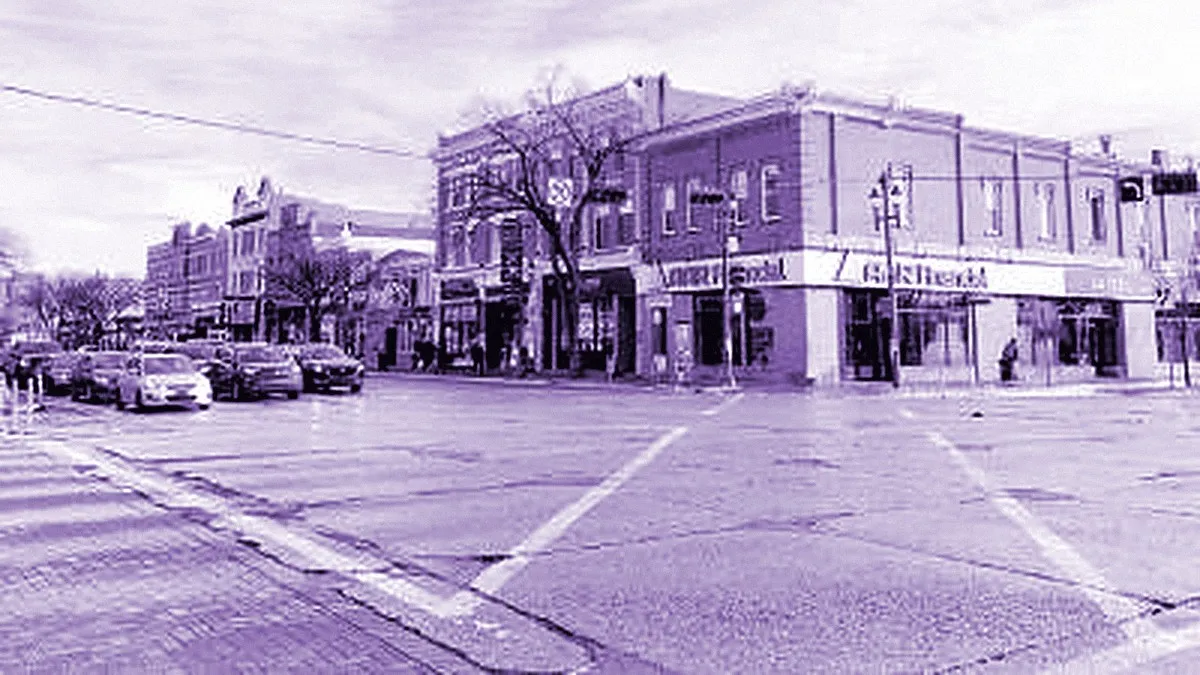
Things to do in Edmonton
Edmonton, Alberta’s capital, blends prairie landscapes, Indigenous heritage, historic neighbourhoods and a vibrant cultural scene, earning its nickname as Canada’s Festival City. Visitors can explore everything from living‑history forts and striking cathedrals to cutting‑edge science centres and outdoor art, all set within a spacious river valley. Neywo offers a free audio guide for Edmonton with 79 narrated places to help you discover the city at your own pace.
Explore Edmonton’s highlights
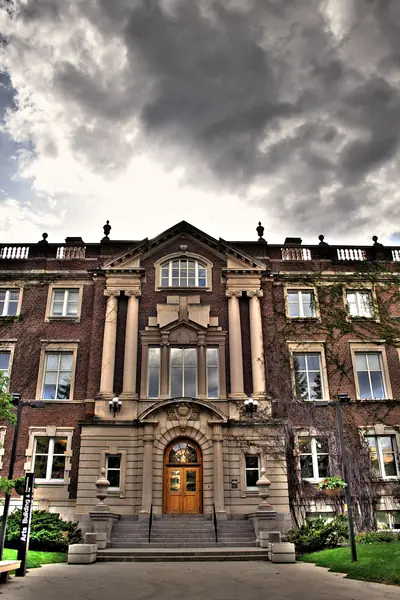
University of Alberta
The University of Alberta sits on the south rim of the North Saskatchewan River valley, across and west from downtown. Founded in 1908 by Alberta’s first premier Alexander Cameron Rutherford and its first president Henry Marshall Tory, it now spans four Edmonton campuses, an Augustana Campus in Camrose and a staff centre in downtown Calgary. The original north campus covers 50 city blocks with 150 buildings, offering about 400 programs across 18 faculties to roughly 37,000 students from Canada and more than 150 other countries.
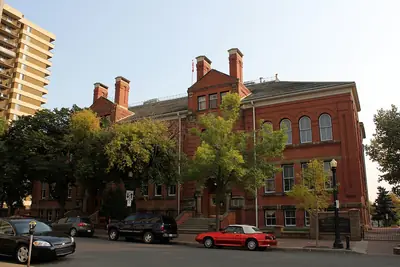
McKay Avenue School
McKay Avenue School now houses the Edmonton Public Schools Archives and Museum. It began in 1881 as a one‑room schoolhouse built on land donated by the Hudson’s Bay Company, with contributions from Matthew McCauley, Malcolm Groat and William Rowland. The modest wooden structure featured double doors, eight large windows and ten‑foot ceilings. As the city grew, a larger building designed by Henry Denny Johnson replaced it in 1905; its three storeys and eight rooms are styled in Richardsonian Romanesque. Named for Dr. William MacKay of the Hudson’s Bay Company, the school hosted the first two sessions of the Alberta Legislative Assembly in 1906‑1907, when Edmonton was confirmed as the provincial capital, the University of Alberta was founded and provincial courts and railway charters were established.
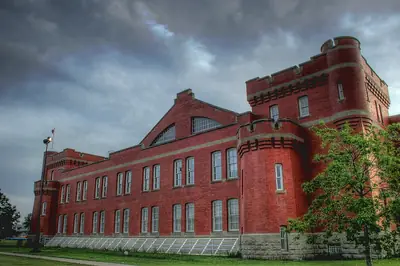
Prince of Wales Armoury
Just north of downtown, the Prince of Wales Armoury is a striking brick and sandstone building with crenelated corner towers and a solid two‑storey form. Completed in 1915 as the Edmonton Drill Hall, it was designed by E. C. Hopkins and reflects the fortress‑like military architecture favoured in early‑20th‑century Canada. For decades it served as a major training site for the Department of National Defence through both World Wars, housing regiments such as the 51st Battalion, the 233rd French‑Canadian Battalion, the 49th Regiment, the 101st Edmonton Fusiliers and the unit that later became the Loyal Edmonton Regiment. Signalmen and medical personnel also used the site before it was renamed the Prince of Wales Armoury in 1921; military use continued until 1977, after which ownership passed to the City of Edmonton.
St. Josaphat Cathedral
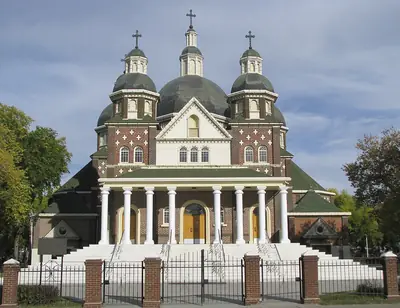
St. Josaphat Cathedral in the McCauley neighbourhood is a Ukrainian Catholic church noted as one of Canada’s finest examples of Byzantine Rite architecture. It has been the seat of the Ukrainian Catholic Eparchy of Edmonton since 1948. Its red brick façade is accented by darker brick pilasters and cream‑coloured inlaid crosses on an eighteen‑lot property. The parish originated in 1902 under the Order of Saint Basil the Great, with a modest log church appearing in 1904 under Reverend Sozont Dydyk. The present building was designed in 1938 by Reverend Philip Ruh, a Belgian Oblate missionary versed in Ukrainian Byzantine architecture, and constructed from 1939 to 1947, blending Ukrainian Baroque with Western European styles to create the Prairie Cathedral aesthetic.
Art Gallery of Alberta
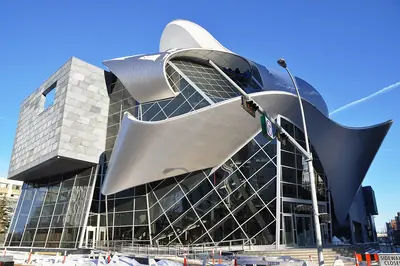
Located on Churchill Square, the Art Gallery of Alberta (AGA) holds more than six thousand works and presents rotating exhibitions and public programs. It originated in 1924 as the Edmonton Museum of Arts, moved several times before settling in the Brutalist Arthur Blow Condell building in 1969. Renamed the Edmonton Art Gallery in 1956 and the Art Gallery of Alberta in 2005, the venue underwent an 88 million‑dollar redevelopment led by Randall Stout Architects between 2007 and 2010, reopening on January 31 2010 with nearly double the exhibition space. The collection includes historical and contemporary paintings, sculptures, installations and photographs.
Alberta Aviation Museum
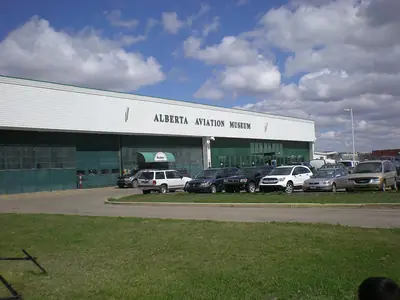
The Alberta Aviation Museum occupies Hangar 14 at the former Edmonton City Centre (Blatchford Field) Airport. Built in 1943, Hangar 14 is one of the last remaining double‑doubles of the British Commonwealth Air Training Plan in Canada, covering 72,000 square feet with a clear span of 112 feet and constructed from British Columbia fir timbers. Over its lifespan the hangar trained air observers, supported military and commercial aviation, served as storage for Pacific Western Airlines, housed a car dealership and was later converted into the museum that preserves Edmonton’s aviation heritage.
Alberta Railway Museum
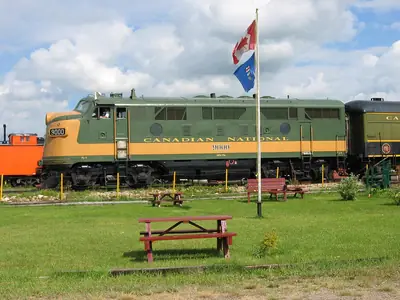
The Alberta Railway Museum preserves locomotives, carriages, equipment and historic railway buildings that tell the story of rail travel in the province. Operated by the Alberta Pioneer Railway Association, a nonprofit founded in 1968, it opened in 1977 on a former Canadian Northern Railway site. Volunteers and a small seasonal staff keep the museum running during summer. Its collection includes about 75 locomotives and railway cars, with both steam and diesel‑electric power represented; notable working pieces are a Ten‑Wheeler steam locomotive from 1913 and an EMD F3A diesel‑electric locomotive from 1948. On certain public holidays the museum offers passenger trips on historic trains, allowing visitors to see the collection in motion.
Fort Edmonton Park
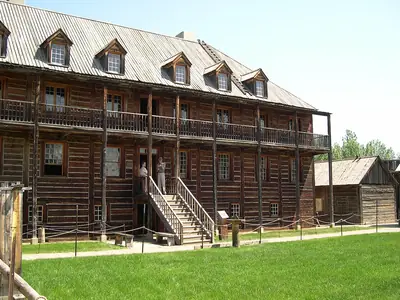
Fort Edmonton Park is an open‑air living history museum along the North Saskatchewan River and the largest of its kind in Canada by area. Named for the original Fort Edmonton, the first enduring European post in the region, the park is divided into five sections: the Indigenous Peoples Experience, the fort itself, and streets representing the years 1885, 1905 and 1920. Costumed interpreters bring the past to life in summer, and visitors can ride a working steam train through the park’s length to the fort, or travel by horse‑drawn carriage and streetcar depending on the period depicted. Founded in 1974, the park is managed by the City of Edmonton.
Neon Sign Museum
The Neon Sign Museum is an outdoor collection of historical neon signs in downtown Edmonton. It is the first museum of its kind in Canada, gathering vintage neon signs and presenting them as part of the city’s streetscape, offering a distinctive view of Edmonton’s visual history.
Royal Alberta Museum
The Royal Alberta Museum is one of Edmonton’s major cultural destinations and the largest museum in Western Canada. Its exhibition spaces exceed 7,600 square metres within a building of 38,900 square metres total. Three permanent galleries form the core: Wild Alberta (ecosystems and wildlife), the Syncrude Gallery of Aboriginal Culture (history and contributions of Indigenous peoples), and Natural History (geological and biological diversity). The museum also features a travelling‑exhibition gallery, a children’s gallery of 650 square metres and a bug room where live invertebrates and a visible nursery introduce visitors to the world of insects. Established by the Government of Alberta in December 1967, it continues to showcase Alberta’s people, landscapes, wildlife and heritage.
Telus World of Science Edmonton
TELUS World of Science Edmonton invites families and children to explore science through interactive exhibits rather than static displays. Its galleries include Discoveryland, the Environment Gallery, GPS Adventures Canada, the Space Gallery and a Feature Exhibit Gallery. Additional facilities comprise an observatory, an IMAX theatre, a planetarium, an on‑site café and a gift shop stocked with science‑related toys such as telescopes. Designed by architect Douglas Cardinal, the centre opened on July 1 1984 (Canada Day), replacing the nearby Queen Elizabeth II Planetarium. After an expansion and renovation in 2001 it was renamed Odyssium, and in 2005 adopted its current name, TELUS World of Science Edmonton.
Ukrainian Canadian Archives & Museum Of Alberta
The Ukrainian Canadian Archives and Museum of Alberta (UCAMA) offers exhibitions, archives, library resources and collections that explore Ukrainian heritage. UCAMA recently acquired the former Lodge Hotel and the Brighton Block at 9670 Jasper Avenue and plans to develop these buildings into a larger facility with exhibition galleries, archive and library areas, collection storage, educational spaces, meeting rooms and rooms for special programming.
St. Joseph’s Basilica, Edmonton
St. Joseph’s Basilica serves as the cathedral of the Roman Catholic Archdiocese of Edmonton and the seat of the archbishop. It is the city’s second‑largest church, accommodating about 1,100 people, and the only minor basilica in Western Canada. The basilica features sixty stained‑glass windows depicting the Twelve Apostles, Old Testament figures and biblical scenes, also recalling the diocese’s link to Saint Albert, the first Catholic diocese in Alberta. The parish began in 1913 when Edmonton’s English‑speaking Catholics outgrew Saint Joachim’s; a basement crypt was built first, while construction of the main church was delayed by the two World Wars and the Great Depression. Designed by Roland Walter Lines, the basilica was completed and opened on May 1 1963, the Feast of Saint Joseph the Worker. In 1984 Pope John Paul II elevated it to the status of a minor basilica by formal decree.
Oblats Maison Provinciale
Oblats Maison Provinciale is a convent in Edmonton that forms part of the city’s religious heritage.
Churchill Square
Churchill Square, officially Sir Winston Churchill Square, is the vibrant heart of downtown Edmonton. It functions as a main gathering place for festivals, performances and community events throughout the year. Bordering the square are Edmonton City Hall to the north, the Law Courts and the Art Gallery of Alberta to the northeast, Chancery Hall and the Francis Winspear Centre for Music to the east, the Citadel Theatre at the southeast corner, the Stanley A. Milner Library to the south and the Edmonton City Centre mall to the west. The square is designed as a family‑friendly public space, featuring pavilions, public art installations, water features and seating areas where people can relax, meet others or enjoy outdoor events.
Experience Edmonton with Neywo
Neywo’s free audio guide for Edmonton includes 79 narrated places that play automatically as you arrive at each site, letting you explore at your own pace with no group and no schedule. The service offers six walking tours, one bus route and one bike route:
- Churchill Square: The Heart of Downtown Edmonton – 2.73 km, 88 min, 11 stops
- From the Grand Hotel to the Legislature and the River Valley – 4.41 km, 102 min, 8 stops
- Old Strathcona: The End of Steel – 2.47 km, 83 min, 11 stops
- Ukrainian Edmonton and the Drill Hall – 2.37 km, 70 min, 6 stops
- Ice District and the Neon Signs – 1.09 km, 36 min, 4 stops
- Garneau and the University Campus – 2.59 km, 64 min, 6 stops
- Bus: ETS 701 – Old Strathcona, Downtown and McCauley – 6.8 km, 29 min, 6 stops
- Bike: Edmonton by Bike – Northlands to Rogers Place and the West End – 8 km, 40 min, 4 stops
Narration is available in 11 languages. Simply download the Neywo app, choose a tour, and let the stories of Edmonton unfold as you walk, bike or ride through the city.
Places with an audio guide in Edmonton
8 places in Edmonton with a Neywo audio guide. Each one starts telling its story as you reach it.
Self-guided tours in Edmonton
8 tours in Edmonton, free in the Neywo app. Each stop tells its story as you reach it.
- Bike ride
Edmonton by Bike: Northlands to Rogers Place and the West End
A ride along Edmonton's cycle lanes from the former Northlands Coliseum, home of the Oilers dynasty, past the Royal Alberta Museum and Rogers Place, the new arena, to the Beth Shalom Synagogue.
Northlands Coliseum · Royal Alberta Museum · Rogers Place · Beth Shalom Synagogue
Open this tour: Edmonton by Bike: Northlands to Rogers Place and the West End - Bus ride
ETS 701: Old Strathcona, Downtown and McCauley
A regular Edmonton Transit local route from Old Strathcona's 1891 hotel, the oldest armoury in Alberta and End of Steel Park across the river into downtown, past the Paramount Theatre, then on to the Royal Alberta Museum and St Josaphat Cathedral in McCauley.
Strathcona Hotel · Connaught Armoury · End of Steel Park · Paramount Theatre · Royal Alberta Museum · St. Josaphat Cathedral
Open this tour: ETS 701: Old Strathcona, Downtown and McCauley - Walk
Churchill Square: The Heart of Downtown Edmonton
Start at the flatiron Gibson Block and the Royal Alberta Museum, then loop around Sir Winston Churchill Square, ringed by the pyramids of City Hall, the Brutalist Art Gallery of Alberta, the library and the city's main stages. Glance up at the stepped Canada Place and end at the McLeod Building, a 1915 Chicago School skyscraper.
Gibson Block · Royal Alberta Museum · Edmonton City Hall · Art Gallery of Alberta · Churchill Square · Citadel Theatre …
Open this tour: Churchill Square: The Heart of Downtown Edmonton - Walk
From the Grand Hotel to the Legislature and the River Valley
Walk from the Hotel Macdonald, Edmonton's grand railway hotel above the North Saskatchewan River, through the city's oldest congregations, including the red-brick St. Joachim's and the Basilica of St. Joseph, to the domed Alberta Legislature. Finish on the High Level Bridge over the river valley.
Hotel Macdonald · McDougall United Church · All Saints' Anglican Cathedral, Edmonton · First Presbyterian Church · St. Joachim's Roman Catholic Church · St. Joseph's Basilica, Edmonton …
Open this tour: From the Grand Hotel to the Legislature and the River Valley - Walk
Old Strathcona: The End of Steel
Whyte Avenue's historic quarter is where the railway ended in 1891. Walk from a clinker-brick Gothic church past the oldest armoury in Alberta, End of Steel Park, the first library, the farmers' market in the old bus barns, the first hotel and a 1915 theatre, ending at the Edwardian post office and the old collegiate.
Holy Trinity Anglican Church · Connaught Armoury · End of Steel Park · The Walterdale Playhouse · Old Strathcona Branch · Knox (Presbyterian) Church …
Open this tour: Old Strathcona: The End of Steel - Walk
Ukrainian Edmonton and the Drill Hall
Head north of downtown to the fortress-like Prince of Wales Armoury, then to the seven domes of St Josaphat Cathedral and the churches and museum that tell the story of Edmonton's Ukrainian and Indigenous communities in McCauley.
Prince of Wales Armoury · St. John Cathedral · St. Josaphat Cathedral · Rhema Chapel · Sacred Heart Church of the First Peoples · Ukrainian Canadian Archives & Museum Of Alberta
Open this tour: Ukrainian Edmonton and the Drill Hall - Walk
Ice District and the Neon Signs
Where Edmonton's hockey legend meets its neon past: the neon signs along 104 Street, Rogers Place, the Wayne Gretzky statue with the Stanley Cup raised and the Paramount Theatre.
Neon Sign Museum · Rogers Place · Statue of Wayne Gretzky · Paramount Theatre
Open this tour: Ice District and the Neon Signs - Walk
Garneau and the University Campus
Cross to the south side for the Garneau Theatre, Alberta's only surviving early modernist cinema, the home of Alberta's first premier, the university library and Students' Union, the Jubilee Auditorium and a church by the river.
Garneau Theatre · Rutherford House · University of Alberta Library · University of Alberta Students' Union · Northern Alberta Jubilee Auditorium · St. George's Anglican Church
Open this tour: Garneau and the University Campus
Walk Edmonton with Neywo
Neywo turns Edmonton into a self-guided audio tour. Stories arrive as you reach the place they belong to, and the route reshapes when you wander off it.

