Things to Do in České Budějovice, Czech Republic: Walking Guide
Things to do in České Budějovice
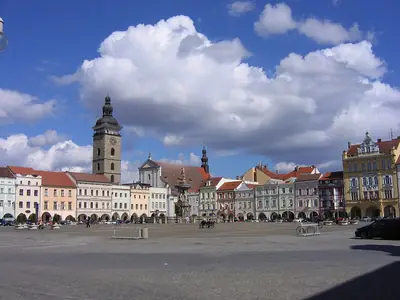
České Budějovice, the capital of the South Bohemian Region, blends royal history, elegant architecture and a long‑standing brewing tradition. Founded in 1265 by King Ottokar II of Bohemia, the city grew prosperous on medieval trade routes and today offers a relaxed atmosphere, lively squares and easy access to nearby castles and the famous Budvar Brewery. Neywo provides a free audio guide for České Budějovice featuring 62 narrated places.
Exploring České Budějovice
Cathedral of St Nicholas
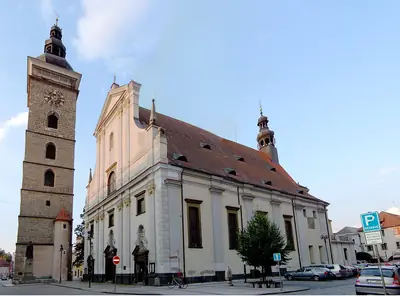
The Cathedral of St Nicholas stands as the city’s main church and a recognizable landmark near the northeastern corner of Přemysl Otakar II Square. Its present Baroque form dates from a reconstruction between 1641 and 1649, while the original church on the site was built in the thirteenth century. Beside the cathedral rises the Black Tower (Černá věž), which serves as the bell tower. A statue of Bishop Jan Valerián Jirsík greets visitors before the entrance. Inside, the vaulting is painted in cream, beige and blue tones. Behind the presbytery, an exterior Uniate chapel from the first half of the eighteenth century displays frescoes from 1785. During the Thirty Years’ War the cathedral housed the royal archive and the Bohemian coronation insignia.
Museum of horse railway
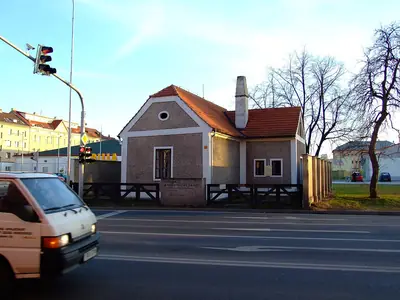
Housed in a former guard’s house erected in 1828 for the horse‑drawn railway, this museum tells the story of one of the earliest public railways on the European continent. The line, engineered by Franz Josef Gerstner as early as 1807, linked České Budějovice with Linz in Austria. Although construction was delayed by the Napoleonic Wars, the railway opened in 1828 and the Czech section was completed a year earlier. From 1832 it ran on a regular timetable; the full 129‑kilometre journey to Linz took about fourteen hours by horse‑drawn train. Initially a side service for passengers, the railway shifted to steam locomotives in 1872, retiring the horses. The building is a protected cultural monument and was physically moved in the 1970s to make way for the widening of Mánesova Street.
Church of Our Lady the Queen of Angels
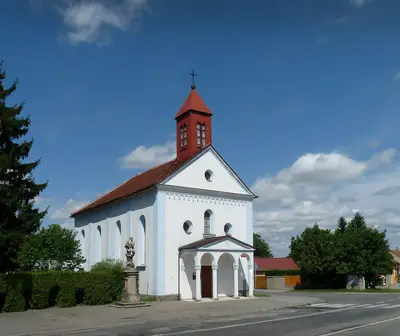
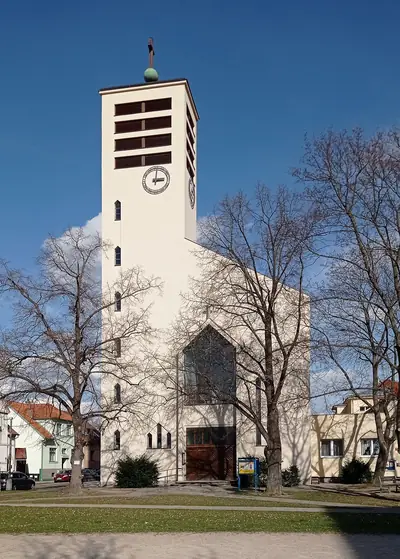
Located in the Nové Hodějovice area, now part of České Budějovice, this church was built between 1938 and 1940. Its modest neo‑Romanesque façade frames a single nave with a rectangular apse and an open vestibule. Near the entrance stands a statue of the Immaculate Conception dated 1727 by Josef Dietrich, moved here in 1940 from Plavská road. Inside, the organ and a statue of Our Lady of Lourdes were transferred in the late 1940s from a closed church in Vitešovice. Above the altar, beneath the cross, a statue known as Our Lady of České Budějovice watches over the nave.
České Budějovice District
The district of České Budějovice covers roughly 1,638 square kilometres and includes about 109 municipalities. It lies at the heart of the South Bohemian Region, sharing borders with Strakonice, Prachatice, Český Krumlov, Tábor, Písek and Jindřichův Hradec, while its southeastern edge forms part of the national frontier with Austria. The capital city sits at the district’s centre. On the corner of Přemysl Otakar II Square and Karel IV Street stands Palác Včela, a three‑story Neo‑Renaissance palace rich in stucco and sculptural decoration. Recognised as a cultural monument since 29 January 1988, it exemplifies the elaborate German Neo‑Renaissance style and belongs to the city’s heritage reserve.
Church of Saint Adalbert
Known locally as Svatý Vojtěch, this notable church is situated on Emy Destinové Street in the Čtyři Dvory district. It stands close to the campus of the University of South Bohemia and the institutes of the Czech Academy of Sciences, offering a quiet place of worship amid academic surroundings.
Odpočívající sportovci
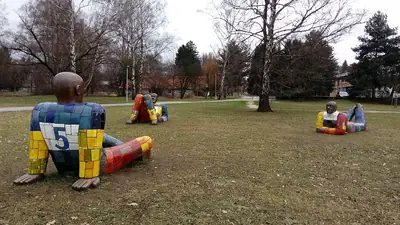
This charming sculpture, whose title translates to “Resting Athletes,” depicts sportspeople taking a break after exertion. It serves as a gentle reminder that even in the midst of effort there is always time to pause and recover.
Dominican Monastery
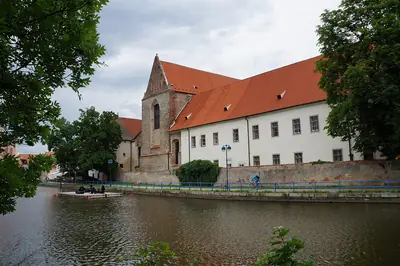
The Dominican Monastery is the oldest Gothic monument in České Budějovice and, together with remnants of the town fortifications, forms the city’s most ancient architectural complex. Set in the northwestern historic centre between Česká Street, a blind branch of the Malše River and Piaristic Square (once the medieval cemetery), its highlight is the Gothic cloister adorned with an impressive collection of medieval wall paintings. After the Dominican monks departed in 1785 due to the Josephine reforms, the complex housed a Piarist grammar school from 1785 to 1871, where many notable figures studied.
Klášter Petrinek
Described as a peaceful spot with a quiet history, the Klášter Petrinek monastery invites visitors to pause for a moment of reflection during their walk through the area.
Kapucínský klášter
Founded on the initiative of Queen Anna of Tyrol, the Capuchine Monastery operated from around 1615 or 1620 until the Josephine reforms of 1788 brought that era to a close. Within its grounds lies the Church of Saint Anne, along with crypts that were used for burying members of the order.
Church of the Sacred Heart
Situated along Rudolfovská třída, the Church of the Sacred Heart forms a quiet landmark that is part of a larger monastery complex in the city centre. It belongs to the Congregation of the Sisters of the Blessed Sacrament, whose monastery buildings surround the church.
Zlatý most
The Golden Bridge (Zlatý most) crosses the Malše River at the end of Dr. Stejskala Street, linking the city centre with its southern part.
Železný most
The Iron Bridge (Železný most) offers a simple crossing over the river and a pleasant spot to pause while taking in the surrounding cityscape.
Boží muka
Between house numbers 961 and 962 on Pražská třída stands a small column shrine known as Boží muka. This early Baroque craftsmanship has been protected as a cultural monument since 1963. A weathered date on its pedestal is believed to read 1692, placing the shrine’s origins at the end of the seventeenth century; its original location remains unknown, and it was moved to its present spot at some point in history.
Nový most
The Nový most carries Strakonická street across the Vltava River, providing another route between the city’s districts.
Dlouhý most
One of the three road bridges that span the Vltava River in České Budějovice, Dlouhý most connects the city centre with the western district of Čtyři Dvory. A bridge at this very location has been recorded under this name since 1369.
Explore with Neywo
Neywo offers three walking tours, one bus route and one bike route in České Budějovice. The walks are: “Gothic Founders and Baroque Towers: The Heart of České Budějovice” (1.08 km, 68 minutes, 10 stops); “Iron Maiden, Golden Bridge and the First Railway on the Continent” (2.99 km, 101 minutes, 11 stops); and “Along Prague Road: Churches, Lovers and a Commune” (2.82 km, 80 minutes, 8 stops). The bus route is “Line 11: from Pražská třída to the cathedral” (16.4 km, 70 minutes, 9 stops). The bike route is “Riverside sculptures to the Iron Maiden” (1.7 km, 8 minutes, 5 stops). Narration is available in 11 languages. As you reach each place, the app tells its story, allowing you to explore at your own pace with no group and no schedule. Download Neywo to enjoy a free, self‑guided audio experience of the city.
Places with an audio guide in České Budějovice
8 places in České Budějovice with a Neywo audio guide. Each one starts telling its story as you reach it.
Self-guided tours in České Budějovice
5 tours in České Budějovice, free in the Neywo app. Each stop tells its story as you reach it.
- Bike ride
Riverside sculptures to the Iron Maiden
A short, flat ride on the city's cycle path along the Malše: the Resting Athletes and Resting Swimmer sculptures, the Iron Maiden tower at the river confluence, the neo-Gothic Holy Family church and the Eggert villa, which now houses the South Bohemian Scientific Library.
Odpočívající sportovci · Odpočívající plavec · Železná panna · Church of the Holy Family · Eggertova vila
Open this tour: Riverside sculptures to the Iron Maiden - Bus ride
Line 11: from Pražská třída to the cathedral
A regular city bus of the Dopravní podnik města České Budějovice that runs down Pražská třída from a Baroque wayside shrine and the Lovers sculpture, past the Evangelical church of 1899, the Empire-style Eggert villa and the Sacred Heart church, to the cathedral with its Black Tower, a Baroque Nepomuk statue and the Beuron-art church of the Rosary.
Boží muka · Milenci, statue near hotel Clarion · Evangelical church · Nám. Švabinského · Eggertova vila · Church of the Sacred Heart (České Budějovice) …
Open this tour: Line 11: from Pražská třída to the cathedral - Walk
Gothic Founders and Baroque Towers: The Heart of České Budějovice
Start at the neo-Gothic Holy Family church and the former Capuchin church of St Anne, then reach the Baroque cathedral and its Black Tower on Přemysl Otakar II Square, one of Europe's largest, laid out in 1265. Walk on to Piarist Square for the Dominican cloister with its medieval frescoes, the oldest building in the city, and the white Solnice with its carved stone faces and its legend of robbers' heads.
Church of the Holy Family · Church of Saint Anne · Jan Valerian Jirsík · Cathedral of St Nicholas, České Budějovice · Bludný kámen · Piarist Square …
Open this tour: Gothic Founders and Baroque Towers: The Heart of České Budějovice - Walk
Iron Maiden, Golden Bridge and the First Railway on the Continent
Follow the rivers: start where the Vltava and Malše meet, pass the Resting Swimmer and Resting Athletes, then the medieval Iron Maiden tower, a Baroque saint and the Golden Bridge. Continue to the memorial of the vanished synagogue and the little guardhouse of the 1828 horse railway to Linz, the first public railway in continental Europe, and finish at the swan fountain and the steel Blue Bridge.
Soutok Vltavy s Malší · Odpočívající plavec · Odpočívající sportovci · Železná panna · Statue of John of Nepomuk · Zlatý most …
Open this tour: Iron Maiden, Golden Bridge and the First Railway on the Continent - Walk
Along Prague Road: Churches, Lovers and a Commune
A quieter walk north of the centre: the Empire-style Eggert villa, the Evangelical and Saint Wenceslaus churches, a small sculpture of lovers, a Paris Commune monument and a weathered Baroque wayside shrine on Pražská třída, with the 1920s Hussite church and the Sacred Heart church on the way.
Church of the Sacred Heart (České Budějovice) · Husův sbor (České Budějovice) · Eggertova vila · Evangelical church · Church of Saint Wenceslaus · Milenci, statue near hotel Clarion …
Open this tour: Along Prague Road: Churches, Lovers and a Commune
Walk České Budějovice with Neywo
Neywo turns České Budějovice into a self-guided audio tour. Stories arrive as you reach the place they belong to, and the route reshapes when you wander off it.

