What to See in Luxor, Egypt: Free Audio Guide
Things to Do in Luxor: Ancient Temples and Tombs
The best things to do in Luxor are spread across the east and west banks of the Nile, from vast temple complexes to richly decorated royal tombs. Built around ancient Thebes, today’s Luxor combines one of Egypt’s most important archaeological landscapes with the life of a riverside city. Neywo has a free audio guide for Luxor with 67 narrated places, helping you understand the monuments as you explore.
What to See in Luxor
Luxor Temple
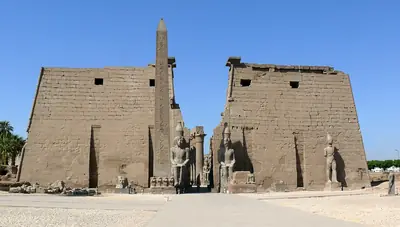
On the east bank, Luxor Temple is one of the best-preserved monuments of the New Kingdom. Its monumental entrance leads to two spacious peristyle courts, a great colonnade and an inner sanctuary that once housed the statue of Amun of Opet.
The temple’s core dates from the eighteenth and nineteenth dynasties. Amenhotep III and Ramses II built its oldest visible sections, while later rulers—including Chabaka, Nectanebo I, the Ptolemaic Lagides and Alexander the Great—added or altered parts of the complex. A former chapel of Mut was later transformed into a Tetrarchy cult chapel and then into a church.
The King’s Festivities Road
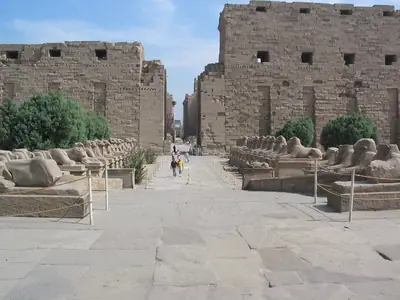
The King’s Festivities Road, also known as the Avenue of Sphinxes or Rams Road, once connected Luxor Temple and Karnak. The avenue stretches for about 2.7 kilometres and is lined with sphinxes and ram-headed statues.
During the 30th dynasty, Nectanebo I left his mark on the route, including by replacing some sphinx heads associated with Amenhotep III with his own effigy. The avenue recalls the royal processions and celebrations that once moved between the two temples.
Luxor Museum
Located on the Nile’s corniche between Karnak and Luxor Temple, Luxor Museum presents a curated collection of ancient Egyptian art connected with Upper Egypt. The two-storey museum opened in 1975 and was extended in March 2004.
One of its notable rooms is the cachette, which displays artefacts discovered in the basement of Luxor Temple. It offers useful context before or after visiting the larger monuments.
Karnak Temple Complex
North of Luxor, the Karnak Temple Complex is the largest religious complex built in antiquity. It covers more than two square kilometres and includes temples, pylons, chapels and other sacred buildings arranged in three walled enclosures.
Most of the visible structures date from the New Kingdom’s 18th dynasty, although construction began under Senusret I in the Middle Kingdom and continued into the Ptolemaic period. Each enclosure contained a sacred lake used for the ritual purification of priests. Karnak was also associated with the Opet festival, which honoured Khonsu.
Temple of Khonsu
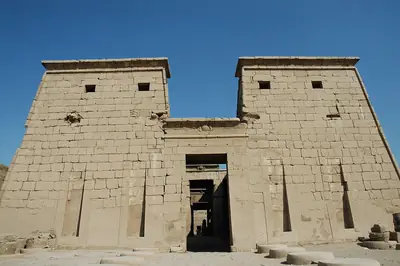
Within the Precinct of Amun-Re at Karnak, the Temple of Khonsu is a relatively well-preserved sanctuary dedicated to the moon god. Ramesses III began the temple on the site of an earlier building, and Ptolemy III Euergetes later added a gateway and enclosure wall, although only the gateway survives.
A modest hypostyle hall built by Nectanebo I contains two baboon statues dating from the time of Seti I. Mismatched and inverted decorations on the stone blocks reveal the repeated rebuilding and reuse of materials at the site.
Precinct of Montu
A short distance north of Karnak, the Precinct of Montu was devoted to the warrior god Montu. Its most striking feature is Bab el-Adb, a monumental Ptolemaic gate preceded by a dromos and a quay once connected to a canal leading towards the Montu sanctuary at Medamud.
The sanctuary developed from a Middle Kingdom shrine that Amenhotep III rebuilt and later rulers enlarged or restored. Beyond the gate are the remains of a courtyard, a pylon, an open court, a hypostyle hall, a chapel hall and a barque hall before the naos of Montu. Archaeologists also uncovered a tax administration building dating from the reign of Thutmose I nearby.
Explore Luxor’s West Bank
Theban Necropolis
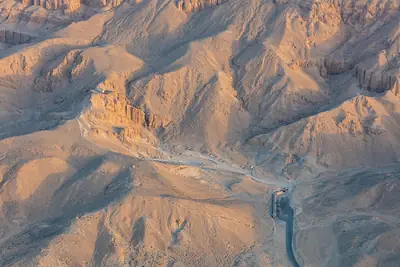
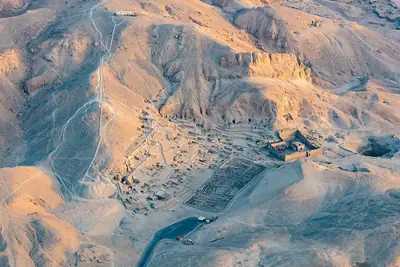
The Theban Necropolis occupies the west bank of the Nile opposite Luxor. Designated a UNESCO World Heritage site in 1979, this extensive funerary landscape includes at least ten burial zones, the Valley of the Kings, the Valley of the Queens and more than 400 other tombs.
Burial activity here began near the end of the First Intermediate Period and continued throughout much of Egypt’s Pharaonic history. The necropolis is not one single cemetery but a broad area containing royal, elite and workers’ tombs.
Valley of the Kings
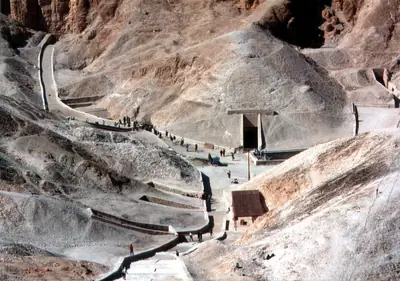
The Valley of the Kings served as the royal necropolis for nearly 500 years, from about 1550 to 1069 BCE. Its rock-cut tombs belonged to pharaohs and powerful nobles of the 18th, 19th and 20th dynasties.
The valley has an East Valley, where most royal tombs are located, and a West Valley, also known as the Valley of the Monkeys. Among its 65 tombs and chambers are KV5, a vast complex built for the sons of Ramesses II, and KV62, the tomb of Tutankhamun discovered by Howard Carter in 1922.
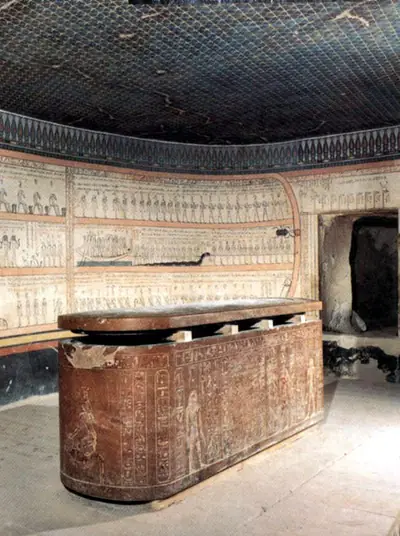
KV34, the tomb of Thutmose III, has an unusual decorative style, including the oldest known version of the Amduat and the Litany of Ra. Its bent axis is characteristic of early 18th-dynasty tombs.
Valley of the Queens
The Valley of the Queens was known in ancient Egyptian as Ta-Set-Neferu, a name meaning both “the place of beauty” and “the place of the royal children”. Located on the west bank near Luxor, it served as a burial ground for queens, princes and high officials from roughly 1560 to 1130 BC.
The valley consists of a main wadi containing about 91 tombs. Together with the Valley of the Kings, it reveals the different burial traditions that developed around ancient Thebes.
Deir el-Medina
Deir el-Medina was the village of the artisans who carved the royal tombs in the Valley of the Kings. Known in ancient Egyptian as Set maat, or the “Place of Truth”, it housed the “Servants in the Place of Truth” during the 18th to 20th dynasties, roughly from 1550 to 1080 BC.
The settlement was deliberately set apart from the wider population to protect the secrecy of the tomb work. Its inhabitants also built and decorated their own tombs, including those of Ipy, Pached and Senedjem. A temple of Hathor was later converted into a Christian monastery, giving the site its Arabic name, Deir el-Medina, or “Monastery of the City”.
Mortuary Temple of Seti I
Near the village of Qurna, the Mortuary Temple of Seti I commemorates Pharaoh Seti I in the Theban Necropolis. The temple was reopened to visitors in March 2004 after extensive restoration and the rebuilding of its first pylon.
The site later required conservation work after wastewater from nearby houses damaged reliefs on the sphinx bases. Conservators dried the sandstone blocks and restored the reliefs.
Colossi of Memnon
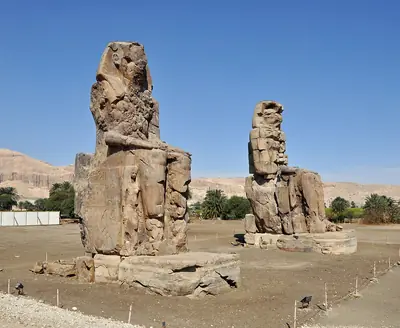
The Colossi of Memnon are two monumental stone statues of Amenhotep III on the road to the west-bank necropolis. Carved from single blocks of stone, they are the last remaining remains of the pharaoh’s enormous mortuary temple, once the largest in the Theban Necropolis.
The northern statue is known for a crack caused by an earthquake in 27 BC and for the ancient belief that it sang at dawn. The statues carry 107 Roman-era inscriptions in Greek and Latin dating from AD 20 to 250. After more than 19 years of excavation and restoration led by Egyptologist Hourig Sourouzian, reunited fragments of both statues were presented to the public in December 2025.
Explore Luxor with Neywo
Neywo offers five self-guided walking tours in Luxor, with 35 narrated stops across the routes:
- Luxor Temple and the Corniche: 2.05 km, 64 minutes and 5 stops
- Karnak: 1.4 km, 51 minutes and 5 stops
- West Bank Giants: 4.54 km, 106 minutes and 7 stops
- Queen Hatshepsut and the Nobles of Thebes: 3.64 km, 90 minutes and 7 stops
- Valley of the Kings: 1.66 km, 82 minutes and 11 stops
Download Neywo and explore Luxor at your own pace. The app tells the story of each place as you reach it, with no group and no schedule. Narration is available in 11 languages. If you are planning a wider trip through Egypt, you can also continue to Aswan, Cairo or Hurghada.
Places with an audio guide in Luxor
8 places in Luxor with a Neywo audio guide. Each one starts telling its story as you reach it.
Self-guided tours in Luxor
5 tours in Luxor, free in the Neywo app. Each stop tells its story as you reach it.
- Walk
Where Gods Processed: Luxor Temple and the Corniche
Begin at Luxor Temple, where a mosque still stands inside a pharaoh's court after 3,400 years of worship. Then stroll the Nile corniche past the Mummification Museum and Luxor Museum to the Avenue of Sphinxes that once linked this temple to Karnak.
Luxor Temple · Abu Haggag Mosque · Mummification Museum · Luxor Museum · The King’s Festivities Road
Open this tour: Where Gods Processed: Luxor Temple and the Corniche - Walk
Karnak: The Largest Temple Ever Built
Enter the precinct of Amun-Ra at Karnak, the biggest religious complex of antiquity. Pass the great gate, the moon-god temple of Khonsu, Thutmose III's carved botanical garden and the mud-brick enclosure of the war god Montu.
Karnak Temple Complex · Bab El Amara Gate · Temple of Khonsu · Statue of Thutmose III at the Akh-menu · Precinct of Montu
Open this tour: Karnak: The Largest Temple Ever Built - Walk
West Bank Giants: Colossi, Medinet Habu and the Ramesseum
Cross to the west bank of ancient Thebes and meet the two colossal statues that greeted travellers for 3,000 years. See the replica of the stele with the earliest Egyptian mention of Israel, the broken giant of the Ramesseum, the painted tombs of the nobles at Sheikh Abd el-Qurna, the village of the tomb-builders at Deir el-Medina and Ramesses III's battle reliefs at Medinet Habu.
Colossi of Memnon · Merneptah Stele · Ramesseum · TT52 · Theban Tomb 69 · Deir el-Medina …
Open this tour: West Bank Giants: Colossi, Medinet Habu and the Ramesseum - Walk
Queen Hatshepsut and the Nobles of Thebes
Start at the terraced temples of Deir el-Bahari, where Hatshepsut copied the older design of Mentuhotep II to proclaim her rule. Walk on through the Valley of the Nobles and the hilltop cemetery of Dra' Abu el-Naga, where Coptic monks later lived among the tombs, and finish at the mortuary temple of Seti I near Qurna.
Deir el-Bahari · Mortuary Temple of Mentuhotep II · Mortuary temple of Hatshepsut · El-Assasif · Dra' Abu el-Naga · Deir el-Bakhit …
Open this tour: Queen Hatshepsut and the Nobles of Thebes - Walk
Valley of the Kings: Tombs of the Pharaohs
Step into the royal burial ground of the New Kingdom, the rock-cut valley where pharaohs were laid to rest for nearly five hundred years. Pass the tombs of Ramesses VII, Ramesses VI, Merenptah and Ramesses III, the hidden cache of royal mummies in the tomb of Amenhotep II, the tomb of Queen Tausret and Seti II, the tomb of Thutmose III with its unique painted walls, and finish at the tomb of Thutmose IV, found by Howard Carter in 1903.
Valley of the Kings · KV1 · KV55 · KV9 · KV8 · KV11 …
Open this tour: Valley of the Kings: Tombs of the Pharaohs
Walk Luxor with Neywo
Neywo turns Luxor into a self-guided audio tour. Stories arrive as you reach the place they belong to, and the route reshapes when you wander off it.

