Cairo, Egypt: Self-Guided Walking Tour
Things to Do in Cairo: A Guide to the City’s Historic Neighbourhoods
Looking for things to do in Cairo? Egypt’s capital brings together ancient history, Islamic monuments, Christian heritage, royal palaces, museums and lively public squares. From the medieval streets around Bab Zuweila to the collections of the Egyptian Museum, Cairo is worth exploring on foot because its history unfolds through one neighbourhood after another. Neywo has a free audio guide for Cairo with 221 narrated places.
What to See in Cairo
Tahrir Square and the Egyptian Museum
Tahrir Square is Cairo’s largest square and one of its most important public gathering places. Established in 1867 as Ismailia Square, it later became associated with liberation and acquired the name Tahrir. Its design was modelled on Place Charles de Gaulle in Paris, while the surrounding landmarks include the Egyptian Museum, the American University in Cairo, the Tahrir Complex and the headquarters of the Arab League.
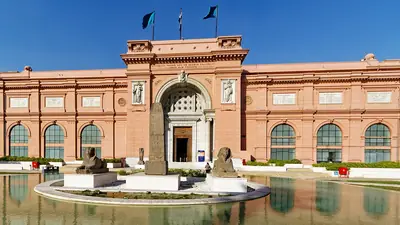
The Egyptian Museum makes the square one of the essential places to visit in Cairo. Its collection contains more than 170,000 objects from the many stages of ancient Egyptian history. The three floors are arranged with large antiquities and monumental statues on the ground floor, while the upper floors include the treasures of Tutankhamun and mummies of Egyptian kings. The museum’s collection moved through several locations before reaching its present building in central Cairo.
Nearby, the Omar Makram Mosque adds another layer to the square’s history. The mosque was expanded after the July 1952 Revolution and renamed after Omar Makram, an Egyptian scholar, fighter and national hero associated with Muhammad Ali’s rise to power.
El-Fustat and Old Cairo
El-Fustat, also called Fustat, was the first capital of Egypt under Muslim rule. Founded by Amr ibn al-As around 641, it became an administrative and religious centre. The Mosque of Amr ibn al-As was recognised as the first mosque built in Egypt, helping establish the city’s importance.
Fustat was burned in 1168 on the orders of the vizier Shawar to prevent its wealth from falling into the hands of invading Crusaders. Over time, the remains of the city were absorbed into Cairo, and the area was later used as a rubbish dump. Today, El-Fustat is an important place for understanding how Cairo developed from earlier centres of power.
Al-Azhar University and Al-Hussein Mosque
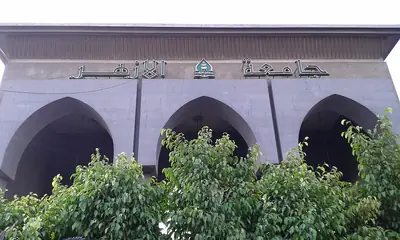
Al-Azhar began around 970 under the Fatimid rulers as a place for worship and teaching. Its early lessons included the Qur’an and Islamic law, as well as language, logic, rhetoric, astronomy and the calculation of the moon’s phases. Al-Azhar University remains associated with Al-Azhar al-Sharif and is one of the world’s oldest institutions of higher learning. In 1961, non-religious subjects were added to its curriculum.
At the heart of the institution stands Al-Azhar Mosque. Construction began in 970, and the first Friday prayer took place in 972. It served both as a place of prayer and as a centre of teaching from the earliest years of Cairo.
Close to the famous Khan el-Khalili bazaar, Al-Hussein Mosque is both a mosque and a mausoleum. Its importance is connected to Husayn ibn Ali, the grandson of the Prophet Muhammad. A tomb associated with him was first built here in 1154, while the mosque and mausoleum were reconstructed in 1874. The shrine has particular significance for Shia Muslims, some of whom believe that Husayn’s head is buried here.
Bab Zuweila and the monuments of Darb al-Ahmar
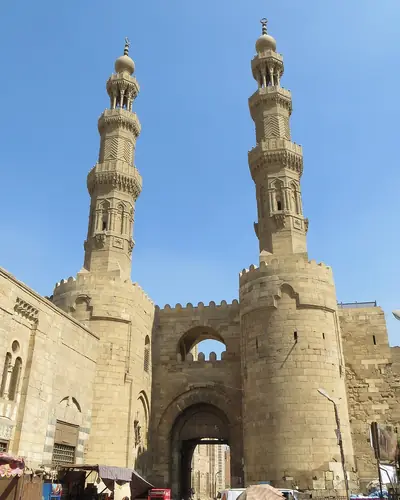
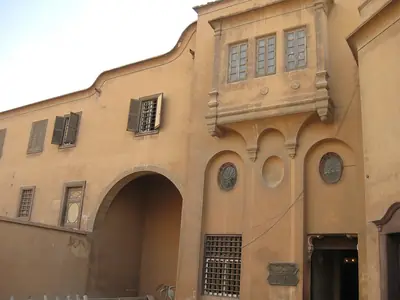
Bab Zuweila is one of the major landmarks of historic Cairo and one of the city’s three remaining gates. Also known as Bab al-Mitwali, the gate was built in 1092 by the Fatimid vizier Badr al-Jamali. Two rounded towers project beyond the city wall, with an entrance passage between them. The two minarets above the gate were added between 1415 and 1422 during the construction of the adjoining Mosque of Sultan al-Muayyad.
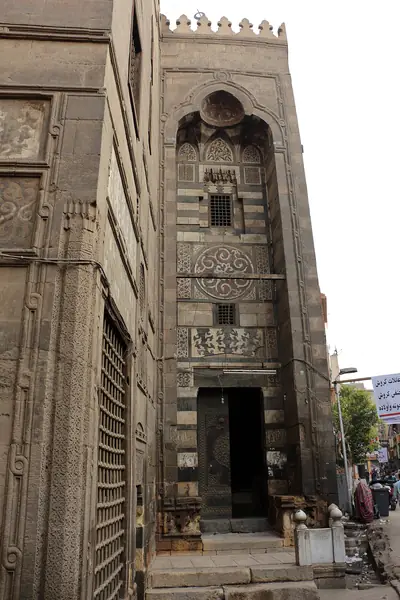
Near the gate, the Amir Qijmas al-Ishaqi Mosque is also known as the Abu Hurayba Mosque. Completed around 1481 during the late Mamluk era, it combines a mosque, madrasa and mausoleum in one complex. Its religious, educational and funerary functions make it a particularly complete example of late Mamluk architecture.
The Zawiya and Sabil of Faraj ibn Barquq stands at the intersection of al-Taht al-Ruba Street and Qasaba Ridwan. Built in 1408, it retains marble facing, colourful gilded ceiling decoration and a sabil with a lowered muqarnas ceiling. These smaller details are part of what makes walking through historic Cairo so rewarding.
The Citadel and Muhammad Ali Mosque
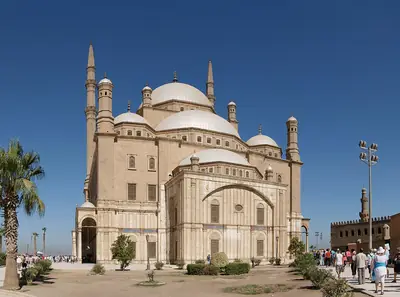
The Cairo Citadel is home to the Muhammad Ali Mosque, one of the city’s most recognisable landmarks. It is also called the Alabaster Mosque because alabaster was used extensively to cover its walls. Muhammad Ali Pasha commissioned the building in the nineteenth century, and its Ottoman design, influenced by European architecture, was inspired by the Sultan Ahmed Mosque in Istanbul.
The mosque stands on part of the former grounds of Al-Ablaq Palace. Later rulers continued its construction and used it for annual religious celebrations. After structural problems caused cracks in the walls, the mosque underwent major restoration before reopening for prayer.
The Citadel area also contains the Ahmad Katkhuda Mosque, or Al-Azab Mosque, along the lower wall near Bab al-Azab. The mosque belongs to the Citadel’s archaeological area. South of the Muhammad Ali Mosque, Al-Gawhara Palace—also called Bijou Palace—was built in 1814 as a residence for Muhammad Ali Pasha’s wife. Its museum preserves richly coloured interiors, paintings, carved wood and plaster decoration, including the reception hall and Clock Hall.
Shaykhu Mosque and Saliba Street
The Shaykhu Mosque forms part of a larger historic ensemble on Saliba Street. Built in 1349 by the Grand Emir Sayf al-Din Shaykhu al-Nasiri, the complex also included a basin, a khanqah and a dome. A nearby Mosque and Khanqah of Shaykhu was added in 1355.
The mosque’s interior combines black glass, wood and marble, with an unusual stone minbar. The khanqah has a radial roof decorated with white and blue tiles, alongside Quranic inscriptions. Together, the buildings show the architectural richness of Mamluk Cairo beyond the city’s most famous monuments.
Baron Empain Palace and Abdeen Palace
Baron Empain Palace is one of Heliopolis’s most distinctive buildings. Commissioned by the Belgian millionaire Édouard Empain, it combines European and Asian influences, including an elongated dome decorated with Buddha statues and Indian-style sculptures. Construction began in 1906, and the palace opened in 1911. After a period of neglect, the Egyptian government acquired it in 2005, restoration began in 2017, and the palace reopened in 2020.
Abdeen Palace offers a different view of modern Cairo. Built during the rule of Khedive Ismail, it became the primary official residence of Egypt’s royal household in the late nineteenth century and remained a seat of government until the 1952 revolution. Its museum preserves the grandeur and political history of the royal era.
Explore Cairo with a Self-Guided Walking Tour
A Cairo self-guided walking tour lets you follow the city’s history without joining a group or planning around a fixed schedule. Neywo offers seven walking tours, all designed for independent exploration:
- Khan el-Khalili to Bab Zuweila: 2.38 km, 102 minutes and 11 narrated stops.
- The Citadel of Saladin and the Mosques Beneath It: 2.32 km, 101 minutes and 11 stops.
- Coptic Cairo: 2.72 km, 105 minutes and 10 stops.
- Downtown Cairo: 2.69 km, 105 minutes and 10 stops.
- Ibn Tulun and Saliba Street: 2.96 km, 98 minutes and 10 stops.
- Darb al-Ahmar: 2.59 km, 89 minutes and 9 stops.
- Rhoda Island: 4.14 km, 84 minutes and 5 stops.
The routes cover medieval gates and mosques, the Citadel, Coptic Cairo, downtown landmarks, Mamluk monuments and the Nile-side heritage of Rhoda Island. The app tells the story of each place as you reach it, at your own pace, with no group and no schedule. Narration is available in 11 languages.
Download Neywo and Explore Cairo
Download Neywo to explore Cairo with a free audio guide that includes 221 narrated places and seven walking tours. Choose a route, walk through the city at your own pace, and hear the story of each monument when you arrive.
Cairo is part of a wider journey through Egypt, with other destinations including Alexandria, Luxor, Aswan, Hurghada, Sharm El-Sheikh and Abu Simbel.
Places with an audio guide in Cairo
8 places in Cairo with a Neywo audio guide. Each one starts telling its story as you reach it.
Self-guided tours in Cairo
7 tours in Cairo, free in the Neywo app. Each stop tells its story as you reach it.
- Walk
Khan el-Khalili to Bab Zuweila: A Medieval Gate-to-Gate Walk
Walk the heart of Fatimid and Mamluk Cairo, from the great Al-Hakim Mosque down past palaces, mosques and the Khan el-Khalili bazaar to the medieval city gate of Bab Zuweila. Along the way stand the Al-Hussein shrine, the thousand-year-old Al-Azhar and the Mamluk caravanserai of Wikalet al-Ghuri.
Al-Hakim Mosque · Al-Aqmar Mosque · Beshtak Palace · Madrassa of Al-Nasir Muhammad · Al-Hussein Mosque · Khan el-Khalili …
Open this tour: Khan el-Khalili to Bab Zuweila: A Medieval Gate-to-Gate Walk - Walk
The Citadel of Saladin and the Mosques Beneath It
Start in Salah al-Din Square between the giant Mamluk madrasa of Sultan Hassan and the royal Al-Rifa'i Mosque, then climb to Saladin's Citadel. Inside are the alabaster Muhammad Ali Mosque, the sultan's royal mosque and the palace of Muhammad Ali's wife, with views across the whole city.
Mosque-Madrassa of Sultan Hassan · Al-Rifa'i Mosque · Salah al-Din Square · Jawhar al-Lala Mosque · Cairo Citadel · Muhammad Ali Mosque …
Open this tour: The Citadel of Saladin and the Mosques Beneath It - Walk
Coptic Cairo: Churches Built into a Roman Fortress
Old Cairo holds the oldest Christian and Jewish sites in Egypt, many inside the walls of the Roman fortress of Babylon. See the Hanging Church, the church where the Holy Family is said to have stayed, the Ben Ezra Synagogue with its famous manuscript cache, the Coptic Museum and the only round church in Egypt.
Church of the Holy Virgin · Hanging Church · Saints Sergius and Bacchus Church · Coptic Museum · Ben Ezra Synagogue · Church of St. George …
Open this tour: Coptic Cairo: Churches Built into a Roman Fortress - Walk
Downtown Cairo: Pharaohs, Revolution and Belle Epoque Streets
From the Egyptian Museum with its Pharaonic treasures to Tahrir Square, the stage of Egypt's modern history, this walk crosses the downtown that Khedive Ismail built in the nineteenth century. See palaces, churches and a mosque named after a national hero.
Annunciation Cathedral, Cairo · Talaat Harb Square · Palace of Said Halim Pasha · Egyptian Museum · Auguste Mariette’s Memorial · Tahrir Square …
Open this tour: Downtown Cairo: Pharaohs, Revolution and Belle Epoque Streets - Walk
Ibn Tulun and Saliba Street: Cairo's oldest mosque and its Mamluk neighbours
Start at the tomb complex on the slopes of the Citadel hill and walk to Egypt's oldest surviving mosque, Ibn Tulun, with its vast open courtyard. Then wander the shrines of Sayyida Ruqayya and Shajarat al-Durr and follow Saliba Street past madrasas, a funerary mosque and the Mamluk emirs' tombs.
Tomb of Salar and Sangar-al-Gawli · Mosque of Ibn Tulun · Mausoleum of Sayyida Ruqayya · Mausoleum of Shajarat al-Durr · Al-Burdayni Mosque · Mosque of Taghribirdi …
Open this tour: Ibn Tulun and Saliba Street: Cairo's oldest mosque and its Mamluk neighbours - Walk
Darb al-Ahmar: Mamluk palaces and mosques below the Citadel road
Begin with the world-class collection at the Museum of Islamic Art, then walk into Darb al-Ahmar, the Red Quarter, where Mamluk emirs built mosques, madrasas and palaces along the old road to the Citadel. Quiet lanes, carved stone doorways and very few tour groups.
Museum of Islamic Art · Amir Qijmas al-Ishaqi Mosque · Mahmud al-Kurdi Mosque · Mosque and Mausoleum of Amir Ahmad al-Mihmandar · Mosque of Amir al-Maridani · Mosque of Aslam al-Silahdar …
Open this tour: Darb al-Ahmar: Mamluk palaces and mosques below the Citadel road - Walk
Rhoda Island: palace, Nilometer and the singer's house on the Nile
Cross to the island in the Nile to see a royal palace of mixed styles, a rebuilt Mamluk mosque and the Nilometer that once measured the river's flood. Finish at the museum of Umm Kulthum, the voice of the Arab world.
Manial Palace and Museum · Rhoda Island · Sultan Qaytbay Roda Mosque · Nilometer in Rhoda Island · Umm Kulthum Museum
Open this tour: Rhoda Island: palace, Nilometer and the singer's house on the Nile
Walk Cairo with Neywo
Neywo turns Cairo into a self-guided audio tour. Stories arrive as you reach the place they belong to, and the route reshapes when you wander off it.

