Visiting Alexandria, Egypt: Top Sights on Foot
Things to Do in Alexandria, Egypt
Alexandria is a Mediterranean city where ancient libraries, Roman monuments, Christian landmarks, mosques, synagogues and royal collections reveal a long, multicultural history. It is worth visiting for the remarkable concentration of historic places in and around the city, as well as its distinctive coastal character. Neywo’s free audio guide for Alexandria covers 55 narrated places in 11 languages.
What to See in Alexandria
The Lighthouse of Alexandria and the Citadel of Qaitbay
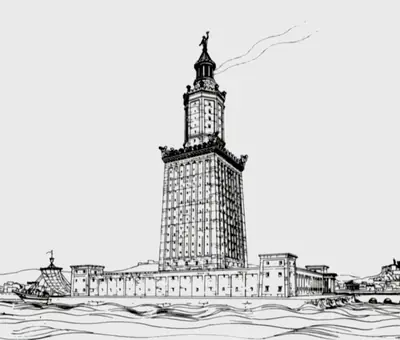
The eastern harbor marks the site of the Lighthouse of Alexandria, the Pharos, one of the Seven Wonders of the Ancient World. Built around 280 BC during the reign of Ptolemy II, it stood at least 100 metres high and guided ships into the harbor for more than 1,500 years.
Three major earthquakes between the tenth and fourteenth centuries destroyed the tower. Its remaining stones were later used to build the Citadel of Qaitbay in 1480. The fortress now occupies the place traditionally associated with the lighthouse, connecting one of Alexandria’s best-known ancient landmarks with its later military history.
Pompey’s Pillar and the Serapeum
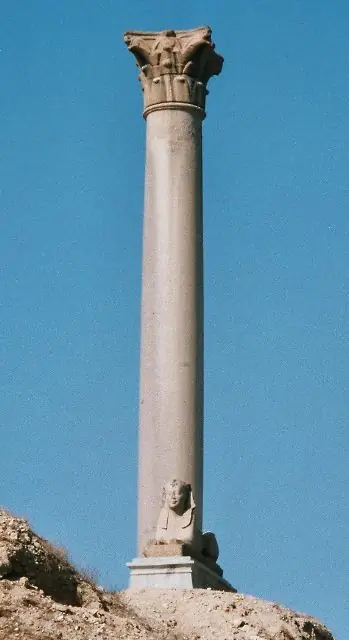
Despite its name, Pompey’s Pillar was not connected to the Roman general Pompey. The approximately 27-metre column was erected in honor of Emperor Diocletian between 298 and 302 AD, after his victory over a local revolt.
Made from a single shaft of red Aswan granite, it is the largest Roman triumphal column outside Rome and the only ancient monument in Alexandria still standing in its original location. It is also the last surviving remnant of the Serapeum, a temple complex dedicated to the Greco-Egyptian god Serapis.
The Catacombs of Kom el Shoqafa
The Catacombs of Kom el Shoqafa form an underground necropolis where Egyptian, Greek and Roman traditions meet. The tombs were cut into the bedrock during the second century CE and remained in use from the second to the fourth century.
A circular staircase descends into the burial chambers. Statues combine Egyptian forms with Roman clothing and hairstyles, while other decorations blend Greek and Pharaonic elements. The complex may have begun as the tomb of a wealthy family before being expanded for many more burials. The Hall of Caracalla contains the bones of horses associated with the Roman emperor Caracalla.
The Library of Alexandria
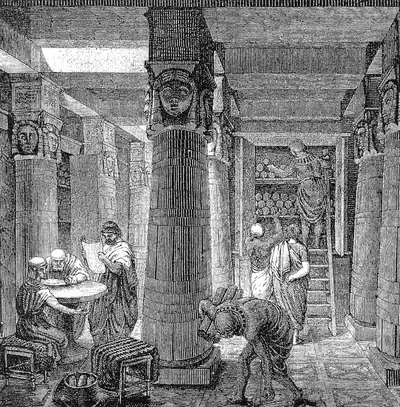
The ancient Library of Alexandria was one of the Mediterranean world’s great centers of learning. Probably established during the reign of Ptolemy II Philadelphus in the early third century BC, it attracted scholars and accumulated papyrus scrolls from across the ancient world.
Its decline was gradual rather than the result of one single fire. A daughter library was also established in the Serapeum, where Neoplatonist philosophers gathered. The ancient library’s influence remains central to Alexandria’s identity, even though the original building and collection have disappeared.
Bibliotheca Alexandrina
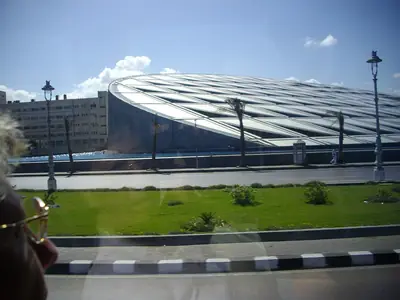
The Bibliotheca Alexandrina is a modern cultural complex near the site of the ancient library in the Shatby district. Inaugurated in 2002, its architecture evokes a rising sun over the Mediterranean.
The complex includes a vast reading room, several specialized libraries, museums, art galleries, a manuscript restoration laboratory, a conference center and a planetarium. Its shelves provide space for eight million volumes, with works in Arabic, English, French and Egyptian collections. A donation of half a million books from the National Library of France in 2009 made it the sixth-largest Francophone library in the world.
Saint Mark’s Coptic Orthodox Cathedral
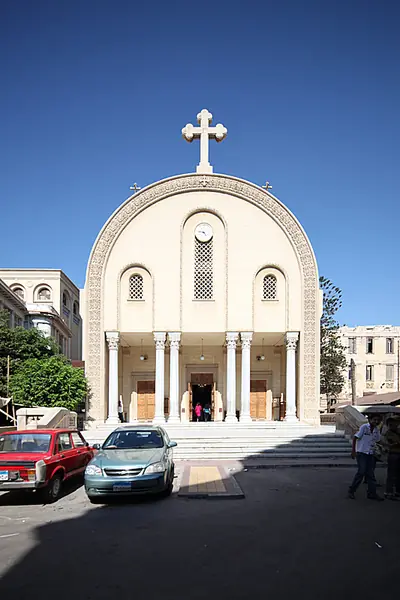
Saint Mark’s Coptic Orthodox Cathedral stands on ground associated with the arrival of Saint Mark the Evangelist in Alexandria in 62 AD. According to the cathedral’s tradition, Saint Mark founded the See of Alexandria and converted Anianus, a shoemaker whose house became the first church in Africa.
The site served as the seat of the Coptic Pope for a thousand years. It remains one of the most important places for understanding Alexandria’s role in the history of Christianity and the Coptic Orthodox Church.
St. Catherine’s Cathedral
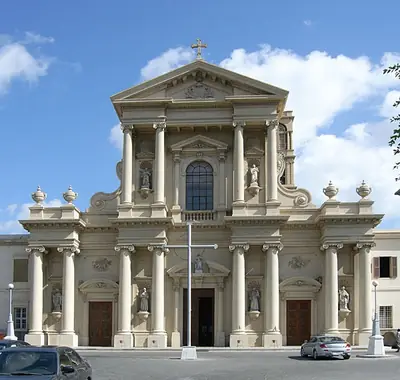
St. Catherine’s Cathedral is a Catholic landmark in Alexandria’s Mansheya district. It serves as the seat of the Apostolic Vicariate of Alexandria of Egypt and as the church of the city’s Franciscan monastery.
Kanīsat ad Dabbānah
The Greek Orthodox Cathedral of Evangelismos, also known as the Cathedral of the Annunciation, is the ecclesiastical seat of the Patriarchate of Alexandria and All Africa. Its cornerstone was laid in 1847, and the completed cathedral was consecrated in 1856.
Unlike the neo-Byzantine style often associated with Orthodox churches, this basilica has a neo-Gothic design. It remains an important spiritual center for Alexandria’s Greek community.
El-Mursi Abul Abbas Mosque
In the Anfoushi neighborhood, beside the Mediterranean coast, the El-Mursi Abul Abbas Mosque combines the functions of a mosque, mausoleum and Sufi shrine. It honors Abu al-Abbas al-Mursi, a thirteenth-century mystic who lived and taught in Alexandria for 43 years.
The mosque is especially recognizable for its cluster of domes. It forms part of an unusual religious ensemble with the Al-Busiri Mosque and the Sidi Yaqut Al-Arsh Mosque, all three opening onto a shared central courtyard.
Mahatet El Raml and the Eliyahu Hanavi Synagogue
Mahatet El Raml is a historic square where Alexandria’s tram network converges. Laid out in 1887 by the Italian engineer Antonio Lasciac, it developed from a sandy coastal area into a cosmopolitan district of shops, cafés and elegant Florentine-style buildings.
On Nabi Daniel Street, the Eliyahu Hanavi Synagogue recalls Alexandria’s once-thriving Jewish community. The original synagogue was built in 1354, destroyed during Napoleon’s Egyptian campaign in the late eighteenth century and reconstructed around 1850. Its library contains around 50 ancient Torah copies, including some dating from the fifteenth century.
Royal Jewelry Museum
The Royal Jewelry Museum occupies a palace built in 1919 for Princess Fatma Al-Zahra’, a member of Egypt’s last royal family. Located in the Zizenia neighborhood, the building is decorated with painted ceilings, intricate woodwork and other details inspired by a nineteenth-century European mansion.
The palace became a public museum in 1986. Its collection covers almost a century and a half of the Muhammad Ali Dynasty, from Muhammad Ali Pasha to King Farouk I, and includes more than 11,500 objects such as crowns, ceremonial swords, orders and medals.
Alexandria Opera House
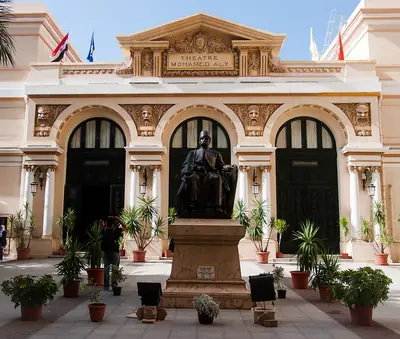
The Alexandria Opera House, also called the Sayed Darwish Theatre, is Egypt’s second opera house. Construction began in 1918, and the building opened in 1921 under the name Teatro Mohamed Ali.
Designed by the French architect Georges Parcq in the Renaissance Revival style, the theatre seats about 1,200 people. Its original name remains inscribed on the main façade, and the building was added to Alexandria’s heritage register in 1999.
Alexandria Museum of Fine Arts
In the Moharam Bek neighborhood, the Alexandria Museum of Fine Arts has the distinction of being the first building in Egypt and the wider Middle East designed specifically as a fine arts museum.
Its collection brings together Egyptian and European traditions, with particular attention to the painters and sculptors who shaped modern Egyptian art in the twentieth century.
Abu Mena
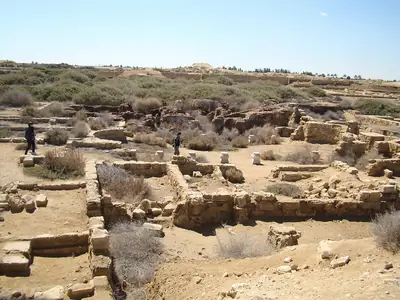
About 50 kilometres southwest of Alexandria, near New Borg El Arab in the Mariout desert, Abu Mena is an early Christian archaeological site built around the tomb of Saint Menas. A soldier martyred in 296 AD, Saint Menas became the focus of a major pilgrimage center after his relics were brought there in the early fourth century.
The first church was built over his tomb between 320 and 325 AD. The site later grew into a town with a basilica, monasteries, churches and accommodation for pilgrims and clergy. Raids in the thirteenth century devastated Abu Mena, after which the relics were moved to Old Cairo and the ruins were gradually reclaimed by the desert.
Explore Alexandria with a Self-Guided Walking Tour
An Alexandria self-guided walking tour is a practical way to connect the city’s landmarks without joining a group or following a fixed schedule. Neywo offers three walking tours:
- The Pharos and the Saints of Anfoushi: 3.21 km, 96 minutes and 8 narrated stops.
- Alexandria of Many Faiths: 3.83 km, 111 minutes and 10 narrated stops.
- Where the World’s Knowledge Lived: 4.66 km, 108 minutes and 7 narrated stops.
The routes include places such as the Lighthouse of Alexandria, El-Mursi Abul Abbas Mosque, Kanīsat ad Dabbānah, Eliyahu Hanavi Synagogue, Saint Mark’s Coptic Orthodox Cathedral, the ancient Library of Alexandria, the Bibliotheca Alexandrina and Alexandria National Museum.
Download Neywo and Explore Alexandria at Your Own Pace
Download Neywo to explore Alexandria with a free audio guide covering 55 narrated places. The app tells the story of each place as you reach it, at your own pace, with no group and no schedule. Its narration is available in 11 languages.
Alexandria is one of the highlights of Egypt, and it can be combined with other destinations such as Cairo, Luxor, Aswan or Abu Simbel.
Places with an audio guide in Alexandria
8 places in Alexandria with a Neywo audio guide. Each one starts telling its story as you reach it.
Self-guided tours in Alexandria
3 tours in Alexandria, free in the Neywo app. Each stop tells its story as you reach it.
- Walk
The Pharos and the Saints of Anfoushi
Begin at the citadel built in 1480 from the stones of the ancient Lighthouse of Pharos. Walk to the old Anfoushi quarter where three Sufi mosques share a single courtyard, and end in the Ottoman customs district at the 17th-century Tirbana Mosque and Ahmed Orabi Square.
Lighthouse of Alexandria · Museum of Taxidermied Marine Life · El-Mursi Abul Abbas Mosque · Sidi Yaqut Al-Arsh Mosque · Al-Busiri Mosque · Tirbana Mosque …
Open this tour: The Pharos and the Saints of Anfoushi - Walk
Alexandria of Many Faiths
A downtown walk through the cosmopolitan city of Greeks, Italians, Jews, Copts and Muslims. Synagogues, Catholic and Greek Orthodox cathedrals, the Mosque of a Thousand Columns, the shrine of Nabi Daniel and the Coptic cathedral on the ground where Saint Mark is said to have founded the church, then the Opera House, the tram square of Mahatet El Raml and the Qaed Ibrahim Mosque.
Menasce Synagogue · Kanīsat ad Dabbānah · Greek Orthodox Patriarchate of Alexandria · Attarine Mosque · Nabi Daniel Mosque · Eliyahu Hanavi Synagogue …
Open this tour: Alexandria of Many Faiths - Walk
Where the World's Knowledge Lived
From the site of the ancient Library of Alexandria, once the intellectual heart of the Mediterranean, to the shining modern Bibliotheca that revives it, with the Sadat Museum inside. Continue to the Shatby Necropolis, one of the oldest burial grounds in Alexandria, then past the university's first faculty to the National Museum in its Italian-style palace.
Library of Alexandria · Bibliotheca Alexandrina · Sadat Museum · Shatby Necropolis · Faculty of Arts, Alexandria University · Alexandria University …
Open this tour: Where the World's Knowledge Lived
Walk Alexandria with Neywo
Neywo turns Alexandria into a self-guided audio tour. Stories arrive as you reach the place they belong to, and the route reshapes when you wander off it.

