Visiting Aswan, Egypt: Top Sights on Foot
Things to Do in Aswan, Egypt: What to See and Explore
Aswan is a city in southern Egypt known for its Nile landscapes, Nubian heritage and extraordinary concentration of ancient monuments. From the Temple of Isis at Philae and the International Museum of Nubia to the temples relocated beside Lake Nasser, there is plenty to discover at a slower, more atmospheric pace. Neywo has a free audio guide for Aswan with 39 narrated places.
What to See in Aswan
Philae and the Temple of Isis
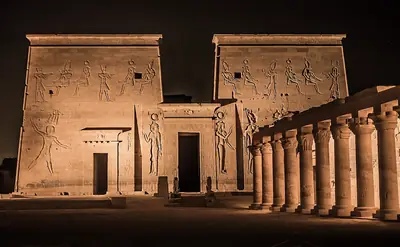
Philae was once an island near Aswan’s First Cataract and served both as a southern frontier fort and as a major religious centre dedicated to Isis. When the Aswan Low Dam submerged the island, its temple complex was moved to nearby Agilkia Island.
Today, the Temple of Isis remains one of Aswan’s defining sights. The sanctuary is part of a larger complex containing dozens of stone structures, including the Temple of Hathor, which was also rescued and rebuilt through the UNESCO campaign to save Nubian monuments from the rising waters of Lake Nasser. Philae’s island setting and connection with the Nile make it one of the most memorable places to visit in Aswan.
The Unfinished Obelisk
The Unfinished Obelisk offers a close look at the stoneworking traditions that shaped ancient Egypt’s monuments. Aswan’s granite was important to the ancient kingdom, and the unfinished monument preserves evidence of how monumental stonework was produced.
The International Museum of Nubia
The International Museum of Nubia explores Nubian culture, heritage and civilisation from prehistoric times to the present. Its displays include Nubian customs, traditions and the ancient Nubian language, giving context to the region’s history beyond the pharaonic monuments.
The museum opened on 23 November 1997 as part of UNESCO’s International Campaign to Save the Monuments of Nubia. Its building was designed by Egyptian architect Mahmoud El-Hakim and received the Aga Khan Award for Architecture in 2001. The museum is also included in Neywo’s city walks, making it a useful stop on an Egypt itinerary focused on history and culture.
Elephantine Island and the Aswan Museum
Elephantine Island occupies a significant position in Aswan’s history. The Aswan Museum stands at its southeastern tip and was the city’s first museum. Its collection includes Nubian objects gathered during construction of the Aswan Dam, among them utensils, weapons, pottery and mummies.
A department added in 1990 presents discoveries made on Elephantine Island itself. Together, the island and museum offer a more local perspective on Aswan’s past, complementing the larger collections of the International Museum of Nubia.
Archangel Michael’s Coptic Orthodox Cathedral
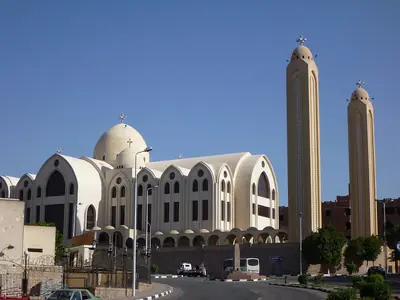
Archangel Michael’s Coptic Orthodox Cathedral is a church in Aswan dedicated to the Archangel Michael. It serves the local Coptic Orthodox community and was consecrated in 2006. The cathedral appears on Neywo’s “Granite, Nubia and the Nile” walking route, alongside several of the city’s historical landmarks.
The Monastery of St. Simeon
The Monastery of St. Simeon, also known as Deir Anba Samaan, stands on a plateau on Aswan’s west bank facing Elephantine Island. Founded in the sixth century, it was originally called Deir Anba Hadra and grew into one of the largest Coptic monasteries in the world.
The monks later abandoned the monastery after a shortage of water. Its position overlooking the river and Elephantine Island adds a distinctive historical landscape to a visit on Aswan’s west bank.
Ancient Sites Near Aswan
Abu Simbel
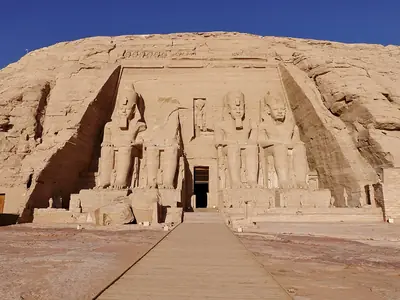
Abu Simbel is one of the most important places to see near Aswan. The site consists of two rock-cut temples carved into cliffs beside Lake Nasser during the reign of Ramesses II in the 13th century BCE.
The Great Temple honours Ramesses II, Queen Nefertari and the Egyptian gods, while its façade is dominated by four colossal seated statues of the pharaoh. Reliefs inside depict his leadership at the Battle of Kadesh. The smaller temple is dedicated to Hathor and Nefertari.
Like Philae, Abu Simbel was threatened by the rising waters created after the Aswan High Dam was built. The temples were cut into blocks, moved and reconstructed on an artificial hill higher up the shore. Travellers continuing through southern Egypt can pair Aswan with Abu Simbel or explore the monuments of Luxor.
Wadi es-Sebua
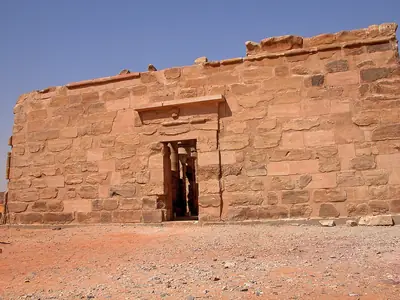
Wadi es-Sebua, or the Valley of the Lions, is home to two New Kingdom temples beside Lake Nasser. A sphinx-lined avenue leads towards the sanctuaries, one begun under Amenhotep III and later expanded by Ramesses II.
The monuments were moved to higher ground in the 1960s as part of the International Campaign to Save the Monuments of Nubia. Their rescue, along with that of Abu Simbel and Philae, contributed to their inscription on the UNESCO World Heritage List in 1979. The older sanctuary was later rededicated to Amun after an earlier association with a local Nubian form of Horus.
The Temple of Kalabsha
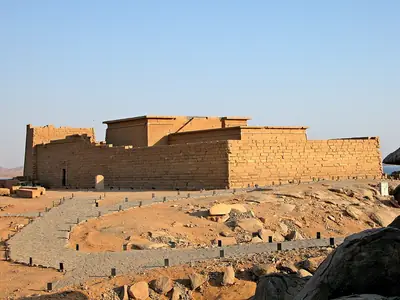
The Temple of Kalabsha now stands on New Kalabsha Island after being relocated in the 1960s. Dedicated to Mandulis, the Nubian sun god, it is recognised by UNESCO alongside Abu Simbel and Amada as part of Nubia’s World Heritage.
The temple was begun around 30 BC during the reign of Augustus but was never completed. Its walls preserve reliefs of Horus, a Roman order from 250 AD and inscriptions by the Nubian king Silko. A staircase leads to the roof, where the temple and sacred lake can be viewed from above.
The Temples of Dakka and Maharraqa
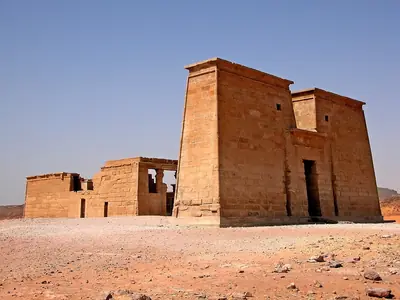
The Temple of Dakka is a Greco-Roman sanctuary dedicated to Thoth, the god of wisdom. Its twelve-metre-high pylon remains especially striking, while a 55-metre processional way leads towards the former cult terrace. Greek, Demotic and Meroitic graffiti cover parts of the pylon.
The nearby Temple of Maharraqa once marked the southern edge of the Roman Empire. Originally dedicated to Isis and Serapis, it was later repurposed as a church after the Christian conversion of Nobatia. The temple is also known as Ed Dakka Temple, although it is distinct from the Temple of Dakka.
The Temple of Edfu
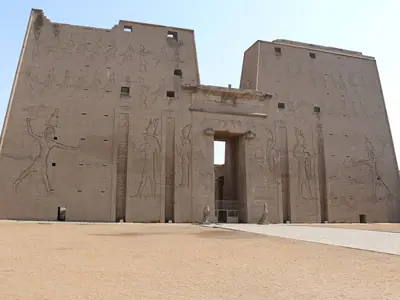
The Temple of Edfu, on the west bank of the Nile in Edfu, is dedicated to Horus and is one of Egypt’s best-preserved ancient shrines. Built during the Ptolemaic period, construction began in 237 BC and ended around 57 BC.
Its walls contain building texts and scenes from the Sacred Drama, which recounts the conflict between Horus and Seth. The temple is one of the major historical sites to consider when travelling between Aswan and other destinations in Egypt.
Nekhen
Nekhen, also known as Hierakonpolis or the Red Mound, was the religious and political capital of Upper Egypt at the end of prehistoric times. It was associated with the falcon god Horus and has produced evidence of tombs, temples, houses and breweries dating from the Predynastic era.
Among its most notable discoveries is the Painted Tomb, with plaster walls thought to date from 3500 to 3200 BC, and the Narmer Palette, an early representation of Egyptian kingship.
Take an Aswan Self-Guided Walking Tour with Neywo
Neywo offers three walking tours in Aswan, with no group and no schedule:
- Granite, Nubia and the Nile: 3.25 km, 84 minutes and 7 narrated stops.
- Elephantine and the Island Gardens: 5.53 km, 119 minutes and 6 narrated stops.
- Aswan Highlights: Obelisk, Museums and the Hilltop Mosque: 3.89 km, 102 minutes and 8 narrated stops.
The app tells the story of each place as you reach it, at your own pace. It is a practical way to follow a free walking tour in Aswan while deciding when to pause, continue or explore further. Narration is available in 11 languages.
Download Neywo and Explore Aswan at Your Own Pace
Download Neywo to explore Aswan with a free audio guide covering 39 narrated places. Choose one of the three walking routes, put on your headphones and let the app guide you from monument to monument. Each story plays as you arrive, so you can discover the city at your own pace, with no group and no schedule.
Places with an audio guide in Aswan
8 places in Aswan with a Neywo audio guide. Each one starts telling its story as you reach it.
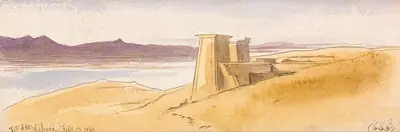
Self-guided tours in Aswan
3 tours in Aswan, free in the Neywo app. Each stop tells its story as you reach it.
- Walk
Aswan: Granite, Nubia and the Nile
Aswan was the southern frontier of ancient Egypt and the source of the granite for its obelisks. Start at the giant obelisk that cracked and was left in the quarry, pass a Fatimid cemetery of ribbed domes and the museum that saved the heritage of drowned Nubia, and rest on the Nile terrace of the Old Cataract hotel. Finish past a Roman temple and the largest Coptic cathedral in the south, at the mosque on the hill in the heart of the city.
Unfinished obelisk · Fatimid Cemetery in Aswan · International Museum of Nubia · Mandarin Oriental Old Cataract · Archangel Michael's Coptic Orthodox Cathedral · Temple of Domitian …
Open this tour: Aswan: Granite, Nubia and the Nile - Walk
Elephantine and the Island Gardens
Cross the Nile to the island where Aswan began. Visit the first museum of Aswan beside the ruins of ancient Abu, then the island's village and the botanical gardens of Kitchener's Island, and go on to the ruined Monastery of St. Simeon and the Aga Khan Mausoleum on the west bank. Finish where the river still breaks into rapids at the First Cataract. Each hop between the islands and the banks is a short boat ride from the city quay.
Aswan Museum · Elephantine · Kitchener's Island · Mausoleum of Aga Khan · Cataracts of the Nile
Open this tour: Elephantine and the Island Gardens - Walk
Aswan Highlights: Obelisk, Museums and the Hilltop Mosque
The best of Aswan on one loop. Begin in the granite quarry with the unfinished obelisk, walk the east bank past the Fatimid cemetery and the Nubian museum to the Old Cataract hotel, hop over to Aswan's first museum on Elephantine, then return to the Coptic cathedral, the Roman temple and the mosque on the hill.
Unfinished obelisk · Fatimid Cemetery in Aswan · International Museum of Nubia · Mandarin Oriental Old Cataract · Aswan Museum · Archangel Michael's Coptic Orthodox Cathedral …
Open this tour: Aswan Highlights: Obelisk, Museums and the Hilltop Mosque
Walk Aswan with Neywo
Neywo turns Aswan into a self-guided audio tour. Stories arrive as you reach the place they belong to, and the route reshapes when you wander off it.

