Narva, Estonia: Self-Guided Walking Tour
Things to Do in Narva, Estonia: Historic Fortresses, Churches and Museums
Narva is an eastern Estonian city shaped by medieval fortifications, wartime destruction and a distinctive position beside the Narva River. The city is worth visiting for its castle, museums, churches and surviving architectural landmarks, as well as for the stories of places that disappeared during the fighting of 1944. Neywo offers a free audio guide for Narva with 23 narrated places, available in 11 languages.
If you are planning a wider trip through Estonia, Narva provides a very different experience from Tallinn, Tartu or the country’s western towns.
What to see in Narva
Hermann Castle and Narva Museum
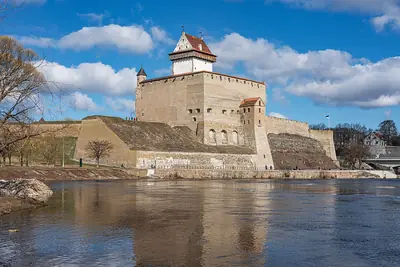
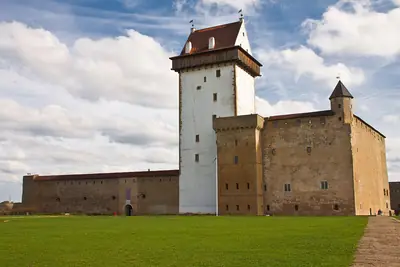
Hermann Castle, also known as Narva Castle or Narva Fortress, is one of Narva’s defining landmarks on the banks of the Narva River. The medieval stronghold was established by the Danes around 1256, and its first entirely stone fortifications were built at the beginning of the fourteenth century.
The castle changed hands several times, belonging to Denmark, the Livonian Order, Sweden and the Russian Empire. It was under Swedish rule from 1581 to 1704 before passing to Russia. Severely damaged during the Second World War, it has since been partly restored. The complex is listed in Estonia’s Register of Cultural Monuments and now accommodates Narva Museum, a library and other institutions.
Narva Museum brings together several experiences: the castle, the Northern Yard and the Narva Art Gallery. Its main historical exhibition follows Narva’s story from the thirteenth century to the beginning of the twentieth century. Renovation renewed the castle’s convent building and permanent exhibition, as well as the main courtyard and castle walls.
Narva Museum Art Gallery
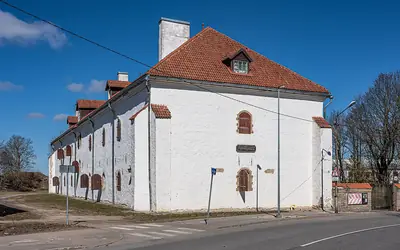
The Narva Museum Art Gallery occupies a former military storehouse at Vestervalli 21, in the historic part of the city. Its first exhibition opened on April 21, 1991, a date the gallery considers its birthday as a branch of Narva Museum.
The gallery continues a collection tradition associated with the Lavretsov family. Their collection included paintings and prints, applied art, miniatures and ethnographic objects, and was once considered one of the strongest collections of Russian art in the Baltic region.
The site of the Battle of Narva
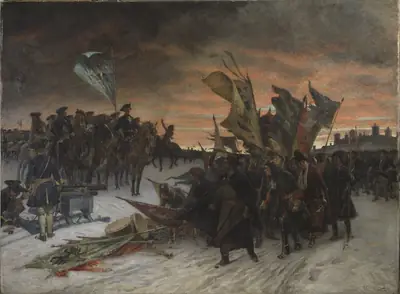
Narva is associated with one of the opening clashes of the Great Northern War. On 30 November 1700, Swedish forces led by King Charles XII faced a much larger Russian army commanded by Charles Eugène de Croy.
Sweden had around 10,500 soldiers, while the Russian force numbered between 29,000 and 37,000, although not all took part in the fighting. Despite being heavily outnumbered, the Swedish army won a decisive victory. The result did not lead immediately to a Swedish advance into Russia: Charles XII instead turned south towards Livonia and Poland-Lithuania. Peter the Great’s army captured Narva only after a second siege in 1704, a separate event from the battle of 1700.
Transfiguration Cathedral
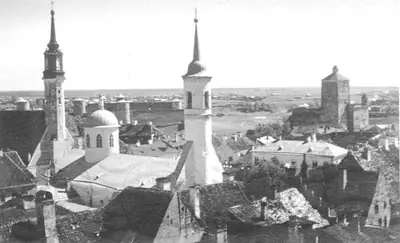
The former Transfiguration Cathedral stood at Viru Street 14 and was once one of Narva’s symbols. First mentioned in 1442, it was the city’s oldest limestone-built church and, from the eighteenth century, served as an Orthodox church. It was also described as Narva’s oldest Gothic church.
The cathedral was destroyed during military action in 1944, and its ruins were dismantled in the 1950s. Today, its importance lies in the history of the building and in what its loss reveals about the destruction of Narva’s historic centre.
Narva Town Hall
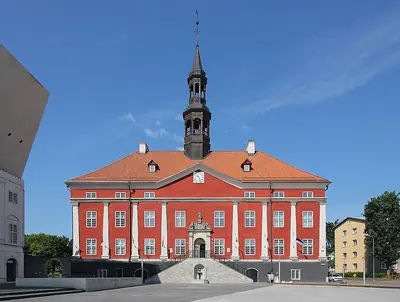
Narva Town Hall stands on Town Hall Square beside Narva College of the University of Tartu. Built during the period of Swedish rule, construction began in 1668 under the direction of Zacharias Hoffmann the Younger and Jürgen Bischoff, and lasted three years.
The design was initially conceived in the Baroque style, but changes made during its approval in Stockholm resulted in a building in Dutch Classicism. Its stone façade has three main levels, a high basement and Tuscan pilasters on the two principal storeys. A triangular gable with a clock crowns the centre of the façade.
Narva Fortress and the lost Old Town
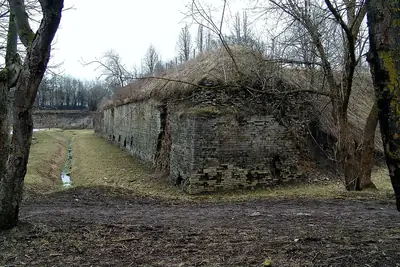
Narva’s medieval defensive system included walls, gateways, towers, ditches and ramparts. The fortified zone eventually stretched for about 1.58 kilometres: the town wall measured one kilometre, while an additional defensive barrier between the town and Hermann Castle extended for 280 metres.
At least seven defensive towers strengthened the bends, junctions and gates of the town wall. The Viru Gate and Cattle Gate had bridges crossing the defensive ditches. These remains help explain how carefully Narva’s historic town was protected.
The city also has important sites that no longer survive. Narva Jaani Church, also known as the Church of Saint John the Baptist or Narva’s Swedish Cathedral, stood at 18 Viru Street until it was destroyed in the March bombing of 1944. The former Lavretsov City Museum occupied Sergei Lavretsov’s house at 28 Rüütli Street. It opened in 1913, but its history was interrupted by the wartime destruction of Narva.
Cathedral of the Resurrection
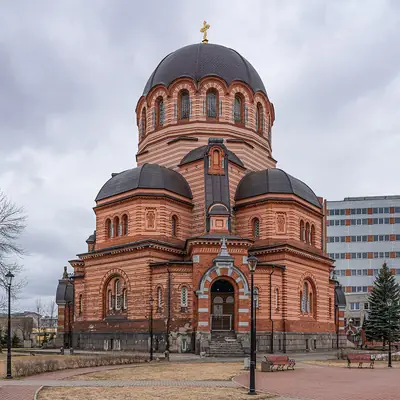
The Cathedral of the Resurrection is one of Narva’s important Orthodox landmarks and is described as the only sacred building in Estonia built in the Neo-Byzantine style. Architect Paul Alisch designed the church for the Orthodox workers of the Krenholm Manufacturing Company.
Construction began in 1890, and the cathedral was consecrated on November 17, 1896. Its foundation stone was laid during a ceremony attended by Emperor Alexander the Third and Wilhelm the Second, who were meeting officially in Narva at the same time. Inside is an icon of the Mother of God of the Sign, brought from Narva’s Church of the Sign. The lower church is dedicated to Saint Seraphim of Sarov and was consecrated in 1996.
Alexander Church
Alexander Church is a Lutheran landmark distinguished by its tall tower. Built between 1881 and 1884, it was dedicated to the memory of Emperor Alexander II. The church was designed in the Neo-Romanesque style by the St Petersburg academic Otto von Hippius.
Its central section is an octagon joined to a long main structure and an octagonal tower that rises 61 metres. The church was planned for 2,500 worshippers and could hold as many as 5,000 people, making it, for a time, the largest church building in Estonia.
The church was damaged during the fighting of 1944 and its spire was destroyed. Its history also includes a political chapter: from November 1918 to January 1919, the government of the Estonian Workers’ Commune was based inside the building.
Orthodox churches of modern Narva
Several churches show how Narva’s religious life continued and developed after the destruction of the historic centre. The Orthodox Church of the Narva Icon of Our Lady on Rakvere Street was built between 1999 and 2003. It has two levels: a stone lower church and a wooden upper church. The lower church was consecrated to Saint John of Kronstadt in 2001, while the upper church was consecrated to the Narva Icon of Our Lady in 2003.
In the Soldina district, the Orthodox Church of the Twelve Holy Apostles was consecrated in 2015. Its story began with the Saints Cyril and Methodius parish, active since 1995. Designed by Nikolai Volkov in the Novgorod architectural style, the building reaches a height of 26.5 metres.
The Narva congregation of the Estonian Methodist Church is another part of the city’s religious history. Established in 1924, the primarily Russian-speaking congregation resumed its activities in Narva in 1967 after its members had belonged to the Estonian Methodist Church congregation in Rakvere during the Soviet period.
Energia
Energia, also known as Energeetika, is a sculpture created by Riho Kuld in 1982. It stands in front of the Baltic thermal power plant near Narva and represents a person breaking free from the Earth’s gravitational pull and surging into space.
The sculpture expresses the idea that human beings can achieve anything through work, giving this industrial setting a distinctly symbolic landmark.
Explore Narva with a free audio guide
For a Narva self-guided walking tour, Neywo offers two walks: one is 2.82 km long, takes 98 minutes and includes 11 narrated stops; the other covers 2.47 km in 55 minutes and includes 4 stops. There is also 1 bus route of 2.6 km, lasting 11 minutes with 4 stops, and 1 bike route of 3.1 km, lasting 16 minutes with 2 stops.
Download Neywo and explore Narva at your own pace. The app tells the story of each place as you reach it, with no group and no schedule.
Places with an audio guide in Narva
8 places in Narva with a Neywo audio guide. Each one starts telling its story as you reach it.
Self-guided tours in Narva
4 tours in Narva, free in the Neywo app. Each stop tells its story as you reach it.
- Bike ride
North Along the River Road to Siivertsi
A ride on marked cycle infrastructure from the wooden-upper Orthodox church on Rakvere Street out to the Siivertsi monument for the soldiers who fell in the Battle of Narva in 1700.
Orthodox church of Narva Icon of Our Lady in Narva · Siivertsi monument
Open this tour: North Along the River Road to Siivertsi - Bus ride
City Bus 2 Through Narva: Church, Gallery and Chess Legend
Narva's public bus 2 runs from the Narova district in the north through the Old Town to Paemurru in the south. Ride it past the two-level Orthodox church of the Narva Icon, the art gallery in a former military storehouse and the square and monument honouring chess master Paul Keres.
Orthodox church of Narva Icon of Our Lady in Narva · Narva Muuseumi kunstigalerii · Paul Keres Square · Monument to Paul Keres
Open this tour: City Bus 2 Through Narva: Church, Gallery and Chess Legend - Walk
Baroque Narva Lost and Found: Castle, Town Hall and Vanished Churches
Narva's Old Town was flattened in March 1944, yet the Danish-built Hermann Castle and the Dutch-classicist Town Hall survived. Walk between them, past the sites of Gothic and Lutheran churches that are now only memories, to bastions, a war memorial and a chess king of bronze.
Monument to Paul Keres · Peetri plats · Hermann Castle · Transfiguration Cathedral · Narva Jaani kirik · Lavretsov city museum of Narva …
Open this tour: Baroque Narva Lost and Found: Castle, Town Hall and Vanished Churches - Walk
Domes and Spires Beyond the Old Town
Four very different churches built after the old town's Swedish era: a Novgorod-style church with a golden dome, an iron foundry turned Lutheran church, the only Neo-Byzantine church in Estonia and the giant Neo-Romanesque Alexander Church with its 61-metre tower.
Narva Kaheteistkümne Püha Apostli kirik · Narva Mihkli kirik · Cathedral of the Resurrection · Alexander Church
Open this tour: Domes and Spires Beyond the Old Town
Walk Narva with Neywo
Neywo turns Narva into a self-guided audio tour. Stories arrive as you reach the place they belong to, and the route reshapes when you wander off it.

