Things to Do in Tartu, Estonia: Walking Guide
Things to Do in Tartu, Estonia: What to See in the University City
Tartu is Estonia’s second-largest city and a historic cultural and intellectual centre in the southeast of the country. Set along the Emajõgi River, it combines a university atmosphere with medieval ruins, churches, bridges, museums, monuments and green spaces. Neywo has a free audio guide for Tartu with 57 narrated places, available in 11 languages.
What to See in Tartu
Tartu Cathedral
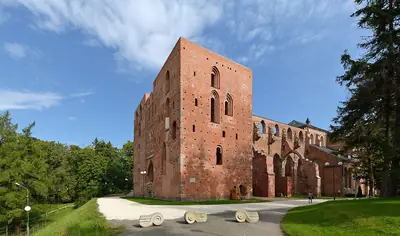
Tartu Cathedral, or Tartu toomkirik, stands on Toomemägi hill above the lower town. Built between the 13th and 16th centuries, it was once the main church of the Bishopric of Tartu and the cathedral of the Bishop of Tartu.
The building was heavily damaged during the Reformation and later devastated during the Livonian War. Its twin towers were demolished in the 1760s, leaving the imposing ruin seen today. Around a third of the cathedral has been renovated. The restored choir section houses the University of Tartu Museum, and the university also uses the premises for major receptions.
The University of Tartu Old Observatory
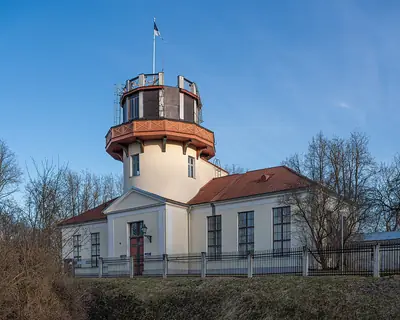
The University of Tartu Old Observatory, known locally as Tartu Tähetorn or Star Tower, sits on Toome Hill. It operated as an observatory from 1810 to 1964 and now contains part of the University of Tartu Museum’s astronomy collection.
The observatory is internationally significant as the first measurement point of the Struve Geodetic Arc, a chain of survey triangulations included on the UNESCO World Heritage list. Astronomy remains part of the site’s identity, with an active astronomy circle, lectures and public observations.
St. John’s Church
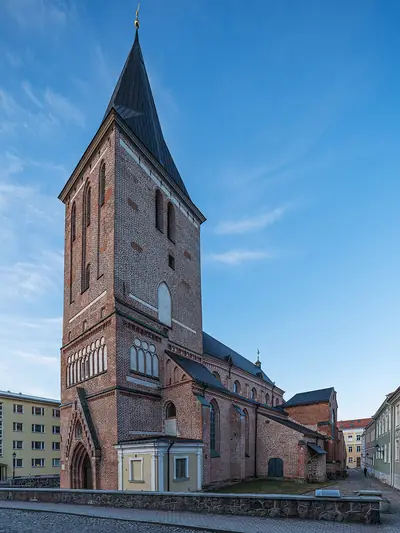
St. John’s Church, or Jaani kirik, is a Brick Gothic church dedicated to John the Baptist and one of Estonia’s oldest churches. The earliest parts of the present building date from the 14th century, while a church has stood on the site since at least the early 13th century.
Its outstanding feature is the collection of medieval terracotta sculptures. Originally, around 2,000 individually hand-sculpted clay figures decorated the church; about a third have survived. One hypothesis suggests that some of the figures may represent former citizens of Tartu. After standing in ruins from 1944, the church was restored in 2005.
Inglisild, the Angel’s Bridge
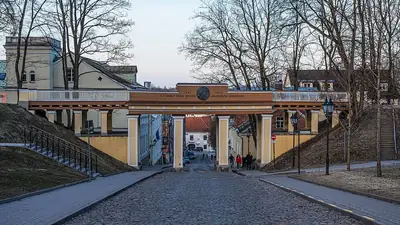
Inglisild means Angel’s Bridge and is a pedestrian bridge on Toomemägi. It was first built as a wooden footbridge between 1814 and 1816, based on a design by Johann Wilhelm Krause. The current version was completed in 1836 after being redesigned and enlarged by Moritz Hermann von Jacobi.
The lower-town side bears the Latin inscription “Otium reficit vires”, meaning “Leisure renews the powers.” The bridge was repaired after a fire in 2012 and remains one of Toome Hill’s most recognisable landmarks.
Kuradisild, the Devil’s Bridge
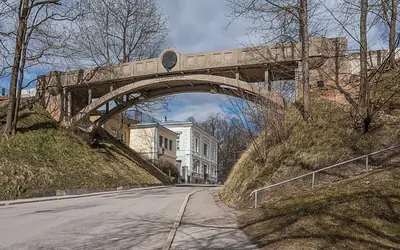
Kuradisild, or Devil’s Bridge, is a dark concrete footbridge on Toomemägi. Built in 1913 to mark the 300th anniversary of the Romanov dynasty, it is one of the few surviving early-20th-century concrete bridges in Estonia.
The bridge was designed by Tartu city architect Arved Eichhorn. The numbers 1613 and 1913 appear on the uphill side, while the downhill side features a bronze relief of Emperor Alexander I of Russia by Constanze von Wetter-Rosenthal.
Monument of Nations
The Monument of Nations stands along Vallikraavi Street on Toome Hill. It marks a common grave containing human remains discovered during the construction of the University of Tartu’s main building. The remains had originally been buried in St. Mary’s Church and its cemetery.
The grave was created in 1806, and the memorial was erected in 1811. Designed by Johann Wilhelm Krause, the four-sided red-brick pillar is topped by a brass sphere and a cross. Brass plaques carry inscriptions in Estonian, German, Russian and Latin.
University of Tartu Botanical Gardens
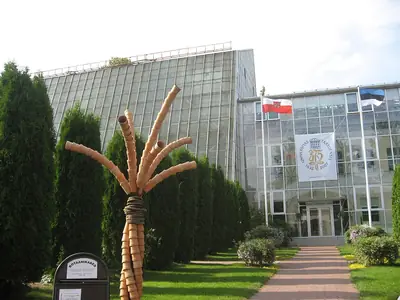
The University of Tartu Botanical Garden is the oldest continuously operating botanical garden in the Baltic states and the most species-rich garden in Estonia. It was established in 1803 by Professor G. A. Germann, when Tartu was home to the Imperial University of Dorpat.
The garden moved to its current location on Lai Street in 1806, on a former bastion beside the Emajõgi River. Its two areas cover about 3.5 hectares and contain around 10,000 plant varieties. The tropical greenhouse offers a change of climate within the garden itself.
Karl Ernst von Baer Museum
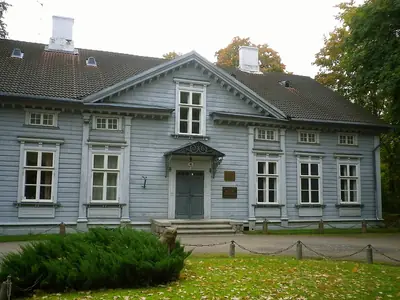
The Karl Ernst von Baer Museum is dedicated to the Estonian scientist Karl Ernst von Baer. It occupies the house at Veski 4 where Baer lived during the final years of his life, from 1867 to 1876.
The museum opened in 1976 and presents his life and scientific work. The house also previously accommodated Ludwig Schwabe, who directed the University of Tartu Art Museum and served as a professor of aesthetics.
Barclay de Tolly Monument
The Barclay de Tolly Monument stands in Barclay Square, between Ülikooli, Vallikraavi and Küüni streets. The bronze monument honours Michael Andreas Barclay de Tolly, a Baltic-German field marshal who served in the Russian Imperial army.
It was unveiled on November 11, 1849, and funded by officers who had served under his command. The monument is now listed as a cultural heritage monument of Estonia. The surrounding square was later landscaped as a garden with shrubs, trees and a fence.
Fortress of Tartu
The site of the Fortress of Tartu recalls the city’s role as a stronghold of the Swedish Empire. During the 17th century, Sweden developed fortifications along its border with the Tsardom of Moscow, and Tartu was among the fortresses repaired and upgraded under plans associated with Erik Dahlberg.
The defensive system included a city wall, towers and an earthen zone reinforced with bastions. It was destroyed during the Great Northern War, so the site is now mainly open ground.
Women from the Countryside
In front of the Tartu Art Museum’s exhibition house stands “Women from the Countryside”, a bronze sculpture group by Estonian sculptor Mare Mikoff. Created in 1974, it shows an older country woman sitting on a bench beside a younger standing woman.
The original was made from plaster for the exhibition “Man and Field” and cast in bronze in 1978. It was installed in front of the museum on Raekoja plats on August 28, 2013, marking the exhibition house’s 25th anniversary.
Oskar Luts Home Museum
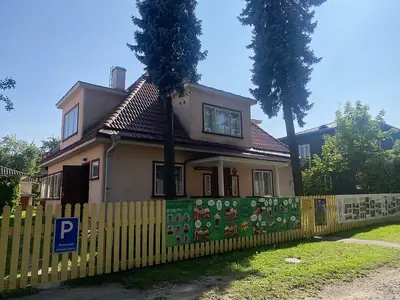
The Oskar Luts Home Museum occupies the house at Riia 38 where the Estonian writer spent the final 17 years of his life. Luts had the house built for his family in 1936, using a design by Tartu city architect Arnold Matteus.
The museum opened in the same house in 1964. After renovation, it reopened in 2006 with a permanent exhibition titled “Writer Oskar Luts: On the Border of Life and Imagination”. Its collection contains nearly 3,600 items.
Other landmarks in central Tartu
Several additional stops add depth to a visit. The Museum of the Estonian Military Academy explores Estonia’s military leadership and officer-training traditions. The Peace Bridge, known until May 19, 2022 as Võidu sild or Victory Bridge, crosses the Emajõgi and connects Narva maantee with the Turu intersection.
The city also preserves reminders of its public and artistic life, including the “Women from the Countryside” sculpture and the historic bridges and monuments around Toome Hill.
Tartu is part of Estonia, and travellers exploring the country can continue to Tallinn, Pärnu, Narva or Haapsalu.
Explore Tartu with Neywo
For a Tartu self-guided walking tour, download Neywo and choose from five walking tours, one bus route and one bike route. The walks range from 1.46 km and 82 minutes to 3.37 km and 98 minutes, with between 6 and 12 narrated stops. The bus route covers 9.2 km in 39 minutes with 7 stops, while the bike route covers 1.1 km in 6 minutes with 4 stops.
The app tells the story of each place as you reach it, at your own pace, with no group and no schedule. It is a practical way to explore Tartu’s university quarter, Toome Hill, riverside landmarks, churches, bridges and southern neighbourhoods while following the city’s history as you walk.
Places with an audio guide in Tartu
8 places in Tartu with a Neywo audio guide. Each one starts telling its story as you reach it.
Self-guided tours in Tartu
7 tours in Tartu, free in the Neywo app. Each stop tells its story as you reach it.
- Bike ride
Tartu Cycle Lane: Peace Bridge to St George's
A short ride on Tartu's riverside cycle infrastructure. Start at the Peace Bridge, once known as Victory Bridge, pass the sculpture group outside the Tartu Art Museum exhibition house and the University botanical gardens, and end at St George's church.
Võidu sild, Tartu · Tartu Kunstimuuseumi näitusemaja · University of Tartu Botanical Gardens · St. George's Church
Open this tour: Tartu Cycle Lane: Peace Bridge to St George's - Bus ride
Bus 6: From Karlova to the Town Hall Square
A regular GoBus city line. Ride from the Baptist Salem church past the site of the Tartu synagogue, the Stone Bridge, the Estonian-Armenian friendship monument and the statue of Gottfried Germann to St John's terracotta church, ending at Town Hall Square in the old centre.
Tartu Salem Church · Tartu Synagogue · Stone Bridge · Eesti ja armeenia rahva sõpruse mälestusmärk · Statue of Gottfried Albert Germann · St. John's Church …
Open this tour: Bus 6: From Karlova to the Town Hall Square - Walk
Kissing Students and Enlightenment Tartu: Old Town to the University
Start where Tartu has met for centuries, on the Town Hall Square beside the Kissing Students fountain, and climb into the university quarter that made this a city of scholars. You pass Barclay de Tolly's bronze, Struve's hourglass monument and the Enlightenment-era main building with its Greek casts and Egyptian mummies, then finish at the brick Gothic church famous for its thousands of hand-made terracotta faces.
Town Hall Square · Tartu Kunstimuuseumi näitusemaja · Isa ja poeg · Barclay de Tolly Monument · Friedrich Georg Wilhelm Struve monument · University of Tartu Old Observatory …
Open this tour: Kissing Students and Enlightenment Tartu: Old Town to the University - Walk
Toome Hill: Ruined Cathedral, Devil's Bridge and the Poets' Park
Toomemägi is Tartu's romantic hill park, built over a medieval cathedral that was left as a ruin. Cross the Angel's Bridge and the Devil's Bridge, find the red-brick Monument of Nations, wander past the statues of Estonia's first poets and scientists and climb the artificial Musumägi, before ending in front of the Old Anatomical Theatre.
Inglisild · Kuradisild · Monument of Nations · Monument to Ernst von Bergmann · Karl Ernst von Baeri muuseum · Immaculate Conception Church …
Open this tour: Toome Hill: Ruined Cathedral, Devil's Bridge and the Poets' Park - Walk
Swedish Bastions and Botanical Greens: Tartu's Riverside North
North of the Old Town the city turns green and quiet. Walk from the Orthodox Dormition Cathedral past the grassy ground of the old Swedish fortress to the Baltic states' oldest botanical garden, then follow the river valley to two churches, one Orthodox and one neo-Gothic, that crown the slope above the Emajõgi.
Dormition Cathedral · Eesti ja armeenia rahva sõpruse mälestusmärk · Fortress of Tartu · Tartu Uus Teater · University of Tartu Botanical Gardens · Statue of Gottfried Albert Germann …
Open this tour: Swedish Bastions and Botanical Greens: Tartu's Riverside North - Walk
Song Festival Roots: Churches and Stages South of the Centre
The Estonian national awakening was rehearsed here: the first church built for Estonian worshippers, the theatre that gave the Estonian stage its home and the churches of every denomination that dot the quarter south of the Old Town. Along the way you meet an Eliel Saarinen Art Nouveau church and a memorial to the victims of communism.
Tartu Calvary Baptist Church · St. Luke's Church, Tartu · St. Mary's Church · Grand Building of the Vanemuine Theatre · Tartu Advent Church · Broken Cornflower …
Open this tour: Song Festival Roots: Churches and Stages South of the Centre - Walk
Across the River: A Lost Stone Bridge, Old Believers and Karlova
Cross to the east bank of the Emajõgi. See where the Stone Bridge of 1784 once stood, the Old Believers' house of prayer rebuilt after the 1941 fire, the Peace Bridge formerly called Victory Bridge, the site of the synagogue destroyed in 1944, and the churches of Karlova, from the Baptist Salem church to the Orthodox St Alexander.
Stone Bridge · Tartu Old Believers church · Võidu sild, Tartu · Tartu Synagogue · Tartu Salem Church · St. Alexander's Church
Open this tour: Across the River: A Lost Stone Bridge, Old Believers and Karlova
Walk Tartu with Neywo
Neywo turns Tartu into a self-guided audio tour. Stories arrive as you reach the place they belong to, and the route reshapes when you wander off it.

