What to See in Ohrid, North Macedonia: Free Audio Guide
Things to Do in Ohrid: Historic Churches, Fortress Views and Lakeside Streets
Ohrid, North Macedonia, is a historic city on the shores of Lake Ohrid, known for its medieval churches, archaeological sites and atmospheric old town. The best things to do in Ohrid are concentrated within a walkable area, where religious heritage, Ottoman history and traditional houses meet views across the lake. Neywo has a free audio guide for Ohrid with 50 narrated places, available in 11 languages.
If you are exploring North Macedonia, Ohrid is one of the country’s richest destinations for seeing history on foot. Its old streets climb from the waterfront towards Samuil’s Fortress, passing churches, museums, mosques and archaeological remains along the way.
What to see in Ohrid
Church of Saint Sophia
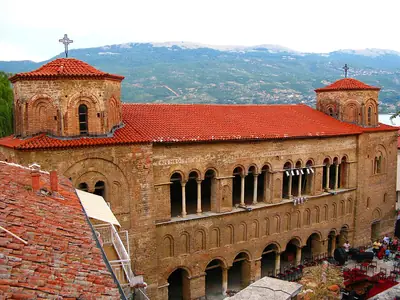
The Church of Saint Sophia is one of Ohrid’s most important monuments. Dedicated to Holy Wisdom, or Hagia Sophia, it stands on the foundations of a fifth-century early Christian basilica. The present building was constructed in the ninth century and rebuilt in the eleventh century, when Archbishop Leo of Ohrid gave it a domed basilica form.
The church was once the cathedral of the Ohrid Archbishopric, whose authority extended across much of the region. Inside, the medieval frescoes are the main attraction: a Great Feast mural fills the nave, while the apse contains an image of the Virgin Enthroned holding Christ within a protective mandorla. The church courtyard, colonnade and portico also provide a setting for concerts and theatrical performances.
Church of Saint John at Kaneo
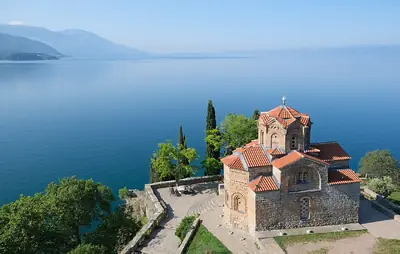
The Church of Saint John the Theologian at Kaneo is one of Ohrid’s most recognizable landmarks. Built on a rocky cliff above Kaneo Beach, it looks across Lake Ohrid from one of the city’s most memorable settings.
The exact construction date is unknown, although documents show that the church existed before 1447 and archaeologists believe it was probably built in the thirteenth century. Restoration work in 1964 revealed frescoes in the dome, adding another layer to the building’s long history.
Plaošnik and Saint Panteleimon
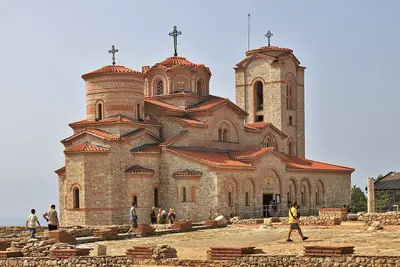
Plaošnik Hill is an archaeological site containing the remains of an early Christian episcopal basilica. Excavation and research continue to reveal the history of the area. The main church associated with the site was built by Saint Clement in 893 over the foundations of an earlier Christian basilica dedicated to Saint Panteleimon, a fourth-century martyr.
Today, the Church of Saints Clement and Panteleimon was built and consecrated in 2002. The site is also associated with the first students of the Glagolitic alphabet, which was used to translate the Bible into Old Church Slavonic during the First Bulgarian Empire.
Samuil’s Fortress
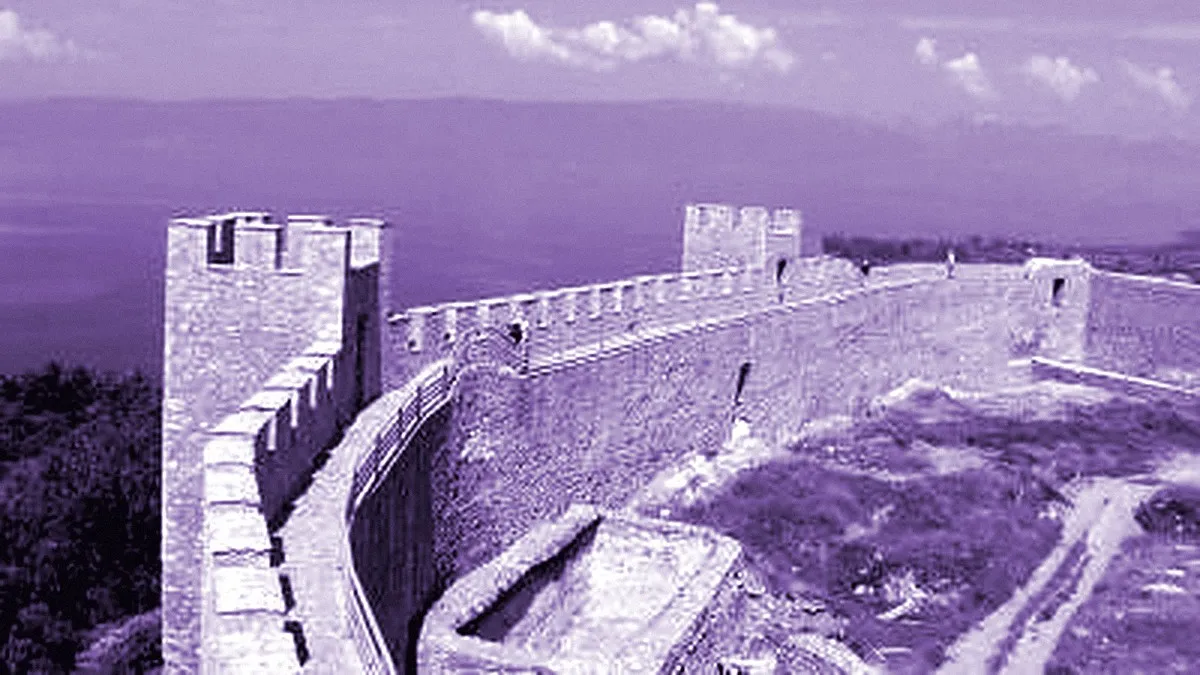
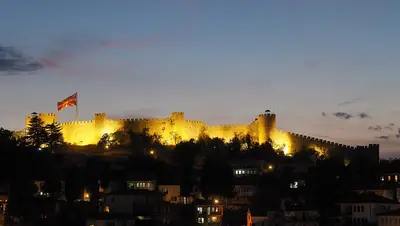
Samuil’s Fortress rises above Ohrid and Lake Ohrid, combining a medieval stronghold with broad views over the surrounding landscape. The fortress stands on the remains of an earlier fortification dated by archaeological excavations to the fourth century BC and associated with King Philip II of Macedon.
In the late tenth century, Tsar Samuil rebuilt the site as a medieval stronghold. During his rule, Ohrid was the residence and capital of the First Bulgarian Empire. The walls extend for about two miles, with towers and ramparts of varying heights. Inside, the citadel was divided between an imperial residence and military areas, while another enclosed section contained housing for courtiers’ families, an ancient cemetery, the remains of a donjon and a cistern.
Ohrid was known in antiquity as Lychnidos, and the fortress was destroyed and rebuilt several times under Roman, Byzantine, Slavic and Ottoman rule.
Church of Saint Nicholas Bolnichki
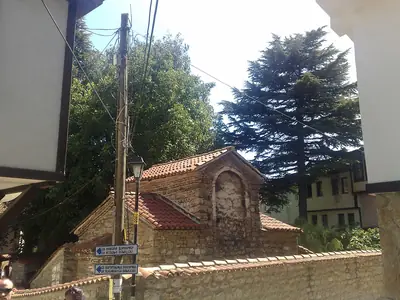
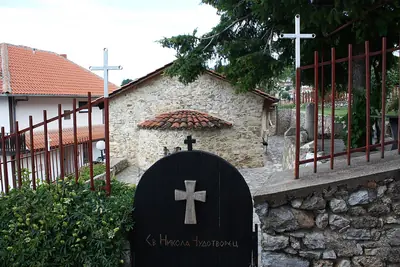
In the old town, the Church of Saint Nicholas Bolnichki stands on Tsar Samoil Street between Ohrid’s harbor and the Robevci Family House. Built and painted in 1313 by an unknown fresco painter, it is a small Orthodox church with a single nave and a semicircular vaulted roof.
A chapel was added on the southern side in the fifteenth century. Its surviving apse contains a depiction of the Communion of the Apostles. The churchyard also preserves remains of the city walls, connecting this modest building with Ohrid’s defensive history.
Saint Nicholas the Wonderworker and Saint Clement the Lesser
The Church of Saint Nicholas the Wonderworker, also called Saint Nicholas Chelnički, was built over the remains of an early Christian sanctuary. Its surviving wall paintings include fragments from the eleventh through the fourteenth century and later periods, offering a rare view of Ohrid’s religious art across time.
Nearby, the Church of Saint Clement the Lesser is a small fourteenth-century Orthodox church. A Greek inscription above the southern entrance records its completion in 1378. Sections of the original frescoes remain inside, including a particularly striking image of Saint Clement on the southern side of the nave.
Church of the Holy Mother of God Perivleptos
The Church of the Holy Mother of God Perivleptos, also called Saint Clement, was built in 1295 and dedicated to the Virgin Mary. It became the cathedral of the Archbishopric of Ohrid from the fifteenth to the eighteenth century.
The church was commissioned by Progon Zgur, the son-in-law of the Byzantine Emperor Andronicus the Second. Its frescoes make it one of the most important medieval churches in Ohrid.
Robevi Family House
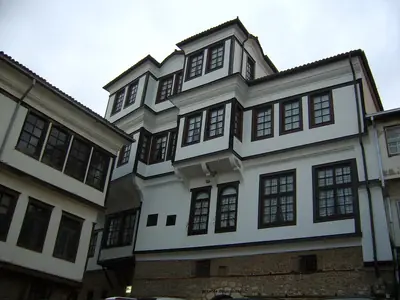
The Robevi Family House is one of the city’s finest examples of traditional urban architecture. Now part of the National Museum in Ohrid, the protected cultural monument was created as an architectural ensemble for the two Robevi brothers, Konstantin and Atanas.
Its present form dates from 1863 and 1864, after an earlier house was destroyed by fire. The ground floor displays epigraphic monuments from Ohrid, objects known as the Milokas from the Via Egnatia, and sculptures of the goddess Isis. The upper floors contain archaeological finds from ancient and medieval periods, works from the Ohrid Woodcarving School and pieces by local artists.
The old town’s smaller churches
Ohrid’s historic centre is filled with smaller churches that reward careful exploration. The Church of Saints Constantine and Helena was built and painted with frescoes in 1477, according to an inscription above its southern entrance. Its entire interior is decorated with fresco painting, and a later chapel was dedicated to Saint Paraskeva.
The Church of the Theotokos Bolnička, near the Lower Gate and waterfront, belongs to the group of fourteenth-century single-nave churches associated with Ohrid. Conservation work revealed older frescoes beneath a later layer painted in 1834.
In the Varosh neighbourhood, the Church of the Theotokos Čelnica stands beside the remains of the old city fortifications. Its two-nave plan is described as unique in Macedonia, while fragments of fourteenth-century frescoes survive inside.
Above the Ohrid amphitheatre, the Church of the Theotokos Pandonos was built on the foundations of an older medieval church. Its surviving fresco decoration is concentrated in the altar area.
Dormition of the Theotokos Kamensko Church
Near Ohrid’s old plane tree and the fountain in the bazaar, the Dormition of the Theotokos Kamensko Church remains the central parish church of Ohrid’s Second Parish. The building is believed to date from the seventeenth century and was enlarged in 1832.
Its richly decorated interior includes a carved iconostasis divided into five horizontal sections. The scenes feature flora and fauna associated with the Ohrid lakeside, while the upper section contains two dragons, a crucifix, the Holy Virgin and Saint John the Theologian. The frescoes were painted again in 1863 and 1864 by Dicho Zograf, his son Avram Dichov and Petar Ioanov.
Ali Pasha Mosque and the Old Bazaar
The Ali Pasha Mosque, also known as the Zeynel Abidin Pasha Mosque, is the city’s main mosque and an important landmark of Ohrid’s Muslim heritage. Built in 1573 during the Ottoman period, it was intended both as a place of worship and as a secondary school.
The building combines stone and fired brick, with a central dome and an entrance hall covered by three smaller domes. It stands in the Old Bazaar, where the mosque’s presence adds another dimension to Ohrid’s religious and architectural history.
Explore Ohrid with a self-guided walking tour
Neywo offers four walking tours in Ohrid, with 37 tour stops across the routes:
- Saints, Scribes and Lakeside Lanes: 1.53 km, 87 minutes and 12 stops
- Samuel’s Fortress and the Hill of Churches: 1.02 km, 71 minutes and 10 stops
- The Old Bazaar and the Thousand-Year Plane Tree: 2.18 km, 81 minutes and 10 stops
- Minarets and a Bathhouse on the Northern Edge: 1.35 km, 44 minutes and 5 stops
The routes bring together Ohrid’s churches, fortress, old bazaar, mosques, traditional houses and archaeological sites. The app tells the story of each place as you reach it, at your own pace, with no group and no schedule. Download Neywo and turn your visit into an Ohrid self-guided walking tour.
Places with an audio guide in Ohrid
8 places in Ohrid with a Neywo audio guide. Each one starts telling its story as you reach it.
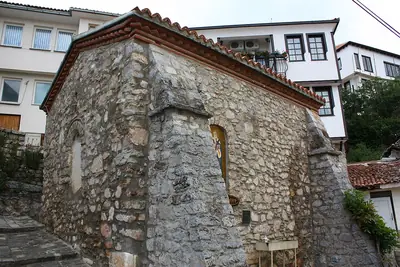
Self-guided tours in Ohrid
4 tours in Ohrid, free in the Neywo app. Each stop tells its story as you reach it.
- Walk
Saints, Scribes and Lakeside Lanes
Begin at Kaneo, where a rock-cut chapel sits under the cliff-top church of St. John, then climb Plaošnik, the hill where Saint Clement taught the first Slavic students. Finish along the old town's lakeside lanes, past St. Sophia, merchant houses of the 1860s and tiny fourteenth-century chapels with their frescoes.
Nativity of the Theotokos and St. Petka Church · Church of St. John at Kaneo · Saint Panteleimon · Parlichev House · Church of St. Sophia · St. Nicholas Gerakomija Church …
Open this tour: Saints, Scribes and Lakeside Lanes - Walk
Samuel's Fortress and the Hill of Churches
Climb from the old Čelnica gate through a knot of small medieval churches, the Perivleptos ensemble among them, to the walls of Tsar Samuel's fortress. Every few steps another church, fresco or stretch of city wall appears, with Lake Ohrid opening up behind.
Church of the Theotokos Čelnica · Ss. Cosmas and Damian Church · Church of Sts. Constantine and Helena · St. Nicholas the Wonderworker Church · Saints Forty Martyrs of Sebaste Church (Ohrid) · Ss. Cosmas and Damian Church (Golemi Vrači, Ohrid) …
Open this tour: Samuel's Fortress and the Hill of Churches - Walk
The Old Bazaar and the Thousand-Year Plane Tree
Ohrid's Varosha quarter keeps its Ottoman face: the sixteenth-century Ali Pasha Mosque, a dervish sheikh's house with a carved balcony, and a plane tree said to be a thousand years old. Walk on to the spot where Saint Clement's literary school began in 886 and out to the bazaar mosques at the eastern edge.
Church of St. Nicholas Bolnichki, Ohrid · House on 1 Promenade Macedonia, Ohrid · Ali Pasha Mosque · Ohrid plane tree · Dormition of the Theotokos Kamensko Church · Hadži Hamza Mosque …
Open this tour: The Old Bazaar and the Thousand-Year Plane Tree - Walk
Minarets and a Bathhouse on the Northern Edge
A short loop through the quieter northern quarter, from the Cypress Mosque, the oldest surviving mosque in Ohrid, to octagonal prayer halls with eight different wall lengths and one of only two Ottoman bathhouses still standing.
Hajdar Pasha Mosque · Gürcü Bey Mosque · Kuloğlu Mosque · Emin Mahmud Mosque · Voska Hamam
Open this tour: Minarets and a Bathhouse on the Northern Edge
Walk Ohrid with Neywo
Neywo turns Ohrid into a self-guided audio tour. Stories arrive as you reach the place they belong to, and the route reshapes when you wander off it.

