Prilep, North Macedonia: Self-Guided Walking Tour
Things to do in Prilep: what to see in North Macedonia
The best things to do in Prilep include exploring medieval churches in Varoš, climbing to Markovi Kuli, discovering the Old Bazaar and visiting museums and memorials connected with the city’s past. Prilep is also a gateway to the rocky landscape around Treskavec Monastery, about ten kilometres away. Neywo’s free audio guide to Prilep brings 19 narrated places to life as you explore.
Prilep lies in North Macedonia’s Pelagonia Statistical Region, named after the Pelagonia Plain. Its heritage combines Orthodox churches, Ottoman landmarks, archaeological remains and memorials from the twentieth century. For more ideas across the country, see the guide to North Macedonia.
What to see in Prilep
Markovi Kuli, or Marko’s Towers
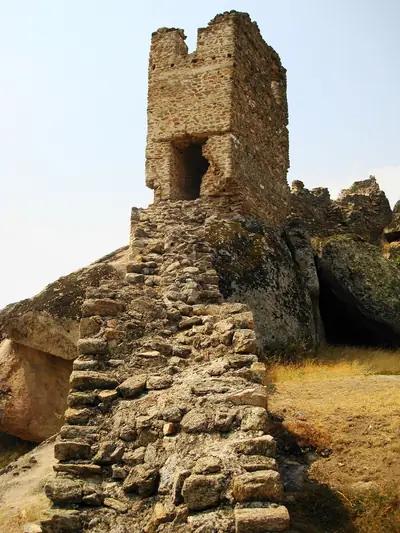
Above the neighbourhood of Varoš, Markovi Kuli rises on a rocky hill covered with small granite stones. The site contains traces of settlement from the late Neolithic period through the nineteenth century, including Hellenistic, Byzantine and Slavic remains.
The most visible structures belong to the medieval fortress. Its thirteenth- and fourteenth-century rampart is about a metre thick and was built with limestone mortar on large limestone rocks. Defensive zones extended across the hill, while a settlement south of the acropolis covered about 3.6 hectares. The combination of archaeology and stark terrain makes Markovi Kuli one of the defining places to visit in Prilep.
The churches of Varoš
Varoš, beneath Markovi Kuli, is home to several historic Orthodox churches. Together, they make the neighbourhood one of the most rewarding areas for seeing Prilep’s medieval heritage.
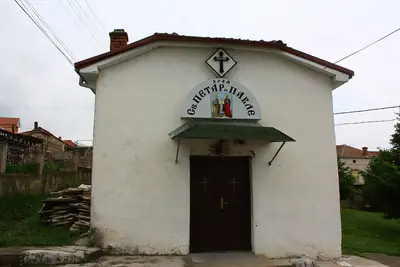
The Church of Saints Peter and Paul is thought to date from the fourteenth century. It has a single nave, a barrel vault and a semicircular apse, with walls built from stone and brick. Fresco fragments survive inside, including scenes of the Way of the Cross, the Lamentation and the Dormition of the Virgin Mary.
The Church of the Presentation of the Theotokos, also called Saint Mary the Immaculate, was built in the early fifteenth century. An inscription above the western entrance dates it to either 1416 or 1438 and names Pavle and Radoslav, the sons of Teodor, as its patrons. Its surviving paintings include the Virgin Mary with the infant Jesus and the Great Entrance.
The small but unusually tall Church of Saint Nicholas was completed in November 1298. Its interior frescoes are arranged in three zones: full-length warrior saints and other saints below, scenes from the Passion of Christ in the middle, and the Great Feasts above. Prophets appear across the vault, while fragments remain on the exterior façade.
Treskavec Monastery
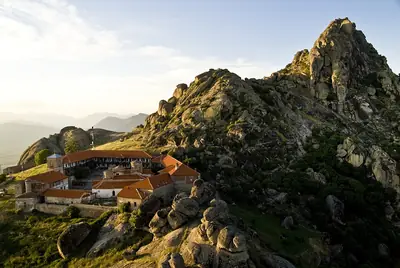
High among the rocks beneath the 1,422-metre peak of Zlatovrv, Treskavec Monastery stands at an elevation of 1,280 metres, around ten kilometres from Prilep. Also known as the Assumption of the Blessed Virgin Mary, it is an important monastic and spiritual centre of the Ohrid Archbishopric.
The monastery was built in the twelfth century and includes monastic lodgings, a dining hall and the Church of the Assumption. Until an asphalt road reached the site in 2013, it was described as one of Macedonia’s most inaccessible sanctuaries, reached by a narrow path through striking rocks and karst formations.
The monastery’s main church, the Dormition of the Theotokos Church, has a single nave with a dome and a fourteenth-century narthex with two domed towers. Its frescoes were created over several centuries. Visible paintings include fifteenth-century calendar scenes and saints, along with later work in the nave, including paintings associated with the Kastoria artistic school.
Čarši Džamija in the Old Bazaar
Čarši Džamija, or the Charshi Mosque, stands beside Prilep’s clock tower in the Old Bazaar. Built in 1475 by Hadži Husein during the reign of Sultan Mehmed the Conqueror, it is regarded as an example of the Bursa style.
Its polygonal minaret rises 25 metres and has two balconies, an unusual feature that makes the mosque distinctive. The building was set on fire during protests in 2001 following the massacre at Karapalk and remains in a ruined state, giving this historic landmark a particularly complex story.
The Broken Mosque
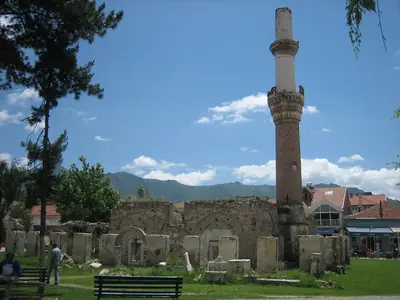
The Broken Mosque, known locally as Скршена Џамија, is considered one of the oldest mosques in Macedonia and the oldest in Prilep. Built at the beginning of the fifteenth century, shortly after the Ottoman conquest of the city, it now survives in a neglected and ruined condition.
The small building has a square plan and a dome. Its minaret is decorated with stalactite ornamentation, a characteristic detail of the period.
Church of the Transfiguration
Beside the quay of the city river, the Church of the Transfiguration is also known as the Greek Church, a name connected with Prilep’s Vlach population. Built in 1871, it is a three-nave basilica with five domes.
The church stands above ground level, reflecting the privileged position of the Vlachs at the time. Its eastern end has a nine-sided apse. The community obtained an imperial decree from the Porte in Constantinople to build the church.
Annunciation Church
The Annunciation Church, also called Stara Crkva or the Old Church, was built in 1838 by the Prilep craftsmen Kosta Lauco and Riste Taslamiche. The building measures 32 metres in length, 26 metres in width and 9 metres in height.
Its churchyard contains the grave of Pere Toshev, a Macedonian revolutionary. The church belongs to the Prespa-Pelagonia Diocese of the Macedonian Orthodox Church, the Ohrid Archbishopric.
Memorial Museum 11th October
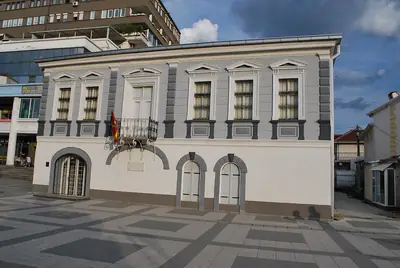
In central Prilep, the Memorial Museum 11th October commemorates the Day of the Macedonian Uprising. The building was constructed at the beginning of the twentieth century and was being used as a Bulgarian police station during the Second World War.
On 11 October 1941, the Prilep Partisan detachment carried out its first attack there as part of the National Liberation War in Yugoslav Macedonia. The site became a museum in 1952 and took its present commemorative form in 1961. It was renovated in 2011.
Mound of the Unbeaten
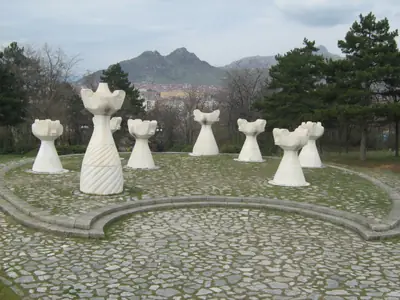
The Mound of the Unbeaten stands in Prilep’s Park of the Revolution. Built in 1961, the memorial complex is dedicated to fighters who died in the People’s Liberation Struggle in Macedonia.
Designed by architect Bogdan Bogdanović, it has two principal sections. One contains eight marble urns inspired by ancient forms, including an urn bearing a symbol of an eternal flame. The other is a crypt lined with marble slabs inscribed with names. The remains of 462 fallen fighters from Prilep and the surrounding area are held there. The complex was revitalized between 2007 and 2008.
Prilep’s museums
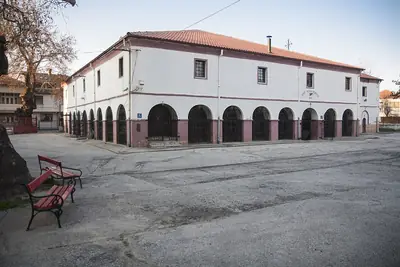
The Institute for Protection of Cultural Monuments and Museum combines museum work with the protection of cultural monuments and natural rarities. Established as the People’s Museum in 1955, it first focused on archaeology, history and ethnology before expanding its role.
The Museum of Tobacco explores tobacco through work, everyday life and production, reflecting an important part of Prilep’s identity.
Explore Prilep with a free audio guide
Neywo’s Prilep self-guided walking tour lets you explore without joining a group or following a fixed timetable. Prilep has two walking tours and one bus route, with stories available in 11 languages. The app tells the story of each place as you reach it, at your own pace, with no group and no schedule.
The available routes are:
- Marko’s Towers and the Churches of Varoš: a 2.46 km walk lasting 76 minutes, with 7 narrated stops.
- Ottoman Bazaar to Partisan Mound: Prilep’s Old Town: a 4.24 km walk lasting 101 minutes, with 8 narrated stops.
- Line 1: From the Partisan Mound to the Churches of Varoš: a 13.8 km bus route lasting 59 minutes, with 5 narrated stops.
Together, the walks and bus route cover 19 narrated places, from Varoš and Markovi Kuli to the Old Bazaar, museums and memorials. Download Neywo and explore Prilep with a free audio guide that fits your own pace.
If you are continuing through North Macedonia, compare Prilep with Bitola, Ohrid, Skopje or Tetovo.
Places with an audio guide in Prilep
8 places in Prilep with a Neywo audio guide. Each one starts telling its story as you reach it.
Self-guided tours in Prilep
3 tours in Prilep, free in the Neywo app. Each stop tells its story as you reach it.
- Bus ride
Line 1: From the Partisan Mound to the Churches of Varoš
Prilep's city bus 1 links the southern Park of the Revolution with the old town and the medieval quarter of Varoš. Ride it past the Mound of the Unbeaten, the Old Church and the museum, then up to the churches beneath Marko's Towers.
Mound of the Unbeaten · Annunciation Church, Prilep · Institute for protection of cultural monuments and Museum, Prilep · Sts. Peter and Paul Church (Varoš) · Čarši Džamija
Open this tour: Line 1: From the Partisan Mound to the Churches of Varoš - Walk
Marko's Towers and the Churches of Varoš
Climb into the medieval quarter that grew at the foot of King Marko's fortress. Walk past tiny, tall Orthodox churches with 14th-century frescoes and ceramic decoration, a Bronze Age hill called The Elephant, and finish at the granite ramparts of Markovi Kuli.
Sts. Peter and Paul Church (Varoš) · Church of the Presentation of the Theotokos · St. Demetrious Church · St. Athanasius Church (Varoš) · St. Nicholas Church (Varoš) · Markovi Kuli
Open this tour: Marko's Towers and the Churches of Varoš - Walk
Ottoman Bazaar to Partisan Mound: Prilep's Old Town
From the 1936 church of Saints Cyril and Methodius through the old bazaar and its two-balconied mosque, past the Greek church and the old Annunciation church, to a ruined 15th-century mosque. End at the white marble Mound of the Unbeaten, designed by Bogdan Bogdanovic.
Sts. Cyril and Methodius Church · Memorial Museum 11th October · Čarši Džamija · Church of the Transfiguration (Prilep) · Annunciation Church, Prilep · Institute for protection of cultural monuments and Museum, Prilep …
Open this tour: Ottoman Bazaar to Partisan Mound: Prilep's Old Town
Walk Prilep with Neywo
Neywo turns Prilep into a self-guided audio tour. Stories arrive as you reach the place they belong to, and the route reshapes when you wander off it.

