Skopje, North Macedonia: Self-Guided Walking Tour
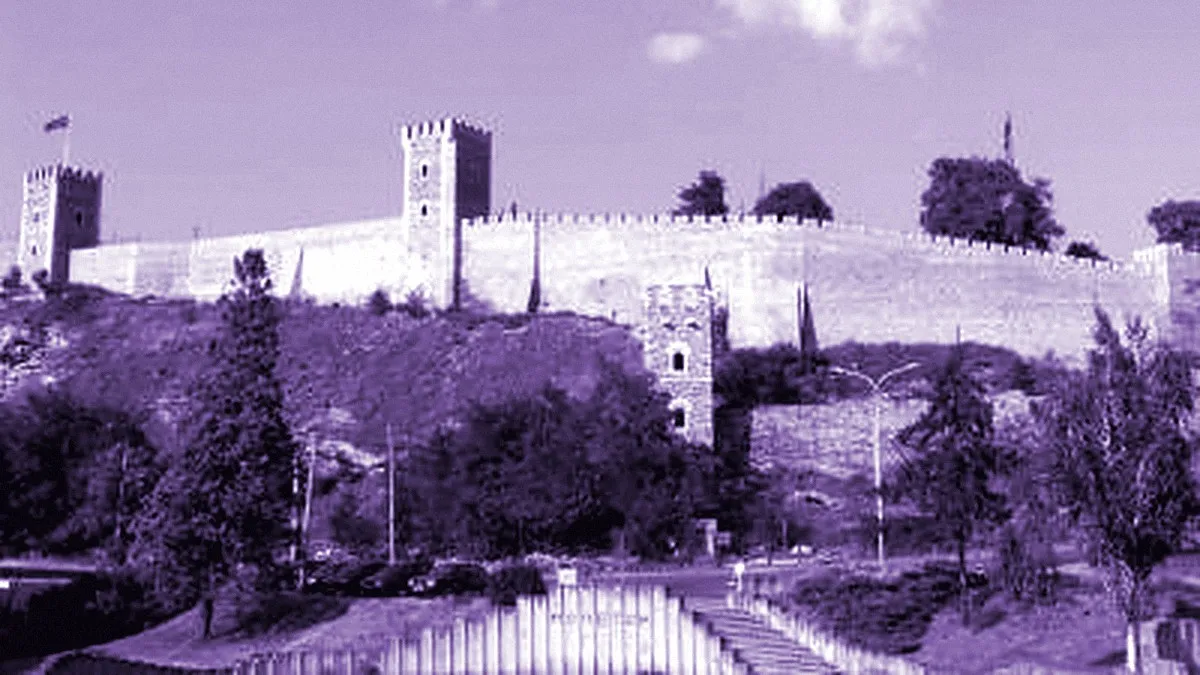
Things to Do in Skopje: What to See in North Macedonia’s Capital
The best things to do in Skopje include exploring the Old Bazaar, crossing the Stone Bridge, visiting museums shaped by the 1963 earthquake, and looking up toward the Millennium Cross on Mount Vodno. North Macedonia’s capital brings together Ottoman heritage, Orthodox and Catholic landmarks, ancient archaeological sites, and striking modern architecture. Neywo’s free audio guide to Skopje covers 89 narrated places, helping you understand the city as you walk.
What to See in Skopje
Church of St. Clement of Ohrid
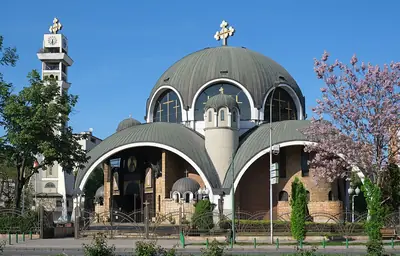
The Church of Saint Clement of Ohrid, also known as the Soborna Crkva, is the cathedral church of the Macedonian Orthodox Church and its largest cathedral. It also hosted a significant joint liturgy on May 24, 2022, when the Serbian Patriarch announced that the Serbian Orthodox Church had recognized the autocephaly of the Macedonian Orthodox Church.
Mother Teresa Memorial House
On Macedonia Street, the Mother Teresa Memorial House commemorates Gonxhe Bojaxhiu, the Catholic saint and Nobel Peace Prize laureate who lived in Skopje from 1910 to 1928. The memorial opened on January 30, 2009, on the site of the former Sacred Heart of Jesus Roman Catholic Church, where she was baptized one day after her birth.
The contemporary building combines a multifunctional design with a sacred atmosphere. Inside, the museum preserves objects connected with Mother Teresa’s life and work, along with realistic sculptures of her and members of her family. Its central location places it just east of Ristiḱ Palace and Macedonia Square.
Porta Macedonia and Macedonia Square
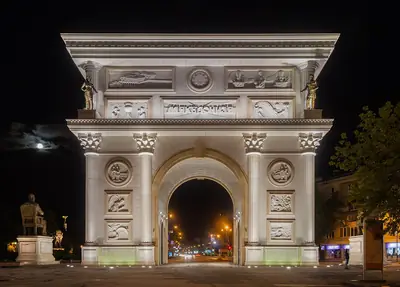
Porta Macedonia is a 21-metre-high triumphal arch on Pella Square and one of the monuments associated with the Skopje 2014 project. Officially opened on 6 January 2012, it was dedicated to twenty years of Macedonian independence.
Its exterior contains 193 square metres of marble reliefs depicting figures and events from Macedonian history and culture, including Emperor Justinian, Tsar Samuil, Marko Kralevich, Karposh, the Ilinden Uprising, the antifascist movement, and the declaration of independence in 1991.
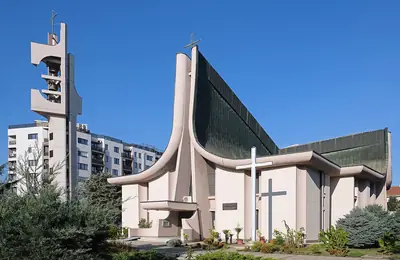
Cathedral of the Sacred Heart of Jesus
The Cathedral of the Sacred Heart of Jesus is the Roman Catholic cathedral of Skopje and the seat of the Skopje Diocese. Completed in 1977, it was designed by Macedonian architect Blagoja Mickovski, also known as Bajo. The church replaced an older cathedral with the same name, destroyed in the 1963 earthquake.
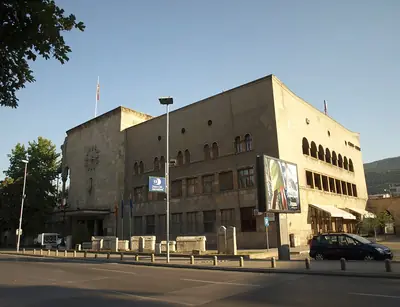
Museum of the City of Skopje
The Museum of the City of Skopje occupies part of the city’s old railway station. The building was partly destroyed in the 1963 earthquake, but one third survived and has housed the museum since 1970. The surviving structure is recognized as significant cultural heritage of North Macedonia.
The museum’s collections cover archaeology, history, ethnology, art history, architecture, urban planning, and design. Its permanent exhibition, A Walk Through the Past, follows Skopje’s development from prehistory to the beginning of the twentieth century. The museum was founded in 1949 and holds 21,950 objects.
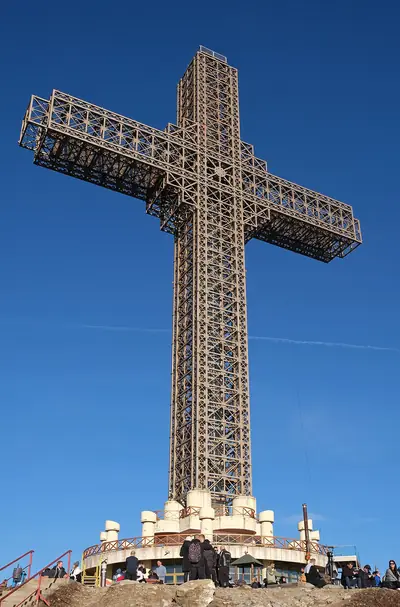
The Millennium Cross and Mount Vodno
The Millennium Cross rises from Krstovar Peak on Mount Vodno, above the southern part of the Skopje Basin. Built in 2002 to mark two thousand years of Christianity in Macedonia and the arrival of the new millennium, the cross reaches 66 metres into the skyline.
Krstovar is the highest point of Vodno, at 1,066 metres. An elevator was installed inside the cross on September 8, 2008. Even from the city below, the monument gives Skopje a powerful vertical landmark and a clear connection with the mountain landscape surrounding the capital.
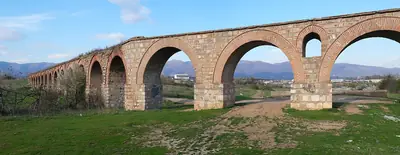
Skopje Aqueduct
Near Vizbegovo, about two kilometres northwest of central Skopje, the Skopje Aqueduct crosses the landscape in stone and brick. Around 386 metres remain, supported by 53 columns and a series of main and secondary arches. The structure bends noticeably at one point, giving its long line an unusual change of direction.
Its exact date is uncertain. Theories connect it with Roman Scupi, the early Byzantine period and Emperor Justinian I, or Ottoman rule in the sixteenth century, when it may have supplied public baths. It is described as the only surviving aqueduct in North Macedonia and one of the three largest and best-preserved aqueducts in the territory of the former Yugoslavia.
The Old Bazaar
The Old Bazaar is one of Skopje’s defining places to visit. The historic market quarter extends from the Stone Bridge to Bit-Pazar, and from the Skopje Fortress to the Serava River. Trade has taken place here since at least the twelfth century, while the bazaar expanded into Skopje’s main commercial district under Ottoman rule.
Ottoman architecture dominates the area, with Byzantine traces visible alongside mosques, türbes, two churches, and a clocktower. Former inns and bathhouses have been adapted for cultural and artistic events. The bazaar also includes the Museum of the Republic of North Macedonia and the Museum of Modern Art.
The district has been repeatedly damaged and rebuilt, including after earthquakes in 1555 and 1963, the fire of 1689, and the two World Wars. That layered history is part of what makes wandering through its streets so rewarding.
Murat Pasha Mosque
Murat Pasha Mosque forms part of the Old Bazaar’s historic centre. Together with the nearby Cifte Hamam and Suli An, it is one of the bazaar’s only surviving Islamic trio and is protected cultural heritage.
The present mosque was built in 1802 or 1803 after an earlier building was destroyed in the great fire of 1689. Its architecture includes Baroque elements, while the minaret appears to belong to an earlier period. The courtyard contains a fountain from 1937 and three old gravestones dated 1741, 1790, and an undetermined year.
Skanderbeg Square
Skanderbeg Square stretches from the Macedonian Philharmonic and Macedonian Opera toward the Old Bazaar. Its central feature is the equestrian statue of Gjergj Kastrioti Skanderbeg. Refurbishment began on 17 January 2012, with the project completed in segments between 2014 and 2018.
Part of the square was built above Goce Delčev Boulevard, creating an open area of 28,000 square metres. An amphitheatre, fountain, underground parking, and murals depicting figures and scenes from Albanian history form part of the design.
Museums on the Vardar’s Left Bank
The Museum of the Macedonian Struggle follows revolutionary movements in the region, from resistance to Ottoman rule through to the declaration of independence from Yugoslavia. It opened on 8 September 2011 and presents the story through thirteen displays, ending before the original copy of the 1991 Declaration of Independence.
Nearby, the Holocaust Memorial Center for the Jews of Macedonia remembers the 7,148 Jews from Macedonia who suffered during the Holocaust. The multimedia centre stands on the site of Skopje’s former Jewish quarter and connects the history of Macedonian Jews with the wider Jewish experience in the Balkans.
Museum of Contemporary Art Skopje
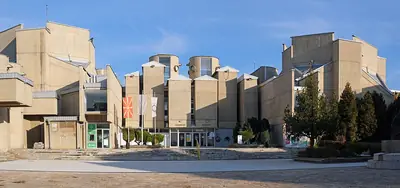
Near Kale Hill, the Museum of Contemporary Art Skopje is one of the city’s most distinctive modernist buildings. It was created after the earthquake as a symbol of international solidarity, following a donation from the Government of Poland.
The Polish architectural group known as the Tigers won the 1966 competition for the design. Construction began on April 5, 1969, and the museum opened on November 13, 1970. It is described as the biggest and most modern museum in North Macedonia, and as the country’s only institution that collects and processes documentation about Macedonian art and presents important historical films.
Scupi
A few kilometres from central Skopje, near Zlokućani and between Zajčev Rid and the Vardar River, the archaeological site of Scupi reveals the city’s Roman past. Scupi began as a Roman military camp in the second century BC on the site of an older Dardanian settlement.
It later developed into the Roman colony Colonia Flavia Scupinorum, where many veteran legionnaires settled. The city was eventually abandoned after an earthquake destroyed it. The archaeological site includes the ancient urban area, while suburban structures and necropolises extended across the surrounding landscape.
Explore Skopje with a Self-Guided Audio Tour
Neywo makes it easy to take a Skopje self-guided walking tour at your own pace. Its seven Skopje routes include five walking tours, one bus route, and one bike route:
- Five walking tours, ranging from 1.33 to 3.96 km, lasting 75 to 107 minutes, with 6 to 12 narrated stops each.
- One bus route, covering 15.3 km in 66 minutes, with 6 narrated stops.
- One bike route, covering 3 km in 15 minutes, with 3 narrated stops.
The walks explore Skopje 2014 and the Stone Bridge, the Old Bazaar’s hans, hammams and mosques, the northern bazaar, the city’s religious landmarks and green spaces, and the area east of the bazaar. The bus route connects the cathedral quarter with the Old Bazaar, while the bike route runs from St. Stephen’s Church to Mother Teresa’s House.
Download Neywo and let the app tell the story of each place as you reach it. Narration is available in 11 languages, and every route works at your own pace, with no group and no schedule. When you continue exploring North Macedonia, you can also discover Ohrid, Bitola, Tetovo, and Prilep.
Places with an audio guide in Skopje
8 places in Skopje with a Neywo audio guide. Each one starts telling its story as you reach it.
Self-guided tours in Skopje
7 tours in Skopje, free in the Neywo app. Each stop tells its story as you reach it.
- Bike ride
From St Stephen's to Mother Teresa's House by Bike
Ride a mapped cycle lane from the hillside church of St Stephen west toward the centre, past the National Bank, to the Mother Teresa Memorial House on Macedonia Street.
St. Stephen's Church · National Bank of North Macedonia · Mother Teresa Memorial House
Open this tour: From St Stephen's to Mother Teresa's House by Bike - Bus ride
Bus 16: From the Cathedral Quarter to the Old Bazaar
A regular city bus run by JSP Skopje. It links St Clement's cathedral, the synagogue, City Park and the Old Bazaar, ending at the Sultan Murad Mosque. A cheap way to cross town without a taxi.
Church of St. Clement of Ohrid · United Methodist Church, Skopje · Beth Yaakov Synagogue · City Park (Skopje) · Old Bazaar · Sultan Murad Mosque
Open this tour: Bus 16: From the Cathedral Quarter to the Old Bazaar - Walk
Skopje 2014: Marble Warriors, Arches and the Stone Bridge
Start where Mother Teresa was baptised and cross the heart of the capital, past the Porta Macedonia arch, the giant Warrior on a Horse fountain and Justinian's marble statue. End on the Ottoman Stone Bridge over the Vardar, the symbol on the city's coat of arms, next to the museums of the left bank.
Museum of the City of Skopje · Saint Teresa of Calcutta, Skopje · Mother Teresa Memorial House · Porta Macedonia · Macedonia Square · Monument of Iustinianus I …
Open this tour: Skopje 2014: Marble Warriors, Arches and the Stone Bridge - Walk
Inside the Old Bazaar: Hans, Hammams and Mosques
Climb to the fortress above the bazaar, then cross into the Carsija, one of the largest Ottoman bazaars in the Balkans still standing. Walk from the domes of Daut Pasha Hammam through the caravanserais of Kapan Han and Suli An, past the Murat Pasha and Mustafa Pasha mosques and the tomb of Mustafa Pasha, and finish at the museum of the republic.
Skopje Fortress · St. Demetrious Church · Daout Pacha Hammam · Skanderbeg Square · Kapan Han · Murat Pasha Mosque …
Open this tour: Inside the Old Bazaar: Hans, Hammams and Mosques - Walk
Minarets and the Painted Mosque: The Northern Bazaar
A short mosque trail along the quieter northern edge of the Old Bazaar. See the fifteenth-century Haci Balaban and Ishak Bey mosques, the Isa Bey mosque with its ancient plane tree, and end at the Sultan Murad Mosque, the oldest preserved mosque in Skopje, with its clock tower.
Dukancik Mosque · Haci Balaban Mosque, Skopje · Ishak Bey Mosque · Ss. Cyril and Methodius University of Skopje · Isa Bey Mosque · Sultan Murad Mosque …
Open this tour: Minarets and the Painted Mosque: The Northern Bazaar - Walk
Faiths and Green Spaces West of the Centre
Leave the tourist core for the Skopje that locals live in. Visit the cathedral built after the 1963 earthquake, the only synagogue left in the city and the huge Orthodox cathedral of St Clement, then relax in City Park, pass the zoo's natural history museum and the football arena, and end at the French military cemetery.
Cathedral of the Sacred Heart of Jesus · Beth Yaakov Synagogue · United Methodist Church, Skopje · Church of St. Clement of Ohrid · City Park (Skopje) · Macedonian Museum of Natural History …
Open this tour: Faiths and Green Spaces West of the Centre - Walk
East of the Bazaar: Library, Bank and Hillside Churches
A quieter walk east of the Old Bazaar. See the national library, the central bank, a church in the old Madzir Maalo quarter, the small Tutunsuz Mosque on the slopes of Gazi Baba Hill and the churches of the Avtokomanda district.
National and University Library "St. Kliment of Ohrid" · National Bank of North Macedonia · Holy Trinity Church - Madžir Maalo · Tütünsüz Mosque, Skopje · St. Michael the Archangel Church · Church of the Protection of the Theotokos
Open this tour: East of the Bazaar: Library, Bank and Hillside Churches
Walk Skopje with Neywo
Neywo turns Skopje into a self-guided audio tour. Stories arrive as you reach the place they belong to, and the route reshapes when you wander off it.

