Things to Do in Lima, Peru: Walking Guide
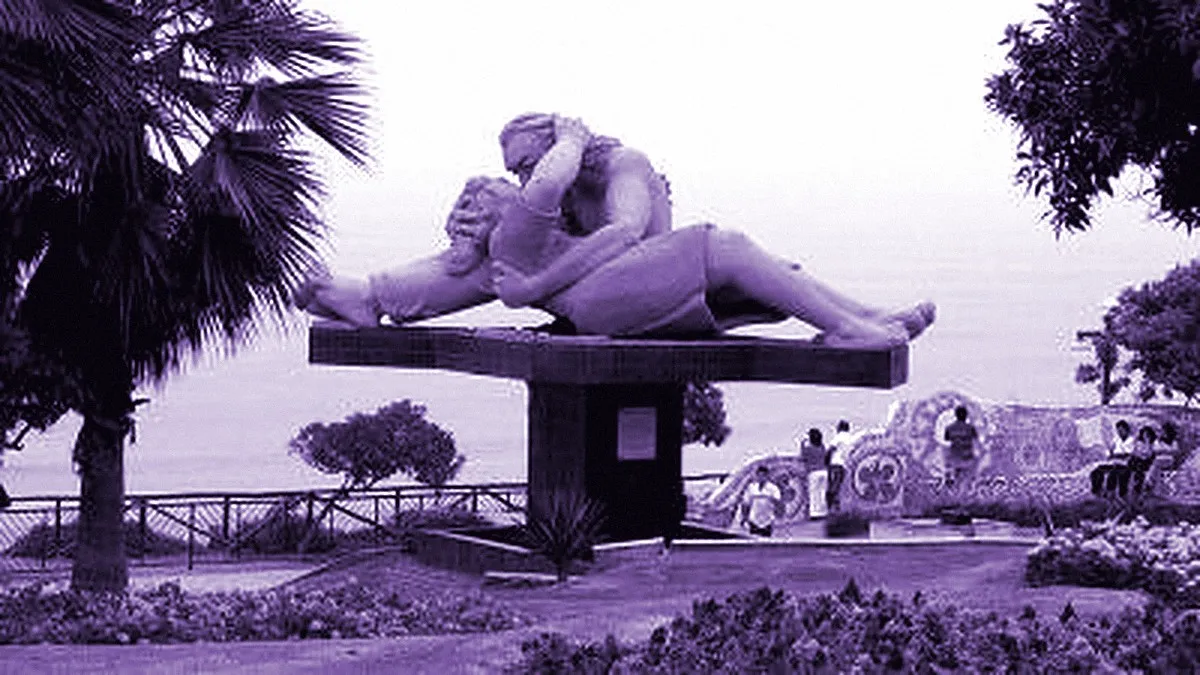
Things to Do in Lima: A Self-Guided Journey Through Peru’s History
Looking for things to do in Lima? Peru’s capital brings together a historic centre shaped by the Spanish viceroyalty, museums devoted to the country’s ancient cultures and religious traditions, and landmarks connected with independence and modern national identity. From the monumental history of Caral to colonial palaces and Lima’s most important public squares, the city offers plenty to explore at your own pace. Neywo has a free audio guide for Lima with 54 narrated places.
What to See in Lima
Caral
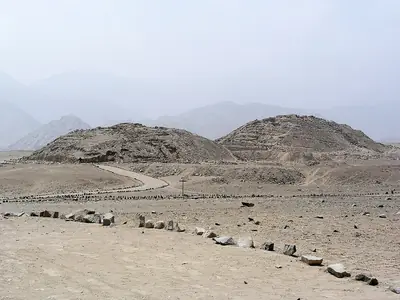
Caral, also known as the Sacred City of Caral-Supe, preserves the remains of the main city of the Caral civilisation. Attributed an antiquity of 5,000 years, it is considered the oldest city in the Americas and one of the oldest in the world.
The site is especially notable for the diversity of its monumental buildings and the ceremonial and administrative functions they represent. The Caral culture developed between 3000 and 1800 BC. At Áspero, archaeologists found remains associated with human sacrifices, including two children and a newborn. In 2016, they also discovered the remains of a woman presumed to have belonged to the local elite around 2500 BC.
Historic Centre of Lima
The Historic Centre of Lima was founded by Francisco Pizarro on 18 January 1535. It later became the political, administrative, religious and economic capital of the Viceroyalty of Peru, as well as the most important city in Spanish South America.
Its streets contain churches, convents and architectural monuments that survived centuries of earthquakes. The area was once enclosed by city walls, and Cercado de Lima still preserves many of its historic buildings. Among its best-known landmarks is the Convent of San Francisco, described as the largest of its kind in this part of the world.
The historic centre also reflects Lima’s educational and religious history. The University of San Marcos, known as the “Dean University of the Americas”, was founded on 12 May 1551 and began operating in the Convent of Santo Domingo on 2 January 1553.
Cathedral of Lima
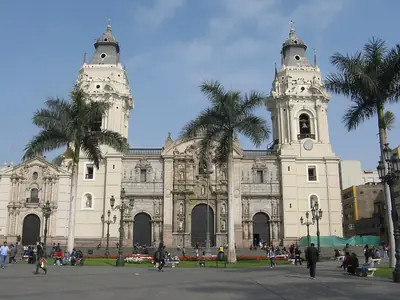
The Cathedral of Lima, also called the Cathedral Basilica of Lima or Metropolitan Cathedral of Lima, is one of the city’s most important historic and spiritual landmarks. Construction began in 1535, with Francisco Pizarro associated with the foundation of the building, and the cathedral was completed in 1797. In its present form, construction took place between 1602 and 1797.
Its Renaissance façade was later completed with neoclassical details. Inside, a vaulted ceiling, checkerboard floor and richly Baroque furnishings create an opulent setting. Highlights include carved choir stalls, a mosaic chapel containing Pizarro’s tomb, marble flooring, 17th-century golden altars and religious paintings. A small museum inside the cathedral displays religious artefacts and artworks.
Torre Tagle Palace
Torre Tagle Palace is one of downtown Lima’s most striking colonial landmarks. Built in the 1730s, the Spanish Baroque residence now houses offices of Peru’s Ministry of Foreign Affairs.
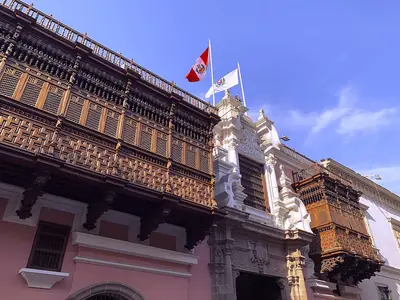
The palace combines a colonial Spanish porch and patio with intricate wooden carvings, richly decorated ceilings and tiles influenced by both Lima and Moorish traditions. Its façade is particularly recognisable for its two dark wooden balconies, one larger than the other. Materials used in the construction were brought from Spain, Panama and other Central American countries.
The palace also contains details connected with colonial commerce, including scales once used by merchants, as well as a large sixteenth-century carriage.
Osambela House
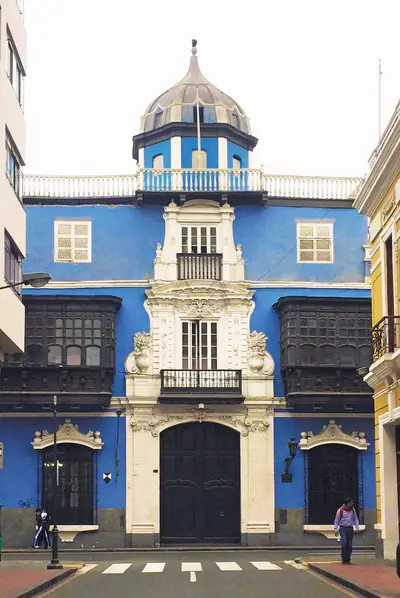
Osambela House is one of the grandest mansions in Lima’s historic centre. Its broad façade and high-quality balconies make it a distinctive example of late colonial architecture.
The house stands on the site of the former novitiate of the Dominican fathers, destroyed by the earthquake of 1746, and incorporates part of its garden. Built between the late 18th and early 19th centuries, it was completed between 1803 and 1805. Its design brings together several successive architectural styles.
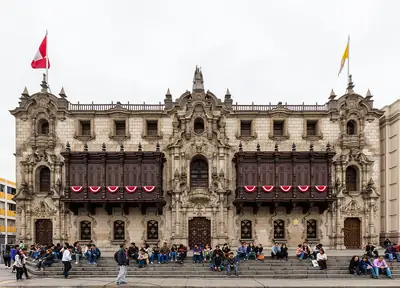
Archbishop’s Palace of Lima
The Archbishop’s Palace of Lima, now also known as the Museo del Palacio Arzobispal de Lima, combines a layered history with an imposing neo-colonial design. The current structure was built on 8 December 1924 to a design by the Polish architect Ricardo de Jaxa Malachowski.
Its stone Baroque-style façade features a cedar balcony above the main entrance and a granite sculpture of Saint Turibius, the archdiocese’s patron saint. The Peruvian and Vatican flags fly from two flagpoles. Before the present palace was built, the site housed Lima’s first police station and first prison.
The richly decorated interior includes sculptures such as Saint Barbara of Cuba and an impressive marble staircase.
Plaza San Martín
Plaza San Martín is one of Lima’s most representative public spaces. At its centre stands a monument to José de San Martín, the general associated with the liberation of South American territories from Spanish control.
The square was inaugurated in 1921, on the centenary of Peru’s declaration of independence in 1821. The mounted monument was created by the Catalan sculptor Mariano Benlliure. Historic buildings surround the spacious plaza, including Club Nacional and Teatro Colón, one of Lima’s first theatres, built in 1914. The square was also once home to the elegant Hotel Bolivar.
Many of the surrounding buildings share Neocolonial and Baroque characteristics, arranged in a symmetrical urban setting.
Panteón de los Próceres
The Panteón de los Próceres preserves the memory of the heroes of Peru’s War of Independence. Its interior contains the remains of 24 national heroes of the conflict, making it an important place for understanding the country’s independence story.
Museo de Arte de San Marcos
The Museo de Arte de San Marcos, or MASM, is connected with the Universidad Nacional Mayor de San Marcos. The museum conserves, studies and exhibits the university’s historical and artistic heritage.
Its collections include cultural goods from Peru as well as materials from other parts of the world, offering a broader view of the artistic history associated with the university.
Museo Señor de los Milagros
The Museo Señor de los Milagros focuses on Lima’s devotion to the Señor de los Milagros. At its centre is an image painted in 1651 by an Angolan enslaved person.
Opened to the public on 17 October 2014, the museum occupies three levels and contains six exhibition rooms. Its collections include religious objects used by the Comunidad de Madres Nazarenas in the early 18th century, as well as jewellery, plates associated with different groups of the Brotherhood, decorations and recognitions. Paintings, sculptures and metalwork complete the exhibitions.
Larco Museum
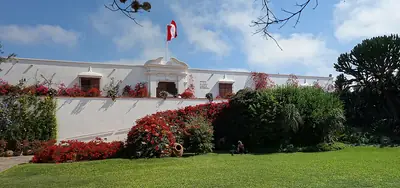
The Larco Museum, officially the Rafael Larco Herrera Archaeological Museum, is a privately owned museum devoted to pre-Columbian art. It occupies an 18th-century vice-royal building in the Pueblo Libre district, built on top of a pre-Columbian pyramid dating from the 7th century.
The museum’s chronological galleries present an overview of around 4,000 or 5,000 years of Peru’s pre-Columbian history. Its best-known collections include pre-Columbian erotic pottery. The collection began in 1925, when Rafael Larco Herrera obtained around 600 ceramic and archaeological pieces from his brother-in-law, Alfredo Hoyle.
Castillo Rospigliosi
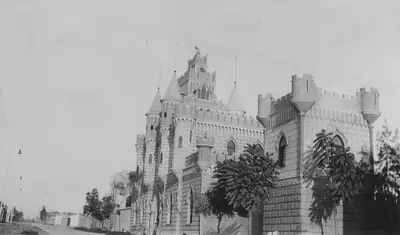
Castillo Rospigliosi is a small castle that also functions as a museum. Since 1959, part of the building has been occupied by the Aeronautical Museum of Peru, which was previously housed at Las Palmas Air Base.
Museo Pedro de Osma
The Museo Pedro de Osma is housed in the Casa de Osma and presents a collection of art from the virreinal period belonging to Pedro de Osma Gildemeister. The museum is administered by the Fundación Pedro y Angélica de Osma Gildemeister and was officially founded in 1987.
Museum of the Nation
The Museum of the Nation, or Museo de la Nación, was a public museum devoted to Peruvian art and history. It opened in 1990 in Lima’s San Borja District and operated for a time in a Brutalist building originally constructed as a government complex.
The museum housed thousands of objects covering Peru’s history, including ceramics from Moche, Nazca and Wari cultures. Its displays also included reproductions of important Andean artefacts, such as the Lanzón from Chavín de Huantar and the burial chamber of the Lord of Sipan. In 2014, its permanent exhibition closed in favour of the National Museum of Peru, after which the space was used for temporary displays.
Quinta de Presa
Quinta de Presa is an 18th-century French-style country mansion associated with the government of the viceroy Manuel de Amat y Junyent. It is sometimes mistakenly called the Perricholi Palace.
The estate has a constructed area of 15,159 square metres. In 2023, it was registered as the Quinta y Molino de Presa and listed as a World Heritage monument as part of the Historic Centre of Lima.
Explore Lima with Neywo
Neywo offers three walking tours in Lima, with routes ranging from 2.14 to 5.09 kilometres and lasting between 83 and 153 minutes. Together, they include 12, 5 and 10 narrated stops respectively, taking in places such as Plaza Mayor, the Cathedral of Lima, Torre Tagle Palace, Plaza San Martín, the Panteón de los Próceres and the Historic Centre of Lima.
Download Neywo and explore Lima with a self-guided audio tour. The app tells the story of each place as you reach it, at your own pace, with no group and no schedule. Narration is available in 11 languages.
Once you have explored the capital, discover more destinations in Peru, including Trujillo, Huanchaco and Arequipa.
Places with an audio guide in Lima
8 places in Lima with a Neywo audio guide. Each one starts telling its story as you reach it.
Self-guided tours in Lima
2 tours in Lima, free in the Neywo app. Each stop tells its story as you reach it.
- Walk
Plaza Mayor: the cathedral and the colonial balconies
Two kilometres of the UNESCO-listed centre — the cathedral where Pizarro is entombed, the government palace, the archbishop's palace, and the Torre Tagle and Osambela houses with their carved Moorish balconies.
St. Peter's Church · Torre Tagle Palace · Museo del Banco Central de Reserva del Perú · Cathedral of Lima · Plaza Mayor, Lima · Osambela House …
Open this tour: Plaza Mayor: the cathedral and the colonial balconies - Walk
Plaza San Martín and the Pantheon of the Heroes
Three kilometres north-west of the square: the university art museum, the crypt where Peru's independence dead are buried, the 1920s Plaza San Martín, and the Quinta de Presa rococo villa across the river.
Museo de Arte de San Marcos (UNMSM) · Panteón de los Próceres · Plaza San Martín · Torre Tagle Palace · Cathedral of Lima · Archbishop's Palace of Lima …
Open this tour: Plaza San Martín and the Pantheon of the Heroes
Walk Lima with Neywo
Neywo turns Lima into a self-guided audio tour. Stories arrive as you reach the place they belong to, and the route reshapes when you wander off it.

