What to See in Ljubljana, Slovenia: Free Audio Guide
Things to Do in Ljubljana: What to See in Slovenia’s Capital
Ljubljana is Slovenia’s compact, historic capital, known for its riverside old town, distinctive architecture, museums, and green urban atmosphere. The city is easy to explore on foot, with landmarks ranging from Ljubljana Castle and the Triple Bridge to the museums and galleries around Tivoli and the city centre. Neywo has a free audio guide for Ljubljana with 52 narrated places.
What to See in Ljubljana
Ljubljana Castle
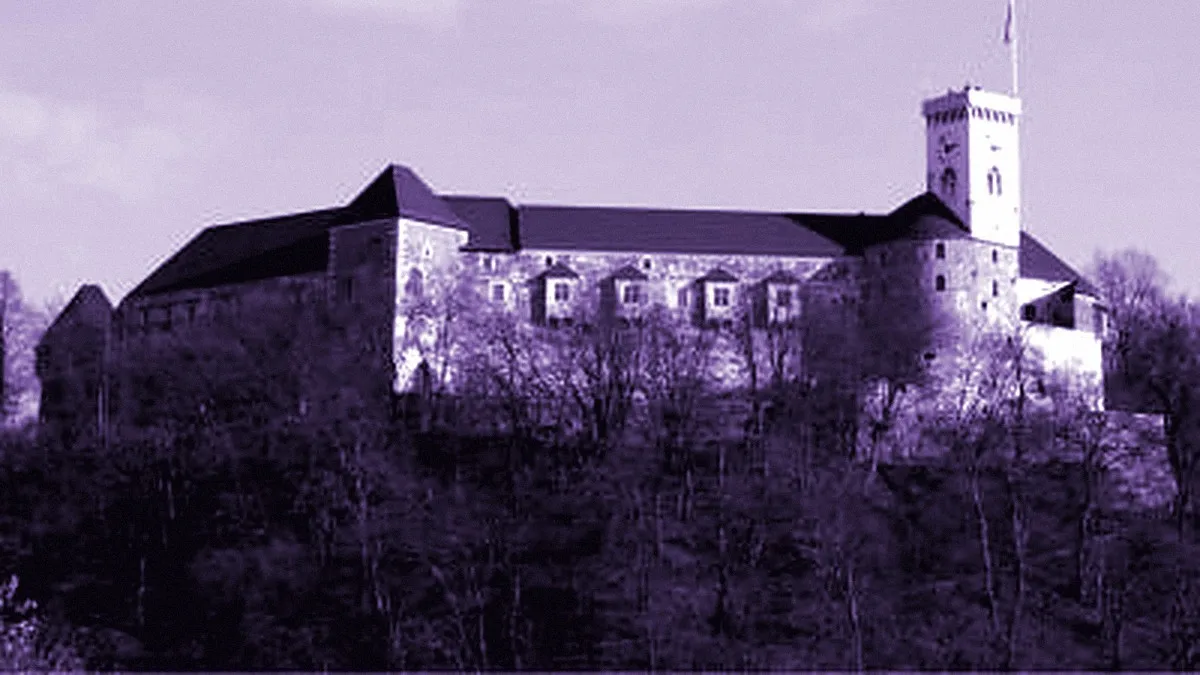
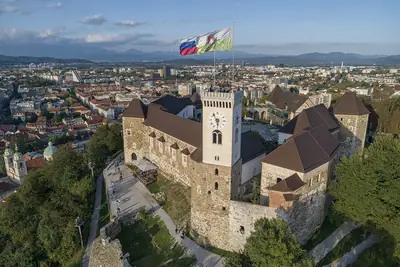
Ljubljana Castle stands above the historic centre on Castle Hill and has been one of the city’s defining landmarks for centuries. The complex began as a medieval fortress, probably built in the 11th century and rebuilt in the 12th. Its present outline took shape mainly through a major 15th-century overhaul, while many of the buildings visible today date from the 16th and 17th centuries.
The hill itself has a much longer history. Archaeological discoveries point to prehistoric settlement and later Roman activity before the medieval fortress was established. The Habsburgs rebuilt the castle in the 15th century to strengthen regional defences against Ottoman raids. Former prison cells remain part of the visitor route, adding another layer to the castle’s political and military history.
Triple Bridge and Prešeren Square
The Triple Bridge, or Tromostovje, crosses the Ljubljanica River between the medieval town and Prešeren Square. The crossing dates back to the 13th century and is considered Ljubljana’s oldest bridge.
In the early 1930s, architect Jože Plečnik transformed it by adding two pedestrian bridges beside the central crossing. The three bridges fan out at subtle angles, creating a unified gateway between the river and the square. Matching concrete balustrades, decorative lamps, trees, and carefully arranged paving bring the three structures together.
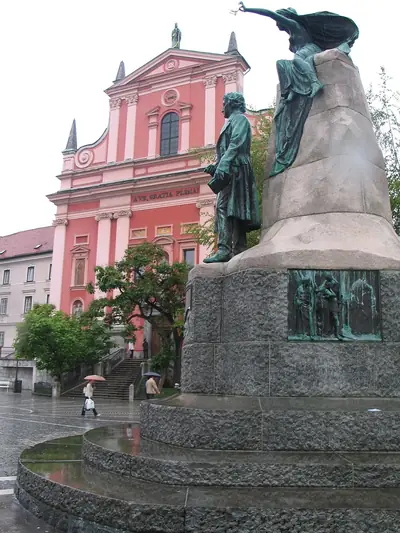
Prešeren Square is one of the best starting points for exploring the historic centre. The Franciscan Church of the Annunciation adds a distinctive pink façade to the square, while the river, bridges, and surrounding buildings create one of Ljubljana’s most recognisable city scenes.
Ljubljana Cathedral
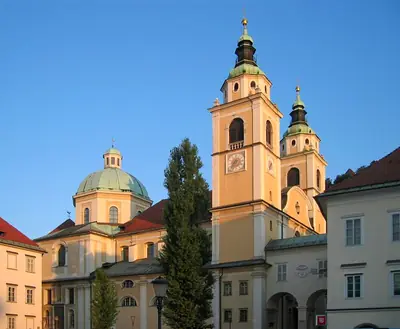
Ljubljana Cathedral rises above Cyril and Methodius Square with a green dome and twin towers. Dedicated to Saint Nicholas, it occupies the site of earlier churches, including a Romanesque church and a larger Gothic building damaged by fire in 1469.
The present Baroque cathedral was built between 1701 and 1706 according to plans by the Capuchin brother Florencijan, with the Italian artist Andrea Pozzo involved in its design. The stone dome was added later, in 1841, completing the silhouette associated with the cathedral today.
Inside, dome frescoes by Matevž Langus and an earlier illusionistic dome painting by Giulio Quaglio add depth to the decoration. Fragments from earlier churches can also be found outside, including a Gothic Pietà and a carved stone bear.
National Museum of Slovenia
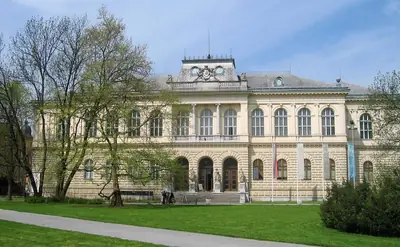
The National Museum of Slovenia is the country’s oldest cultural institution, operating continuously since its foundation in 1821. Its Neo-Renaissance building was constructed between 1883 and 1885 and opened to the public in 1888. It shares the building with the Slovenian Museum of Natural History.
The museum’s collections include archaeological artefacts, old coins and banknotes, and objects connected with the applied arts. Among its best-known highlights are the Divje Babe Neanderthal flute, described as 60,000 years old, and the Vače Situla from the 5th century BC, decorated with scenes of processions and feasts. The main staircase is decorated with an 1885 fresco by Janez and Jurij Šubic.
National Gallery of Slovenia
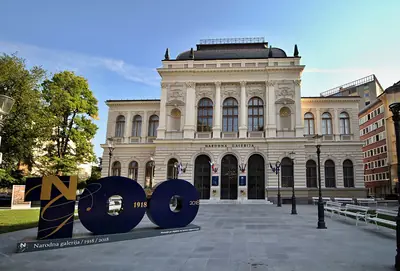
The National Gallery of Slovenia is the country’s main museum for historic art, with works ranging from the Middle Ages to the early 20th century. Founded in 1918, it moved to its present location in 1925.
The gallery occupies the Narodni dom, a Neo-Renaissance building completed in 1896. A glass extension connects the historic exhibition spaces and introduces a modern architectural element. The permanent collection includes medieval religious sculptures, Baroque paintings, Neoclassical works, Realism, and Slovenian Impressionism.
One of the works associated with the collection is Ivana Kobilca’s Kofetarica, painted in 1888 and showing a woman drinking coffee. The entrance hall also contains the original Fountain of the Three Carniolan Rivers, created by Francesco Robba.
Museum of Modern Art
The Museum of Modern Art, known in Slovene as Moderna galerija, focuses on Slovenian art from the 20th and 21st centuries. Its building was designed by Edvard Ravnikar in the 1930s, shortly after his studies with Jože Plečnik and before his training with Le Corbusier in Paris. Construction began in 1939, was interrupted during the Second World War, and the museum opened in 1948.
The collection follows Slovenian art from Impressionism to the post-war avant-garde. It also includes newspapers, posters, drawings, and prints created by the resistance during the 1940s. The museum hosted the first International Biennial of Graphic Arts in 1955, an event credited with helping establish Slovenia as an important centre for printmaking.
City Museum of Ljubljana
The City Museum of Ljubljana occupies a palace associated with the remains of Roman Emona. Roman remains are preserved beneath the building, making the museum a particularly useful place to explore the city’s earliest history and later development.
The museum was established in 1935 to collect and present objects connected with Ljubljana. Its first collection opened in 1937 and explored the living culture of the townspeople from the late Middle Ages to the first half of the 19th century. The museum remains closely connected to the city’s social, cultural, and urban history.
Plečnik House
Plečnik House preserves the home and studio of Jože Plečnik, one of Slovenia’s best-known architects. Plečnik lived there from 1921 until his death in 1957, and the interiors retain his furniture, books, drawings, tools, models, and personal belongings.
The complex includes an older family house and a cylindrical extension designed by Plečnik as his private workspace. Rooms such as the drawing room, bedroom, library, workshop, and winter garden reveal both his daily life and his working methods. The property was bought by the city in 1957, opened to the public in 1974, and comprehensively renovated between 2013 and 2015.
International Centre of Graphic Arts
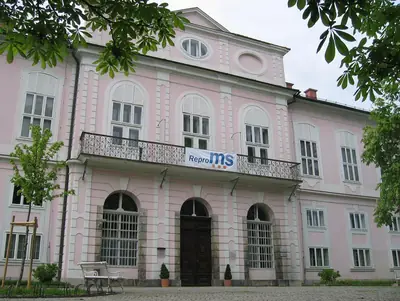
The International Centre of Graphic Arts, or MGLC, occupies Tivoli Mansion and has been the home of the Ljubljana Biennial of Graphic Arts since 1986. Four cast-iron dogs attributed to sculptor Anton Dominik Fernkorn stand on the entrance steps.
The centre holds prints and artist books created after the Second World War, as well as posters, fanzines, and other printed ephemera. It also has workshops and studios where visiting artists work with graphic processes, so the institution combines collecting, exhibitions, and production.
Slovene Ethnographic Museum
The Slovene Ethnographic Museum explores everyday life, customs, crafts, and identity in Slovenia. Its roots lie in collections formed within the ethnography department of the Provincial Museum of Carniola. An independent ethnographic institution took shape in 1921, and the museum adopted its current name in 1941.
The museum occupies a former Habsburg military barracks complex built between 1886 and 1889. Its exhibitions combine historic objects, photographs, films, and interactive interpretation, connecting material culture with the people and traditions behind it.
More museums and unusual places
Ljubljana offers several other stops for visitors interested in history, science, and culture. The National Museum of Contemporary History presents Slovenia’s recent past through objects, photographs, films, and multimedia displays, including the world wars, socialist Yugoslavia, independence in 1991, and later political and social developments.
At Hiša eksperimentov, Slovenia’s first science centre, visitors investigate physics, mathematics, biology, engineering, and human perception through experiments. Its activities include a bed of nails, a pulley system, and a giant soap bubble station.
The Slovenian Railway Museum presents historic locomotives, carriages, machinery, and railway equipment. Its locomotive rotunda displays around ten preserved steam locomotives, while the wider collection contains more than sixty locomotives and more than fifty other vehicles.
For contemporary and experimental art, Škuc Gallery has operated in the ground-floor spaces at Stari trg 21 since 1978. Its programme includes painting, photography, video, installation, performance, and socially engaged projects.
Explore Ljubljana with a Free Audio Guide
A Ljubljana self-guided walking tour with Neywo lets you discover the city at your own pace. The app offers 4 walking tours, 1 bus route, and 1 bike route, with 52 narrated places across Ljubljana. Narration is available in 11 languages.
The walks include:
- Museum Square and Congress Square: 1.44 km, 88 minutes, 12 stops
- The Castle, the Triple Bridge and the Dragon Bridge: 1.25 km, 84 minutes, 12 stops
- Old Square and Plečnik’s library: 2.01 km, 86 minutes, 12 stops
- The Ultimate Ljubljana: the museums to the castle: 2.42 km, 91 minutes, 7 stops
There is also a 2.1 km bus route lasting 9 minutes with 4 stops, and a 2.5 km bike route lasting 12 minutes with 7 stops. Neywo tells the story of each place as you reach it, at your own pace, with no group and no schedule. Download Neywo and explore Ljubljana while you walk, ride, or travel through the city.
If you are continuing through Slovenia, Ljubljana is a useful base for discovering other destinations, including Bled, Piran, Kobarid, Škofja Loka, and Celje.
Places with an audio guide in Ljubljana
8 places in Ljubljana with a Neywo audio guide. Each one starts telling its story as you reach it.
Self-guided tours in Ljubljana
6 tours in Ljubljana, free in the Neywo app. Each stop tells its story as you reach it.
- Bike ride
Museums to the Dragon Bridge by Bike
A short, flat ride on Ljubljana's cycle lanes. Start by the National Gallery and National Museum, roll past the Ursuline Church and the Nebotičnik skyscraper, then reach the Trubar church, cross to the pink Franciscan church on Prešeren Square and finish at the Dragon Bridge and its four copper dragons.
National Gallery of Slovenia · National Museum of Slovenia · Ursuline Church of the Holy Trinity · Nebotičnik · Primož Trubar Evangelical Church · Franciscan Church of the Annunciation …
Open this tour: Museums to the Dragon Bridge by Bike - Bus ride
Bus 3: Trubar Church to St James along Slovenska
LPP's line 3 is one of Ljubljana's main city lines. Heading south from Litostroj it runs along Gosposvetska and Slovenska cesta, the spine of the modern centre outside the pedestrian old town. Ride it past the Trubar Evangelical Church, Nebotičnik (the 1933 skyscraper), the Ursuline Church and St James.
Primož Trubar Evangelical Church · Nebotičnik · Ursuline Church of the Holy Trinity · St. James' Church
Open this tour: Bus 3: Trubar Church to St James along Slovenska - Walk
Museum Square and Congress Square
Ljubljana's institutions in a kilometre and a half — the National Gallery, the Museum of Modern Art, the National Museum, the opera and the parliament — ending in the park below the castle.
National Gallery of Slovenia · Museum of Modern Art · National Museum of Slovenia · Opera Ljubljana · National Assembly Building · Maximarket …
Open this tour: Museum Square and Congress Square - Walk
The Castle, the Triple Bridge and the Dragon Bridge
The right bank and the hill above it: the castle for the view over the red roofs, the cathedral's bronze doors, and Plečnik's Triple Bridge and market colonnade along the Ljubljanica.
Ljubljana Castle · Ljubljana Town Hall · Town Square · Kresija Palace · Triple Bridge · Hauptmann House …
Open this tour: The Castle, the Triple Bridge and the Dragon Bridge - Walk
Old Square and Plečnik's library
Two kilometres on the left bank — the medieval Stari trg, the city museum, the Cobblers' Bridge, and Plečnik's National and University Library, whose dark entrance hall opens into light on purpose.
St. Florian's Church · St. James' Church · Škuc Gallery · Old Square · City Museum of Ljubljana · Our Lady of Help Church …
Open this tour: Old Square and Plečnik's library - Walk
The Ultimate Ljubljana: the museums to the castle
Two and a half kilometres and the whole city: the national museums, the Triple Bridge, the cathedral and the climb to the castle. Ljubljana is small enough that this really is all of it.
National Museum of Contemporary History · National Gallery of Slovenia · Museum of Modern Art · National Museum of Slovenia · Triple Bridge · Ljubljana Cathedral …
Open this tour: The Ultimate Ljubljana: the museums to the castle
Walk Ljubljana with Neywo
Neywo turns Ljubljana into a self-guided audio tour. Stories arrive as you reach the place they belong to, and the route reshapes when you wander off it.

