Things to Do in Norfolk, United States: Walking Guide
Things to Do in Norfolk, Virginia: A Self-Guided Tour of the City
Looking for things to do in Norfolk? This waterfront city brings together naval history, historic churches, Victorian architecture, museums and performing arts venues. From the decks of USS Wisconsin to the galleries of the Chrysler Museum of Art, Norfolk offers a varied introduction to the cultural and military history of Virginia. Neywo has a free audio guide for Norfolk with 41 narrated places, so you can explore while the story plays as you arrive.
What to See in Norfolk
USS Wisconsin and Nauticus
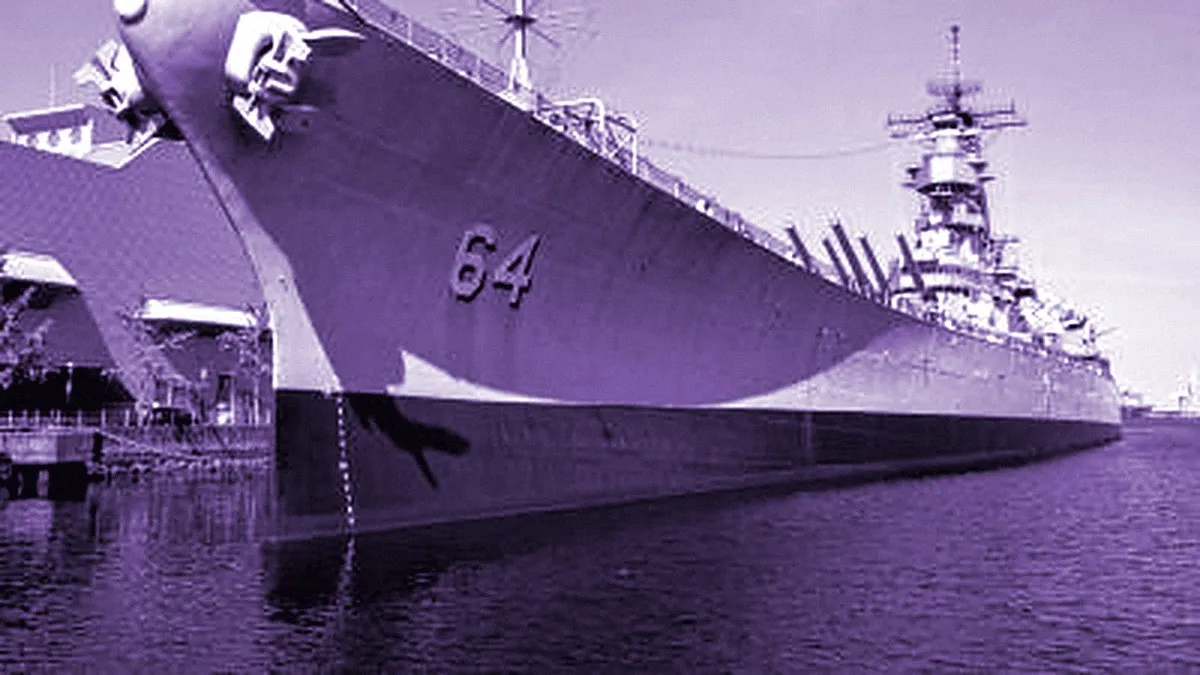
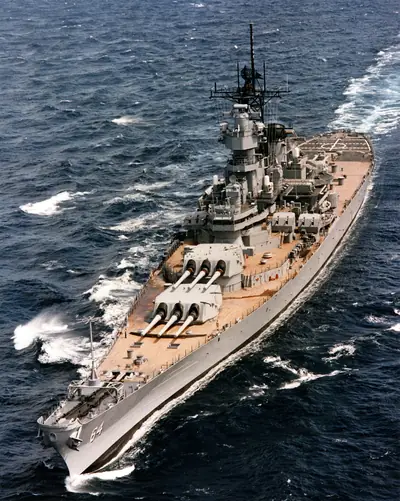
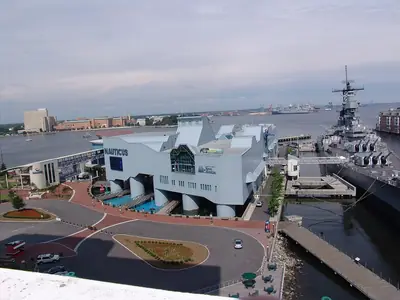
Begin on the downtown waterfront with USS Wisconsin, also known as Battleship Wisconsin or BB-64. This Iowa-class battleship was completed in 1944 and served in the Pacific Theater during World War II, including the Philippines campaign and the battles of Iwo Jima and Okinawa. It later returned to combat during the Korean War and was reactivated in 1986 before taking part in Operation Desert Storm in January and February 1991.
The ship was finally decommissioned in September 1991. It earned six battle stars for service in World War II and Korea, as well as a Navy Unit Commendation for its role in the 1991 Gulf War. Since 2006, it has been preserved as a museum ship, where the main and upper decks convey the scale of life aboard a battleship.
Next door, Nauticus—also known as the National Maritime Center—combines interactive exhibits, aquariums, theaters and educational experiences. The museum includes access to USS Wisconsin, while younger visitors can explore Aquaticus, an underwater-themed space with slides, sensory activities and interactive features.
Fort Norfolk
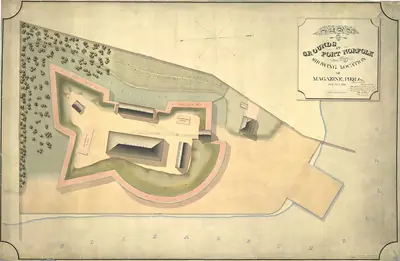
Fort Norfolk preserves part of the harbor defenses built between 1795 and 1809. The historic fort encloses eleven buildings, including the main gate, guardhouse, officers’ quarters, powder magazine and carpenter’s shop.
It is the last remaining fortification of George Washington’s eighteenth-century harbor defenses, later known as the first system of United States fortifications. The site also has a later military role: since 1923, it has served as the district office for the U.S. Army Engineer District, Norfolk.
MacArthur Memorial
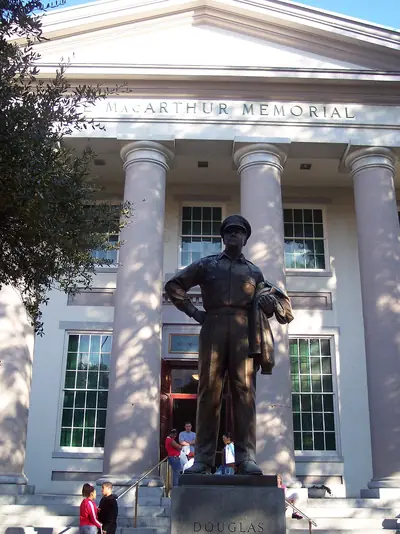
At MacArthur Square, the MacArthur Memorial brings together a museum, mausoleum and research center dedicated to General Douglas MacArthur. The main memorial occupies Norfolk’s former City Hall, a neoclassical building centered on a domed Rotunda.
Beneath the dome, MacArthur and his wife, Jean, rest in crypts. Nine galleries display photographs, uniforms, flags, medals, weapons, paintings, sculptures and personal objects connected with his life and military career. MacArthur chose Norfolk as his burial place because his mother, Mary Pinkney—known as Pinky—was born and raised there.
Basilica of Saint Mary of the Immaculate Conception
Known locally as the Mother Church of Tidewater Virginia and also as the Black Basilica, the Basilica of Saint Mary of the Immaculate Conception has roots reaching back to 1791. The parish began as Saint Patrick’s, established by French émigré Catholics, and is the oldest parish in the Diocese of Richmond.
The present church was built in 1857 and 1858 after the earlier building was lost in a suspected arson fire. Its Late Gothic Revival exterior includes a three-stage tower and slender spire. Inside, soaring vaults, graceful columns and stained-glass windows made by Mayer and Company of Munich add detail to the space.
Chrysler Museum of Art
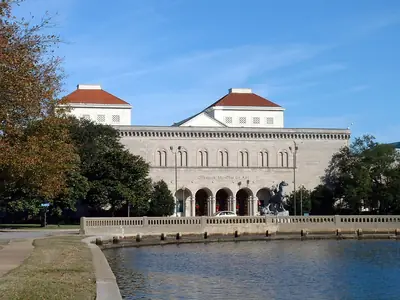
On the border between downtown Norfolk and Ghent, the Chrysler Museum of Art houses more than 35,000 objects spanning 5,000 years. Its collection includes ancient artifacts, European and American paintings and sculpture, Cubist and modernist works, photography, decorative arts and an exceptional glass collection.
The museum’s growth changed significantly in 1971, when automotive heir Walter P. Chrysler Jr. donated most of his personal collection. Among the artists represented are Tintoretto, Bernini, Manet, Matisse, Pollock and Warhol. Notable works include Bernini’s marble bust of Jesus Christ and Thomas Moran’s Salvator Rosa Sketching the Banditi.
Hunter House Victorian Museum
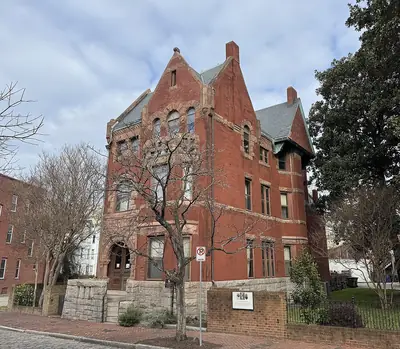
In Norfolk’s Historic Freemason District, Hunter House Victorian Museum offers a close look at domestic life in the late nineteenth century. Built in 1894, the red-brick house was designed by Boston architect William Pitt Wentworth in the Richardsonian Romanesque style.
Curved walls, stained-glass cabinetry, pocket doors and a lavish walk-in closet reveal the character of the home. The house also preserves the story of the Hunter siblings, James Junior, Harriet and Eloise, who never married and lived their entire lives there. After Eloise died in 1965, the house remained untouched until it opened as a museum in 1988.
Christ and St. Luke’s Church
Christ and St. Luke’s Church traces its history to Elizabeth River Parish, founded in the late 1630s. The present building, completed in 1909 and 1910, is a notable example of English Perpendicular Gothic Revival architecture.
Its rough-faced stone walls, tall four-stage corner tower, battlements and pinnacles create a strong presence. Inside, the carved Newton Memorial reredos stands behind the altar, while statues honor figures including Saint Monica, Saint Hilda and Pocahontas.
Attucks Theatre
The Attucks Theatre opened in 1919 at the intersection of Church Street and Virginia Beach Boulevard. Financed, designed and built by African American entrepreneurs, it became known as the Apollo Theatre of the South.
Its stage welcomed Duke Ellington, Cab Calloway, Ella Fitzgerald, Red Foxx and Louis Armstrong, as well as Norfolk’s Gary U.S. Bonds and Portsmouth’s Ruth Brown. Added to the National Register of Historic Places in 1982, the theatre reopened in 2004 after a three-year restoration.
Annunciation Greek Orthodox Cathedral
The Annunciation Greek Orthodox Cathedral reflects more than a century of Greek Orthodox life in Norfolk. The community acquired its own building in 1913, while the present church was completed in 1955 and the Hellenic Center followed in 1959.
The cathedral combines Byzantine-inspired design with American ecclesiastical architecture. Its dome rises over a Greek-cross floor plan, and the iconostasis—the decorative partition covered with icons—separates the nave from the sanctuary.
The Hermitage Foundation
The Hermitage Foundation combines art, architecture and gardens in a former summer retreat. William and Florence Sloane began with a five-room Arts and Crafts-style home, which expanded to 42 rooms by 1936 as their collection grew.
The Sloanes established the Hermitage Foundation in 1937, giving the house, its contents and the gardens to the nonprofit organization. The museum opened to the public in 1942. Its collection spans more than 5,000 years and cultures from over 30 countries, while the formal garden rooms include Eastern red cedars, live oaks, a Himalayan cedar, camellias, azaleas and native trees.
More places to explore
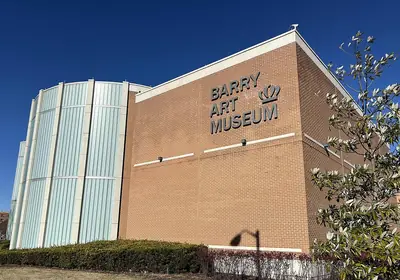
Norfolk’s cultural landscape also includes the Barry Art Museum, Chrysler Hall and Epworth United Methodist Church. Chrysler Hall, built in 1972 beside Norfolk Scope, is the city’s primary theatre and concert space. Epworth United Methodist Church is known for its Richardsonian Romanesque design, granite walls, yellow sandstone details and 22 stained-glass windows, including the Ascension window and two Tiffany windows.
The city’s naval presence extends beyond museum ships. USS Harry S. Truman, a Nimitz-class aircraft carrier homeported at Naval Station Norfolk, measures 1,092 feet in length and rises 244 feet high. Its flight deck covers 4.5 acres and can accommodate around 90 aircraft.
Explore Norfolk with Neywo
Neywo offers 3 walking tours, 1 bus route and 1 bike route in Norfolk, with narration available in 11 languages.
- Three walking tours:
- From Battleship to General: Norfolk’s Waterfront — 2.56 km, 82 minutes, 9 narrated stops
- Ghent and Freemason: Brick, Steeples and Opera — 3.33 km, 92 minutes, 9 narrated stops
- Church Street and East Bute: Norfolk’s Black Heritage — 1.15 km, 36 minutes, 4 narrated stops
- One bus route: Ghent to Downtown by Bus — 5.6 km, 24 minutes, 5 narrated stops
- One bike route: Elizabeth River Waterfront Ride — 1.1 km, 6 minutes, 3 narrated stops
Download Neywo and explore Norfolk at your own pace. The app tells the story of each place as you reach it, with no group and no schedule. When you continue exploring Virginia Beach, Richmond or elsewhere in the United States, Neywo’s city audio guides can accompany you there too.
Places with an audio guide in Norfolk
8 places in Norfolk with a Neywo audio guide. Each one starts telling its story as you reach it.

Self-guided tours in Norfolk
5 tours in Norfolk, free in the Neywo app. Each stop tells its story as you reach it.
- Bike ride
Elizabeth River Waterfront Ride
A short, flat ride along downtown Norfolk's riverfront bike lanes from the Waterside District to Town Point Park and the battleship Wisconsin.
Waterside · Town Point Park · USS Wisconsin
Open this tour: Elizabeth River Waterfront Ride - Bus ride
Route 2: Ghent to Downtown by Bus
HRT Route 2 runs from the Chrysler Museum through Ghent and into downtown Norfolk. Ride it past Christ and St. Luke's and the Harrison Opera House to two historic Black churches near the downtown transit center.
Chrysler Museum of Art · Christ and St. Luke's Church · Harrison Opera House · First Baptist Church · St. John's African Methodist Episcopal Church (Norfolk, Virginia)
Open this tour: Route 2: Ghent to Downtown by Bus - Walk
From Battleship to General: Norfolk's Waterfront
Start under the guns of USS Wisconsin and follow the Elizabeth River into the heart of downtown. You will pass Nauticus, Town Point Park with its armed forces memorial, a Greek Revival Custom House, the Waterside promenade, a Beaux-Arts vaudeville palace, the tomb of General MacArthur and the only colonial building to survive Norfolk's burning in 1776.
USS Wisconsin · Nauticus · Town Point Park · Owen B. Pickett United States Custom House · Waterside · Wells Theater …
Open this tour: From Battleship to General: Norfolk's Waterfront - Walk
Ghent and Freemason: Brick, Steeples and Opera
Walk Norfolk's historic Ghent and Freemason districts from an English Gothic church and the Harrison Opera House to a world-class art museum and red-brick Victorian houses. Along the way you pass Gothic and Methodist churches, the NorVa, an 18th-century merchant's house and Chrysler Hall.
Christ and St. Luke's Church · Harrison Opera House · Chrysler Museum of Art · Hunter House Victorian Museum · Epworth United Methodist Church · Norva Theatre …
Open this tour: Ghent and Freemason: Brick, Steeples and Opera - Walk
Church Street and East Bute: Norfolk's Black Heritage
Visit the landmarks of Norfolk's African American community: two historic Black churches with Romanesque towers, the Attucks Theatre that its founders called the Apollo of the South, and the First Calvary Baptist Church with its stained-glass dome.
First Baptist Church · St. John's African Methodist Episcopal Church (Norfolk, Virginia) · Attucks Theatre · First Calvary Baptist Church
Open this tour: Church Street and East Bute: Norfolk's Black Heritage
Walk Norfolk with Neywo
Neywo turns Norfolk into a self-guided audio tour. Stories arrive as you reach the place they belong to, and the route reshapes when you wander off it.

