Visiting Williamsburg, United States: Top Sights on Foot
Things to do in Williamsburg, Virginia
The best things to do in Williamsburg include exploring Colonial Williamsburg, visiting historic churches and museums, and discovering the College of William & Mary and the city’s Black history. Once Virginia’s colonial capital, Williamsburg brings the eighteenth century to life through preserved buildings, reconstructed landmarks, and museums that connect the past with the present. Neywo offers a free audio guide for Williamsburg with 31 narrated places.
Williamsburg is part of Virginia, in the United States, and is especially rewarding to explore on foot. Its historic centre brings together political, religious, educational, and cultural landmarks within a compact area.
What to see in Williamsburg
Colonial Williamsburg
Colonial Williamsburg is a living history museum in the Williamsburg Historic District, the historic heart of the city. Its restored buildings and collections recreate life in eighteenth-century America, making it more than a traditional museum visit. The district presents Williamsburg as it was when it served as the capital of colonial Virginia.
Several of the city’s most important landmarks are here, including the Capitol, the Governor’s Palace, Raleigh Tavern, Bruton Parish Church, and the Williamsburg Bray School.
Capitol
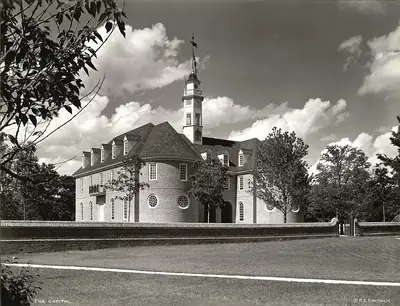
The Capitol was built in 1705, when Virginia moved its seat of government from Jamestown to Williamsburg. For 75 years, the General Assembly, the Governor’s Council, and the House of Burgesses met here. Patrick Henry, George Washington, and Thomas Jefferson all served as young legislators in its chambers.
The current building is a reconstruction on the original foundation. The first Capitol was destroyed by fire in 1747, and a second building stood until the capital moved to Richmond in 1780.
Governor’s Palace
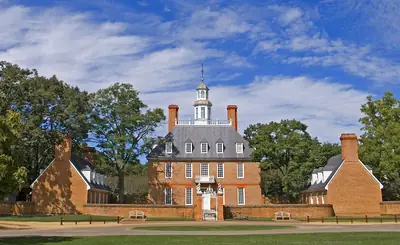
The Governor’s Palace was the official residence of Virginia’s royal governors. Construction began in 1706 and finished in 1722. Seven royal governors lived there over 60 years, and the building was designed to display the authority of the British Crown.
During the Battle of Yorktown in 1781, the Palace became a hospital for wounded American soldiers. A fire destroyed the main structure later that year, but the Colonial Williamsburg Foundation acquired the site in 1928 and reconstructed the building in the 1930s.
Bruton Parish Church
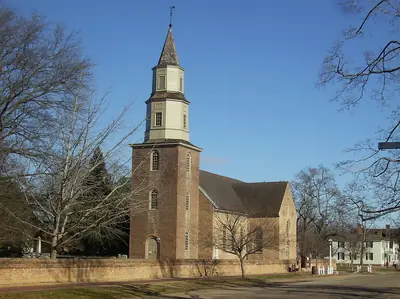
Bruton Parish Church has been a place of worship for more than three centuries and remains an active Episcopal parish. The parish was established in 1674 when two earlier Virginia parishes were consolidated. The present brick church was built between 1711 and 1715.
Inside, box pews, a high pulpit, and clear glass windows reflect the simple elegance of an early colonial parish church. The adjoining Bruton Parish Episcopal Church Cemetery is also included among the historic places to explore in the area.
Raleigh Tavern
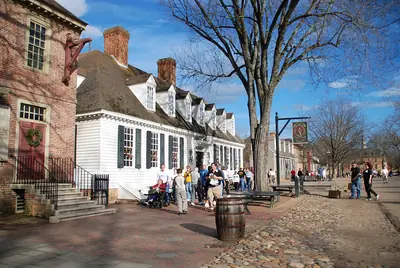
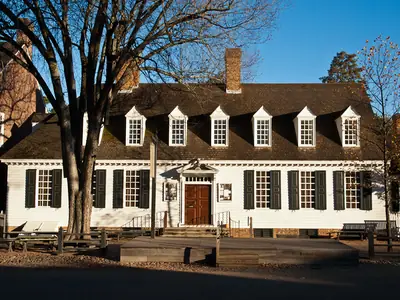
Raleigh Tavern was one of colonial Virginia’s largest taverns and became an important meeting place during the political tensions with the Crown. When royal governors dissolved the House of Burgesses, elected representatives gathered here to continue their work.
The tavern also has an important place in academic history: on December 5, 1776, students founded the Phi Beta Kappa Society in its rooms. The present building is a reconstruction completed between 1930 and 1931, the first structure rebuilt and opened as part of the Colonial Williamsburg restoration. Today it operates as a museum.
St. George Tucker House
Built in 1718 and 1719, the St. George Tucker House is one of the original colonial homes still standing in Historic Williamsburg. It was first built for William Levingston, who constructed the first theatre in America, and later became associated with St. George Tucker, a lawyer, College of William & Mary law professor, and judge.
The house expanded over time with additional chimneys, a second storey, wings, a kitchen, and bathrooms. Because the Tucker family kept detailed records, it is the most thoroughly documented home in Williamsburg. The house also hosted Williamsburg’s first Christmas tree in 1842.
Williamsburg Bray School
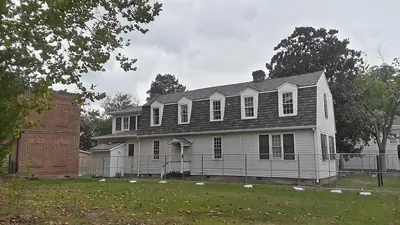
The Williamsburg Bray School is the oldest surviving building in the United States dedicated to educating Black children. It opened in 1760 and served both free and enslaved Black children for 14 years.
The building has also been known as the Dudley Digges House and the Bray-Digges House. After later changes of ownership and use, it was moved to the College of William & Mary campus in 1930. In February 2023, it was moved again, returning to Colonial Williamsburg’s historic area.
The College of William & Mary
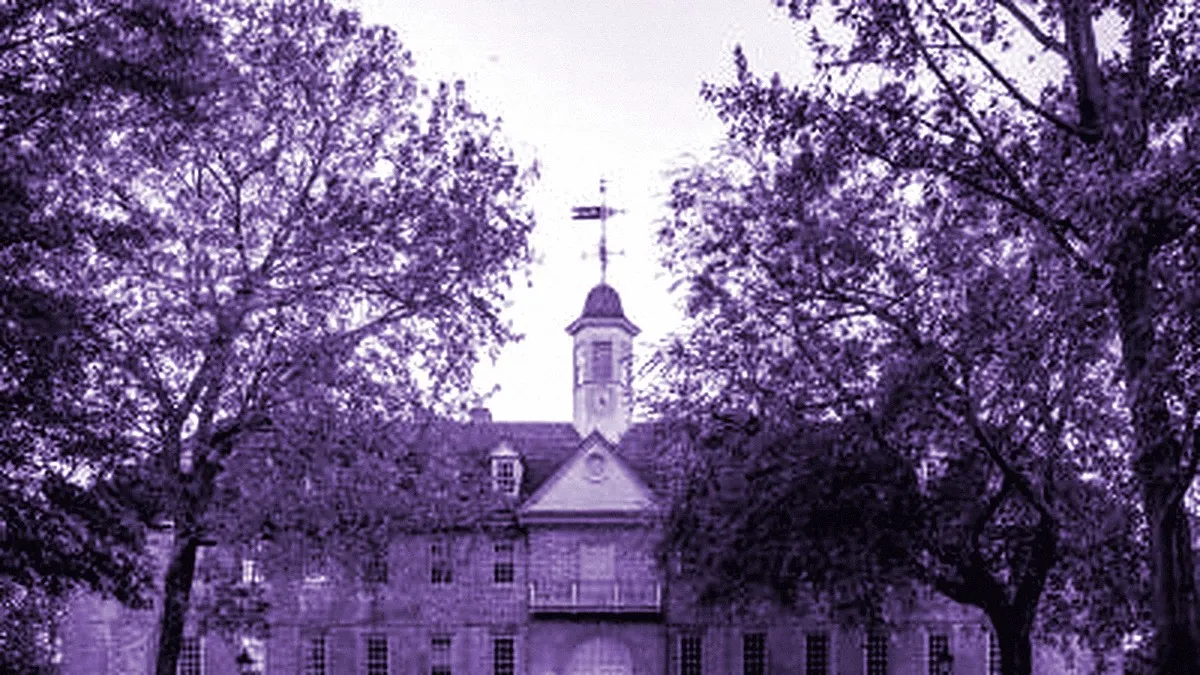
Founded in 1693 by royal charter from King William III and Queen Mary II, the College of William & Mary is the second-oldest institution of higher learning in the United States. It is one of the original nine colonial colleges.
The historic campus includes the Wren Building, the oldest academic building still in use in the United States. The college is also associated with several notable firsts, including the nation’s first honour code, adopted in 1736, and the founding of Phi Beta Kappa in 1776.
Muscarelle Museum of Art
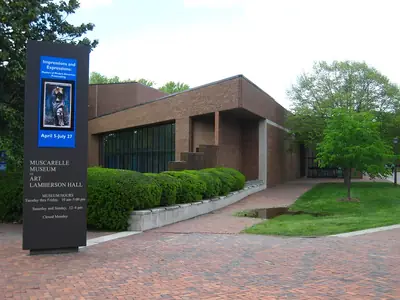
Located on the William & Mary campus, the Muscarelle Museum of Art opened in 1983. Its collection began with a portrait of the physicist Robert Boyle, donated to the campus in 1732, and grew through gifts from alumni and friends of the university.
The museum now holds more than 5,000 works from across centuries and continents. Its collection includes colonial portraits, modern and contemporary art, and works connected with the history of Virginia and the college. Portraits of prominent Virginia families form an important part of its early collection.
Art Museums of Colonial Williamsburg
The Art Museums of Colonial Williamsburg bring together the DeWitt Wallace Decorative Arts Museum and the Abby Aldrich Rockefeller Folk Art Museum. Opened together in 1985, the complex presents American art and craftsmanship from the seventeenth through the nineteenth centuries.
The DeWitt Wallace Decorative Arts Museum focuses on British and American fine and decorative arts from 1670 to 1840. Its collections include furniture, paintings, silver, ceramics, textiles, glass, maps, weapons, tools, and early coins. The complex also includes the Abby Aldrich Rockefeller Folk Art Museum and a street-level entrance added in 2019.
Bassett Hall and Tayloe House
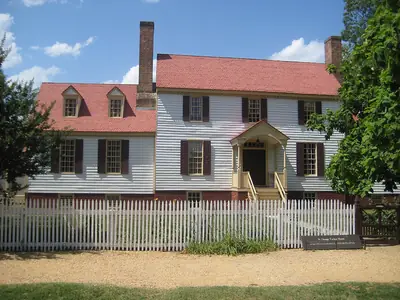
Bassett Hall is an eighteenth-century farmhouse with a significant connection to the restoration of Williamsburg. The Rockefellers directed the transformation of the city into the living history museum from this modest building.
On East Nicholson Street, the Tayloe House is an eighteenth-century residence built between 1752 and 1759. Colonial Williamsburg restored it to reflect its colonial appearance. Tayloe served on the King’s Council, represented the colony in the House of Burgesses in 1774, and later joined the first Republic Council under Governor Patrick Henry.
First Baptist Church
First Baptist Church traces its origins to 1776, when enslaved and free Black men and women gathered secretly at Green Spring Plantation. Their first leader was Reverend Moses, a free Black itinerant preacher. By 1781, the congregation had formally organised as Baptists under Reverend Gowan Pamphlet, an enslaved man living in Williamsburg.
The congregation became known as First Baptist Church of Williamsburg in 1863. The present brick Colonial Revival building on Scotland Street was completed in 1956.
Kimball Theatre
Kimball Theatre has been a cultural gathering place in Merchants Square since 1933. It opened on January 12 that year with a production of The Recruiting Officer performed by students from the College of William & Mary.
Its first programme combined live theatre with cinema, including newsreels and Mickey Mouse cartoons. The theatre continues to host films, live performances, and community events.
Explore Williamsburg with a self-guided audio tour
A Williamsburg self-guided walking tour lets you explore the historic district without joining a group or following a fixed timetable. Neywo has two walking tours in Williamsburg, with 17 narrated stops in total:
- Capital of Colonial Virginia: Duke of Gloucester Street — 2.36 km, 87 minutes, 11 stops.
- Second-Oldest College: William & Mary and Williamsburg’s Black History — 3.55 km, 80 minutes, 6 stops.
The tours cover landmarks including Bassett Hall, the Capitol, Raleigh Tavern, the Governor’s Palace, Bruton Parish Church, the Williamsburg Bray School, the DeWitt Wallace Decorative Arts Museum, First Baptist Church, the College of William & Mary, and the Muscarelle Museum of Art.
Download Neywo and explore Williamsburg at your own pace. The app tells the story of each place as you reach it, with no group and no schedule. Its narration is available in 11 languages, making it a practical Williamsburg audio guide for discovering the city independently. When planning a wider trip through the state, you can also continue to Richmond, Norfolk, or Virginia Beach.
Places with an audio guide in Williamsburg
8 places in Williamsburg with a Neywo audio guide. Each one starts telling its story as you reach it.
Self-guided tours in Williamsburg
2 tours in Williamsburg, free in the Neywo app. Each stop tells its story as you reach it.
- Walk
Capital of Colonial Virginia: Duke of Gloucester Street
For most of the 18th century Williamsburg was the political heart of Virginia. Start at Bassett Hall, the farmhouse where the Rockefellers lived during the restoration, then walk the restored historic area from the Capitol and Raleigh Tavern, where burgesses met after the governor dissolved them, past colonial homes to the Governor's Palace, Bruton Parish Church and its graveyard, and the Bray School.
Bassett Hall · Capitol · Raleigh Tavern · Ludwell–Paradise House · Tayloe House · St. George Tucker House …
Open this tour: Capital of Colonial Virginia: Duke of Gloucester Street - Walk
Second-Oldest College: William & Mary and Williamsburg's Black History
The College of William & Mary dates from 1693 and has the oldest academic building still in use in the country. This walk links the Wren Building and the campus with the memorial to the people the college enslaved, the museum of art, and the First Baptist Church, whose congregation began in secret in 1776, and ends at the open-air amphitheatre by Lake Matoaka.
First Baptist Church · Hearth: Memorial to the Enslaved · Campus of the College of William & Mary · Muscarelle Museum of Art · College of William & Mary · Lake Matoaka Amphitheatre
Open this tour: Second-Oldest College: William & Mary and Williamsburg's Black History
Walk Williamsburg with Neywo
Neywo turns Williamsburg into a self-guided audio tour. Stories arrive as you reach the place they belong to, and the route reshapes when you wander off it.

