What to See in Khiva, Uzbekistan: Free Audio Guide
Things to Do in Khiva, Uzbekistan
Khiva is a historic city in Uzbekistan, best known for Itchan Kala, its exceptionally concentrated walled centre of mosques, madrasas, palaces, minarets and traditional houses. Once the capital of the Khanate of Khiva and an important centre of Khorezm, it offers one of the clearest ways to experience the architectural heritage of the Great Silk Road. Neywo has a free audio guide for Khiva with 15 narrated places, available in 11 languages.
What to See in Khiva
Most of the main sights are in or around Itchan Kala, the ancient inner city. This compact historic district is the natural starting point for exploring Khiva, whether you follow a route or wander between its monuments.
Ota Darvoza
Ota Darvoza, also known as Aa Darvoza or the Shermuhammad Gate, is the western entrance to Itchan Kala. Built in 1828 and 1829 during the rule of Olloqulixon, it served as the main entrance to the fortress and makes a fitting starting point for discovering the walled city.
Muhammad Amin Khan Madrasa
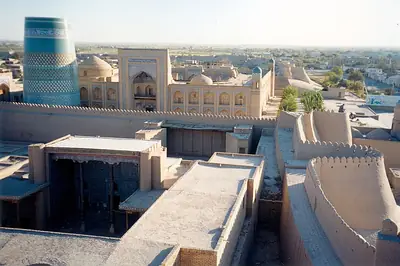
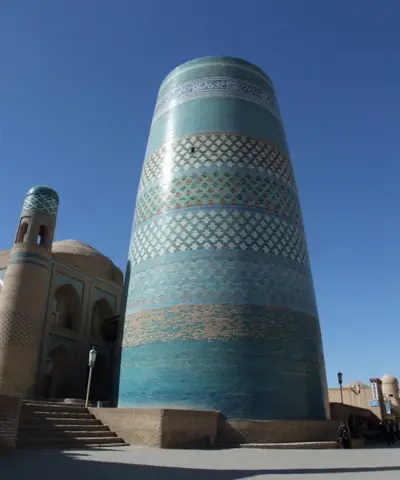
Near the western side of Itchan Kala, the Muhammad Amin Khan Madrasa stands beside Kalta Minor. Built between 1852 and 1855, it was commissioned by the Uzbek ruler Muhammad Amin Khan. Its large scale and particularly rich tiled decoration make it one of the most impressive madrasas in Khiva.
Kalta Minor
Kalta Minor is one of Khiva’s most recognisable landmarks. The unusual minaret rises in front of the Muhammad Amin Khan Madrasa, but it was never completed. Its name comes from Uzbek words meaning a short or small minaret, a reference to its unfinished form.
Ko’hna Ark
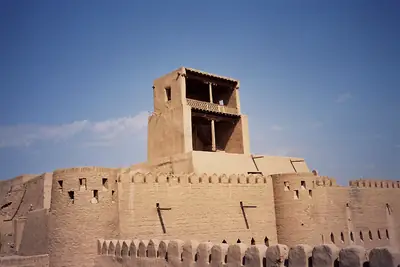
Ko’hna Ark, or Konya Ark, was the Old Fortress and a city within the city. Located in the western part of Itchan Kala, it served as a residence of the Khans of Khorezm until the fall of the Khanate of Khiva in 1920.
The citadel developed between the seventeenth century and the middle of the nineteenth century. Its high raw-earth walls enclosed courtyards, reception rooms, mosques, a mint, a harem, kitchens, stables, a prison, offices and workshops. The surviving reception hall, summer and winter mosques, mint and harem offer a glimpse of how the khan’s court functioned.
Mohammed Rahim Khan Madrasa
Opposite the eastern gate of the Kunya-Ark citadel, the Mohammed Rahim Khan Madrasa forms part of the Itchan Kala World Heritage Site. Commissioned by Muhammad Rahim Khan II, also known as Feruz, it was built between 1871 and 1876.
Its courtyard is surrounded by 76 single-storey student cells. The complex also included a mosque, teaching room, library and aivan, or covered veranda, combining religious learning with student life.
Hasanmurod Qushbegi Mosque
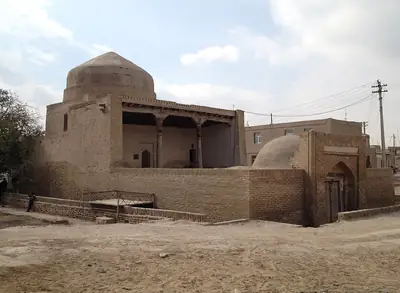
Near the Bogcha Gate, the Hasanmurod Qushbegi Mosque is a historic memorial site within Itchan Kala. Built in the late eighteenth or early nineteenth century, it stands opposite the Amir Tura Madrasa and is managed by the Ichan Kala State Museum Reserve.
Itchan Kala
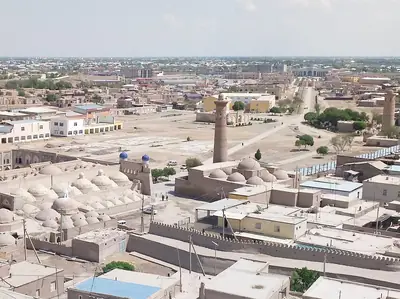
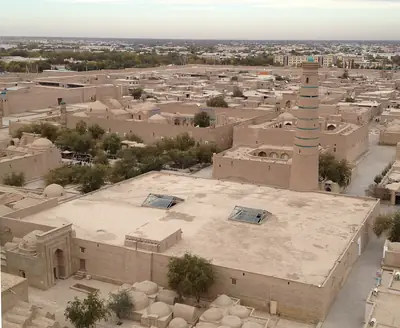
Itchan Kala, also written Ichan-Qal’a, is the walled inner city and the centrepiece of any visit to Khiva. Protected as a World Heritage Site since 1990, it contains more than 50 historic monuments and around 250 old houses.
The oldest architectural monuments date from the fourteenth century, while much of the town visible today took shape between the sixteenth and nineteenth centuries. Palaces, mosques, mausoleums, madrasas, markets and caravanserais stand close together within the fortress walls, creating the atmosphere of an open-air museum.
Among its major landmarks are Ko’hna Ark, Toshhovli Palace, the Muhammad Amin Khan, Mohammed Rahim Khan and Alla Kulli Khan madrasas, Kalta Minor, and the mausoleums of Pahlavon Mahmoud and Sayid Allavuddin.
Juma Mosque
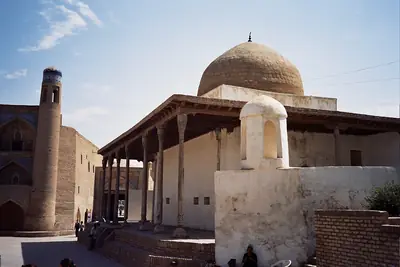
Juma Mosque, or the Friday Mosque, occupies a central position along the street between the Ota Darvoza and Polvon Darvoza gates. Unlike many monumental mosques, it has no grand portal, dome, gallery or inner courtyard. Instead, the flat-roofed brick building contains a spacious prayer hall supported by rows of wooden columns.
The columns reflect the mosque’s long history. Some may have come from Kyat, the medieval capital of Khorezm, while others carry Arabic inscriptions, floral patterns and carved decoration. The mosque was first recorded in the tenth century and rebuilt in 1788 with funds donated by Khan Abdurahman Mekhtar. Twenty-one columns date from the tenth to the twelfth centuries, while others display characteristic Khivan designs from the eighteenth and nineteenth centuries. A 42-metre minaret rises beside the building.
Baghbanli Mosque
In the southeastern part of Itchan Kala, the small Baghbanli Mosque, also known as Bog’bonli masjid, preserves the work of craftsmen from the early nineteenth century. Built in 1809, it has a rectangular plan, a two-column aivan and a domed winter prayer room.
Its carved wooden columns are particularly notable. Local legend says that two brothers who were gardeners donated the money used to build the mosque, linking this quiet monument with the generosity of ordinary residents.
Toshhovli Palace
Toshhovli Palace, or the Stone Palace, was built for Allah Kuli Khan between 1830 and 1838. The complex is arranged around three main courtyards: the harem to the north, the Ishrat courtyard for audiences and receptions to the southeast, and the Arz courtyard for official matters to the southwest.
Each courtyard had its own servants’ rooms, working spaces and stables. The harem was built first, between 1830 and 1832, with five southern porches intended for the khan and his four wives. The audience courtyard followed between 1832 and 1834, giving the palace a carefully organised setting for royal, domestic and administrative life.
Ak Mosque
Near the Polvon Gate, Ak Mosque—or Oq Masjid, the White Mosque—is a small building arranged around a square domed room. An open portico, or aivan, surrounds it on three sides.
The mosque is known for its carved wooden doors, delicate window screens and wooden columns with carved bases. Although its foundations were laid in 1647, the present building dates from 1838 to 1842, during the rule of Allah Kuli Bahadur Khan. The southern wall contains the mihrab, indicating the direction of Mecca.
Said Niyoz Sholikorboy Mosque
Outside the inner city, in Khiva’s outer historic district of Dishan Kala near the Palvan-Darwaza gate, the Said Niyoz Sholikorboy Mosque forms part of a larger religious complex. The site includes a madrasa, a minaret and two small courtyards.
Completed in 1842, the complex was named after the merchant Sholikorboy, who commissioned and built it. It provides a different perspective on Khiva’s religious architecture beyond the principal monuments of Itchan Kala.
Nurullabay’s Palace
Nurullabay’s Palace and garden were created for Asfandiyar, the son of Muhammad Rahim Khan II, and later became his official reception hall. The palace was built at the beginning of the twentieth century on the site of a garden belonging to a man named Nurullabai, whose name it retains.
Khiva and the Khanate of Khiva
Khiva was the capital of the Khanate of Khiva, an Uzbek monarchy in the historic region of Khorezm that lasted from the early sixteenth century until 1920. The state’s territory lay in the irrigated plains of the lower Amu Darya, south of the Aral Sea, and at different times extended across parts of present-day Uzbekistan, Kazakhstan and Turkmenistan.
By 1873, the khanate had been greatly reduced in size and became a Russian protectorate. In 1920, it was replaced by the Khorezm People’s Soviet Republic; in 1924, the area was formally incorporated into the Soviet Union. Today, it is largely part of Karakalpakstan and the Xorazm Region of Uzbekistan, as well as the Daşoguz Region of Turkmenistan.
Khiva’s story is part of the wider history of Uzbekistan, and it is often visited alongside the country’s other historic cities, including Samarkand and Bukhara.
Explore Khiva with Neywo
Neywo’s free audio guide lets you explore Khiva independently with one walking tour: Inside the Walls of Khiva: Minarets, Madrasas and the Khan’s Palaces. The route covers 1.56 km, takes 98 minutes, and includes 12 narrated stops, from Ota Darvoza and Kalta Minor to Ko’hna Ark, Juma Mosque, Toshhovli Palace, Ak Mosque and Said Niyoz Sholikorboy Mosque.
Download Neywo and walk through Khiva at your own pace. The app tells the story of each place as you reach it, with no group and no schedule.
Places with an audio guide in Khiva
8 places in Khiva with a Neywo audio guide. Each one starts telling its story as you reach it.

Self-guided tours in Khiva
1 tour in Khiva, free in the Neywo app. Each stop tells its story as you reach it.
- Walk
Inside the Walls of Khiva: Minarets, Madrasas and the Khan's Palaces
Khiva's walled inner city, Itchan Kala, is one of the best-preserved Silk Road towns, and people still live inside it. Enter by the Ota Gate, pass the stubby Kalta Minor, the khan's old citadel and the forest of wooden columns in the Friday Mosque, then finish at the carved doors of the Ak Mosque and the Palvan Gate.
Ota darvoza · Muhammad Amin Khan Madrasa · Kalta Minor · Ko'hna Ark · Mohammed Rahim Khan madrasa · Hasanmurod Qushbegi mosque …
Open this tour: Inside the Walls of Khiva: Minarets, Madrasas and the Khan's Palaces
Walk Khiva with Neywo
Neywo turns Khiva into a self-guided audio tour. Stories arrive as you reach the place they belong to, and the route reshapes when you wander off it.

