Tashkent, Uzbekistan: Self-Guided Walking Tour
Things to Do in Tashkent: What to See in Uzbekistan’s Capital
Tashkent is the capital of Uzbekistan and a city where medieval Islamic architecture, imperial buildings, Soviet monuments and modern museums stand side by side. The best things to do in Tashkent include exploring the old town, visiting the Hazrati Imam religious quarter, learning about Uzbek history and seeing the city from its television tower. Neywo offers a free audio guide for Tashkent with 91 narrated places.
Tashkent is also a useful starting point for discovering more of Uzbekistan, including historic cities such as Samarkand, Bukhara and Khiva.
What to see in Tashkent
Kukeldash Madrasah and Chorsu Square
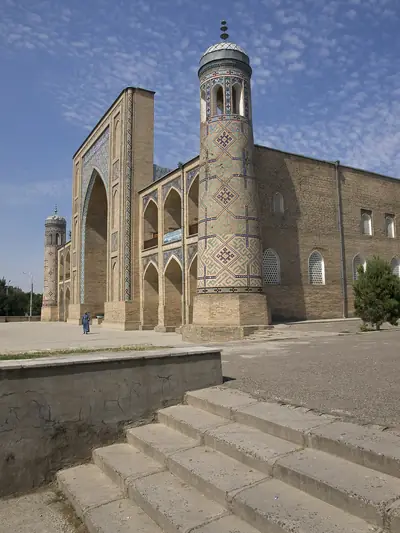
Kukeldash Madrasah stands on Chorsu Square, close to Chorsu Bazaar in the historic centre of Tashkent. Built around 1570 under the Shaybanid rulers, it was the largest of the 23 madrasas that once stood in old Tashkent.
Its yellow-brick structure follows a traditional rectangular plan around a large courtyard. Two-storey rows of student cells surround the courtyard, while the approximately 20-metre portal is decorated with glazed tiles, star and plant motifs, and Arabic calligraphy. The building has also served different purposes over time, including a conversion in the eighteenth century.
Nearby Chorsu Bazaar offers a more everyday view of the city. Its distinctive domed market hall is associated with spices, dried fruit, ceramics, textiles, traditional caps and other local goods.
Barakhan Madrasah and the Hazrati Imam quarter
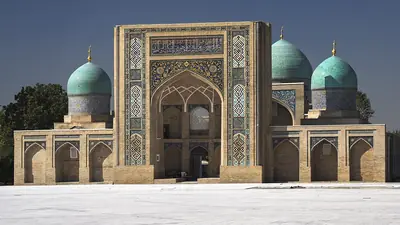
Barakhan Madrasah forms part of the Khazrati Imam ensemble, one of Tashkent’s most important religious and architectural areas. The complex developed during the sixteenth century from earlier structures, including a mausoleum and a khanqah, or Sufi hospice.
A second domed mausoleum was added around 1530 for Suyunchkhodja Khan, a ruler of Tashkent from the Shaybanid dynasty. The complex was later rebuilt as a madrasah and named after Navruz Ahmed Khan, known as Barak Khan.
The main portal is especially notable for its unusual decorative style. Around the same quarter, the Hazrat Imam mosque complex and other religious buildings create one of the clearest links with Tashkent’s medieval Islamic heritage.
Amir Timur Museum
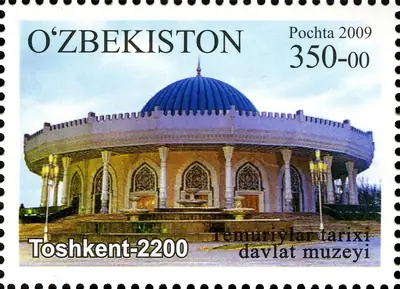
The Amir Timur Museum is dedicated to the life and legacy of Amir Timur, also known as Tamerlane, and the Timurid dynasty he founded. It opened in 1996, marking the 660th anniversary of Amir Timur’s birth, after Uzbekistan gained independence.
The museum building is 31 metres high and 70 metres in diameter, with 500 lights illuminating it at night. Inside, three floors hold more than 5,000 exhibits connected with the Timurid era and the history of Central Asia during the dynasty’s rule.
State Museum of History of Uzbekistan
The State Museum of History of Uzbekistan is one of the oldest museums in Central Asia and the main repository of the country’s historical heritage. It was founded in 1876 as the People’s Museum of Turkestan and later changed names and administrative forms several times before taking its current name in 1992.
The present building dates from the early 1970s and was constructed during the Soviet era. Its collections cover areas including archaeology, ethnography and numismatics, making it a useful stop for understanding Uzbekistan’s long history beyond the monuments of the capital.
Monument of Courage
The Monument of Courage commemorates the Tashkent earthquake of 1966. It stands at the epicentre of the disaster, beside the ancient Anhor canal in the Yunusabad district.
Unveiled in April 1976, the memorial includes a bronze family group: a woman holding a child while a man protects them. In front of the figures is a black labradorite cube. One side bears the date April 26, 1966; another shows a clock stopped at 5:23, the time of the earthquake. A crack in the cube represents the rupture of the earth and continues towards the sculpture.
Palace of Grand Duke Nikolai Konstantinovich Romanov
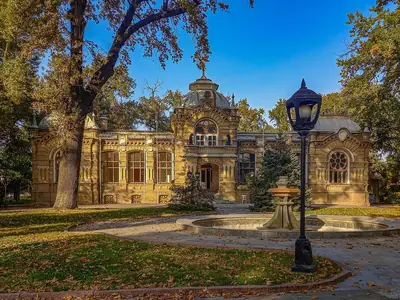
This palace was built in 1891 for Grand Duke Nikolai Konstantinovich Romanov, a Russian prince who had been exiled to the Turkestan region. The architects were V. S. Geintselman and A. L. Benois.
Its Roman-Byzantine design was intended to resemble a fortress or hunting castle rather than a conventional urban palace. The interior was divided into separate wings: the Grand Duke’s apartments occupied the left wing, while his wife’s apartments were on the right.
The palace reflects the imperial chapter of Tashkent’s history, when Russian influence introduced new architectural styles and institutions to the city.
Tashkent Tower
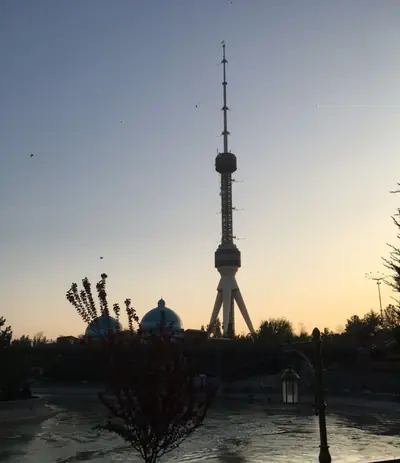
The Tashkent Television Tower is 375 metres tall and is the tallest structure in Central Asia. It was designed to transmit television and radio signals throughout Uzbekistan. Construction began in 1978, and the tower began operating on January 15, 1985.
The steel structure includes an observation deck 97 metres above the ground, offering views across the capital. The tower is near Bodomzor metro station in the Yunusabad district and is recognised as a monument of architecture and urban planning in Uzbekistan.
Tashkent Museum of Railway Equipment
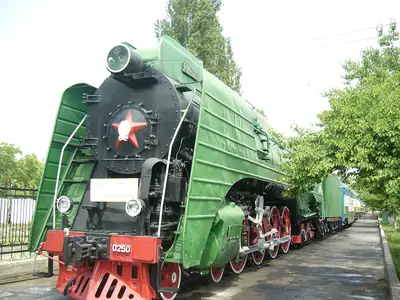
The Tashkent Museum of Railway Equipment is the only museum of its kind in Uzbekistan. Opened on August 4, 1989, it is operated by Uzbekistan Temir Yullari, the national railway company.
The open-air collection includes steam locomotives, diesel locomotives and rail cars that once operated on Uzbekistan’s mainline. It is a chance to see the scale and variety of railway equipment rather than only models or photographs.
State Museum of Applied Arts of Uzbekistan
The State Museum of Applied Arts of Uzbekistan began in 1937 as a temporary exhibition of local handicrafts and later became a major cultural and scientific institution. Its collection contains more than 4,000 exhibits arranged across more than 20 categories of craftsmanship.
The displays include wood carving, ceramics, metal embossing, jewellery, gold weaving, embroidery, traditional textiles and national clothing. For travellers interested in the visual traditions of Uzbekistan, it provides a focused complement to the city’s religious and historical monuments.
Other museums and historic buildings
Tashkent has several smaller museums and distinctive landmarks worth adding to a longer visit. The Tashkent Polytechnical Museum traces the development of automobiles, with a focus on cars made between 1800 and 1900. The Sergei Yesenin Museum preserves the memory and work of the Russian poet; its collection in Tashkent is considered the second most significant among museums dedicated to him.
The Memorial House of Tamara Khanum presents the costumes of the Soviet Uzbek dancer, singer, actress and choreographer. The museum opened in 1994 around an earlier exhibition of her stage costumes.
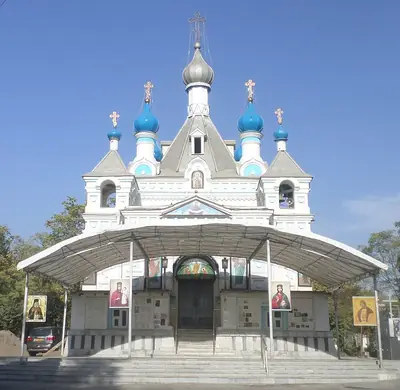
Saint Alexander Nevsky Church is a Russian Orthodox church within Cemetery Number One. Another religious landmark is the Sacred Heart Cathedral, also known as the Polish Church, a Roman Catholic cathedral with stained-glass windows, a library and a library named in honour of Pope John Paul II.
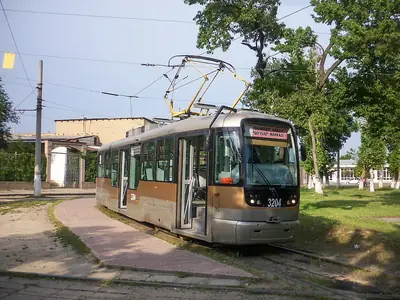
Tram history offers a different way to read the city. The Tashkent tramway opened on December 29, 1912, and operated for more than a century before closing on May 2, 2016. It was once the oldest and largest tram network in Central Asia.
Explore Tashkent with a self-guided walking tour
A Tashkent self-guided walking tour makes it possible to connect the city’s monuments without joining a group or following a fixed timetable. Neywo has five walking tours in Tashkent:
- Old Tashkent: Silk Road Bazaar and the Holy Quarter — 4.26 km, 117 minutes and 10 narrated stops.
- Timur, Tsars and Opera: Tashkent’s Grand Centre — 4.4 km, 110 minutes and 7 narrated stops.
- Imperial Tashkent: The Russian Quarter — 4.28 km, 99 minutes and 7 narrated stops.
- Palaces, Puppets and Art: The White Palace to the Art Museum — 5 km, 111 minutes and 8 narrated stops.
- Soviet Stages and Sacred Tombs: Tashkent’s West Side — 2.92 km, 72 minutes and 6 narrated stops.
The app tells the story of each place as you reach it, at your own pace, with no group and no schedule. Narration is available in 11 languages, so you can explore Tashkent independently while learning about the buildings and history around you.
Download the Neywo audio guide for Tashkent
Download Neywo to explore Tashkent with five walking routes, from the old town and Chorsu Bazaar to the Russian quarter, museums, palaces and sacred sites. The free audio guide includes 91 narrated places, and each story begins as you arrive at the location. Choose a route, walk at your own pace and discover the city without a group or a schedule.
Places with an audio guide in Tashkent
8 places in Tashkent with a Neywo audio guide. Each one starts telling its story as you reach it.
Self-guided tours in Tashkent
5 tours in Tashkent, free in the Neywo app. Each stop tells its story as you reach it.
- Walk
Old Tashkent: Silk Road Bazaar and the Holy Quarter
Start at the Ukkosha spring mosque and the courtyard Friday mosque of Khoja Ahror, then pass the 16th-century Kukeldash Madrasah and the blue domes of Chorsu Bazaar, where traders have gathered since the Silk Road. Walk north into Hazrat Imam, the spiritual heart of the city, with its medieval madrasahs, mausoleums and the mosque that keeps one of the oldest Qur'an manuscripts, and end at a master builder's tiny tomb.
Ukkosha Mosque · Kukeldash Madrasah · Chorsu Bazaar · Qaffol Shoshiy Mausoleum · Barakhan Madrasah · Tillya Sheikh Mosque …
Open this tour: Old Tashkent: Silk Road Bazaar and the Holy Quarter - Walk
Timur, Tsars and Opera: Tashkent's Grand Centre
Walk from the monument that remembers the 1966 earthquake to Amir Timur Square, the heart of the modern capital. On the way you pass a grand duke's exile palace, the state history museum, a Soviet-era opera house and a museum shaped like a dome, then finish with the Polytechnical Museum's early automobiles.
Monument of Courage · Palace of Grand Duke Nikolai Konstantinovich Romanov, Tashkent · State Museum of History of Uzbekistan · Navoi Theater · Amir Timur Square · Amir Timur Museum …
Open this tour: Timur, Tsars and Opera: Tashkent's Grand Centre - Walk
Imperial Tashkent: The Russian Quarter
After the conquest of 1865 the Russians built a new European town next to the old one. Follow its churches, a cadet school and the city's oldest cemetery to see the Lutheran, Catholic and Orthodox communities that settled here.
Mukhtar Ashrafi museum · Evangelical Lutheran Church in Tashkent · Sacred Heart Cathedral · Cadet Corps in Tashkent · Church of the Intercession of the Holy Virgin · Botkin Street Cemetery …
Open this tour: Imperial Tashkent: The Russian Quarter - Walk
Palaces, Puppets and Art: The White Palace to the Art Museum
A relaxed walk from the museum of Uzbekistan's literary heritage to the White Palace of the former president. Continue to the puppet theatre that hosted Asia's first puppet festival, the applied arts museum, the monument to Ukraine's national poet and the State Art Museum.
Alisher Navoi State Museum of Literature · Ok Saroy Presidential Palace · Republican Puppet Theater of Uzbekistan · Yunus Rajabiy museum · State museum of applied arts of Uzbekistan · Taras Shevchenko monument …
Open this tour: Palaces, Puppets and Art: The White Palace to the Art Museum - Walk
Soviet Stages and Sacred Tombs: Tashkent's West Side
A compact tour of the western city: the parliament, the vast Soviet-era Peoples' Friendship Palace, the Muqimiy musical theatre, the site of the old Kukcha Gate and a writer's monument, ending at a 19th-century standard-bearer's mausoleum in a historic cemetery.
Theatre Muqimiy · Peoples' Friendship Palace · Oliy Majlis · Aybek monument · Khoja Alambardor mausoleum
Open this tour: Soviet Stages and Sacred Tombs: Tashkent's West Side
Walk Tashkent with Neywo
Neywo turns Tashkent into a self-guided audio tour. Stories arrive as you reach the place they belong to, and the route reshapes when you wander off it.

