Bukhara, Uzbekistan: Self-Guided Walking Tour
Things to do in Bukhara: what to see in Uzbekistan’s historic city
Bukhara is a historic city in Uzbekistan known for its mosques, madrassas, fortress, trading domes, and centuries-old religious and commercial districts. Its monuments reveal the city’s changing history, from medieval Islamic architecture to the era of the Emirate of Bukhara. Neywo has a free audio guide for Bukhara with 36 narrated places.
What to see in Bukhara
Kalyan Minaret and Po-i-Kalyan
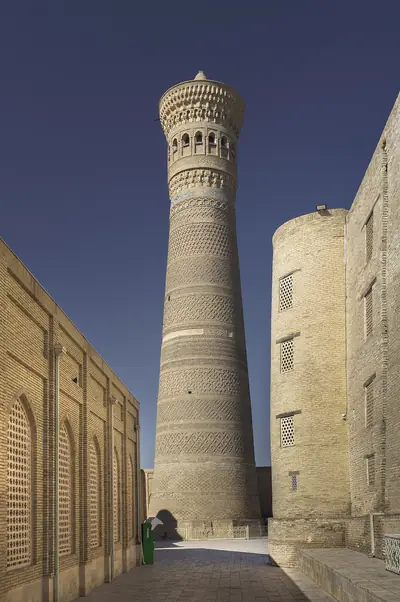
The Kalyan Minaret is one of Bukhara’s most recognizable landmarks. Built in 1127 for the Qarakhanid ruler Mohammad Arslan Khan, it rises about 47.5 metres above the historic city. Its circular baked-brick tower narrows towards the top and is decorated with patterned brick bands, blue-glazed details, and inscriptions.
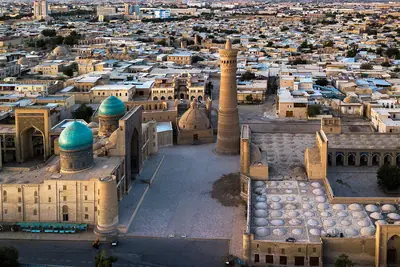
The minaret forms part of Po-i-Kalyan, Bukhara’s central architectural ensemble. The complex also includes Kalan Mosque and the Mir-i-Arab Madrasah, whose façades face each other across a square courtyard. Together, these buildings were constructed between the twelfth and sixteenth centuries and form one of the defining views of Bukhara.
Kalan Mosque
Kalan Mosque, also called Kalyan Mosque or Masjidi Kalon, is Bukhara’s principal Friday mosque. The present building dates from the Timurid period, while archaeological research has revealed the remains of two earlier mosques beneath it.
The mosque’s courtyard and large-scale brick architecture reflect the importance of Bukhara as a centre of religion and learning. Its name means “Great Mosque”, and the building can hold up to 12,000 worshippers.
Ark of Bukhara
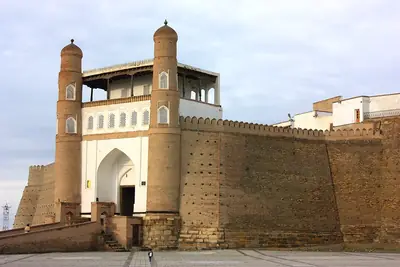
The Ark of Bukhara is a massive fortress rising nearly 20 metres above the surrounding ground. Its hill was formed by layers of ruins accumulated over centuries, making it the oldest part of Bukhara and the city’s oldest architectural and archaeological monument.
The fortress was first built and occupied around the fifth century. Its present form began to develop under the Shaybanid Uzbek dynasty in the sixteenth century, while the surviving buildings were constructed during the last three centuries. From 1785 to 1920, the Ark was the seat of government for the emirs of Bukhara. Today, its restored spaces house museums.
Bolo Haouz Mosque
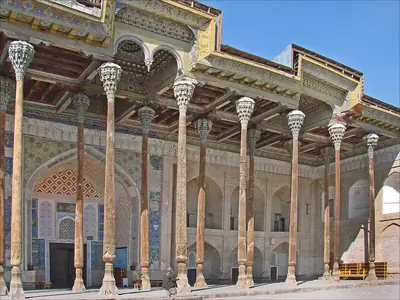
Opposite the Ark, in the Registan district, Bolo Haouz Mosque forms an ensemble with a minaret and a hauz, or pool. Built in 1712, it later served as a Friday mosque during the period when the emir of Bukhara was being subjugated under Bolshevik Russian rule in the 1920s.
The mosque is especially notable for its entrance iwan and summer prayer room. Thin painted wooden columns were added to the front in 1917, supporting the roof and displaying colourful muqarnas decoration.
Samanid Mausoleum and Baland Mosque
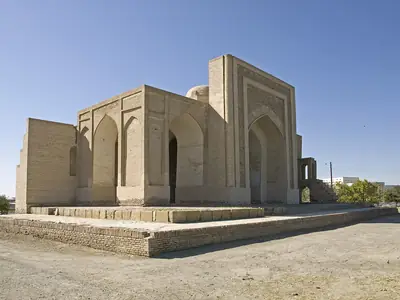
The Samanid Mausoleum is one of the key monuments of Bukhara’s earlier architectural history. Its refined brickwork represents an important stage in the development of Islamic architecture in Central Asia.
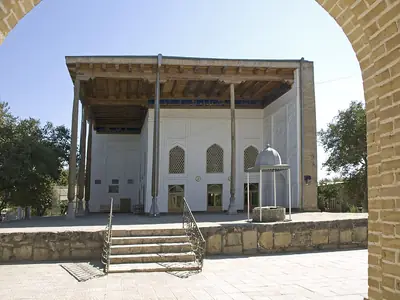
Baland Mosque, in the southern part of the old town, dates from the beginning of the sixteenth century. Its name means “high” or “upper”. The building combines a winter section with a cube-shaped brick structure and a summer section formed by a shaded ayvan. Inside, glazed tiles, gilded ornament, painted decoration, and a richly decorated mihrab create an unusually detailed interior.
Ulugh beg Madrassah
Built in 1417, Ulugh beg Madrassah is the oldest preserved madrassah in Central Asia and the oldest surviving madrassah commissioned by Ulugh Beg, the Timurid ruler and astronomy scholar.
The building stands opposite the Abdulaziz Khan Madrassah. Together, the two structures form a qoʻsh ensemble: a pair of buildings facing each other. The madrassah was substantially renovated in 1586 and now houses the Museum of the History of the Restoration of Bukhara Monuments.
Divanbegi Madrasa and Lyab-i Hauz
The Divanbegi Madrasa stands on the eastern side of the Lyab-i Hauz ensemble. Built in 1622 and 1623 by Nadir Devanbegi, it was originally constructed as a caravanserai before being converted into a madrasa.
The building is part of the historic centre where religious architecture, public spaces, and everyday city life come together. Lyab-i Hauz remains one of the places where Bukhara’s historic setting is particularly easy to experience on foot.
Chor Minor
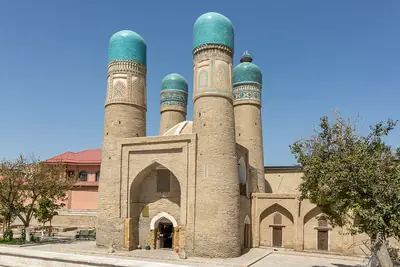
Chor Minor means “four minarets” in Persian, referring to the four unusual towers rising from its entrance building. It was built in 1807 by Khalif Niyazquli as part of the former Khalif Niyaz-kul Madrasa complex, which also included a mosque, courtyard, and student cells known as hujras.
The two-storey domed gatehouse has four corner towers, each topped with a blue-tiled dome featuring different decoration. Its irregular layout makes Chor Minor distinctive among Central Asian madrassas.
Magok-i-Attari Mosque
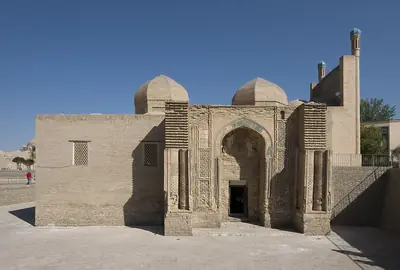
Magok-i-Attari Mosque stands more than four and a half metres below today’s ground level. It is considered the oldest of Bukhara’s surviving monuments and forms part of the Historic Centre of Bukhara, inscribed on the UNESCO World Heritage List in 1993.
The mosque was rebuilt in the twelfth century on the plan of an earlier ninth-century four-column Moh Mosque. Its carved decoration is a highlight, and the building now houses a carpet museum.
Khoja Gaukushan Ensemble
The Khoja Gaukushan Ensemble, also known as Govkushon, is one of central Bukhara’s largest architectural complexes. It includes the Gaukushan Madrasa, the Khoja Mosque, a minaret, a courtyard, and other historic elements.
The madrasa was built in 1570 during the reign of Uzbek Khan Abdullah II. The Khoja Mosque followed in 1598. The madrasa’s trapezoidal courtyard reflects its position at a fork in the streets, while the ensemble’s glazed decoration and brick galleries illustrate the architectural richness of sixteenth-century Bukhara.
Hoja Zayniddin Mosque and Khanqah
The Hoja Zayniddin Mosque and Khanqah is a sixteenth-century ensemble in Bukhara’s Hoja Zayniddin quarter. Built during the Shaybanid period, its central building served both as a mosque and a khanqah.
The complex also includes a pool, a school building, a tomb associated with its builder, and cells for visitors. Together, these features show how the site combined worship, learning, remembrance, and accommodation.
Sitori-i-Mokhi Khosa Palace
Sitori-i-Mokhi Khosa was the country residence of the Emir of Bukhara. Its name is often translated as “the Palace Like the Stars and the Moon”. Set within a spacious garden, the complex now houses a museum of architectural and decorative art.
The palace developed over several generations of the Manghit dynasty. It covers 6.7 hectares and includes the old palace, three brick-paved courtyards, gardens, and numerous rooms. Local architectural traditions meet European influences in the buildings, with the grand arched gateway to the new palace among its most memorable features.
Explore Bukhara with a self-guided walking tour
A Bukhara self-guided walking tour is a practical way to explore the historic centre without joining a group. Neywo offers three walking tours, with a total of 25 route stops:
- Po-i-Kalyan and the Trading Domes: 1.62 km, 87 minutes, 11 narrated stops.
- From the Samanid Tomb to the Emir’s Fortress: 2.85 km, 85 minutes, 7 narrated stops.
- Lyab-i Hauz, Chor Minor and the Eastern Gate: 3.03 km, 81 minutes, 7 narrated stops.
Neywo’s stories play as you reach each place, at your own pace, with no group and no schedule. The narration is available in 11 languages, making the app a useful way to connect the monuments you see with the history behind them.
If you are planning a wider trip through the country, you can also continue to Samarkand, Khiva, or Tashkent, and explore more of Uzbekistan with Neywo.
Places with an audio guide in Bukhara
8 places in Bukhara with a Neywo audio guide. Each one starts telling its story as you reach it.
Self-guided tours in Bukhara
3 tours in Bukhara, free in the Neywo app. Each stop tells its story as you reach it.
- Walk
Bukhara: Po-i-Kalyan and the Trading Domes
Start under the 12th-century Kalyan Minaret, the tower that Genghis Khan reportedly spared, and cross the great square of Po-i-Kalyan. Then wander into the covered bazaars, where money changers and hatmakers once traded across Central Asia, past sunken mosques and twin madrasas facing each other.
Mullo Tursunjon Madrasah · Po-i-Kalyan · Kalan Mosque · Kalyan Minaret · Ulugh beg Madrassah · Madrasa of 'Abd al-'Aziz Khan …
Open this tour: Bukhara: Po-i-Kalyan and the Trading Domes - Walk
Bukhara: From the Samanid Tomb to the Emir's Fortress
Begin at the 10th-century Samanid Mausoleum, a brick cube that anchors Islamic architecture in Central Asia. Pass the paired Kosh madrasas and the small Baland Mosque, then cross the Registan to the Ark, the fortress where the emirs ruled until 1920.
Samanid Mausoleum · Baland Mosque · Abdullah Khan Madrasa · Modari Khan Madrasa · Bolo Haouz Mosque · Ark of Bukhara …
Open this tour: Bukhara: From the Samanid Tomb to the Emir's Fortress - Walk
Bukhara: Lyab-i Hauz, Chor Minor and the Eastern Gate
Follow the old city's eastern edge from a working Bukharan Jewish synagogue and a recreated city gate to the Lyab-i Hauz pool. Finish at the whimsical four-towered gatehouse of Chor Minor and an Orthodox church from the 19th century.
Kanesoi Isoki Zambur sinagogasi · Darvozai Sallohhona · Khankah Nadir Divanbegi · Divanbegi Madrasa · Kukeldash Madrasah · Chor Minor …
Open this tour: Bukhara: Lyab-i Hauz, Chor Minor and the Eastern Gate
Walk Bukhara with Neywo
Neywo turns Bukhara into a self-guided audio tour. Stories arrive as you reach the place they belong to, and the route reshapes when you wander off it.

