What to See in Samarkand, Uzbekistan: Free Audio Guide
Things to Do in Samarkand: What to See in the Timurid City
The best things to do in Samarkand include exploring its monumental Timurid architecture, ancient archaeological sites, historic mosques, and Russian-era churches. Registan Square, Shah-i-Zinda, Bibi-Khanym Mosque, and Gur-e Amir reveal the city’s extraordinary architectural heritage, while Afrasiyab and the Ulugh Beg Observatory reach further into Samarkand’s ancient and scientific past. Neywo offers a free audio guide for Samarkand with 34 narrated places.
What to See in Samarkand
Registan Square
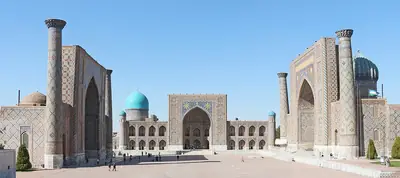
Registan is the historic center of Samarkand and one of the most celebrated architectural ensembles in Central Asia. Three madrasas surround the square: the Ulugh Beg Madrasa, built between 1417 and 1420; the Sherdar Madrasa, built between 1619 and 1636; and the Tilля-Kari Madrasa, built between 1646 and 1660.
Their soaring iwans, turquoise domes, geometric ornament, mosaic tilework, and muqarnas create the defining image of the city. Registan was once the heart of the Timurid Empire and later served as Samarkand’s commercial, educational, and ceremonial center. Royal proclamations were announced here with blasts from enormous copper pipes called dzharchis.
Chorsu
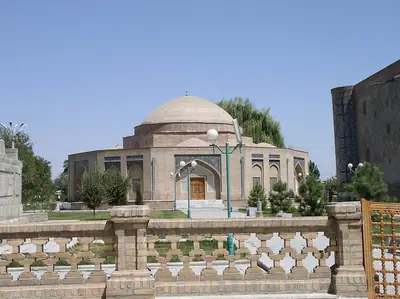
Southeast of Registan stands Chorsu, a historic domed building at the meeting point of roads linking Samarkand with Tashkent, Bukhara, and Shahrisabz. Its name means “four roads”, and the building has four entrances beneath a large central dome and four smaller domes.
The present structure was built in 1785 during the rule of the Bukharan emir Shahmurad. A market had stood on the site since the fifteenth century, while an earlier domed market occupied approximately the same location at the end of the fourteenth century. Today, Chorsu functions as a museum and fine-art gallery. Its dome was fully restored in 2005, when a three-metre layer of earth was removed to recover the building’s full height.
Bibi-Khanym Mosque
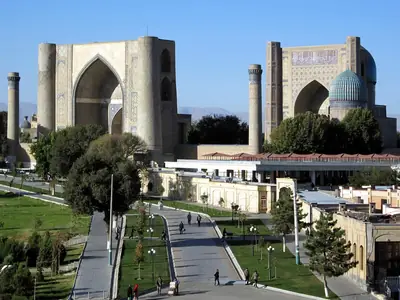
Bibi-Khanym Mosque is one of Samarkand’s most imposing monuments. Amir Temur commissioned the vast congregational mosque, which was built between 1399 and 1404. Its official historical name was Masjidi Jami, meaning the congregational or Friday mosque.
The mosque’s main courtyard measures about 64 by 76 metres, and the wider complex once measured about 167 by 109 metres. Tall minarets stood at its corners, while arched galleries and monumental entrance structures surrounded the courtyard. Earthquakes caused extensive damage over time: only the lower part of the northwestern minaret survives, and the upper section of the entrance portal collapsed in the earthquake of 1897. Its remaining scale and decoration still convey the ambition of the original complex.
Dahbedi Complex
Close to Bibi-Khanym Mosque and Siab Bazaar, the Dahbedi Complex is a small mahalla mosque set among private homes in Samarkand’s old city. Its setting gives it a direct connection with everyday local life.
The rectangular building has an aivan projecting from two sides. Carved wooden columns support a richly decorated ceiling filled with traditional Uzbek and Tajik patterns. The courtyard contains a small hauz, or pool, and trees. A nearby minaret and a low white stone pillar carry inscriptions in Arabic. Built during the 1910s, Dahbedi is included among Samarkand’s monuments on the UNESCO World Heritage List under the title Samarkand, Crossroads of Cultures.
Hazrat-Hyzr Mosque
Hazrat-Hyzr Mosque, also known as Hazrati Xizr Mosque, stands on a hill opposite Shah-i-Zinda, at the southern edge of Afrasiyab. Its name is associated with the legendary Islamic prophet Khizr, who is linked with travelers and the fabled water of life.
The mosque dates from the middle of the nineteenth century and was built on the foundations of an ancient mosque. An inscription in the mihrab gives the year 1855. The grounds also contain the mausoleum of Islam Karimov, the first President of the Republic of Uzbekistan, which opened here in 2018.
Shah-i-Zinda
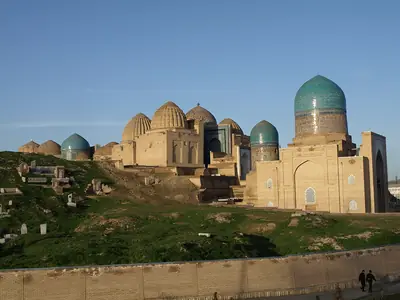
Shah-i-Zinda, also known as Shohizinda, means “the Living King”. This historic necropolis combines mausoleums, a mosque, a minaret, and madrasas arranged along a passageway. Its oldest surviving focus is the mausoleum of Qusam ibn Abbas, while archaeological excavations on the eastern slope of Afrasiyab have revealed remains dating from the eleventh and twelfth centuries.
The complex is arranged in three connected groups. Along the passage, visitors encounter the Abdulaziz chortaq, built in 1434 and 1435, the Davlat Qushbegi madrasa from 1812 and 1813, a decorated mosque with a veranda, and a fifteenth-century double-domed mausoleum. The central group includes mausoleums associated with Amirzoda, Tuglu Tekin, Shirinbeka Ogo, and Turkan Ogo, described as another sister of Timur. The close arrangement of buildings creates one of Samarkand’s most distinctive architectural sequences.
Gur-e Amir
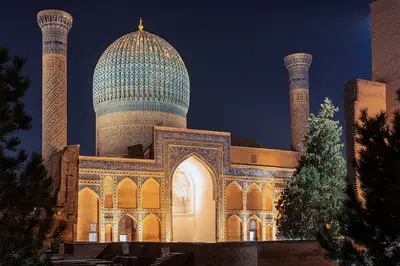
Gur-e Amir, also known as Go’ri Amir or the Amir Temur Mausoleum, is the resting place of Timur, also known as Tamerlane, and members of the Timurid family. The mausoleum was created after the death of Timur’s grandson, Muhammad Sultan Mirzo, in 1403. It was built in the courtyard of a madrasa that Muhammad Sultan had established near the Samarkand fortress.
Associated with the year 1405, Gur-e Amir occupies an important place in the architectural history of Turkestan. Its design influenced later Mughal tombs built by Timur’s descendants, including Bagh-e-Babur in Kabul, Humayun’s Tomb in Delhi, and the Taj Mahal in Agra. The monument has also undergone extensive restoration.
Khoja Nisbatdor Mosque
Built in 1901 on the site of an older mosque, Khoja Nisbatdor Mosque is a distinctive architectural monument in Samarkand. Its fired-brick building rises on a high platform and combines a prayer hall, a broad southern ayvan, and a low faceted minaret.
The eastern façade has three arched openings with doors and upper windows containing carved plaster screens in geometric girih patterns. The ayvan holds some of the richest decoration, including a ceiling finished in red and blue carved plaster. The mihrab features muqarnas work, while the prayer hall has carved ornament around the mihrab.
Saint Alexius of Moscow Church
Saint Alexius of Moscow Church, also known as St. Alexis Cathedral, represents Samarkand’s Orthodox heritage. The building was completed in 1911 and consecrated in 1912 in honor of Saint Alexius of Moscow. It belongs to the Samarkand deanery of the Tashkent and Uzbekistan Diocese of the Russian Orthodox Church and remains active for the public.
Church of St. George
The surviving building of the Church of St. George the Victorious is a former Russian Orthodox church in central Samarkand. Built with money collected from Orthodox believers, it could accommodate about 600 people and was associated with the Samarkand military command by 1910.
The church closed in 1960 and was converted into an OSOAVIAKHIM club. Its bell tower was replaced by an airplane, and the building is no longer used for religious purposes. The structure has survived, but it has not been returned to the Russian Orthodox Church.
Afrasiyab and the Afrasiab Museum
Afrasiyab is the archaeological site of ancient Samarkand, located in the northern part of the modern city. The settlement was occupied from around the middle of the first millennium BC until the Mongol invasion in the thirteenth century. Covering about 219 hectares, the site now appears as broad yellow and grey loess hills.
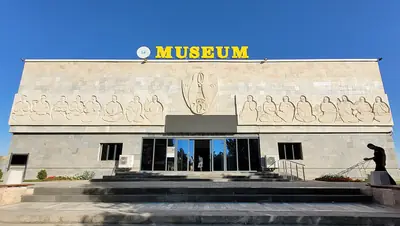
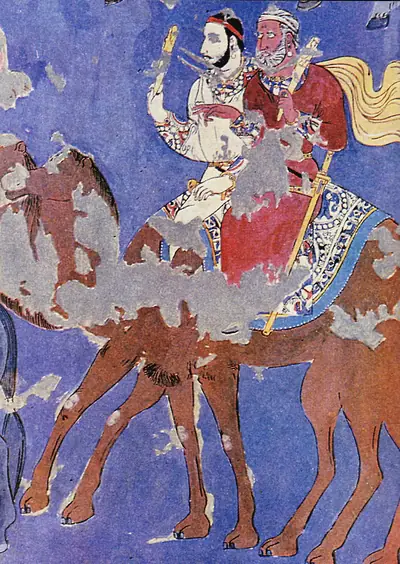
Excavations have uncovered homes, workshops, merchants’ shops, streets, squares, palaces, places of worship, defensive structures, and water-supply systems. Nearby, the Afrasiab Museum of Samarkand traces the history of the city and the ancient settlement through five exhibition rooms. Its collection contains more than twenty-two thousand unique items, including tools, coins, ceramics, manuscripts, figurines, and everyday objects. Particularly notable are murals from a Samarkand palace associated with the Ikhshid dynasty, dating from the seventh and eighth centuries.
Ulugh Beg Observatory
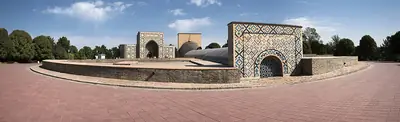
Built near Samarkand between 1424 and 1428, the Ulugh Beg Observatory was both an astronomical observatory and a school of astronomy. Ulugh Beg, an astronomer and ruler of the Timurid dynasty, constructed it on Kuhak Hill during the Timurid Empire.
The observatory was destroyed in 1449 and rediscovered in 1908. A museum now operates on the grounds, continuing the story of this important medieval center of astronomy.
Explore Samarkand with a Self-Guided Walking Tour
A Samarkand self-guided walking tour is an easy way to connect the city’s monuments without joining a group or following a fixed timetable. Neywo’s free audio guide includes three walking tours:
- Registan to Shah-i-Zinda: The Timurid Heart of Samarkand — 3.76 km, 117 minutes, 10 narrated stops.
- Tamerlane’s Tomb to Russian Samarkand — 4.26 km, 114 minutes, 10 narrated stops.
- Ancient Afrasiab and the Astronomer-King’s Observatory — 3.32 km, 72 minutes, 5 narrated stops.
The routes cover 25 stops in total, from Registan, Chorsu, Bibi-Khanym Mosque, and Shah-i-Zinda to Gur-e Amir, Russian Samarkand, Afrasiyab, and the Ulugh Beg Observatory. Each story plays as you reach the place, at your own pace, with no group and no schedule. Narration is available in 11 languages.
Download Neywo and Explore Samarkand at Your Own Pace
Download Neywo to explore Samarkand with a free audio guide covering 34 narrated places and three walking tours. The app tells the story of each place as you reach it, so you can pause, look around, and continue when you are ready—without a group or a schedule.
Samarkand is one of the essential stops on a journey through Uzbekistan. If your trip continues across the country, you can also discover Tashkent, Bukhara, and Khiva with Neywo.
Places with an audio guide in Samarkand
8 places in Samarkand with a Neywo audio guide. Each one starts telling its story as you reach it.
Self-guided tours in Samarkand
3 tours in Samarkand, free in the Neywo app. Each stop tells its story as you reach it.
- Walk
Registan to Shah-i-Zinda: The Timurid Heart of Samarkand
Start in the quiet mahalla lanes north-west of Registan, then reach the great square where the Ulugh Beg Madrasa has stood since the 1420s. From the domed Chorsu crossroads you pass the colossal ruins of Bibi-Khanym, the neighbourhood mosques of the old city and the Hazrat Khizr hill, and finish by climbing the forty steps into the necropolis of Shah-i-Zinda.
Hoja Zudmurad complex · Kuk Mosque · Ulugh Beg Madrasa · Registan · Chorsu · Dahbedi complex …
Open this tour: Registan to Shah-i-Zinda: The Timurid Heart of Samarkand - Walk
Tamerlane's Tomb to Russian Samarkand
Begin at a richly carved 1901 mosque, then enter the tomb where Timur and his heirs lie. Walk the old King's Road past the Friday mosque of Ruhabad and cross into the nineteenth-century European quarter: the opera house, a pre-revolutionary bank, a university museum with a famously travelled elephant skeleton, and and the Orthodox, Catholic and Armenian churches of a multi-faith city.
Khoja Nisbatdor Mosque · Gur-e Amir · Ruhabad Mosque in Samarkand · Samarkand Opera House · Zoological Museum of Samarkand State University · Russian-China Bank building …
Open this tour: Tamerlane's Tomb to Russian Samarkand - Walk
Ancient Afrasiab and the Astronomer-King's Observatory
Walk from the Amir Burunduk mausoleum above the city onto the grassy mounds of Afrasiab, where Samarkand stood before the Mongols, and into the museum with its seventh-century palace murals. Finish on Kuhak Hill at Ulugh Beg's observatory, where the medieval world's star catalogue was made.
Amir Burunduk Mausoleum · Afrasiyab · Afrasiab Museum of Samarkand · Ulugh Beg Observatory · Ulugbek observatory museum
Open this tour: Ancient Afrasiab and the Astronomer-King's Observatory
Walk Samarkand with Neywo
Neywo turns Samarkand into a self-guided audio tour. Stories arrive as you reach the place they belong to, and the route reshapes when you wander off it.

