Visiting Valencia, Spain: Top Sights on Foot
Things to Do in Valencia: What to See in the City
The best things to do in Valencia range from Gothic landmarks and historic markets to museums, gardens, and the futuristic City of Arts and Sciences. Valencia brings together Roman foundations, medieval trading wealth, Valencian Modernisme, Mediterranean traditions, and contemporary architecture in a city that is easy to explore on foot. Neywo offers a free audio guide for Valencia with 188 narrated places.
What to See in Valencia’s Historic Center
La Lonja de la Seda
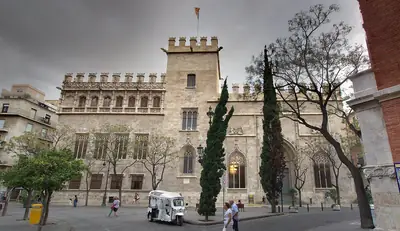
Facing the Central Market and the Church of Sant Joan del Mercat, La Lonja de la Seda — the Silk Exchange — is one of Valencia’s principal attractions. Built between 1482 and 1548, it is a masterpiece of late Valencian Gothic civil architecture and a symbol of the city’s prosperous fifteenth-century golden age.
Its design began with Francesc Baldomar around 1470. After his death, Joan Ivarra and Pere Compte completed the building according to his plans. The surviving documents emphasize that the two worked as equals, with neither master subordinate to the other.
Central Market and the Church of Sant Joan del Mercat
The Central Market stands directly opposite La Lonja de la Seda, making the pair a natural stop in the historic center. Its food stalls connect Valencia’s commercial heritage with everyday city life, while the nearby Church of Sant Joan del Mercat adds another historic landmark to the square.
The market and the Silk Exchange are also examples of Valencia’s distinctive architectural language. Along with North Railway Station, the Central Market displays decorative tilework and organic details associated with Valencian Modernisme.
Valencia Cathedral
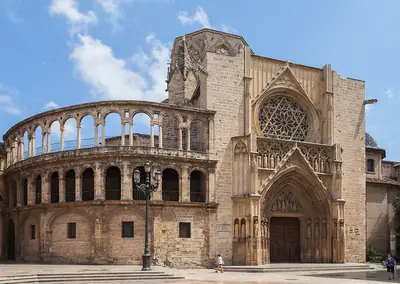
Valencia Cathedral, known locally as la Seu, rises in the heart of the old city. It was built on the site of a mosque, which had itself replaced the city’s former Visigothic cathedral, and was consecrated in 1238 in dedication to Saint Mary at the wish of James the Conqueror.
Valencian Gothic dominates the building, but later additions introduced Romanesque, French Gothic, Renaissance, Baroque, and Neoclassical elements. One chapel holds the Holy Chalice, a first-century cup that many believe to be the true Holy Grail. King Alfonso the Magnanimous gave it to the cathedral.
Monestir de Sant Miquel dels Reis
On Valencia’s northern edge, in the Orriols district, the Monestir de Sant Miquel dels Reis now houses the Biblioteca Valenciana. Fernando de Aragón, Duke of Calabria, founded it in 1545 for the Hieronymite order, on the site of an earlier Cistercian monastery.
Its affiliation and commemorative role have led some scholars to describe it as a forerunner of El Escorial. The monastery offers a different perspective on Valencia’s architectural history, away from the busiest streets of the old town.
Museu de la Ciutat de València
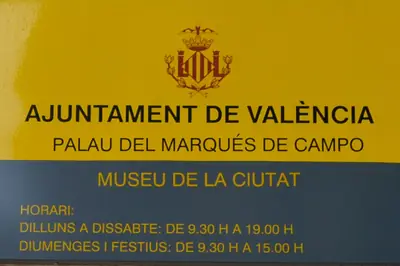
The Museu de la Ciutat de València occupies the Palau del Marqués de Campo, also known as the Palace of the Counts of Berbedel. The building combines seventeenth-century origins with a nineteenth-century transformation.
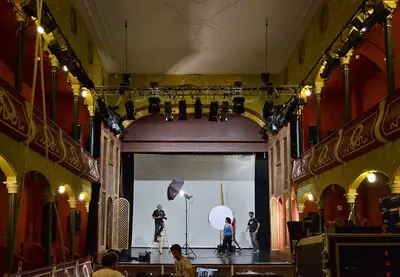
A rectangular arcaded courtyard leads to a grand staircase beneath a small cupola. Rooms including the former Ballroom and Salón Imperio now serve as exhibition spaces, following a careful restoration completed in 1989.
Banys de l’Almirall
In the Xerea quarter, the Banys de l’Almirall occupies an unassuming building near the old Palace of the Almirantes de Aragón. Inside is one of the last working Arab-style bathhouses in Spain.
Its hammam layout moves from a vestibule to cold, temperate, and hot rooms, following a tradition descended from Roman baths and adapted under Muslim rule. Although these baths were built after the Christian reconquest, probably for Pere de Vilarasa, they follow an Islamic model and are considered a rare example of Mudéjar architecture. They remained in continuous use until 1959 and reopened to visitors in 2005 after restoration.
Escalante Centre Teatral and the theatres of Carrer dels Cavallers
Carrer dels Cavallers brings together several stages in historic buildings. The Escalante Centre Teatral was created in 1985 to introduce children to theatre. Its original home was a late-Renaissance palace whose courtyard once served as a carriage entrance and whose stalls were formerly stables.
The theatre eventually left the building in 2016 because of structural problems, but continues its work elsewhere in the city. Nearby, L’Iber occupies a late-fourteenth- or early-fifteenth-century manor house and contains a museum of miniature lead soldiers. The Teatre Talià, at number 31, completes this unusual group of historic performance spaces.
Museums and Cultural Places in Valencia
Museu de Belles Arts de València
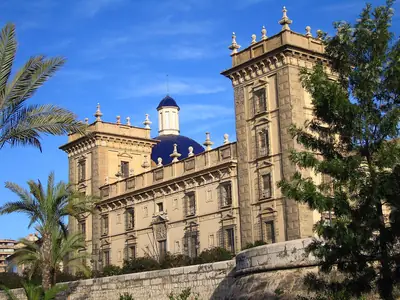
The Museu de Belles Arts de València is housed in the Palace of St Pius V. Founded in 1913, it is the most important art gallery in Valencia and the Valencian Community, as well as one of the earliest museums of its kind in Spain.
L’ETNO, Valencian Museum of Ethnology
At the Centre Cultural de la Beneficència, the Valencian Museum of Ethnology — rebranded L’ETNO after a renovation in 2020 — explores traditional Valencian culture alongside Mediterranean and world traditions. Created in 1982 and opened to the public the following year, it is the region’s reference museum for traditional culture.
Institut Valencià d’Art Modern
The Institut Valencià d’Art Modern, or IVAM, opened in 1989 as Spain’s first center dedicated to modern art. It remains the region’s leading museum for twentieth- and twenty-first-century art.
Capella de l’Antic Col·legi de Sant Pau
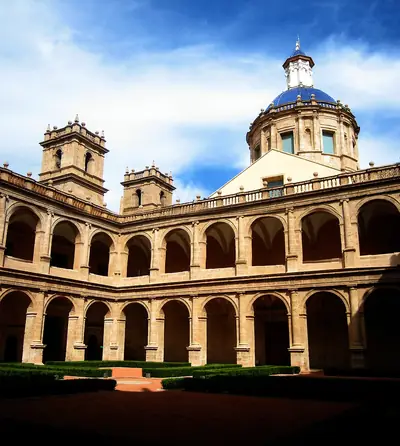
Inside what is now the Instituto Lluís Vives, on Calle Xàtiva, the Capella de l’Antic Col·legi de Sant Pau belongs to the first Jesuit college built in Spain. Saint Ignatius of Loyola authorized the college in 1562 at the request of the Valencian canon Juan Jerónimo Domenech.
The surviving complex includes the old cloister, with round arches resting on Tuscan columns, and a chapel with six side chapels between its buttresses. The cloister also appeared in one of Joaquín Sorolla’s scenes of Valencia, known as El patio del instituto.
Palau de l’Exposició
The Palau de l’Exposició, on Carrer de Galícia, was built in 1908 by Francesc Mora i Berenguer. Its design combines Valencian Modernisme with neo-Gothic details.
Bombas Gens
Bombas Gens brings contemporary art into a former industrial setting. The art centre opened in July 2017 inside the former Bombas Hidráulicas Carlos Gens hydraulic pump factory, giving the building a new cultural role.
Casa-Museo de Blasco Ibáñez
At the edge of Malvarrosa beach, the Casa-Museo de Blasco Ibáñez occupies the rebuilt home of writer Vicente Blasco Ibáñez, also known as the Chalet de Vicente Blasco Ibáñez. The original building was confiscated after the Civil War and later abandoned. Because it had become severely ruinous, it was demolished in the 1990s and rebuilt from the original plans.
Turia Gardens and the City of Arts and Sciences
Turia Gardens
The Turia Gardens occupy the former riverbed of the Turia. The river was diverted after the catastrophic flood of 1957, leaving a long green corridor through the city.
The gardens connect Valencia’s historic center with the City of Arts and Sciences. They form a natural route between medieval monuments, museums, bridges, and the city’s most recognizable modern architecture.
City of Arts and Sciences
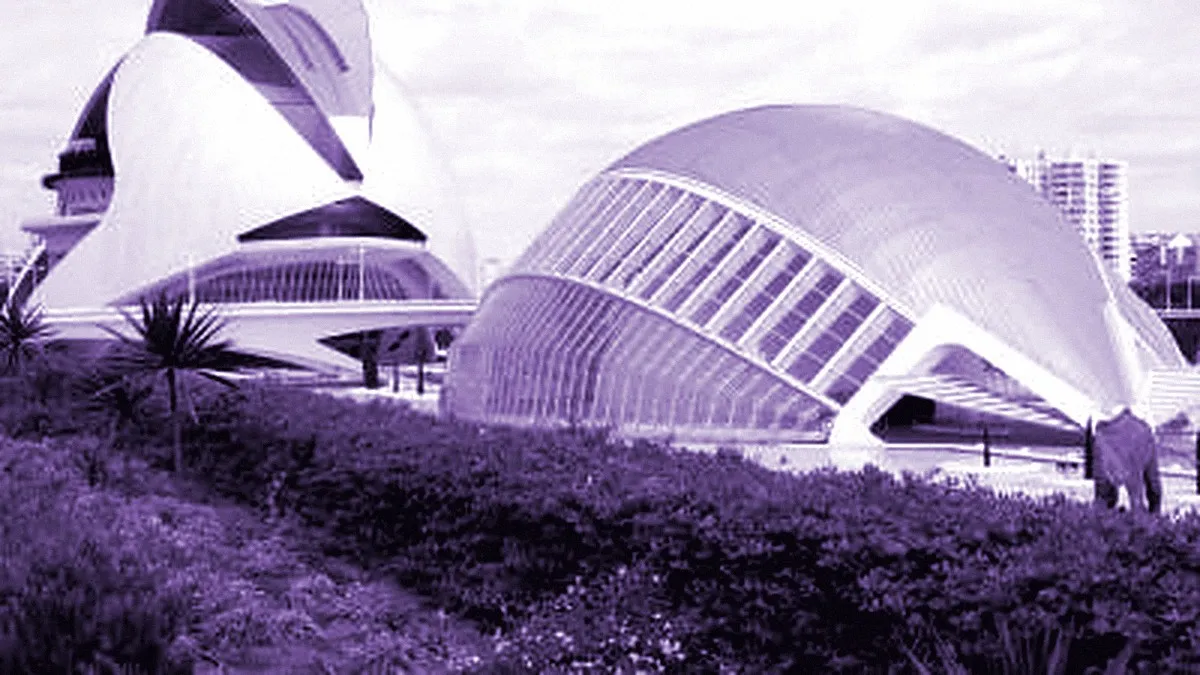
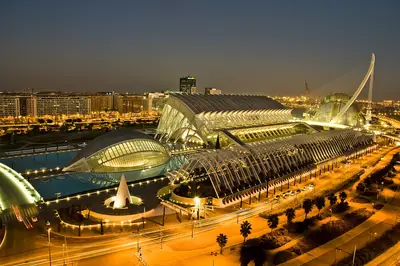
At the end of the former Turia riverbed, the City of Arts and Sciences has become Valencia’s biggest draw for visitors, ahead of the historic old town. Santiago Calatrava designed the complex, with Félix Candela contributing to some of its buildings. Its curving white forms have become the city’s modern architectural signature.
The complex was built in stages during the 1990s and early 2000s. L’Hemisfèric opened in 1998, the Palau de les Arts opera house followed on 9 October 2005, and L’Àgora opened in 2009.
Museu de les Ciències Príncipe Felipe
Part of the City of Arts and Sciences, the Museu de les Ciències Príncipe Felipe occupies a building designed by Santiago Calatrava to resemble a whale’s skeleton. Construction began around 1994, and the museum opened to the public in November 2000 after its symbolic inauguration by the future King Felipe VI in March of that year.
The building has hosted science and technology events, including the Campus Party technology gathering and astronautics congresses. It was also used for the 2007 presentation of the McLaren Formula One team and appeared in scenes from the 2015 film Tomorrowland.
Explore Valencia with Neywo
A Valencia self-guided walking tour lets you explore the city without joining a group or following a fixed timetable. Neywo has seven walking tours, one bus route, and one bike route in Valencia, with routes ranging from 1.24 to 5.9 km and from 20 to 106 minutes. Together, they include the city’s historic center, Turia Gardens, the City of Arts and Sciences, museums, theatres, churches, palaces, and markets.
The walks include routes through the Silk Exchange and Central Market, Valencia Cathedral and the Holy Grail, the former riverbed, El Carme, the city’s central square, Gothic La Xerea, and the City of Arts and Sciences. The C1 bus route covers the old town loop, while the bike route follows the Turia Gardens from the medieval gate to the City of Arts.
Download Neywo and explore Valencia with its free audio guide. The app tells the story of each place as you reach it, at your own pace, with no group and no schedule. Narration is available in 11 languages, and the guide includes 188 narrated places across the city.
Valencia is part of the Valencian Community in Spain, a region also home to Sagunto, Xàbia, and Alicante.
Places with an audio guide in Valencia
8 places in Valencia with a Neywo audio guide. Each one starts telling its story as you reach it.
Self-guided tours in Valencia
9 tours in Valencia, free in the Neywo app. Each stop tells its story as you reach it.
- Bike ride
Turia Gardens: from the medieval gate to the City of Arts
Ride the old river bed, now a nine-kilometre green belt, from the Torres dels Serrans past the Museu de Belles Arts and a historic bridge to the Parotet sculpture, the opera house and the City of Arts and Sciences. Flat, traffic-free for most of the way and about 6 km.
Torres dels Serrans · Museu de Belles Arts de València · Pont de la Mar · Parotet · Palau de les Arts Reina Sofia · City of Arts and Sciences
Open this tour: Turia Gardens: from the medieval gate to the City of Arts - Bus ride
Bus C1: the old town loop
EMT's small circular C1 runs through the historic centre for the price of a normal bus ticket. It passes the Torres de Quart, the Beneficència cultural centre with the Ethnology and Prehistory museums, the IVAM modern art museum and the Torres dels Serrans, then follows the old riverbed past the Temple and Cervelló palaces and drops back to the Plaça de l'Ajuntament and its Art Deco cinema. A cheap way to link Valencia's medieval gates.
Capella de l'Antic Col·legi de Sant Pau · Church of Sant Agustí, Valencia · Església del Pilar de València · Torres de Quart · Valencian Museum of Ethnology · Institut Valencià d'Art Modern …
Open this tour: Bus C1: the old town loop - Walk
Silk, Saints and the Sistine Chapel of Valencia
Start at a medieval gate still scarred by cannon fire and the statue of the baker's boy who fought Napoleon, then wind through the old Carme and Mercat quarters. You will pass the arch where the Iberian Peninsula's first printed book appeared, a church nicknamed the Sistine Chapel of Valencia, the UNESCO-listed Silk Exchange and the tower of Santa Catalina. End among the Art Nouveau iron and tiles of the Central Market square.
Torres de Quart · El Palleter · Portal de la Valldigna · L'Iber, Museo de los soldaditos de plomo · Church of San Nicolás · Church of Sant Joan del Mercat …
Open this tour: Silk, Saints and the Sistine Chapel of Valencia - Walk
Valentia to Valencia: Forum, Cathedral and the Holy Grail
Two thousand years of power sit on a single square: Roman forum, Visigothic cathedral, mosque, then the cathedral and parliament seen today. Walk past the Generalitat and the Borgia palace, meet the Virgin the whole city adores, see the chalice said to be the Holy Grail, and go underground among Roman and Visigothic ruins. Then find the last Arab bathhouse, an old Gothic courtyard-palace and one of the first churches built after the Christian conquest.
Palace of the Borgias · Palau de la Generalitat Valenciana · Plaça de la Mare de Déu · Basilica of Our Lady of the Forsaken · Valencia Cathedral · Centre Arqueològic de l'Almoina …
Open this tour: Valentia to Valencia: Forum, Cathedral and the Holy Grail - Walk
The River That Became a Garden
After the great flood of 1957 Valencia moved its river and turned the old bed into a park. Walk beside it from the northern gate of the medieval wall past Valencia's finest art gallery and the Renaissance courtyard of an ambassador, the gardens where the Royal Palace once stood, a Templar-named palace-church and a Gothic Dominican convent, to the Porta de la Mar. A calm, green route, with a Gothic monastery founded in 1242 and the city's oldest bridges on the way.
Palau dels Català de Valeriola · Torres dels Serrans · Pont dels Serrans · Monestir de la Trinitat de València · Pont de la Trinitat · Museu de Belles Arts de València …
Open this tour: The River That Became a Garden - Walk
Calatrava's City of the Future
Valencia's modern face: a whale-skeleton science museum, an opera house, a harp-shaped bridge, a 46-metre dragonfly sculpture and Europe's largest aquarium, all built on the old riverbed. Begin at the neighbourhood sanctuary beside the giant papier-mache sculptures of the Fallas, then step into the white world of Santiago Calatrava. Tickets for the museum and aquarium are optional; the exteriors alone are worth the walk.
Santuari de la Mare de Déu de Montolivet · Museu Faller de València · Parotet · Palau de les Arts Reina Sofia · City of Arts and Sciences · Museu de les Ciències Príncipe Felipe …
Open this tour: Calatrava's City of the Future - Walk
El Carme: Convents, Palaces and Museums of the Bohemian Quarter
The Carme quarter is Valencia's creative old town. Pass a Gothic palace with a painted ceiling, a theatre where an actor died on stage, the palaces facing the old Carmelite convent, the convent's two cloisters, the IVAM modern art museum and the former hospice that holds the prehistory and ethnology museums. End at the university's botanical garden and the church by the Torres de Quart.
Fundació Chirivella Soriano · Teatro Princesa · Palau de Raga · Palau de Forcalló · Convent del Carme (València) · Església de la Santíssima Creu …
Open this tour: El Carme: Convents, Palaces and Museums of the Bohemian Quarter - Walk
Ajuntament Square, the Silk Guild and the Bullring
From Valencia's biggest square, with its Art Deco cinema and the post office, walk south and west through the old Sant Francesc district: the silk-weavers' guild hall, a medieval hospital, the first Jesuit college in Spain, the MuVIM museum of ideas and the bullring with its bullfighting museum.
Post Office of Valencia, Spain · Falla de l'Ajuntament · Cine Rialto · Edifici i Teatre Olympia · Col·legi de l'Art Major de la Seda (València) · Hospital de los Pobres Inocentes …
Open this tour: Ajuntament Square, the Silk Guild and the Bullring - Walk
Alabaster Palace, the Patriarch's College and Gothic La Xerea
A short walk through La Xerea, the quarter behind the cathedral. See the oldest church in Valencia, a contemporary art centre in a palace built over Roman Valentia, the seminary the Patriarch Ribera founded in 1583, the Baroque palace that houses the national ceramics museum and a stock exchange in a medieval palace.
Sant Joan de l'Hospital church · Centro de Arte Hortensia Herrero · Church of Saint Thomas and Saint Philip Neri · Reial Col·legi Seminari de Corpus Christi · Palacio de los Condes de Peñalba · Teatre Principal …
Open this tour: Alabaster Palace, the Patriarch's College and Gothic La Xerea
Walk Valencia with Neywo
Neywo turns Valencia into a self-guided audio tour. Stories arrive as you reach the place they belong to, and the route reshapes when you wander off it.

