Visiting Granada, Spain: Top Sights on Foot
Things to Do in Granada: What to See in the City
Granada is an Andalusian city shaped by Nasrid, Christian and Renaissance history, with palaces, religious monuments, historic neighbourhoods and views across the city. The Alhambra is its defining sight, but the best things to do in Granada include exploring the Generalife, the Albaicín, the cathedral quarter and the city’s many layers of architectural history. Neywo offers a free audio guide for Granada with 72 narrated places.
Granada lies in Andalusia, in southern Spain, and its compact historic centre makes it especially rewarding to explore on foot. Here is what to see in Granada, from the monuments of the Alhambra hill to the streets around the cathedral and the Albaicín.
What to see in Granada
The Alhambra
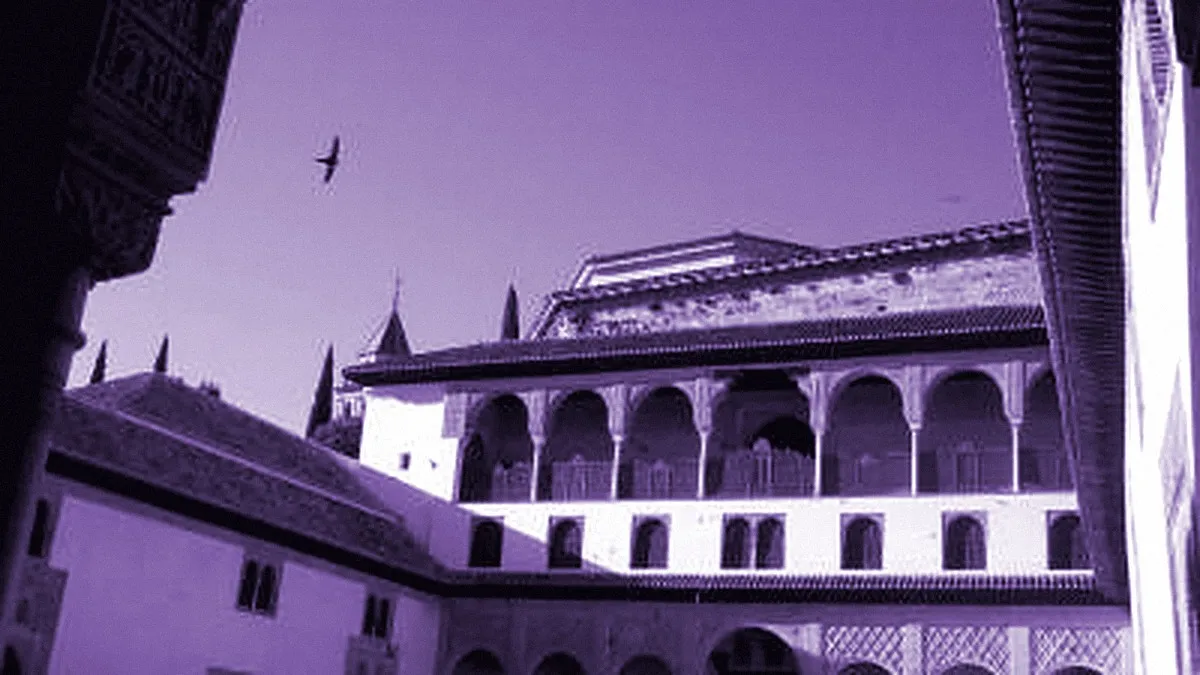
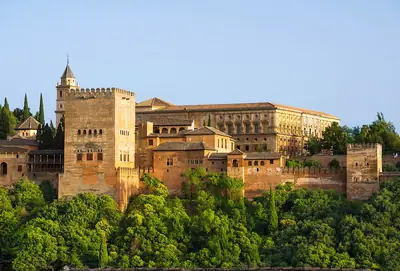
The Alhambra is a palace and fortress complex famous for its Islamic art and for being one of the best-preserved palaces from the medieval Islamic world. Its Nasrid palaces contain interiors regarded as among the highest achievements of Andalusi art.
Construction began in 1238 under Muhammad I Ibn al-Ahmar, the first Nasrid emir and founder of the Emirate of Granada. Later rulers transformed the complex, especially during the 14th century under Yusuf I and Muhammad V. After the Christian conquest of Granada in 1492, the Alhambra became the royal court of Ferdinand and Isabella, and parts of the complex were altered.
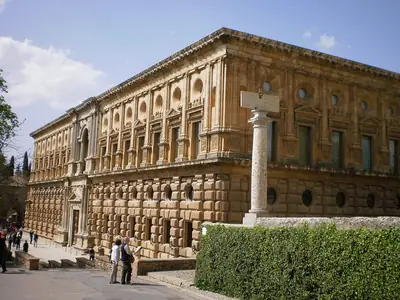
The site also brings together later architectural periods. In 1526, Charles V commissioned a Renaissance-style palace directly beside the Nasrid palaces, creating a striking contrast between Islamic and Renaissance design.
The Generalife
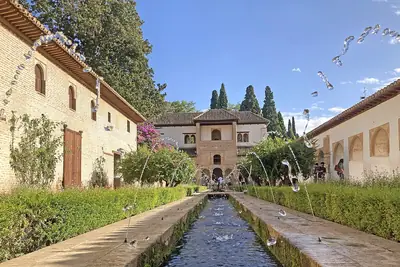
The Generalife was the summer palace and country estate of the Nasrid rulers. It stands directly east of the Alhambra, uphill on the slope of the Cerro del Sol, outside the Alhambra’s walls.
The complex combines buildings, courtyards and gardens. Its oldest decorative elements suggest a late-13th-century origin under Muhammad II, who ruled from 1273 to 1302. In the medieval period, the estate included at least four orchards and also served agricultural purposes.
Together, the Generalife and the Alhambra form one of the most remarkable ensembles of Muslim civil architecture. The gardens and carefully arranged spaces give the Generalife a quieter character than the royal palaces.
Silla del Moro
Silla del Moro is a small medieval fortress connected to the defensive system of the Generalife and Alhambra. Built in the 13th century on the northern slope of the Cerro de Santa Elena, it overlooks the valley of the Río Darro and Granada.
The fortress controlled the distribution of water from the acequia, which supplied the palaces and the surrounding orchards. It fell into ruin during the 17th century and was never rebuilt. Remains discovered in 1929 included a conduit, a staircase and a tower, offering clues to the site’s connection with the nearby Dar al-Arusa palace.
The Palace of Charles V and the Alhambra Museum
The Palace of Charles V stands inside the Alhambra on Sabika hill. Construction began in 1527, and the building was eventually completed after 1923, when restoration was initiated by Leopoldo Torres Balbás.
Its square exterior contains a circular patio. The lower level is surrounded by a Doric colonnade, while the upper level has a stylised Ionic colonnade. This geometric contrast makes the interior particularly distinctive.
The ground floor houses the Alhambra Museum, with objects, furnishings, books and architectural remains from Hispano-Muslim art. The upper floor is home to the Fine Arts Museum of Granada.
Granada Cathedral
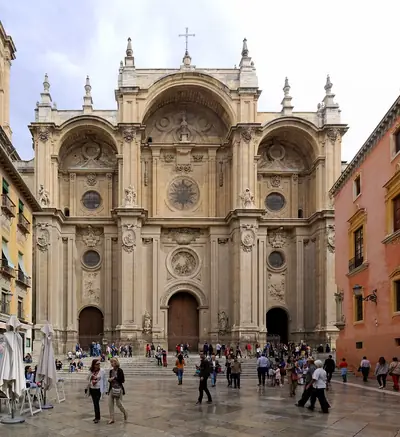
The S.A.I. Catedral Metropolitana de la Encarnación, commonly known as Granada Cathedral, is one of the major religious landmarks in the city. It is considered one of the great works of the Spanish Renaissance.
Construction began in the 16th century under Charles I and continued until the cathedral was completed in 1704 under Philip V. Like several other cathedrals in Andalusia, it was built on the site of the city’s main mosque after the Christian reconquest.
The Royal Chapel of Granada
The Royal Chapel, or Capilla Real, forms part of Granada’s cathedral complex. It was commissioned by Isabella I of Castile and Ferdinand II of Aragon at the end of the 15th century, after the conquest of Granada in 1492.
The chapel is associated with the burial of the Catholic Monarchs and also contains the tombs of their daughter Juana I of Castile and her husband, Philip the Handsome. Its architecture brings together Isabelline, Gothic, Flemish and Renaissance influences.
The Albaicín and the Palace of Dar-Al-Horra
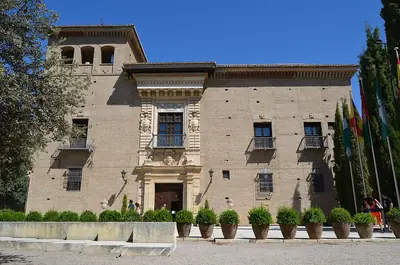
The Albaicín is one of Granada’s historic districts, and the Palacio de Dar-Al-Horra is one of its most important surviving Muslim monuments. This former Nasrid palace was built in the 15th century on the remains of an earlier palace.
Its name means “the House of the Honest Lady” and is traditionally associated with the mother of Boabdil, the last Arab monarch of Spain. After the conquest, Isabella converted the palace into the convent of Santa Isabel la Real.
The surviving palace includes Nasrid decoration and a central courtyard framed by two porticoes. It is considered the only Muslim palace in the Albaicín to have been at least partially preserved.
Palacio de los Córdova
The Palacio de los Córdova stands near the Darro River at Cuesta del Chapiz and now houses Granada’s City Historical Archive. Its history includes demolition, relocation and reconstruction.
The original palace was built between 1530 and 1592 at the Plaza de las Descalzas. After being sold by the Córdova family, it was used as a factory and warehouse before being demolished in 1919. A new building was completed at its present location in 1965, and the preserved treasures were returned there.
The Granada Charterhouse
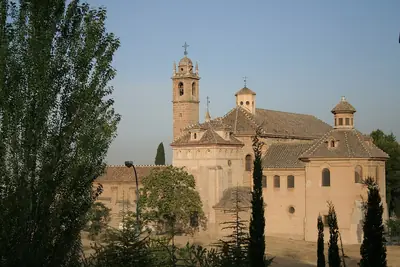
The Granada Charterhouse, or Monasterio de La Cartuja, is a Carthusian monastery admired for its Spanish Baroque architecture. It was founded in 1506, while construction began in 1516 and continued for three centuries.
The exterior is restrained, but the interior is highly decorative, with an exuberant Churrigueresque style. Notable features include the tabernacle designed by Francisco Hurtado Izquierdo and the sacristy built between 1727 and 1764 by Luis de Arévalo and F. Manuel Vasquez. The monastery also contains an extensive collection of paintings.
Other historic places in central Granada
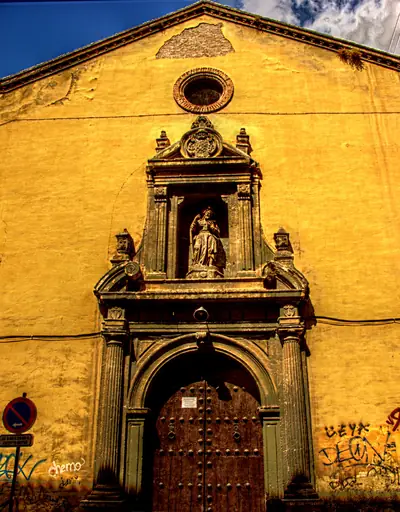
Granada’s historic centre contains many further sites that reveal the city’s changing religious, civic and artistic identity. The Church of Saint James is one of the city’s historic churches, while the Antiguo Monasterio de Santa Paula, now home to the Hotel Santa Paula, preserves traces of Arabic houses incorporated into the former convent.
Casa de los Tiros combines a historic residence with the Museo Casa de los Tiros de Granada. Its name comes from the artillery pieces on its battlements.
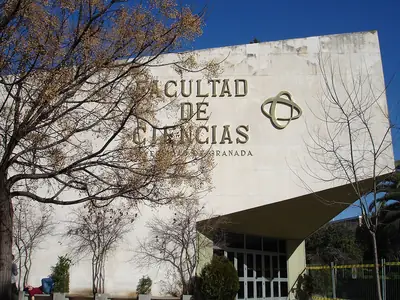
The University of Granada, founded in 1531 by Emperor Charles V, is one of Spain’s historical universities. Its faculties occupy buildings across the city, including the downtown Centro campus, and the university also has campuses in Ceuta and Melilla.
The Casa Molino de Ángel Ganivet and the Cuarto Real de Santo Domingo add further layers to a visit. The latter was an Almohad-period palace, also known as Dar al-Bayda, with a qubba or protocol hall connected to the fortifications of the former Alfareros suburb.
Explore Granada with a self-guided audio tour
A Granada self-guided walking tour lets you explore the city’s monuments while keeping your own pace. Neywo has six walking tours and one bus route in Granada:
- The Alhambra and the Generalife: 1.31 km, 121 minutes and 12 narrated stops.
- The cathedral, the Royal Chapel and the silk market: 1.74 km, 102 minutes and 12 stops.
- The Albaicin: gates, carmens and San Nicolas: 2.19 km, 95 minutes and 12 stops.
- Along the Darro: Arab baths and the Paseo de los Tristes: 2.05 km, 91 minutes and 12 stops.
- Granada’s squares, from Trinidad to Bib-Rambla: 0.78 km, 34 minutes and 4 stops.
- The Ultimate Granada: the Albaicin, the cathedral and the Alhambra: 5.72 km, 234 minutes and 15 stops.
- Minibus C32: from the Alhambra gate to the Albaicin: a bus route of 8.3 km, 36 minutes and 11 stops.
The app tells the story of each place as you reach it, at your own pace, with no group and no schedule. Narration is available in 11 languages, making Neywo a practical free audio guide for discovering Granada independently.
Download Neywo and discover Granada
Download Neywo to explore the Alhambra, Generalife, cathedral, Royal Chapel, Albaicín and Darro with 72 narrated places across the city. Choose a walk or the minibus route, follow the route at your own rhythm and let the stories begin when you arrive at each site.
Granada also makes a useful base for discovering other Andalusian destinations, including Málaga, Córdoba and Frigiliana.
Places with an audio guide in Granada
8 places in Granada with a Neywo audio guide. Each one starts telling its story as you reach it.
Self-guided tours in Granada
7 tours in Granada, free in the Neywo app. Each stop tells its story as you reach it.
- Bus ride
Minibus C32: from the Alhambra gate to the Albaicin
Granada's small city minibus climbs from the Alhambra's Gate of Justice down through the old centre and up the narrow streets of the Albaicin. For the price of a normal bus ticket you pass Plaza Nueva, the Darro valley and the San Nicolas viewpoint without a single steep walk. Ride it end to end for the best view of the Alhambra from across the valley.
Casa de los Tiros · Puerta de la Justicia · Plaza de Santo Domingo, Granada · Plaza Nueva · Palacio de los Olvidados · Archaeological Museum of Granada …
Open this tour: Minibus C32: from the Alhambra gate to the Albaicin - Walk
The Alhambra and the Generalife
The Nasrid palaces, Charles V's Renaissance intrusion, the fortress and the summer gardens above — the reason most people come to Granada, and a half-day at minimum. Book the Nasrid palace slot before you go; nothing else here needs a ticket in advance.
Silla del Moro · Palacio del Generalife · Generalife · Convent of San Francisco, Granada · Alhambra · Partal …
Open this tour: The Alhambra and the Generalife - Walk
The cathedral, the Royal Chapel and the silk market
Christian Granada built directly on top of Muslim Granada. Ferdinand and Isabella are buried in the chapel beside the cathedral; the Alcaiceria alleys next door are what is left of the Nasrid silk bazaar.
Casa de los Tiros · Monument to Isabella I of Castile and Christopher Columbus · Corral del Carbón · Plaza del Carmen, Granada · Plaza de Bib-Rambla · Alcaicería …
Open this tour: The cathedral, the Royal Chapel and the silk market - Walk
The Albaicin: gates, carmens and San Nicolas
Uphill through the Moorish quarter's white lanes to the viewpoint that faces the Alhambra across the valley — the postcard, and worth the climb at sunset. On the way, two city gates, the last Nasrid noble house standing, and the modern mosque.
Church of Saint Andrew · Puerta de Elvira · Puerta Monaita · Palacio de Dar-Al-Horra · Convent of Santa Isabel la Real · Iglesia de San Miguel Bajo …
Open this tour: The Albaicin: gates, carmens and San Nicolas - Walk
Along the Darro: Arab baths and the Paseo de los Tristes
The river walk under the Alhambra walls, past an eleventh-century bath house, a Mudejar convent and the archaeological museum in a Renaissance palace. The best free views of the fortress are from this side.
Palacio de los Córdova · Paseo de los Tristes · Archaeological Museum of Granada · Convento de Santa Catalina de Zafra · Baños árabes del Bañuelo · Palacio de los Olvidados …
Open this tour: Along the Darro: Arab baths and the Paseo de los Tristes - Walk
Granada's squares, from Trinidad to Bib-Rambla
A short flat walk for a first evening, linking the plazas where the city actually sits outside: flower stalls on Bib-Rambla, orange trees on Trinidad, and a Nasrid palace pavilion surviving in a convent garden on Santo Domingo.
Cuarto Real de Santo Domingo · Plaza de Santo Domingo, Granada · Iglesia de San Matías · Fountain of the Battles
Open this tour: Granada's squares, from Trinidad to Bib-Rambla - Walk
The Ultimate Granada: the Albaicin, the cathedral and the Alhambra
City and hill in one line: down from the Albaicin's Nasrid house through the cathedral quarter, then the long climb to Charles V's palace, the Alhambra and the Generalife. Nearly six kilometres and a very full day.
University of Granada · Palacio de Dar-Al-Horra · Church of Saint James · Antiguo Monasterio de Santa Paula · S.A.I. Catedral Metropolitana de la Encarnación · Royal Chapel of Granada …
Open this tour: The Ultimate Granada: the Albaicin, the cathedral and the Alhambra
Walk Granada with Neywo
Neywo turns Granada into a self-guided audio tour. Stories arrive as you reach the place they belong to, and the route reshapes when you wander off it.

