What to See in Florianópolis, Brazil: Free Audio Guide
Things to do in Florianópolis: what to see in the city
Florianópolis is the capital of Santa Catarina, where colonial history, museums and landmark architecture meet the island’s strategic coastal setting. The best things to do in Florianópolis include exploring the historic centre, seeing the Hercílio Luz Bridge and discovering the forts that once defended Santa Catarina Island. Neywo offers a free audio guide for Florianópolis with 29 narrated places, available in 11 languages.
What to see in Florianópolis
Hercílio Luz Bridge
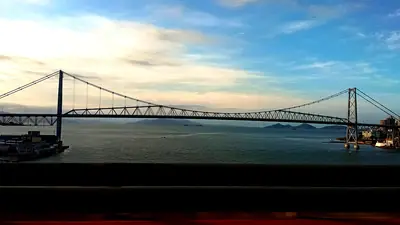
The Hercílio Luz Bridge is Florianópolis’ most recognisable landmark and the oldest bridge connecting Santa Catarina Island to the Brazilian mainland. It is also the longest suspension bridge in Brazil, spanning more than 800 metres, with a 339-metre central suspended section.
Construction began on 14 November 1922, and the bridge opened on 13 May 1926. It replaced the ferry service that had connected the island with the mainland and, for almost five decades, was the sole road connection between them. After safety concerns led to its closure to motor traffic in 1982, it was reopened between 1988 and 1991 to pedestrians, cyclists, motorcycles and animal-drawn transport.
The viewpoint at the island end offers a broad panorama of central Florianópolis. Parque da Luz is nearby, providing a green setting from which to appreciate the bridge.
Palácio Cruz e Sousa
Facing Praça XV de Novembro, Palácio Cruz e Sousa was once the seat of the state government and is now home to Santa Catarina’s Historical Museum. Originally called Palácio Rosado, the building was constructed between 1739 and 1749.
Its façade features ten allegorical statues by Italian artist Gabriel Sielva, including Saint Catherine, the state’s patron saint, the sea nymph Amphitrite and Mercury carrying two barrels, a reference to commerce and industry. Exterior floor tiles were imported and installed in 1910.
Inside, the palace is known for its monumental staircase, Carrara marble balustrades, bronze statues of medieval knights and an Art Nouveau stained-glass window. The building also welcomed Emperors Pedro I and Pedro II in 1826 and 1865.
The palace houses Santa Catarina’s Historical Museum — a museum founded in 1979 that moved from the Customs Building to the palace in 1986.
Our Lady of Exile and St. Catherine of Alexandria Cathedral
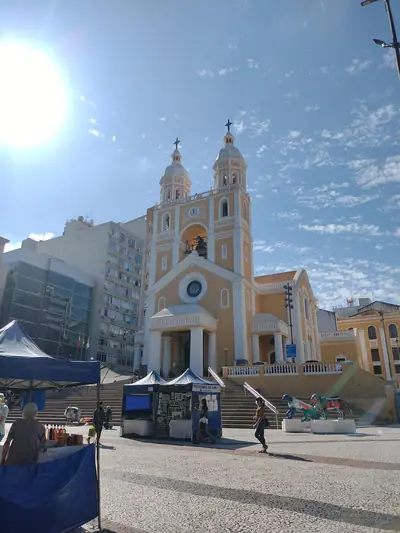
The cathedral has served Florianópolis’ Catholic community since the eighteenth century and is the seat of the Archdiocese of Florianópolis, a role it has held since 19 March 1908. It is also protected as a national historic monument by Brazil’s Institute of Historical and Artistic Heritage.
The history of the site reaches back to 1673, when Florianópolis was definitively colonised. In 1679, Francisco Dias Velho obtained legal title to the land and ordered a small limestone church dedicated to the Virgin Mary. The present colonial-style building was erected between 1753 and 1773, before the church became a cathedral in 1908. The site is also associated with the assassination of the city’s founder inside the original church.
Museu da Escola Catarinense
The Museu da Escola Catarinense preserves the memory of education in Santa Catarina. Founded in 1992 and linked to the Universidade do Estado de Santa Catarina, it occupies a historic city-centre building that once housed the Escola Normal Catharinense, the Instituto Estadual de Educação and the country’s first Faculty of Education, FAED/UDESC.
The museum moved into the building in 2000 and gained full use of the premises after FAED/UDESC left in 2007. Renovated in 2013 following an architecture exhibition, the building combines preserved classrooms with spaces for art exhibitions, courses and cultural events.
Museu Homem do Sambaqui
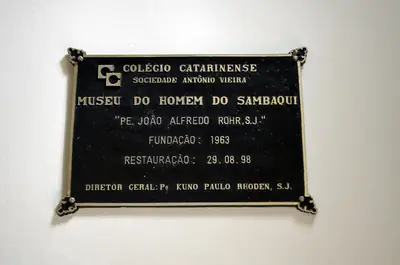
Inside Colégio Catarinense, the Museu Homem do Sambaqui brings together the natural and cultural history of the region. Its exhibitions include native animals and human artefacts, offering a glimpse into local biodiversity and the area’s ancient peoples.
The collections were assembled through the lifelong work of Jesuit priest and researcher João Alfredo Rohr SJ. Among the historical objects is a letter signed in 1864 by Paraguayan president Francisco Solano López, the same year Brazil entered the war against Paraguay.
Museu da Escola Catarinense and the old centre
The museum is one of several places that make the historic centre particularly rewarding to explore on foot. Nearby, the city’s religious, civic and cultural buildings reveal different chapters of Florianópolis’ past, from colonial administration to public education and the arts.
Other museums in the city include the Santa Catarina Art Museum, known as MASC and created in 1949 as the Museum of Modern Art of Florianópolis; the Museu da Imagem e do Som de Santa Catarina; the Museu Contador Renato Gonçalves; the Museu do Presépio; the Museu Aberto da Tartaruga Marinha; and the Memorial da Procuradoria da República em Santa Catarina.
Fortaleza de São José da Ponta Grossa
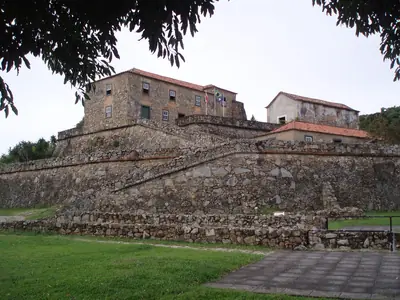
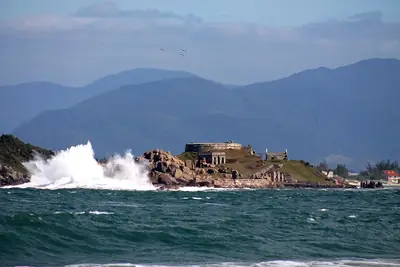
On Morro da Ponta Grossa, Fortaleza de São José da Ponta Grossa overlooks Florianópolis’ northern coastline. Built between 1740 and 1744, it formed part of a triangular defensive system designed to protect the entrance to the North Bay and defend Santa Catarina Island.
The fort was conceived by Brigadier José da Silva Pais, the first governor of the Santa Catarina captaincy. Enslaved labourers built its stone walls, giving the stronghold a distinct colonial military character. In 1765, the northern defences were reinforced with the São Caetano da Ponta Grossa battery.
The fort also belonged to Portugal’s wider strategy for holding Colonia do Sacramento, linking the island’s defences with the broader colonial frontier.
Fortaleza de Nossa Senhora da Conceição de Araçatuba
At the southern mouth of Santa Catarina’s bay, on Araçatuba Island, Fortaleza de Nossa Senhora da Conceição de Araçatuba was the final link in an eighteenth-century defensive chain. It was also known as Fortaleza da Conceição da Barra do Sul.
Brigadier José da Silva Pais conceived and built the fort between 1742 and 1744. Together with the other fortifications, it helped Portugal consolidate control over Santa Catarina Island and maintain a strategic base connected to Colonia do Sacramento.
Teatro da UBRO
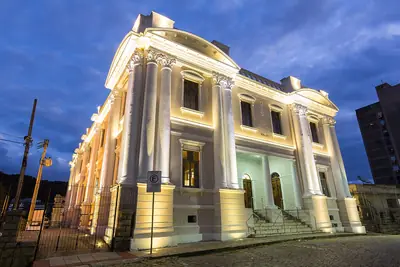
Teatro da UBRO, or the União Beneficente Recreativa Operária Theatre, is another historic cultural site in Florianópolis. It belongs among the city-centre landmarks that connect the city’s architectural heritage with its cultural life.
Explore Florianópolis with a self-guided audio tour
Neywo turns a visit to Florianópolis into a self-guided experience. The app tells the story of each place as you reach it, at your own pace, with no group and no schedule.
There are two walking tours and one bus route:
- “Desterro: Where Florianópolis Began” — a 3.76 km walk lasting 108 minutes, with 9 narrated stops.
- “Painter’s house and Jesuit museum: north of the old centre” — a 1.97 km walk lasting 48 minutes, with 4 narrated stops.
- “Bus 131: through the old centre of Desterro” — a 1.8 km bus route lasting 8 minutes, with 4 narrated stops.
The walks include places such as Praça Pio XII, Igreja da Ordem Terceira de São Francisco da Penitência, Igreja de Nossa Senhora do Rosário e São Benedito, Palácio Cruz e Sousa, Teatro da UBRO, Museu da Escola Catarinense, the cathedral and Hercílio Luz Bridge. The bus route connects Fernando Machado square, Praça XV de Novembro, Museu da Escola Catarinense and Palácio Cruz e Sousa.
Download Neywo to explore Florianópolis with a free audio guide and discover the city’s history as you move from one place to the next. If you are continuing through Brazil, you can also find Neywo audio guides for cities including Curitiba, Belo Horizonte and Ouro Preto.
Places with an audio guide in Florianópolis
8 places in Florianópolis with a Neywo audio guide. Each one starts telling its story as you reach it.
Self-guided tours in Florianópolis
3 tours in Florianópolis, free in the Neywo app. Each stop tells its story as you reach it.
- Bus ride
Bus 131: through the old centre of Desterro
Consórcio Fênix's route 131 runs from the TICEN terminal along the heart of old Florianópolis. Ride it past Praça Fernando Machado, the fig tree of Praça XV, the Museu da Escola Catarinense and the pink Palácio Cruz e Sousa.
Fernando Machado square · Praça XV de Novembro (Florianópolis) · Museu da Escola Catarinense · Palácio Cruz e Sousa
Open this tour: Bus 131: through the old centre of Desterro - Walk
Desterro: Where Florianópolis Began
Florianópolis was founded in 1662 on the spot where the city's central square stands today. Pass the old squares, climb the Church of the Staircase, visit the pink governor's palace with its allegorical statues, stand under the famous fig tree of Praça XV and finish at the Hercílio Luz Bridge, Brazil's longest suspension bridge and the postcard symbol of the island.
Praça Pio XII · Igreja da Ordem Terceira de São Francisco da Penitência, Florianópolis, Brasil · Igreja de Nossa Senhora do Rosário e São Benedito · Palácio Cruz e Sousa · Teatro da UBRO · Museu da Escola Catarinense …
Open this tour: Desterro: Where Florianópolis Began - Walk
Painter's house and Jesuit museum: north of the old centre
Walk north from Praça Pio XII through the quieter streets of the centre: the Jesuit school's museum of natural history and archaeology, the listed church of São Sebastião and the former home of the Romantic painter Victor Meirelles.
Praça Pio XII · Museu Homem do Sambaqui · Igreja São Sebastião (Florianópolis) · Museu Victor Meirelles
Open this tour: Painter's house and Jesuit museum: north of the old centre
Walk Florianópolis with Neywo
Neywo turns Florianópolis into a self-guided audio tour. Stories arrive as you reach the place they belong to, and the route reshapes when you wander off it.

