Visiting Ouro Preto, Brazil: Top Sights on Foot
Things to do in Ouro Preto
Ouro Preto is a historic mountain town in Minas Gerais, Brazil, famous for its well‑preserved colonial architecture, baroque churches and steep cobblestone streets that recall its 18th‑century gold rush. Visitors wander its atmospheric alleys, admire gilt‑covered interiors and enjoy panoramic views of the surrounding hills. Neywo offers a free audio guide for Ouro Preto with 32 narrated places.
Exploring Ouro Preto’s Historic Center
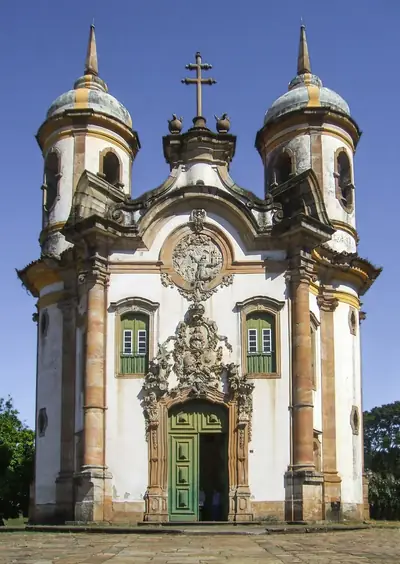
Church of Saint Francis of Assisi
This Catholic church is regarded as one of the most significant works of colonial art in Brazil, blending Baroque design with Rococo decoration. Its façade features a soapstone frontispiece framing the entrance and a relief showing Saint Francis receiving the stigmata. Circular bell towers and an oculus closed by a relief were original in Brazilian religious architecture of the period. Inside, golden woodwork, statues and paintings create a richly decorated setting; the wooden nave ceiling displays Manuel da Costa Ataíde’s most famous painting, and he also painted other panels and gilded the main altar. Construction began after a 1752 request, faced a nineteen‑year wait for Lisbon’s permission, proceeded under a provisional license in 1765 and received final council approval in 1771.
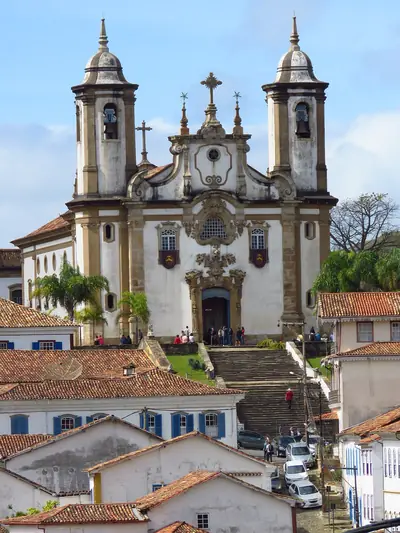
Carmine Church (Church of Our Lady of Mount Carmel)
Also known as the Carmine Church, this building is an important example of Brazil’s Rococo tradition and is listed as a monument by IPHAN, the National Institute of Historic and Artistic Heritage.
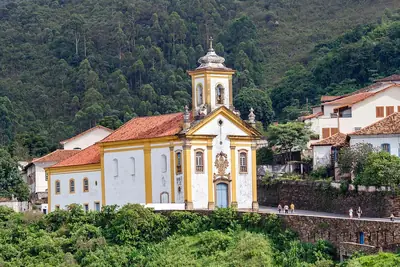
Church of Our Lady of Mercy and Forgiveness (Mercês de Baixo)
The modest exterior of this church opens onto an interior shaped by more than three decades of construction, built between 1740 and 1772 and completed in 1772. An earlier chapel to Senhor Bom Jesus dos Perdões stood on the site from 1740. The building was renovated in the mid‑20th century. Inside, the main altar, choir, four side altars and two wooden pulpits display carved elements that give the space its distinctive character.
Igreja de Nossa Senhora das Mercês e Misericórdia (Mercês de Cima)
Constructed between 1771 and 1793, this church’s central tower was designed by Manuel Francisco de Araújo, a detail worth noting when looking up at the façade.
Casa dos Contos
A grand baroque residence now serving as a museum, Casa dos Contos offers insight into the Gold Cycle and an important part of Brazil’s national culture. It is considered one of the finest examples of residential architecture in Ouro Preto, with abundantly worked stone that recalls the city’s most important historic buildings and churches.
Museu da Inconfidência
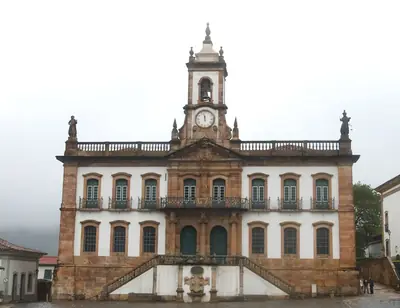
Located in Tiradentes Square, the museum occupies the former Casa de Câmara e Cadeia (town hall and jail) and preserves the memory of the Inconfidência Mineira, the failed movement seeking independence from Portugal. Established in 1938, it became a National Museum of Brazil in 1990. The main building once housed Vila Rica’s civic and penal authorities, and the museum also uses four auxiliary buildings, linking its collections to the city’s earlier civic and penal history.
Casa Guignard Museum
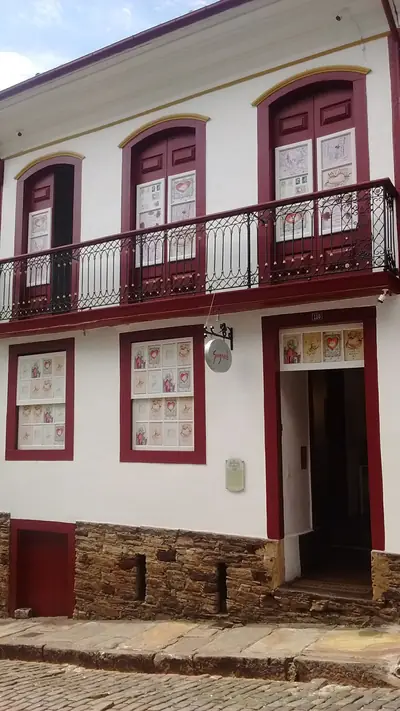
This intimate cultural space presents the work and memory of Alberto da Veiga Guignard, one of Brazil’s major 20th‑century painters and draughtsmen. The collection includes works by Guignard, photographs, personal objects, and pieces by Carlos Scliar and Amílcar de Castro dedicated to him. A notable work is the Portrait of a Man from the late 1940s. The museum began to take shape in 1960 and was inaugurated in 1986; alongside the permanent collection it also offers art and creative workshops.
Igreja Matriz de Nossa Senhora do Pilar (Ouro Preto)
Also known as the Minor Basilica of Our Lady of the Pillar, this church is regarded as one of the most important examples of Baroque architecture in Ouro Preto. Its gold decoration is especially notable, described as the second richest in Brazil after the Mother Church of Saint Anthony in Tiradentes. Protected by IPHAN, the building connects Ouro Preto’s religious history, Baroque splendor and the wealth of the gold cycle.
Museu do Oratório
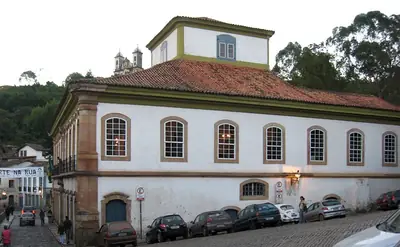
Situated beside the Church of Nossa Senhora do Carmo, this historic three‑story mansion holds a collection of 162 oratories and 300 images. The objects vary widely in type, size and material, illustrating the diverse ways private religious devotion could be expressed. Established in 1998 through the Flávio Gutierrez Cultural Institute and the Gutierrez family, the pieces were donated to IPHAN and the museum was designed by French museologist Pierre Catel.
Praça Tiradentes
This historic square is closely linked to Joaquim José da Silva Xavier, known as Tiradentes, a martyr of Brazilian independence. In 1792 his head was displayed here when Ouro Preto was still called Vila Rica. Today the square marks the site with a monument; the bronze statue of Tiradentes is positioned with its back turned toward what was once the official residence of the governor.
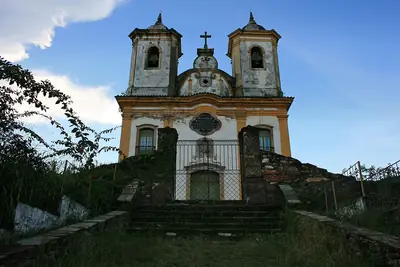
Church of Our Lady of the Rosary (Church of Our Lady of the Rosary of Black Men)
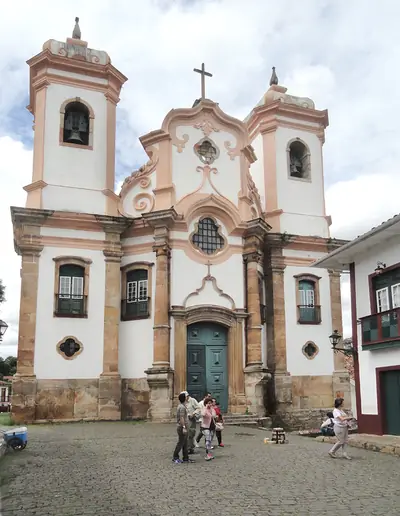
Protected by IPHAN, this Catholic church is regarded as one of the most original sacred buildings from Brazil’s colonial period. Its distinctive character makes it a memorable part of Ouro Preto’s historic landscape.
Governors’ Palace
Located at Tiradentes Square, this building is one of the historic structures that define Ouro Preto’s centre.
Chafariz dos Contos
Regarded as the most important fountain in Ouro Preto, the Chafariz dos Contos was built in 1745 as a public work to supply water to the population. Its sturdy Baroque design is executed in stone masonry with visible carved‑stone sections. At the centre of the broad wall, two large stone scrolls curve inward and outward around a great Baroque shell that rests above a sculpted basin. The stone comes from Itacolomi sandstone. A Latin inscription explains that the Senate of the Chamber, acting as an administrative body rather than the governor, delivered the fountain to the people. A replica of this fountain exists in the American town of Brazil, Indiana.
Chapel of Our Lady of Sorrows (Chapel of Our Lady of Sorrows of Mount Calvary)
This chapel offers a glimpse into the religious brotherhoods that shaped the city’s history. Construction began on land donated by the Brotherhood of the Blessed Sacrament of Antônio Dias, and the initiative came from the Brotherhood of Our Lady of Sorrows of Calvary, founded in 1768 at the Mother Church of Antônio Dias by members of the Dolorous Brotherhood of Braga who lived in Vila Rica.
Igreja de Nossa Senhora da Conceição (Church of Our Lady of the Conception of Antônio Dias)
Set between Praça Barão de Queluz and Praça Antônio Dias, this important Baroque landmark is a striking example of sacred art and architecture. It serves both as a place of worship and as an expression of sacred art in the city.
Explore Ouro Preto with Neywo
Neywo provides three walking tours and one bus route in Ouro Preto.
- “Ouro Preto: Tiradentes, Aleijadinho and the Golden Churches” – 1.33 km, 93 minutes, 10 stops (Governors’ Palace, Praça Tiradentes, Museu da Inconfidência, Carmine Church, Museu do Oratório, Largo de Coimbra, Church of Saint Francis of Assisi, Church of Our Lady of Mercy and Forgiveness, Igreja de Nossa Senhora da Conceição, Museu Aleijadinho).
- “Ouro Preto’s Gold Cycle: Fountains, an Opera House and Hilltop Churches” – 1.97 km, 83 minutes, 9 stops (Teatro Municipal, Casa Guignard museum, Igreja de Nossa Senhora das Mercês e Misericórdia, Chafariz dos Contos, Casa dos Contos, Igreja de São Francisco de Paula, Igreja de Nossa Senhora do Rosário dos Pretos, Igreja de São José, Igreja Matriz de Nossa Senhora do Pilar).
- “Antônio Dias and Santa Efigênia: Ouro Preto’s Quiet Eastern Hills” – 1.36 km, 49 minutes, 6 stops (Museu Aleijadinho, Igreja de Nossa Senhora da Conceição, Praça Antônio Dias, Largo Marília de Dirceu, Chapel of Our Lady of Sorrows, Igreja Matriz de Santa Efigênia).
- “Line 100: Ouro Preto’s Historic Centre by Local Bus” – 5.1 km, 22 minutes, 5 stops (Praça Tiradentes, Igreja de Nossa Senhora das Mercês e Misericórdia, Igreja de Nossa Senhora do Rosário dos Pretos, Praça Monsenhor Castilho Barbosa, Ouro Preto train station).
Each story plays automatically as you reach the site, allowing you to explore at your own pace with no group and no schedule. Narration is available in 11 languages. Download Neywo to hear the history of Ouro Preto’s churches, museums, squares and fountains as you walk through the town.
Places with an audio guide in Ouro Preto
8 places in Ouro Preto with a Neywo audio guide. Each one starts telling its story as you reach it.
Self-guided tours in Ouro Preto
4 tours in Ouro Preto, free in the Neywo app. Each stop tells its story as you reach it.
- Bus ride
Line 100: Ouro Preto's Historic Centre by Local Bus
Ride the city bus 100 from Tiradentes Square across the historic centre to the Rosário and Pilar churches and the old railway station, passing the town's colonial churches on its way down the hill.
Praça Tiradentes · Igreja de Nossa Senhora das Mercês e Misericórdia · Igreja de Nossa Senhora do Rosário dos Pretos · Praça Monsenhor Castilho Barbosa · Ouro Preto train station
Open this tour: Line 100: Ouro Preto's Historic Centre by Local Bus - Walk
Ouro Preto: Tiradentes, Aleijadinho and the Golden Churches
Begin in Tiradentes Square, where the martyr of Brazilian independence was exposed in 1792 and the town hall and jail now hold the Inconfidência Museum. Then climb through the great colonial churches of Carmo, São Francisco de Assis and Mercês, ending at the mother church where Aleijadinho, the master sculptor of Minas Gerais, is buried.
Governors’ Palace · Praça Tiradentes · Museu da Inconfidência · Carmine Church (Ouro Preto) · Museu do Oratório · Largo de Coimbra …
Open this tour: Ouro Preto: Tiradentes, Aleijadinho and the Golden Churches - Walk
Ouro Preto's Gold Cycle: Fountains, an Opera House and Hilltop Churches
Follow the money of eighteenth-century Vila Rica: the oldest theatre in the Americas, the Baroque fountain that supplied the town, the Casa dos Contos where the gold was counted, and the churches paid for with it. Finish at the glittering Pilar church, the second richest in Brazil.
Teatro Municipal · Casa Guignard museum · Igreja de Nossa Senhora das Mercês e Misericórdia · Chafariz dos Contos · Casa dos Contos · Igreja de São Francisco de Paula …
Open this tour: Ouro Preto's Gold Cycle: Fountains, an Opera House and Hilltop Churches - Walk
Antônio Dias and Santa Efigênia: Ouro Preto's Quiet Eastern Hills
Leave the crowds behind for the old mining district of Antônio Dias. Walk its squares and the Calvary chapel of Our Lady of Sorrows, then climb to Santa Efigênia, the church built by and for the town's Black brotherhood, with its Afro-Brazilian symbols.
Museu Aleijadinho · Igreja de Nossa Senhora da Conceição · Praça Antônio Dias · Largo Marília de Dirceu · Chapel of Our Lady of Sorrows · Igreja Matriz de Santa Efigênia
Open this tour: Antônio Dias and Santa Efigênia: Ouro Preto's Quiet Eastern Hills
Walk Ouro Preto with Neywo
Neywo turns Ouro Preto into a self-guided audio tour. Stories arrive as you reach the place they belong to, and the route reshapes when you wander off it.

