Caen, France: Self-Guided Walking Tour
Things to Do in Caen: Historic Abbeys, Churches and Norman Heritage
Caen is a historic city in Normandy where Romanesque abbeys, medieval churches, fortified architecture and post-war reconstruction tell the story of the city. The best things to do in Caen include exploring the two great abbeys associated with William the Conqueror and Matilda of Flanders, discovering historic squares and manors, and tracing the marks left by the fighting of 1944. Neywo offers a free audio guide for Caen with 87 narrated places.
What to See in Caen
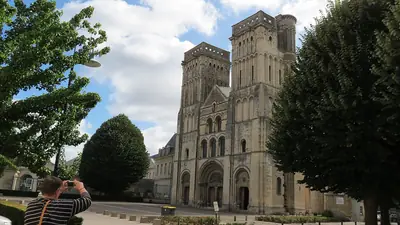
Abbey of Sainte-Trinité, or Abbaye aux Dames
The Abbey of Sainte-Trinité, better known as the Abbaye aux Dames or Abbey of the Ladies, was founded around 1060 as one of Caen’s two great religious foundations. It was associated with Matilda of Flanders, whose tomb remains in the church. William the Conqueror was connected with the other major abbey, the Abbaye aux Hommes.
Sainte-Trinité is an important Romanesque building in Normandy. Its six-part rib vaults, with strongly projecting central transverse ribs, also reveal architectural developments that helped lead towards Gothic design.
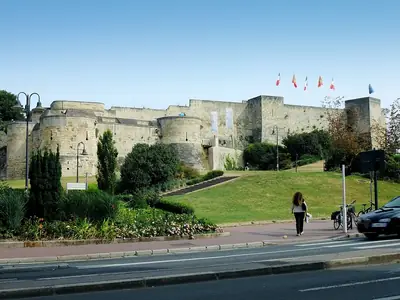
Castle of Caen
The Castle of Caen, or Château Ducal, stands on a rocky spur in the historic centre. Founded around 1060 by William, Duke of Normandy, the fortified complex was altered repeatedly over the centuries.
Covering five and a half hectares, it is one of the largest fortified castles in Europe. Its buildings and remains bring together several periods of Caen’s history, while the castle itself is protected as a historic monument, apart from structures built in the twentieth and twenty-first centuries.
Church of Saint-Pierre
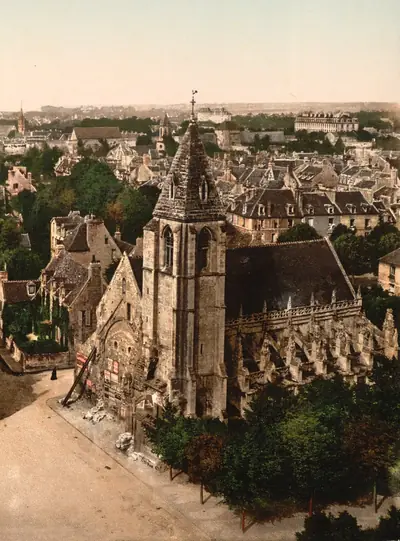
The Church of Saint-Pierre is one of the major religious monuments in Caen’s historic centre. Dedicated to Saint Peter, it is sometimes mistaken for the cathedral because it was once the largest religious building in Bourg-le-Roi.
The present church developed from the early thirteenth century to the sixteenth century and was the setting for major public ceremonies in the Middle Ages. Its eastern apse, built by Hector Sohier between 1518 and 1545, shows the transition from Gothic architecture to the Renaissance.
The church also bears the marks of the twentieth century. On 9 June 1944, its spire was destroyed by a shell fired by HMS Rodney at German forces, and the roof was damaged by fire during the fighting. The spire was later rebuilt.
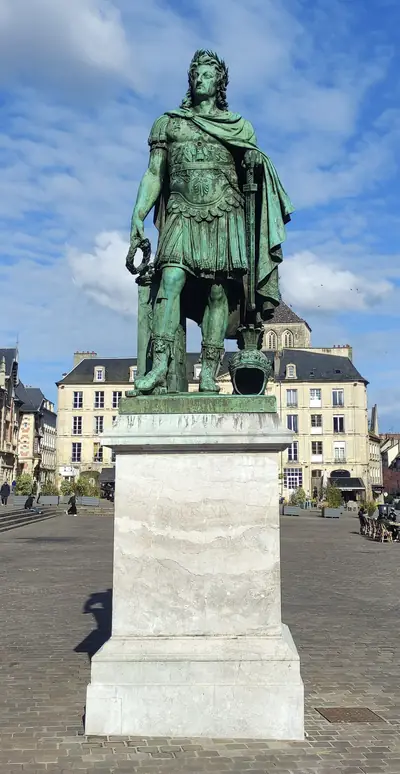
Place Saint-Sauveur and the Statue of Louis XIV
Place Saint-Sauveur is one of the oldest public spaces in Caen’s historic centre. Almost entirely spared by the bombings of 1944, it offers an example of classical-period urban planning.
At its centre stands a neoclassical statue of Louis XIV by Louis Petitot. Installed in 1828, it expressed the city’s loyalty to the new regime during the Restoration. It replaced an earlier statue of Louis XIV, erected on Place Royale in the seventeenth century and destroyed during the French Revolution.
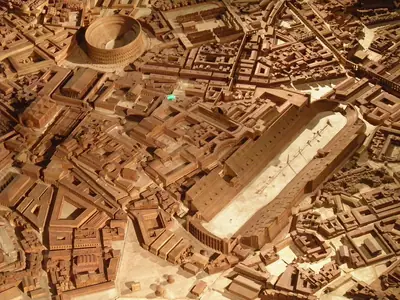
Plan de Rome
The Plan de Rome is a three-dimensional relief map of ancient Rome in the fourth century, made from varnished plaster. It represents three-fifths of the ancient city at a scale of one to four hundred.
Designed by architect Paul Bigot, who won the Grand Prix de Rome in 1900, the model measures eleven by six metres and consists of around one hundred pieces. What began as a reconstruction centred on the Circus Maximus grew into a work covering more than seventy square metres. Bigot developed it over four decades, combining literary, archaeological and visual research.
Since the 1990s, the University of Caen has also been developing a virtual reconstruction based on the model. This digital version can evolve as archaeological discoveries and research change knowledge of ancient Rome.
Saint-Jean Church
The Church of Saint-Jean is the parish church of Caen’s Saint-Jean district and has been protected as a historic monument since 1840. Worship on this site reaches back to the seventh century, when a sanctuary dedicated to the Apostle John stood beside a Roman road crossing the marshes of the lower Orne valley.
The road connected Bayeux and Lisieux and later became rue Exmoisine, now rue Saint-Jean. Discoveries made during work between 1954 and 1956, including monolithic sarcophagi made from Caen stone, suggest that a small necropolis and an oratory once stood near the road.
The Monastère des Bénédictines de Caen
The Monastère des Bénédictines de Caen recalls the city’s Benedictine history. Founded in 1643 by the Sisters of the Order of Saint Benedict, the monastery belonged to the Benedictine nuns of the Blessed Sacrament and was described as a priory from 1685 until 1986.
Much of the complex was destroyed in 1944 during the Battle of Caen. A new monastery was built at Couvrechef, and from 1986 that building was converted into a residence for older people. It has been protected as a historic monument since 2005. This site is distinct from the Abbaye aux Dames, another Benedictine establishment that existed from the first half of the seventeenth century until 1792.
Saint-Gilles and Saint-Martin
The remains of Église Saint-Gilles de Caen stand in a public garden. The former Catholic parish church was dedicated to Gilles the Hermit and was destroyed in 1944. Its site was preserved and arranged as a garden; it has also been recognized as a protected historic monument since 1862.
The ruins of Église Saint-Martin de Caen offer another quiet reminder of the city’s past. The former Catholic parish church has been listed as a historic monument since 25 June 1929. Its surviving fragments preserve the memory of a place of worship lost over time.
Saint-Julien Church
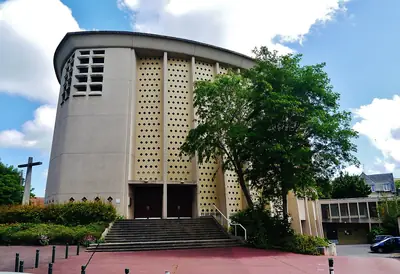
Saint-Julien Church is a modern place of Christian worship designed by Henry Bernard and built during the 1950s. It replaced an older Saint-Julien Church farther south, which was destroyed in 1944. The building is therefore part of Caen’s story of wartime destruction and reconstruction.
Other historic religious sites
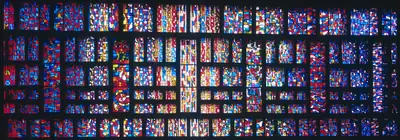
Caen’s architectural heritage extends across the city. The Visitation Monastery was founded in the early nineteenth century by the Order of the Visitation, replacing an earlier convent whose community was dispersed during the French Revolution. Its chapel has been protected as a historic monument since 19 November 2002.
The former Church of the Holy Sepulchre, or Église du Saint-Sépulcre de Caen, was founded in the Vaugueux district in 1219. It later served as a military storage depot, archive and museum store, and is now occasionally used for events as well as being a residence for a dance company. The church was destroyed during the Wars of Religion, reconstructed in the eighteenth century, and deconsecrated during the French Revolution.
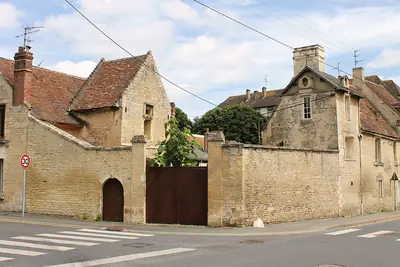
Other protected sites include the Manoir du Pont-Créon in the Saint-Ouen district, the Sainte-Paix Chapel, the Church of the Sacred Heart of La Guérinière, and the remains of the former church of Saint-Martin. Together, these places show how Caen’s religious and civic landscape changed through war, political upheaval and rebuilding.
Explore Caen with a Free Audio Guide
A Caen self-guided walking tour with Neywo lets you discover the city without joining a group or following a fixed schedule. The app has four walking tours and one bus route:
- Two Abbeys: In the Footsteps of William the Conqueror — 3.06 km, 119 minutes and 10 narrated stops.
- Rebuilt Caen: Squares, Mansions and War-Scarred Churches — 2.3 km, 92 minutes and 10 narrated stops.
- Around the Abbaye aux Hommes: Nature, Knights and Convents — 3.1 km, 96 minutes and 8 narrated stops.
- East Caen: Joan of Arc, Carmelites and Renaissance Manors — 2.33 km, 71 minutes and 7 narrated stops.
- Bus 21: Across Caen’s Old Town — 2.6 km, 11 minutes and 7 narrated stops.
Neywo’s stories play as you reach each place, at your own pace, with no group and no schedule. The narration is available in 11 languages, making it an easy way to explore Caen independently. Once you have discovered the city, continue through Bayeux, Deauville or Rouen with the same approach. Download Neywo and explore Caen with the city’s history unfolding around you.
Places with an audio guide in Caen
8 places in Caen with a Neywo audio guide. Each one starts telling its story as you reach it.
Self-guided tours in Caen
5 tours in Caen, free in the Neywo app. Each stop tells its story as you reach it.
- Bus ride
Bus 21: Across Caen's Old Town
The Twisto 21 crosses the old centre of Caen from the Abbaye aux Hommes past Saint-Etienne-le-Vieux, Du Guesclin's statue and the Maison des Quatrans to Saint-Pierre and Saint-Jean. Seven sights without leaving your seat.
St-Étienne de Caen · Church of Saint-Étienne-le-Vieux · Equestrian statue of Bertrand du Guesclin · Ancienne église Saint-Julien de Caen · Maison des Quatrans · Church of Saint-Pierre …
Open this tour: Bus 21: Across Caen's Old Town - Walk
Two Abbeys: In the Footsteps of William the Conqueror
Caen was the capital of William the Conqueror, who founded two great abbeys here. Walk from the tomb of his wife Matilda at the Abbaye aux Dames, past the ruined church of Saint-Gilles, the ducal castle, the Renaissance mansions around Place Saint-Pierre and the square of Saint-Sauveur, to William's own burial place at the Abbaye aux Hommes.
Abbey of Sainte-Trinité · Église Saint-Gilles de Caen · Église du Saint-Sépulcre de Caen · Castle of Caen · Maison des Quatrans · Hôtel d'Escoville …
Open this tour: Two Abbeys: In the Footsteps of William the Conqueror - Walk
Rebuilt Caen: Squares, Mansions and War-Scarred Churches
The Battle for Caen in 1944 destroyed most of the old city, yet a few mansions, churches and statues survived or were carefully rebuilt. Wander the streets south of the castle to see monuments saved from the metal collectors, a Jesuit church used for concerts and the ruins of Old Saint-Stephen's and Saint-Martin.
Monument à Charles Demolombe · Hôtel Daumesnil · Église Notre-Dame-de-la-Gloriette · Antique Dealers' Museum · Church of Saint-Étienne-le-Vieux · Église du Vieux Saint-Sauveur …
Open this tour: Rebuilt Caen: Squares, Mansions and War-Scarred Churches - Walk
Around the Abbaye aux Hommes: Nature, Knights and Convents
Explore the eastern quarter that grew around William's abbey. Meet a medieval knight on horseback, the smallest natural history museum in France, an eleventh-century church with its old cemetery and two convents of the Visitation.
Église Saint-Sauveur de Caen · Equestrian statue of Bertrand du Guesclin · Musée d'initiation à la Nature · Place de l'Ancienne-Boucherie · Visitation de Caen · Ancienne Visitation de Caen …
Open this tour: Around the Abbaye aux Hommes: Nature, Knights and Convents - Walk
East Caen: Joan of Arc, Carmelites and Renaissance Manors
From the Saint-Jean district with its mansions, parish church and statue of Joan of Arc to the quiet east of Caen, where early Renaissance manor houses such as the Manoir des Gens d'armes survive.
Hôtel de Blangy · Church of Saint-Jean de Caen · Equestrian statue of Joan of Arc · Couvent des Carmes de Caen · Maison Sainte-Blaise · Manoir de Vaubenard …
Open this tour: East Caen: Joan of Arc, Carmelites and Renaissance Manors
Walk Caen with Neywo
Neywo turns Caen into a self-guided audio tour. Stories arrive as you reach the place they belong to, and the route reshapes when you wander off it.


More in Normandy
Elsewhere in France
- BayonneNouvelle-Aquitaine
- BiarritzNouvelle-Aquitaine
- BidartNouvelle-Aquitaine
- BordeauxNouvelle-Aquitaine
- BrantômeNouvelle-Aquitaine
- CognacNouvelle-Aquitaine
- DommeNouvelle-Aquitaine
- La RochelleNouvelle-Aquitaine
- Oradour-sur-GlaneNouvelle-Aquitaine
- Saint-Jean-de-LuzNouvelle-Aquitaine
- Sarlat-la-CanédaNouvelle-Aquitaine
- UzercheNouvelle-Aquitaine