Visiting Borjomi, Georgia: Top Sights on Foot
Things to Do in Borjomi, Georgia: Historic Palaces and Mineral-Water Heritage
The best things to do in Borjomi include exploring historic villas, learning about the town’s mineral-water heritage, and discovering the remains of an early hydroelectric power plant. Set in Georgia, Borjomi combines a forested setting with the atmosphere of a historic spa town. Neywo’s free audio guide for Borjomi tells the stories of five narrated places as you explore.
What to See in Borjomi
The town’s main sights reveal different sides of Borjomi, from aristocratic retreats and cultural monuments to the technology that brought electricity to the region.
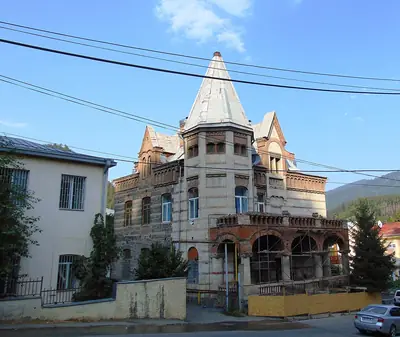
Borjomi Local Museum
The Borjomi Local Museum, also known as the Museum of Local Lore, preserves the history and cultural heritage of the Borjomi region. It is a useful place to begin understanding the area beyond its famous mineral water and resort atmosphere.
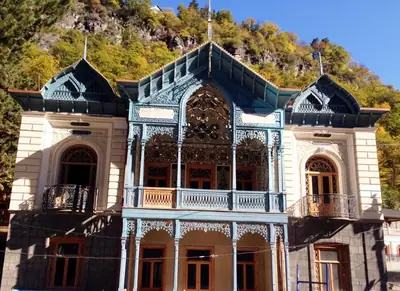
Mirza Riza Khan House, or Blue Palace Firuza
Near the central park stands one of Borjomi’s most recognizable landmarks: the Mirza Riza Khan House, also known as the Blue Palace Firuza. The late-nineteenth-century villa is an immovable cultural heritage monument of Georgia and has become one of the symbols of the town.
The site originally belonged to the Georgian noble family of Avalishvili, who were drawn to the area by the mineral and curative waters for which Borjomi has long been known. The palace’s distinctive architecture reflects the character of Borjomi as a historic spa town.
Borjomi Park
Borjomi Park is a green space in the heart of the town. The Borjomi State Puppet Theatre is located within the park grounds, adding a cultural attraction to this central public space.
The park is also closely connected with Borjomi’s mineral-water identity and provides a natural setting for experiencing the town’s resort character.
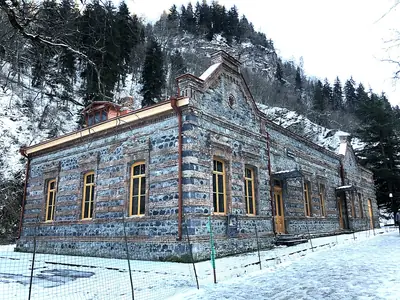
Borjomi Hydro Power Plant, or Prometheus
The remains of the Borjomi Hydro Power Plant, also known as Prometheus, recall the early development of hydroelectric power in the region. The plant began operating in 1899 and continued running for more than half a century, until 1950.
It was one of the first hydroelectric power stations in Georgia and the Russian Empire. Only the plants in St. Petersburg and New Athos came earlier. Its name, Prometheus, reflects the role electricity played in bringing a new form of power to Borjomi at the turn of the twentieth century.
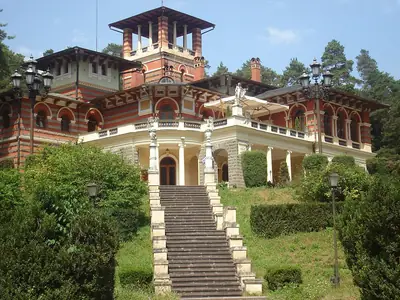
Romanov Palace, or Likani Palace
Just outside Borjomi, on the banks of the Kura River, the Romanov Palace is one of the area’s most striking historic buildings. Also known as Likani Palace, this Moorish-style villa was built in the 1890s as a summer retreat for Grand Duke Nicholas Mikhailovich of Russia.
The palace stands on a specially built terrace and has an asymmetrical layout. Each facade shows a different architectural influence, reflecting the eclectic tastes of the late nineteenth century. The project was designed by Leon Benois, while construction was overseen by the Tbilisi-based architect L. Bilfeldi.
Likani Palace also has an important connection with the history of electricity. In 1898, the first hydroelectric power station in the entire Russian Empire was built in Likani to provide electric light for the palace. The residence once contained remarkable gifts, including a table presented by Napoleon, a saddle from the Shah of Iran, a table made from oak by Peter the Great, and the Romanovs’ billiard table. Some of these objects are now preserved in the Georgian National Museum.
Borjomi’s Mineral-Water and Resort Character
Borjomi developed around its naturally carbonated mineral water, which has traditionally been valued for its supposed health benefits. The springs helped the town grow into a spa destination during the Russian Empire and later made it a celebrated Soviet health resort.
Today, Borjomi’s appeal comes from the combination of this mineral-water history with its historic buildings, green public spaces, and surrounding mountain landscape. Its identity is less about a dense concentration of urban monuments than about the relationship between the resort town, the river, the forests, and the villas built here.
For a wider trip through the country, explore Georgia and consider adding Gori, Kutaisi, or Tbilisi to the itinerary.
Explore Borjomi with Neywo
Neywo offers a free Borjomi self-guided walking tour called “Borjomi: Mineral Springs, Prometheus and a Romanov Retreat.” The walk covers 5.64 km, takes about 110 minutes, and includes four narrated stops: Borjomi Local Museum, Mirza Riza Khan House, Borjomi Hydro Power Plant, and Romanov Palace.
The app has five narrated places in Borjomi, with narration available in 11 languages. Each story plays as you reach the place, at your own pace: there is no group and no schedule. Download Neywo and explore Borjomi with a free audio guide that lets the town’s history unfold as you walk.
Places with an audio guide in Borjomi
4 places in Borjomi with a Neywo audio guide. Each one starts telling its story as you reach it.
Walk Borjomi with Neywo
Neywo turns Borjomi into a self-guided audio tour. Stories arrive as you reach the place they belong to, and the route reshapes when you wander off it.

