Gori, Georgia: Self-Guided Walking Tour
Things to Do in Gori, Georgia: What to See in the Historic City
Gori is a historic city in central Georgia and the capital of Shida Kartli, known for its fortress, museums, theatre, and connection with Joseph Stalin. Its position in the historical region of Kartli, near the meeting point of the Great Liakhvi and Mtkvari rivers, makes it a useful place to explore Georgia’s layered past. Neywo has a free audio guide for Gori with 8 narrated places, available in 11 languages.
What to See in Gori
Gori’s main sights can be explored on foot, with landmarks that connect the city’s regional history, cultural life, and modern identity.
Birthplace of Stalin
The Joseph Stalin Museum is one of Gori’s most distinctive landmarks. Dedicated to the Soviet Union’s leader, who was born in the city, the museum complex preserves its Soviet-era character and includes an exhibition building with a tower, a memorial house, Stalin’s personal railway carriage, and personal belongings associated with him.
The collection contains up to 60,000 exhibits, so it is a place to explore selectively rather than rush through. The small memorial house where Joseph Stalin—whose family name was Dzhugashvili—was born and spent his childhood is preserved within the complex. The house was restored and opened on November 10, 1937, while protective structures were also built that year.
Another notable object is Stalin’s personal railway carriage. According to the museum information, he travelled in it to Tehran and Yalta. Together, the memorial house, exhibition building, and carriage create a museum complex closely tied to Gori’s best-known native son.
Gori Fortress
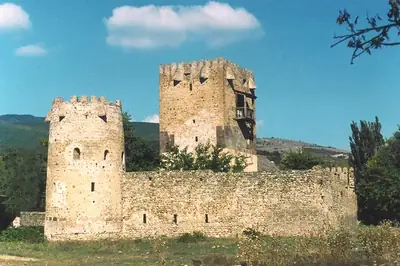
Gori Fortress rises on a rocky hill above the city and reflects Gori’s long strategic importance. From its elevated position, the fortress looks across the surrounding landscape and helps explain the city’s role as a historic crossroads.
The fortress also provides the setting for another important Gori landmark: the Memorial of Georgian Warrior Heroes.
Memorial of Georgian Warrior Heroes
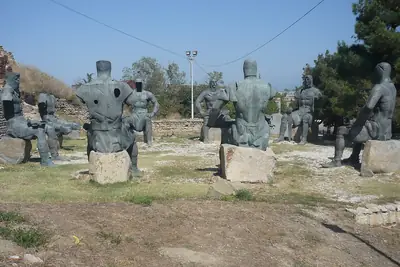
At the foot of Gori Fortress, the Memorial of Georgian Warrior Heroes forms a solemn sculptural circle known as Requiem. Eight seated warriors occupy separate stone blocks, arranged so that the figures face one another in a unified composition.
The memorial was created by sculptor Gogi Ochiauri between 1981 and 1985. It was first installed in Vake Park around the Tomb of the Unknown Soldier, with four sculptures facing four others. In 2009, it was moved to Gori, where it now stands beneath the fortress.
Eristavi State Theatre
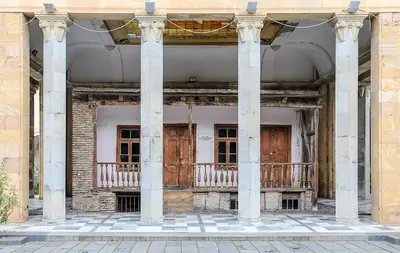
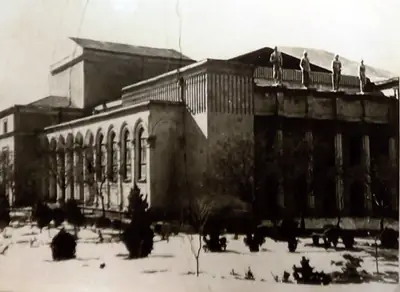
The Eristavi State Theatre is dedicated to Georgian dramatic theatre in Gori. Founded in 1845, it is known as the State Professional Drama Theatre of Gori, and its full name honours Giorgi Eristavi.
The theatre adds a cultural dimension to a visit focused on fortifications and museums, showing the city’s longstanding theatrical tradition.
Gori Ethnographic Museum
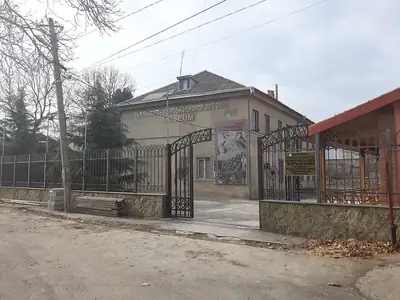
The Gori Ethnographic Museum, named after Sergi Makalatia, explores the archaeology, history, and everyday culture of Georgia, with particular attention to Shida Kartli.
It began in 1935 as a local studies museum through the initiative of people in Gori and with the support of Ivane Javakhishvili, Sergi Makalatia, and Ilia Kipshidze. It became a historical and ethnographic museum in 1943 and received Sergi Makalatia’s name in 2005. From the 1950s onwards, it served as the leading museum of Shida Kartli.
The collections grew through field expeditions and research. Its first permanent exhibition opened in 1938, and by 2010 the museum held around 85,000 objects. These include archaeological and ethnographic material, coins, Georgian and Arabic inscriptions, manuscripts, early printed books, archival documents, photographs, and a scientific library. Archaeological discoveries come from sites including the burial mounds at Tqviavi, the necropolis at Dvani, and the settlement of Gudabertka.
Great Liakhvi River
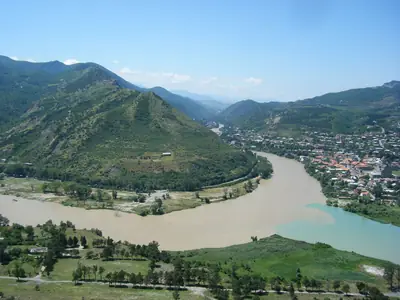
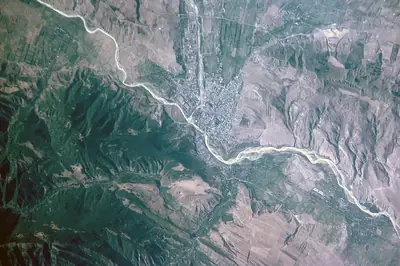
The Great Liakhvi River, or Didi Liakhvi, passes through the region before joining the Mtkvari near Gori. It links the high Caucasus slopes with the landscape around the city.
The river rises on the southern slopes of the Caucasus. Its source area includes the Kheli volcanic highlands, where the Kadlasanistsqali and Deskokhirdon rivers meet at an elevation of 2,338 metres. From there, the Great Liakhvi runs for about 115 kilometres and is joined by tributaries including the Little Liakhvi and the Mejuda.
Near Gori, it flows into the Mtkvari from the left bank. Its water is also used for irrigation, with channels carrying it to agricultural land.
Understanding Gori and Shida Kartli
Gori lies in the historical region of Kartli, one of Georgia’s major regions. Kartli stretches across central and eastern Georgia and is traversed by the Mtkvari, also known as the Kura. Tbilisi lies within its historic lands, and the region played an important role in the ethnic and political consolidation of the Georgian people during the Middle Ages.
The borders of Kartli changed considerably over the centuries. After the kingdom of Georgia was divided in the fifteenth century, Kartli became a separate kingdom with Tbilisi as its capital. Today, its historic territory is divided among several administrative regions, including Shida Kartli and Kvemo Kartli.
Gori is the capital and largest city of Shida Kartli, whose name means “Inner Kartli”. The region was established in 1995 from the former South Ossetian Autonomous Oblast and part of Georgia proper. Its northern areas have been outside the control of the Georgian authorities since the conflicts of the 1990s and the Russo-Georgian War of 2008. This political reality remains an important part of the region’s modern history.
Gori is one of the places that makes Georgia easier to understand beyond its best-known cities. It also works well as part of a wider journey through the country, including Tbilisi, Borjomi, or Kutaisi.
Explore Gori with Neywo
Download Neywo and explore Gori with a self-guided walking tour that follows the city’s history at your own pace. The Gori tour is a 2.17 km walk lasting about 65 minutes, with 5 narrated stops: the Great Liakhvi River, Eristavi State Theatre, Memorial of Georgian Warrior Heroes, Gori Ethnographic Museum, and Birthplace of Stalin.
The app tells the story of each place as you reach it. You can walk alone, stop when you want, and continue without joining a group or following a schedule.
Places with an audio guide in Gori
7 places in Gori with a Neywo audio guide. Each one starts telling its story as you reach it.
Self-guided tours in Gori
1 tour in Gori, free in the Neywo app. Each stop tells its story as you reach it.
- Walk
Gori: Fortress, Theatre and Stalin's Hometown
From the banks of the Liakhvi to the foot of Gori Fortress. Meet the eight stone warriors of the Requiem memorial, a theatre that has played since 1845, the regional museum of Shida Kartli, and finally the house and railway carriage of the Stalin Museum.
Great Liakhvi River · Eristavi State Theatre · Memorial of Georgian Warrior Heroes · Gori Ethnographic Museum · Birthplace of Stalin
Open this tour: Gori: Fortress, Theatre and Stalin's Hometown
Walk Gori with Neywo
Neywo turns Gori into a self-guided audio tour. Stories arrive as you reach the place they belong to, and the route reshapes when you wander off it.

