Tbilisi, Georgia: Self-Guided Walking Tour
Things to Do in Tbilisi: A Self-Guided Walk Through Georgia’s Capital
Tbilisi is Georgia’s capital, a city where medieval churches, historic neighbourhoods, religious landmarks, museums and modern urban spaces come together along the Mtkvari River. The best things to do in Tbilisi include exploring Old Town, climbing towards Narikala Fortress, discovering the city’s many faiths and following Rustaveli Avenue from Freedom Square towards its cultural institutions. Neywo offers a free audio guide for Tbilisi with 165 narrated places.
What to See in Tbilisi
Freedom Square and the story of the 1907 bank robbery
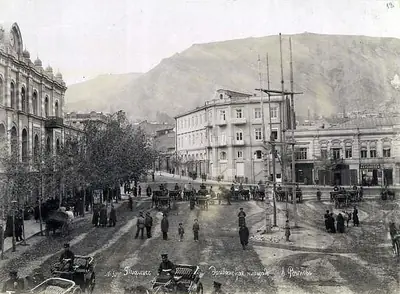
Freedom Square stands at the eastern end of Rustaveli Avenue and remains one of Tbilisi’s central public spaces. Its current name is only the latest in a long sequence: it was known as Erivansky Square under Imperial Russia, then Beria Square and Lenin Square during the Soviet period.
At the centre is the Monument of Freedom, a bronze Saint George slaying a dragon, unveiled in 2006 by Zurab Tsereteli. The square also recalls a dramatic event from 1907, when Bolshevik revolutionaries attacked a bank stagecoach transporting money through what was then Erivansky Square.
Old Town’s churches and communities
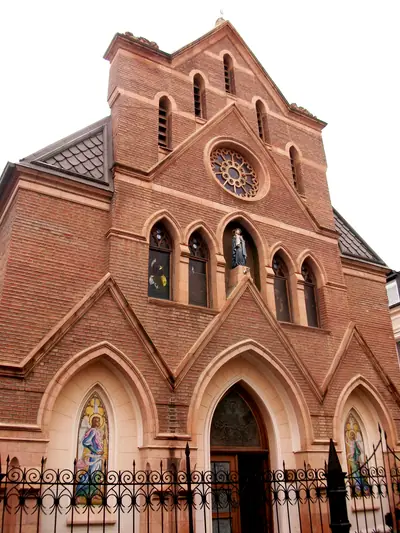
Tbilisi’s historic centre contains places of worship connected with several religious traditions. The Cathedral of the Assumption of the Virgin, at 4 Gia Abesadze Street, is a Roman Catholic cathedral and the seat of the Latin Apostolic Administration of the Caucasus. The present building was constructed between 1805 and 1808, expanded during the nineteenth century, confiscated during the Soviet period and returned to the faithful after Georgia regained independence.
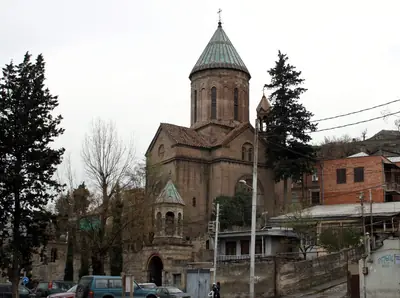
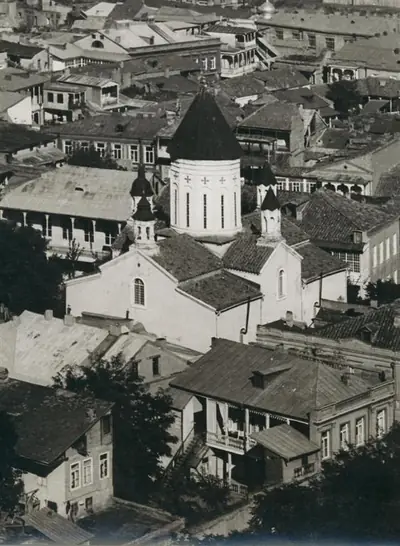
Above Jvaris Mama church stands Saint Gevorg of Mughni Church, also known as Saint George of Mughni. Its origins reach back to the thirteenth century, although the existing building was entirely rebuilt in 1756. Today, the Armenian church is in ruins, with its dome collapsed.
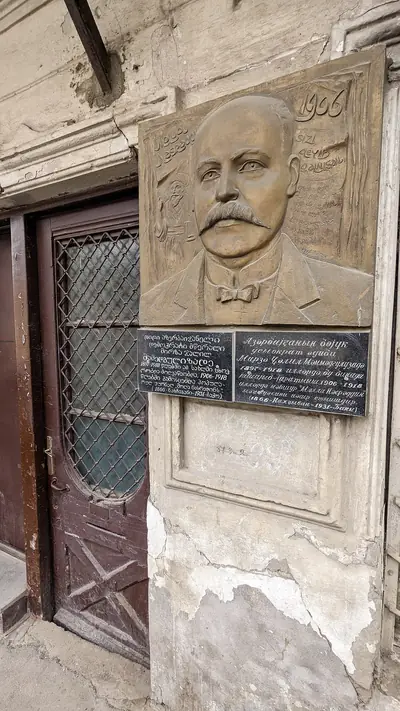
The House-Museum of Jalil Mammadguluzadeh offers another perspective on Tbilisi’s multicultural history. The Azerbaijani writer, publicist and publisher of Molla Nasraddin lived and worked in the house from 1897 to 1918. The museum occupies two rooms on the ground floor of a more-than-two-hundred-year-old building and displays documents, photographs, film posters and copies of the satirical magazine. The Geyrat printing house, which printed Molla Nasraddin, was once located in the basement.
Abanotubani, Juma Mosque and Narikala
In Abanotubani, a small park opened in 2004 around a monument to Heydar Aliyev. Nearby, at the end of Botanical Street, the Juma Mosque sits beneath Narikala Fortress. It is the only surviving mosque in Tbilisi’s historic Old Town.
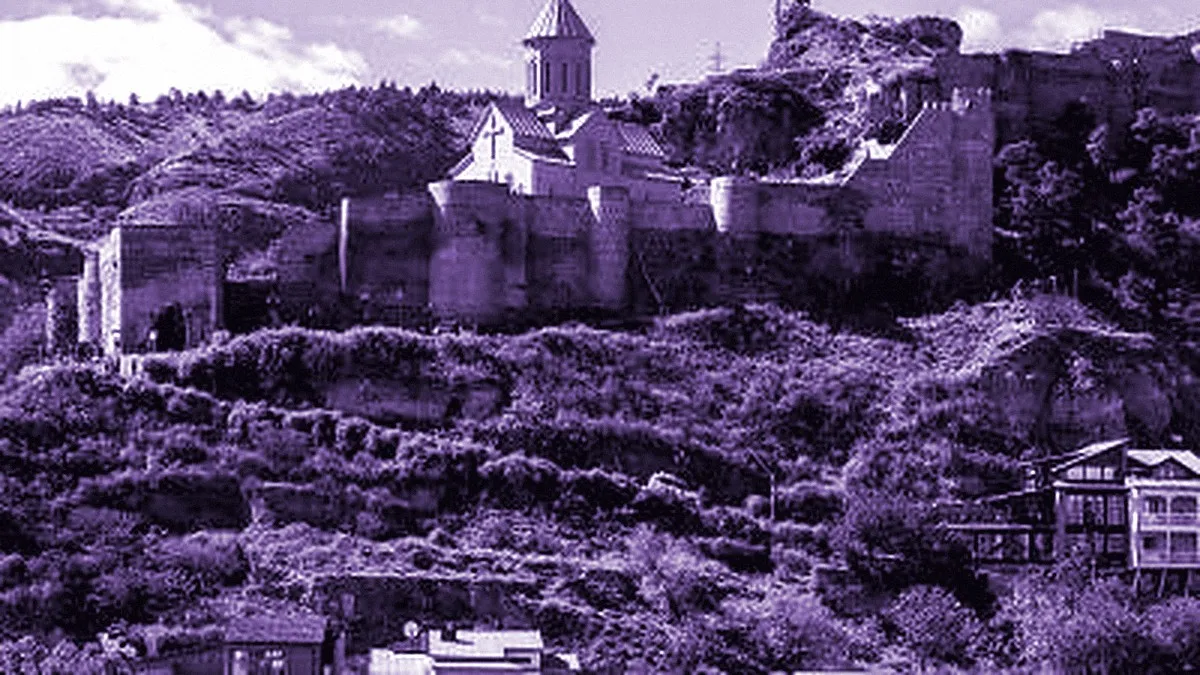
Narikala rises on a rocky hill between the sulfur baths and the National Botanical Garden of Georgia. The fortress consists of two walled sections and reflects several periods in the city’s history. Its lower courtyard contains Saint Nicholas Church, rebuilt in 1996 and 1997 after a thirteenth-century church on the site was destroyed by fire. Inside are frescoes depicting scenes from the Bible and the history of Georgia.
The National Botanical Garden of Georgia occupies the Tsavkisis-Tskali Gorge on the southern foothills of the Sololaki Range, with its central entrance at the foot of Narikala. Its history stretches back more than three centuries: the gardens were described by Jean Chardin in 1671, revived after the Persian invasion of 1795 and officially established as the Tiflis Botanical Garden in 1845. Its collections include Georgian flora and plants from around the world, while the Tsavkisis-Tskali River adds water to the landscape.
Metekhi Church and the Holy Trinity Cathedral
Metekhi Church stands dramatically on the Metekhi Cliff above the Kura River. Much of the existing Georgian Orthodox church dates from 1278 to 1289, during the reign of King Demetrius the Second of Georgia, although oral tradition places its origins as far back as the fifth century. Its position above the river makes it one of Tbilisi’s most recognizable landmarks.
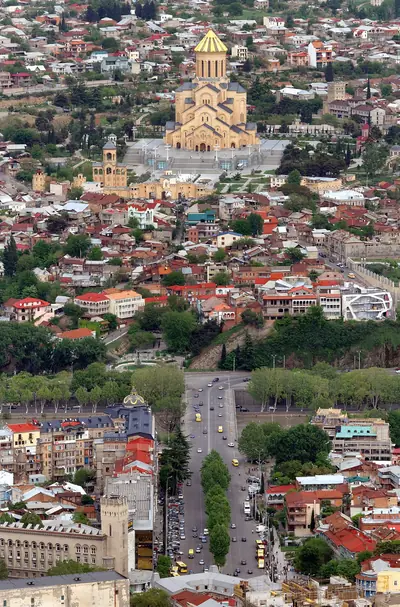
Across the river, in Avlabari, the Holy Trinity Cathedral rises on St. Ilya Hill. Commonly called Sameba, it is the main cathedral of the Georgian Orthodox Church. Built between the mid-1990s and 2004 to a design by architect Archil Mindiaashvili, the complex combines Georgian church traditions from different historical periods with elements of Byzantine design.
Sameba includes a lower church dedicated to the Annunciation of the Virgin Mary, a bell tower and three chapels. One chapel honours Elijah the Prophet, another contains a cross-shaped baptismal pool and is dedicated to the Holy Spirit, while the third is dedicated to the Iveron icon of the Mother of God and provides services for deaf and mute people.
Kharpukhi and Saint Nicholas Church
Saint Nicholas Church sits on a sloping hillside in the Kharpukhi neighbourhood, where a customs house once stood. Greeks who had resettled in the area from Anatolia funded its construction, which began in 1846 under the direction of archpriest Vasily Andrianov.
The brick church has a bluish tin roof and dome. Inscriptions in Greek, Georgian and Russian give different dates for the end of construction: 1854 in Georgian and 1853 in the other two languages. Services were originally held in Greek. During the Soviet period, the church was closed and used for other purposes; in the 1980s, it housed the Georgian Patriarchate’s library.
Vera Park and the Blue Monastery
The Lurji Monastery, or Blue Monastery, is a twelfth-century Georgian Orthodox church in Vera Park. Dedicated to Saint Andrew the First-Called, it takes its name from the vivid blue glazed tiles that once covered its roof.
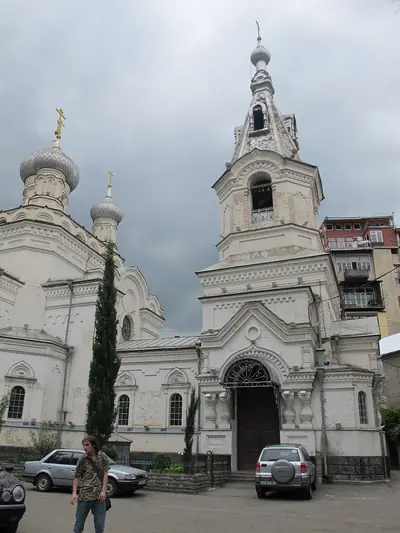
Nearby, the Church of John the Apostle stands south of the Blue Monastery, close to the beginning of Niko Nikoladze Street. This Russian Orthodox church was built with money collected from its congregation and consecrated on 13 May 1901. Its stylized Russian appearance creates a noticeable contrast with the surrounding cityscape.
Books, museums and Rustaveli Avenue
Tbilisi’s Book Museum opened in 2017 inside the first building of the National Parliamentary Library of Georgia. It was the first museum of its kind in Georgia and is described as the largest book museum in the Caucasus. Its collection contains more than 19,000 rare books, including a Georgian–Italian dictionary from 1629, publications from Vakhtang’s printing house and an incunabulum.
The Smirnov Museum, at 20 Galaktion Tabidze Street, occupies a cultural heritage monument and offers another glimpse into the artistic culture preserved in the historic centre.
For a broader view of the country, explore Georgia and consider adding Gori, Kutaisi or Batumi to your itinerary.
Explore Tbilisi with Neywo
Neywo turns a visit into a Tbilisi self-guided walking tour: the app tells the story of each place as you reach it, at your own pace, with no group and no schedule. Its Tbilisi audio guide includes four walking tours and one bus route, with narration available in 11 languages.
The walks cover:
- Old Tbilisi: Many Faiths on One Hill — 2.1 km, 91 minutes and 11 narrated stops.
- Up to Narikala and the Mother of Georgia — 1.55 km, 69 minutes and 8 narrated stops.
- Rustaveli Avenue: Freedom to the Opera — 1.64 km, 86 minutes and 10 narrated stops.
- Modern Art to the Blue Monastery — 3.1 km, 111 minutes and 10 narrated stops.
There is also a bus route:
- Bus 331: From the Kura Bridge to Rustaveli and the Old Town — 8.9 km, 38 minutes and 11 narrated stops.
Download Neywo for free and explore Tbilisi independently, from Freedom Square and Rustaveli Avenue to the churches of Old Town, Narikala, the Blue Monastery and the city’s museums.
Places with an audio guide in Tbilisi
8 places in Tbilisi with a Neywo audio guide. Each one starts telling its story as you reach it.
Self-guided tours in Tbilisi
5 tours in Tbilisi, free in the Neywo app. Each stop tells its story as you reach it.
- Bus ride
Bus 331: From the Kura Bridge to Rustaveli and the Old Town
A regular city bus from Station Square past the Queen Tamar Bridge and down Rustaveli Avenue to Freedom Square, the Museum of Soviet Occupation and the National Gallery. It then crosses into the old town for Karapet church, the wine museum and the Akhundov House, ending at Saint Nicholas church in Kharpukhi.
Queen Tamar Bridge · National Science Library · Georgian National Academy of Sciences · Shota Rustaveli Theatre and Film University · Freedom Square · Museum of Soviet Occupation …
Open this tour: Bus 331: From the Kura Bridge to Rustaveli and the Old Town - Walk
Old Tbilisi: Many Faiths on One Hill
A short walk through the streets below Narikala where Georgian Orthodox, Armenian, and Jewish communities have prayed side by side for centuries. Pass hidden Armenian churches, a synagogue, the Sioni Cathedral and the old caravanserai that now holds the city's history museum, cross Gorgasali Square to the rock of Metekhi above the Kura river, then climb into Avlabari to a ruined Armenian church and the Ejmiatsin church.
Norashen Holy Mother of God Armenian Church · Jvaris Mama church, Tbilisi · Church of Saint George · Great Synagogue · Sioni Cathedral · Tbilisi History Museum …
Open this tour: Old Tbilisi: Many Faiths on One Hill - Walk
Up to Narikala and the Mother of Georgia
Climb the Betlemi stairs from the old town to the fortress that has watched over Tbilisi for 1,500 years. Meet Kartlis Deda, the aluminium Mother of Georgia with her cup of wine and her sword, wander the walls of Narikala, and come down to Tbilisi's last surviving old-town mosque.
Gudiashvili Square, Tbilisi · Lower Bethlehemi Church · Holy Mother of God Church of Bethlehem · Kartlis Deda · Narikala · Church of St. Nicholas, Tbilisi …
Open this tour: Up to Narikala and the Mother of Georgia - Walk
Rustaveli Avenue: Freedom to the Opera
Tbilisi's grand boulevard, from Freedom Square past the museum that tells of Soviet occupation, the church with frescoes by Lado Gudiashvili and the National Gallery, to the Rococo Rustaveli Theatre and the neo-Moorish opera house.
Freedom Square · Georgian Museum of Fine Arts · Museum of Soviet Occupation · Book Museum · Alexander Nevsky Cathedral · Kashveti Church …
Open this tour: Rustaveli Avenue: Freedom to the Opera - Walk
Modern Art to the Blue Monastery
Leave the avenue for the quieter Vera district: a Tsereteli museum, a Russian-style church on the hill, the squares and academy of the city's intellectual life, and the 12th-century Lurji Monastery in Vera Park, named for the blue tiles that once covered its roof.
Zurab Tsereteli Museum Of Modern Art · Mikhail Tverskoy church, Tbilisi · First Republic Square · Georgian National Academy of Sciences · Lurji Monastery · Church of John the Apostle …
Open this tour: Modern Art to the Blue Monastery
Walk Tbilisi with Neywo
Neywo turns Tbilisi into a self-guided audio tour. Stories arrive as you reach the place they belong to, and the route reshapes when you wander off it.

