Things to Do in Zugdidi, Georgia: Walking Guide
Things to Do in Zugdidi: What to See in Georgia’s Samegrelo Region
The best things to do in Zugdidi include exploring the Dadiani Palaces Historical and Architectural Museum, walking through the Zugdidi Botanical Garden, and visiting historic churches. As the administrative heart of Samegrelo-Zemo Svaneti, Zugdidi is also a place to understand the contrast between Georgia’s subtropical lowlands and its high mountain culture. Neywo has a free audio guide for Zugdidi with four narrated places, available in 11 languages.
What to See in Zugdidi
Dadiani Palaces Historical and Architectural Museum
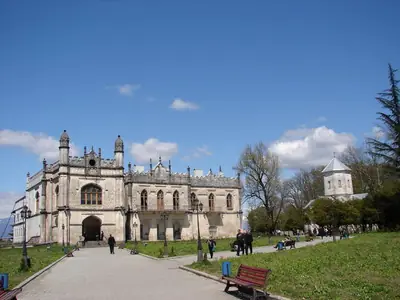
The Dadiani Palaces Historical and Architectural Museum is the essential first stop for anyone wondering what to see in Zugdidi. It occupies a princely residence that began as a 17th-century home and was extensively renovated in the 19th century into the Neo-Gothic ensemble visible today.
The complex was once the seat of the House of Dadiani, which ruled Samegrelo for centuries. The museum opened in April 1921, based on the personal collection of David Dadiani, the last ruling prince of Samegrelo, together with objects collected from churches and monasteries across the region.
Its roughly 50,000 exhibits cover an exceptionally broad span, from the Paleolithic and Bronze Age to the late 19th century. The displays include archaeological finds, weapons, household objects, clothing, and examples of traditional Megrelian life. Reconstructed dwellings such as the patskha and jargvali help make that regional history more tangible.
The collection also contains the personal belongings of David Dadiani and his family, as well as important religious relics and objects of world significance. More than a story about one aristocratic family, the museum presents the cultural heritage of western Georgia.
Zugdidi Botanical Garden
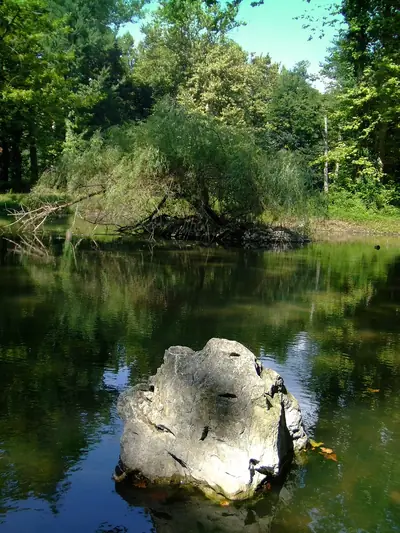
Beside the palace, the Zugdidi Botanical Garden offers a different way to experience the legacy of the Dadiani family. It began as the family’s private decorative park and took its present form in the late 19th century, when David Dadiani developed the grounds around his residence.
Today, it operates as the Zugdidi branch of the Central Botanical Garden under the Georgian Academy of Sciences. Its mild climate and location make it an important site for studying and acclimatizing subtropical plants.
The garden contains more than 80 genera of exotic trees and shrubs brought from Southeast Asia, India, Japan, the Mediterranean, and the Americas. Among the highlights are six species of magnolia, several kinds of oak, Atlas and Himalayan cedars, and the Canary Island date palm. Some plants are relict or endemic species, living remnants of ancient flora preserved far from their original homes.
A walk here complements the museum visit: the palace explains the political and cultural history of the Dadiani family, while the garden reflects their interest in landscape and horticulture.
Church of the Savior, or Mantskhvar-kari
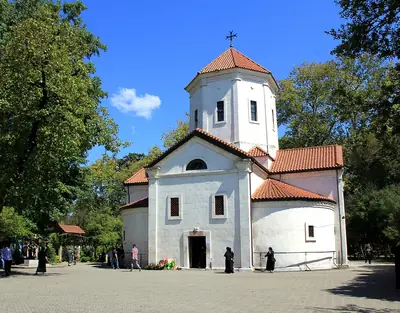
On a gentle rise east of Zugdidi’s city centre stands the Church of the Savior, locally known as Mantskhvar-kari. Its red-brick walls belong to one of the older surviving structures in the city, although its exact construction date remains disputed.
The church has a cross-shaped plan and a single dome. The dome is hexagonal and pierced by six windows, while the eastern apse has three additional windows. A narthex stands on the west side, and doorways open onto the north and south façades.
Several details reward a close look. Three deep niches are carved into the apse, and each of the northern and southern façades contains an arched niche. The western doorway was removed during a later restoration.
Scholars have proposed different dates for the building. The French scholar Marie Brosset placed it at the end of the 15th century, while the Georgian scholar Ekvtime Taqaishvili argued for the 13th or 14th century. That uncertainty is part of the church’s story, connecting it to the long and layered history of Zugdidi.
Explore Samegrelo-Zemo Svaneti from Zugdidi
Zugdidi is the administrative heart of Samegrelo-Zemo Svaneti, a region stretching from the Black Sea coast to the high peaks of the Greater Caucasus. Its geography brings together two very different historical and cultural worlds.
Samegrelo, also known as Mingrelia, covers the lowlands and coastal areas. It has a subtropical climate and rich agricultural traditions, and was once the powerful Principality of Mingrelia. Zemo Svaneti, or Upper Svaneti, is a high mountain region known for alpine meadows, medieval defensive towers, and a culture shaped by centuries of isolation.
The two areas also developed different forms of political and community life. Samegrelo was ruled by its princely dynasty, while Svaneti maintained its autonomy through a distinctive system of community governance. The towers that still dot the mountain landscape remain among the most recognizable expressions of Svaneti’s heritage.
This contrast makes Zugdidi more than a stop before continuing elsewhere. It is a useful starting point for understanding the relationship between the subtropical west of Georgia and the Greater Caucasus. For a broader introduction to the country, see the Georgia destination guide. Travellers continuing through western Georgia can also explore Kutaisi or Batumi.
A Zugdidi Self-Guided Walking Tour with Neywo
There are no scheduled group walks to join. Instead, Neywo’s free audio guide for Zugdidi covers four narrated places, with stories available in 11 languages. The app tells the story of each place as you reach it, at your own pace, with no group and no schedule.
Download Neywo and explore Zugdidi independently, moving between the palace, its botanical garden, and the city’s historic religious architecture while the app provides the context around you. If your journey continues through Georgia, Neywo also covers destinations including Tbilisi, Gori, and Telavi.
Places with an audio guide in Zugdidi
3 places in Zugdidi with a Neywo audio guide. Each one starts telling its story as you reach it.
Walk Zugdidi with Neywo
Neywo turns Zugdidi into a self-guided audio tour. Stories arrive as you reach the place they belong to, and the route reshapes when you wander off it.

