Batumi, Georgia: Self-Guided Walking Tour
Things to Do in Batumi: What to See in Georgia’s Black Sea City
Looking for things to do in Batumi? Georgia’s Black Sea city brings together ancient fortresses, religious buildings, museums, theatres and monuments shaped by the history of Adjara. From the legendary Medea statue in the centre to the Roman ruins of Gonio beyond the city, Batumi is worth exploring for its unusually rich mix of cultures and eras. Neywo offers a free audio guide for Batumi with 20 narrated places, available in 11 languages.
Batumi is the capital of Adjara and a coastal city with connections to Georgian, Roman, Byzantine, Ottoman, Jewish, Armenian and Catholic history. Its streets and surrounding area are best understood through the places that preserve those different layers.
What to see in Batumi
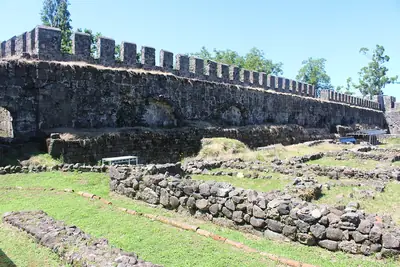
Gonio Fortress
Gonio Fortress is a Roman stronghold on the coast, beside the Chorokhi River and the Black Sea. The Romans knew the site as Apsarus, and ancient writers including Pliny the Elder and Appian mentioned it.
By the second century, Gonio had become a fortified Roman city in Colchis, with a theatre and hippodrome. Later, the fortress passed through Byzantine, Genoese and Ottoman hands. Ottoman control began in 1547 and lasted for more than three centuries, until Adjara entered the Russian Empire in 1878.
The surviving walls make Gonio one of the most important archaeological sites around Batumi. They also show why this location mattered: the fortress controlled a strategic crossing and a section of the Black Sea coast.
Medea statue
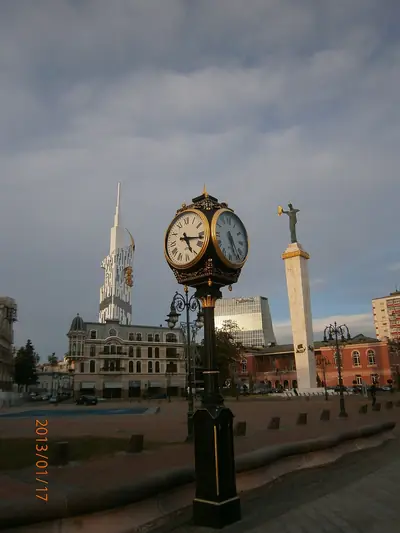
On Europe Square, a bronze Medea holds a golden fleece above her head. The monument refers to the legendary princess of Colchis, the ancient kingdom associated with this part of the Black Sea.
In Greek mythology, Medea helped Jason and the Argonauts take the Golden Fleece from her father before fleeing with them. The statue connects Batumi’s modern city centre with one of the best-known stories linked to the ancient Caucasus.
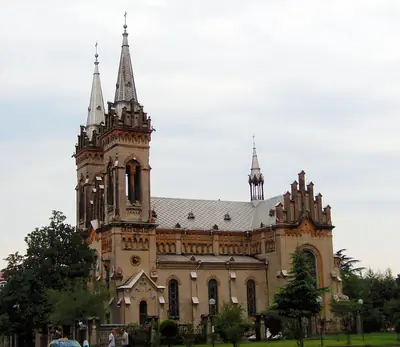
Batumi Cathedral of the Mother of God
The Batumi Cathedral of the Mother of God is a striking Gothic Revival building with pointed arches and strong vertical lines. Aleksander Rogojski designed it, and construction took place between 1898 and 1903.
The building began as a Roman Catholic church, funded by the Georgian Catholic businessmen the Zubalashvili brothers. During the Soviet period, it was closed for worship and used as a high-voltage laboratory. In 1989, it was transferred to the Georgian Orthodox Church and returned to religious use as a cathedral.
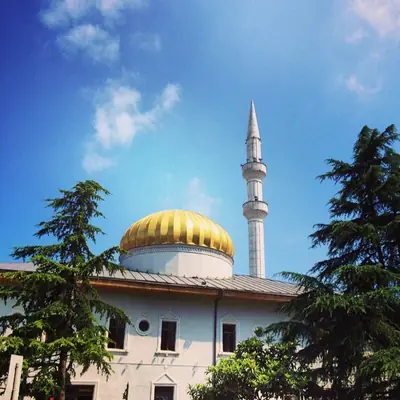
Batumi Mosque
Built in 1886, Batumi Mosque is the only working mosque in the city. The noble Georgian Muslim family of Aslan Beg Khimshiashvili funded its construction, while the Laz brothers created its design.
The mosque is also known as Orta Jame, meaning “the mosque in the middle”. The name recalls a time when three mosques stood beside one another; this is the only one that remains.
Batumi Synagogue
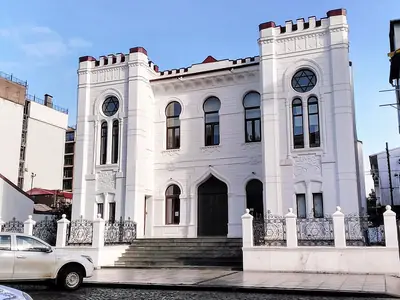
The Batumi Synagogue, also called the Stone Ashkenazi Synagogue, has stood on Vazha-Pshavela Street since 1904. Semyon Vulkovich directed the construction for Batumi’s Ashkenazi Jewish community.
The synagogue served as a religious centre for nearly two decades before Soviet authorities converted it into a sports hall in 1923. Its stone façade remains a reminder of the Jewish community that once played an important role in the city.
Adjara State Museum
The Adjara State Museum on Israil Jincharadze Street traces the long history of human life along the coast. It opened in 1908 as a school collection, developed into a city museum and a museum of local lore, and became the Adjara State Museum in 1943. It bears the name of the scholar Khariton Akhvlediani.
The archaeological collection includes objects from the twelfth to ninth centuries BC and from the seventh to fourth centuries BC. Among its notable pieces are a Greek black-figure crater, engraved vessels and a bronze belt. The Gonio treasure includes gold jewellery depicting Aphrodite and Eros, a gold cup from the first or second century AD, a small gold figurine from Badr and fragments of a gold diadem.
For wider context on the country’s heritage, see the Georgia destination guide.
Batumi Drama Theatre I. Chavchavadze
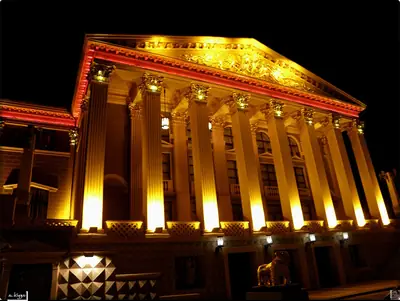
Named after the Georgian writer Ilia Chavchavadze, Batumi Drama Theatre is the city’s state drama theatre. It is an important cultural venue for Georgian theatrical tradition and one of the city’s principal performance spaces.
Batumi Puppet and Youth State Theatre
Batumi’s puppet-theatre tradition began in the 1930s, when amateur enthusiasts started staging performances. In 1936, the first professional puppet theatre in Adjara opened as Tikini Theatre.
That early company developed into today’s Batumi Puppet and Youth State Theatre, where puppetry and performances for younger audiences remain at the centre of the programme.
Batumi State Musical Center
The Batumi State Musical Center combines modernist and classical elements in its architecture near the Black Sea promenade. Five resident companies work under one roof: an opera troupe, a symphony orchestra, a chapel choir, a youth musical theatre and the Nota quartet.
The centre hosts operas, dramatic productions, concerts and international festivals. It is also used for exhibitions, conferences, state ceremonies and other public events.
Batumi Summer Theatre
The original Batumi Summer Theatre opened in 1947 and became one of the city’s best-known symbols. Its wooden structure was compared locally with the mythical ship Argo.
Architects K. I. Javakhishvili and Bogdan Kirakosyan designed the building, while structural engineer Vladimir Shukhov contributed innovative solutions. It was once the largest open-air theatre in the Soviet Union, built with concrete, metal and glass and crowned by a large dome using Shukhov’s technology.
Its interior auditorium was made entirely of wood and had no windows. A special ventilation system kept the air fresh and cool, even during hot weather.
Losorion Castle
The ruins of Losorion Castle stand on a cone-shaped hill above the left bank of the Chorokhi River. The Byzantine fortification was built in the sixth century under Emperor Justinian I, on the eastern edge of the Black Sea kingdom of Lazica.
Losorion played a role in the Lazic War between the Roman Empire and Sasanian Persia, fought from 541 to 562. Its hilltop position gave defenders a natural advantage, since attackers had to climb towards the fort.
In Georgian tradition, the site is known as Tamaris Tsikhe, or Queen Tamar’s Castle. The different names reflect the long sequence of powers and cultures that shaped this part of the coast.
Churches and religious heritage
Batumi’s religious landscape extends beyond its cathedral and mosque. The Church of the Holy All Savior is the city’s Armenian Apostolic Church, also known as Surp Kristos Amenaprkich in Armenian.
The Church of the Holy Spirit represents Batumi’s more recent Roman Catholic history. The current building was designed by Oleg Pataridze and Giorgi Baghoshvili in the late 1990s and consecrated in 2000. It replaced an earlier Catholic church that had been confiscated during the Soviet period and later transferred to the Georgian Orthodox Church.
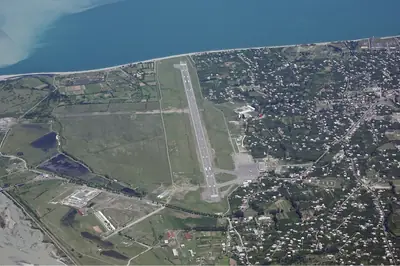
Batumi International Airport
Batumi International Airport lies two kilometres south of the city and serves as a gateway to Georgia’s Black Sea coast. The current terminal opened in May 2007, with capacity for 600,000 passengers per year.
A sculpture near the terminal honours Fadiko Gogitidze, described as Adjara’s first woman pilot. The airport is also sometimes called Chorokh Airport, after the nearby Chorokhi River.
Explore Batumi with a free audio guide
A Batumi self-guided walking tour is an easy way to connect the city’s historic centre without joining a group or following a fixed timetable. Neywo’s free Batumi audio guide includes one walking tour and one bus route:
- Batumi Old Town: Argonauts, Mosques and Gothic Spires — a 3.98 km walk lasting 117 minutes, with 12 narrated stops.
- Line 1: Batumi’s Old Centre by City Bus — a 9.6 km route lasting 41 minutes, with 6 narrated stops.
The walking route includes the Medea statue, Batumi Mosque, Batumi Cathedral of the Mother of God, Batumi Synagogue, Adjara State Museum and several theatres and churches. The bus route offers another way to reach places including the Medea statue, Batumi Mosque and the Church of the Holy Spirit.
Download Neywo and explore Batumi at your own pace. The app tells the story of each place as you reach it, with no group and no schedule. If you are continuing through Georgia, you can also discover Kutaisi, Tbilisi, Zugdidi or Gori with Neywo.
Places with an audio guide in Batumi
8 places in Batumi with a Neywo audio guide. Each one starts telling its story as you reach it.
Self-guided tours in Batumi
2 tours in Batumi, free in the Neywo app. Each stop tells its story as you reach it.
- Bus ride
Line 1: Batumi's Old Centre by City Bus
Ride the municipal line 1 through the heart of Batumi, past the Revolutionary Committee building, Medea's statue on Europe Square, the drama theatre, the Orta Jame mosque and Freedom Square by the port, ending at the Catholic Church of the Holy Spirit.
Medea statue · Batumi Drama Theatre I. Chavchavadze · Batumi Mosque · Church of the Holy Spirit · Freedom Square
Open this tour: Line 1: Batumi's Old Centre by City Bus - Walk
Batumi Old Town: Argonauts, Mosques and Gothic Spires
A relaxed loop through the old centre of Batumi, where a Greek legend, an Ottoman mosque, a Gothic Revival cathedral and a Soviet-era synagogue stand a few streets apart. Pass Medea with her golden fleece, the churches of four faiths and the squares that changed names with every regime, and finish with the art and archaeology of the Adjara museums.
Batumi Summer Theatre · Medea statue · Batumi Drama Theatre I. Chavchavadze · Church of the Holy All Savior (Batumi) · Saint Nicholas Church in Batumi · Batumi Mosque …
Open this tour: Batumi Old Town: Argonauts, Mosques and Gothic Spires
Walk Batumi with Neywo
Neywo turns Batumi into a self-guided audio tour. Stories arrive as you reach the place they belong to, and the route reshapes when you wander off it.

