Kutaisi, Georgia: Self-Guided Walking Tour
Things to Do in Kutaisi: A Self-Guided Walk Through Georgia’s Old Capital
Looking for things to do in Kutaisi? This historic city on the Rioni River brings together medieval churches, museums, theatres, Jewish heritage, and the remains of hilltop fortifications. Its compact center makes it especially well suited to exploring on foot, with a free Neywo audio guide for Kutaisi featuring 12 narrated places.
What to See in Kutaisi
The most important sights are connected by a walk through the historic center and up toward Ukimerioni Hill. Together, they reveal Kutaisi’s religious, cultural, and political history.
White Bridge
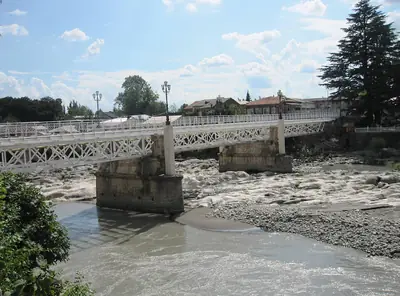
The White Bridge, or Tetri Chidi, is a pedestrian bridge across the Rioni River in Kutaisi’s historic center. It connects Grishashvili Street with Pushkin Street and acts as a familiar meeting point between the two sides of the city. The bridge is listed in Georgia’s register of immovable cultural heritage monuments and is also associated with the name “Picasso Boy.”
Kutaisi State Historical Museum
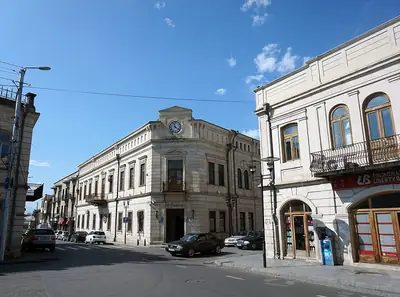
At 18 A. Pushkin Street, the Kutaisi State Historical Museum—formally the Niko Berdzenishvili Kutaisi State History Museum—offers an introduction to the history of the city and the wider region. It is regarded as one of Georgia’s important scientific and research institutions, with an extensive research library and a laboratory.
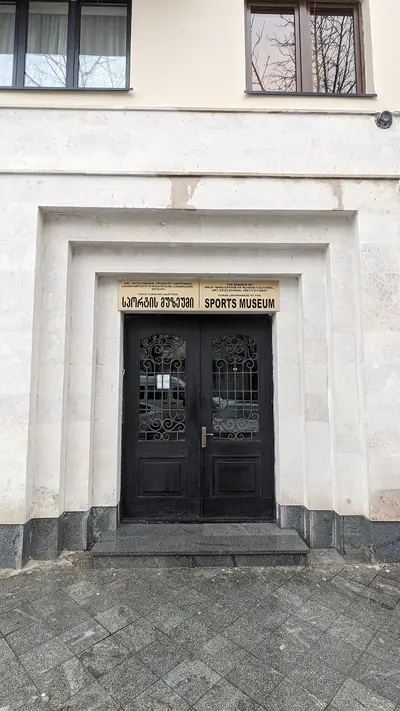
Kutaisi Museum of Sport
The Kutaisi Museum of Sport is dedicated to sport and forms part of the city’s varied collection of museums. It adds a different perspective to a walk through central Kutaisi, alongside institutions devoted to regional history and military remembrance.
Lado Meskhishvili State Drama Theatre
Kutaisi’s largest and most important theatre traces its history to March 3, 1861, when theatre enthusiasts presented Giorgi Eristavi’s comedy “Gaqra.” That performance marked the beginning of a new era in the city’s Georgian theatre tradition.
The present drama theatre officially opened in 1955. Designed by Mikheil Shavishvili and Shalva Tavadze, the building is recognized as a unique architectural work and received monument status in 2009. It also contains a one-hundred-seat small stage and a museum devoted to Kutaisi’s theatre history. Commemorative stars in front of the building honor several actors, including Eva Khutunashvili, Anzor Kerkhadze, Eremo Svanadze, Natela Sagaradze, Lamara Vashakidze, and Gizo Kakauridze.
Kutaisi Museum of Martial Art
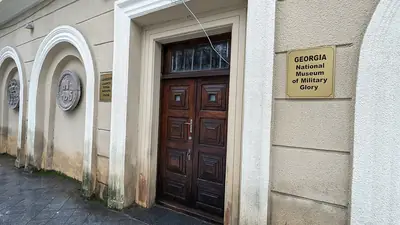
The Kutaisi Museum of Martial Art, also known as the Kutaisi National Museum of Military Glory, preserves documents and personal records connected with Georgian military history. Its collection includes weapons, photographs, awards, and correspondence related to the Second World War, including material about soldiers from Kutaisi.
The museum also presents documentary material about the wars in Abkhazia and the 2008 war with Russia. Together, these exhibits cover several chapters of Georgia’s modern military history.
Bagrati Cathedral
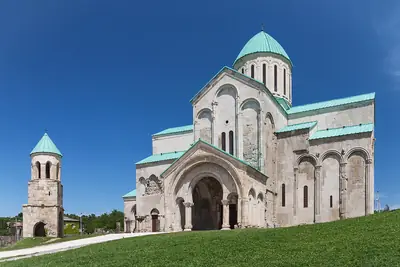
Bagrati Cathedral rises on Ukimerioni Hill and is one of Kutaisi’s defining landmarks. Also known as the Cathedral of the Dormition, it was built in 1003 during the reign of Bagrat III, who ruled from 975 to 1014. It was created as the main cathedral of the united Georgian kingdom and became an important center of medieval Georgian history.
The cathedral’s monumental scale and balanced proportions marked a significant development in medieval Georgian church architecture. Carved details and mosaics once enriched the building, although it suffered severe damage over the centuries. An explosion of gunpowder destroyed its roof and dome in 1691, while artillery used by the Russian general Totleben destroyed Kutaisi Fortress and the cathedral’s entire eastern section in 1770.
The building’s current appearance reflects a reconstruction process that began in the 1950s. Conservation works concluded in 2012, though the restoration was controversial. From the hill, Bagrati Cathedral remains a powerful symbol of Kutaisi and its place in Georgian history.
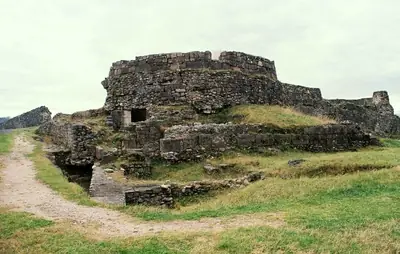
Uqimerioni Fortress
The remains of Uqimerioni Fortress are associated with Kutaisi’s hilltop landscape and the area where Bagrati Cathedral stands. Historians have proposed more than one possible location for the fortress, but one interpretation identifies it with the ruins on Uqimerioni Hill.
The stronghold was an important defensive structure of the Kingdom of Egrisi and is first mentioned in written sources in the sixth century. It later formed part of the fortifications surrounding medieval Kutaisi, which served for a time as the capital of the Kingdom of Abkhazia and later of the united Kingdom of Georgia.
The surviving walls and other remains belong to different periods in the hill’s history. Recent archaeological research has added further depth to the story of this strategic site.
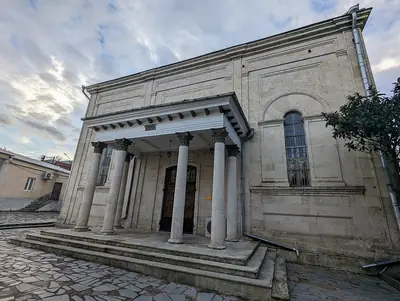
Kutaisi Synagogue
Kutaisi’s historic Jewish quarter lies on the left bank of the Rioni River, along what is now Boris Gaponov Street. The Great Synagogue, also known as Kutaisi Synagogue, is a nineteenth-century stone building designed in the Romanesque Revival style. Its substantial form gives it a distinctive presence in this part of the city.
The Great Synagogue stands in a courtyard with a smaller synagogue and is one of three surviving Jewish houses of prayer in Kutaisi. It is described as the second-largest synagogue in Georgia after the Great Synagogue in Tbilisi. A second building known as the Upper Prayer House, also dating from the middle of the nineteenth century, reflects the importance of the Jewish community in Kutaisi’s history.
Mtsvanekvavila Church
In the Mtsvanekvavila neighborhood, the Church of the Archangels is a notable Georgian Orthodox landmark. The domed church follows a temple design prepared in 1889 by the engineer Tarasevich. Construction took place from 1909 to 1913, and the church was consecrated in 1914.
Its history continued to change during the twentieth century. The church was closed from October 1941 until August 1944, then served as the cathedral of the Kutaisi and Gaenati Diocese from 1944 to 1946.
Kutaisi and the Kingdom of Imereti
Kutaisi was the capital of the Kingdom of Imereti, a Georgian kingdom that emerged in the fifteenth century after the unified Georgian monarchy broke apart into separate kingdoms. A member of the Bagrationi royal house established Imereti, with Kutaisi as its capital and main royal residence.
For centuries, the kingdom faced internal rivalries as well as pressure from the Ottoman Empire. Powerful feudal families controlled their own territories and held tax, administrative, and limited judicial privileges. In the seventeenth century, Imereti was divided into four military districts associated with Racha, Argveti, Vake, and Ok reba and Lechkhumi.
The kingdom’s final chapter began when Solomon the Second accepted Russian protection in 1804. Relations with Russian officials later deteriorated, and in 1810 the Russian Empire abolished the Kingdom of Imereti and established its own rule.
Kutaisi’s history forms part of the wider story of Georgia, from medieval unity to the political struggles that shaped the country’s western regions.
Explore Kutaisi with a Self-Guided Walking Tour
Neywo’s Kutaisi audio guide includes one walking tour: From the White Bridge to Bagrati: Kutaisi’s Old Capital on Foot. The route covers 3.31 km, takes 113 minutes, and includes 10 narrated stops. It visits the White Bridge, Kutaisi State Historical Museum, Kutaisi Museum of Sport, Lado Meskhishvili State Drama Theatre, Kutaisi Museum of Martial Art, Bagrati Cathedral, Uqimerioni Fortress, Kutaisi Synagogue, and Mtsvanekvavila Church.
Download Neywo and explore Kutaisi at your own pace. The app tells the story of each place as you reach it, with no group and no schedule. Narration is available in 11 languages, so you can turn a walk through Georgia’s old capital into your own self-guided experience.
Places with an audio guide in Kutaisi
8 places in Kutaisi with a Neywo audio guide. Each one starts telling its story as you reach it.

Self-guided tours in Kutaisi
1 tour in Kutaisi, free in the Neywo app. Each stop tells its story as you reach it.
- Walk
From the White Bridge to Bagrati: Kutaisi's Old Capital on Foot
Cross the Rioni on the pedestrian White Bridge and climb through Kutaisi's museum and theatre quarter to Ukimerioni Hill, where Bagrati Cathedral and the ruins of an ancient fortress crown the city. Then drop into the old Jewish quarter and end at the domed church of Mtsvanekvavila.
White Bridge, Kutaisi · Kutaisi State Historical Museum · Kutaisi Museum of Sport · Lado Meskhishvili State Drama Theatre · Kutaisi Museum of Martial Art · Bagrati Cathedral …
Open this tour: From the White Bridge to Bagrati: Kutaisi's Old Capital on Foot
Walk Kutaisi with Neywo
Neywo turns Kutaisi into a self-guided audio tour. Stories arrive as you reach the place they belong to, and the route reshapes when you wander off it.

