Eger, Hungary: Self-Guided Walking Tour
Things to Do in Eger: A Self-Guided Walk Through Hungary’s Historic City
Looking for things to do in Eger? This northern Hungarian city brings together a celebrated castle, Ottoman-era architecture, grand churches, Baroque palaces, museums and layers of religious history in a compact historic centre. It is also a rewarding stop for travellers exploring Hungary beyond Budapest. Neywo has a free audio guide for Eger with 21 narrated places, available in 11 languages.
What to See in Eger
The best way to explore Eger is on foot, moving between the city’s central squares, historic buildings and Castle Hill. The following sights reveal the city’s history in roughly the order covered by Neywo’s walks.
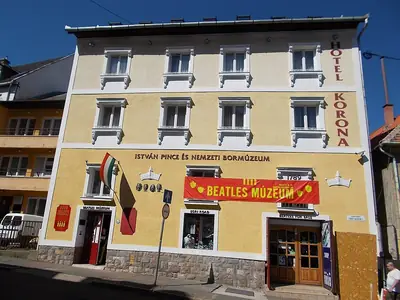
Egri Road Beatles Múzeum
The Egri Road Beatles Múzeum offers an unusual cultural experience in Eger: a museum dedicated to The Beatles, housed in the Hotel Korona Eger. Its collection contains nearly two thousand Beatles-related objects and presents the band’s story chronologically.
The visit begins with a short film in the cellar before continuing through multimedia displays, film clips, interviews, concert recordings and music listening stations. Display cases contain clothing, press material, models, limited editions and other rarities, while replicas of instruments, posters, flags and a recreation of the Yellow Submarine add to the atmosphere. The museum opened in 2015 and is described as the only Beatles collection in Central and Eastern Europe.
City Beneath the City
Város a város alatt, or “City Beneath the City”, leads into part of Eger’s underground cellar system. The exhibition occupies archbishopric wine cellars near Eger Cathedral, with the entrance at 1 Városfal Street through the former House of Gyertyás Wines, now known as the Time Tunnel.
It is an opportunity to see a different layer of the city, below the streets and historic buildings of the centre.
Archiepiscopal Palace
The Archiepiscopal Palace, also called the Archbishop’s Palace or Érseki Palota, stands beside the cathedral and the Líceum. Rather than being a single building, it is a palace complex made up of three connected sections.
The complex succeeded the medieval bishop’s palace in Eger Castle and forms part of one of the city centre’s most important historic architectural groups. The site is also associated with the Archbishop’s Palace Visitor Centre.
Basilica in Eger
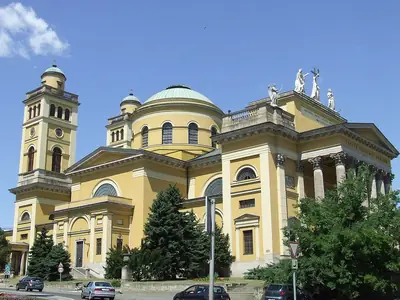
On Pyrker Square, the Basilica of St. John the Apostle—also known as Eger Cathedral—makes an immediate impression with its monumental Classical design. It is the cathedral of the Archdiocese of Eger and one of Hungary’s largest churches.
József Hild designed the building for Archbishop János László Pyrker, and construction took place between 1831 and 1836. Its two towers rise to 55 metres, while the dome dominates the church’s three-nave layout. The eastern porch resembles a Greek temple, with tall Corinthian columns reaching 17 metres. Statues of Saint Stephen, Saint Ladislaus, and Saints Peter and Paul decorate the entrance.
Little Provost’s Palace
At Kossuth Lajos Street 4, the Little Provost’s Palace, or Kispréposti Palota, contributes to Eger’s Baroque architectural ensemble. This ecclesiastical Rococo monument has a more delicate character than some of the grander buildings nearby and forms part of the historic streetscape.
Great Provost’s Palace
The Great Provost’s Palace stands at the corner of Egészségház Street and Kossuth Lajos Street. Known in Hungarian as the nagypréposti palota, it is an ecclesiastical Baroque monument and one of the notable buildings in Kossuth Lajos Street’s architectural ensemble.
The palace now houses the Bródy Sándor County and City Library, giving the historic building a contemporary public role.
Dobó Square
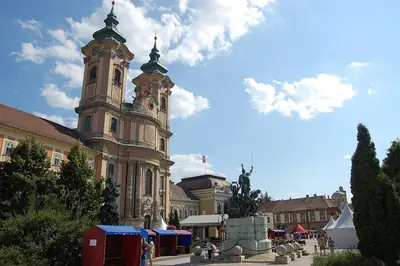
Dobó Square is the main square in Eger’s historic centre. Its long, trapezoidal shape extends along a northeast-to-southwest axis and brings together several contrasting parts of the city.
The square is bordered by the Minorite monastery, the Minorite church, the town hall and Baroque residential buildings. The Eger stream marks its northeastern side, while the opposite bank is often called Little Dobó Square. The central space is also listed as Páduai Szent Antal.
Eger Minaret
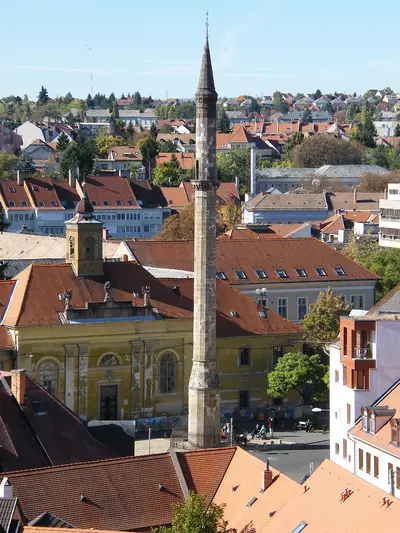
The Eger minaret is one of the clearest surviving reminders of Ottoman rule in the city. Built probably in the early seventeenth century, the roughly forty-metre tower originally belonged to the Kethüda Mosque, also known as the Djami of Kethuda. The mosque has disappeared, but the red-sandstone minaret remains.
A spiral staircase of 98 steps leads to a balcony 26 metres above the ground, offering views across the city. The tower is the northernmost Ottoman minaret in Europe and the highest and best-preserved of Hungary’s three surviving Ottoman minarets. A wrought-iron cross now stands above it, while the monument retains a connection with its original religious purpose.
Synagogue Gallery
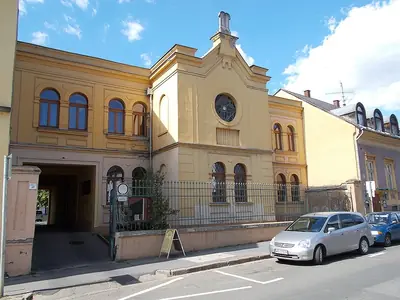
The Synagogue Gallery occupies Eger’s former Orthodox synagogue and forms part of the city’s Jewish heritage. The nearby Ziffer Sándor Galéria is also included in this cultural stop, adding another gallery space to the visit.
Former Neological Synagogue
The former site of Eger’s Neolog synagogue marks another important chapter in the city’s Jewish history. The synagogue was completed in 1913 and remained a place of worship until the Second World War. It was later used for nonreligious purposes before being demolished in 1967.
Although the building no longer survives, the site helps explain the different communities and religious traditions that shaped Eger.
Géza Gárdonyi Memorial Museum
The Géza Gárdonyi Memorial Museum occupies the Eger home where the writer lived and worked. Gárdonyi lived there from 1897 until his death in 1922, and the house became a literary memorial in 1952.
Its permanent exhibition has been reconstructed almost to its original condition. The rooms preserve Gárdonyi’s furniture, household objects, personal belongings and library, offering a personal view of the writer’s later life.
Castle of Eger
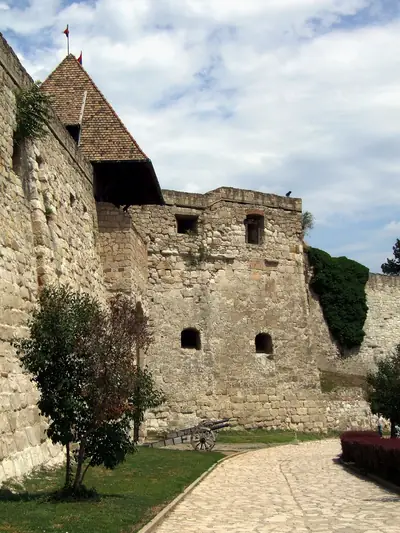
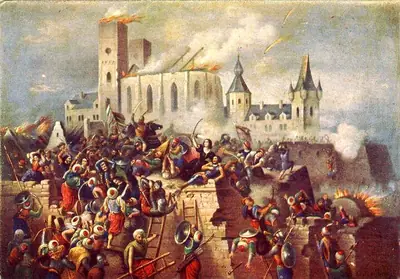
The Castle of Eger, or Egri vár, rises above the old town and remains the city’s defining historic monument. Although partly reconstructed, it is closely associated with the Siege of Eger in 1552.
Under the command of Captain István Dobó, the castle’s defenders repelled an Ottoman army that greatly outnumbered them. That resistance made Eger Castle one of Hungary’s most celebrated historic sites. The castle complex also contains the Dobó István Castle Museum and Hősök terme.
Medieval Gothic Cathedral of Eger
Within the castle grounds, the ruin garden of the István Dobó Castle Museum preserves the foundation walls of Eger’s first cathedral. The Diocese of Eger was founded by Saint Stephen around 1004, and the original cathedral was built on Castle Hill near the bishop’s palace.
The church was later destroyed, leaving the foundations visible today as an archaeological reminder of the city’s early religious history.
Explore Eger with a Free Audio Guide
Neywo offers two walking tours in Eger, with a total of 21 narrated places:
- Baroque Eger: From the Beatles to Dobó Square covers 2.02 km in 87 minutes and includes 11 stops.
- Minaret, Castle Hill and the Lost Synagogues covers 1.85 km in 74 minutes and includes 9 stops.
The routes bring together the Beatles museum, underground cellars, palaces, the basilica, Dobó Square, the minaret, the synagogues, the memorial museum and Eger Castle. The app tells the story of each place as you reach it, at your own pace, with no group and no schedule. Download Neywo and explore Eger as a self-guided walking tour.
Places with an audio guide in Eger
8 places in Eger with a Neywo audio guide. Each one starts telling its story as you reach it.
Self-guided tours in Eger
2 tours in Eger, free in the Neywo app. Each stop tells its story as you reach it.
- Walk
Baroque Eger: From the Beatles to Dobó Square
Eger's old town is a Baroque stage set, and this loop walks through all of it. Start with an unexpected Beatles museum, descend into the wine cellars beneath the cathedral quarter, pass the great Classical basilica and the palaces of Kossuth Lajos Street, and finish on Dobó Square, the town's living room.
Egri Road Beatles Múzeum · Város a város alatt · Archiepiscopal Palace (Eger) · Basilica in Eger · Little Provost's Palace, Eger · Géza Gárdonyi Theater …
Open this tour: Baroque Eger: From the Beatles to Dobó Square - Walk
Minaret, Castle Hill and the Lost Synagogues
The northernmost Ottoman minaret in Europe, the fortress that held off an army in 1552 and the ruins of Eger's first cathedral share one walk with the traces of the city's Jewish community. Climb Castle Hill, then wander down to three synagogues, two of which have found new lives and one of which is gone.
Eger minaret · Servite Church and Monastery · Géza Gárdonyi Memorial Museum · Castle of Eger · Hősök terme · Medieval Gothic Cathedral of Eger …
Open this tour: Minaret, Castle Hill and the Lost Synagogues
Walk Eger with Neywo
Neywo turns Eger into a self-guided audio tour. Stories arrive as you reach the place they belong to, and the route reshapes when you wander off it.

