Visegrád, Hungary: Self-Guided Walking Tour
Things to do in Visegrád: castles, royal history and the Danube Bend
Wondering what to do in Visegrád? This small Hungarian town brings together medieval castles, Roman frontier history and views over the Danube Bend, making it a rewarding destination near Budapest. Neywo has a free audio guide for Visegrád with 4 narrated places, available in 11 languages.
Visegrád’s historic sites are spread through a landscape of wooded hills and river scenery. The town is best explored at a relaxed pace, moving from the Roman remains and lower fortifications to the royal palace and the castle above the Danube.
What to see in Visegrád
Castra of Visegrád-Gizellamajor
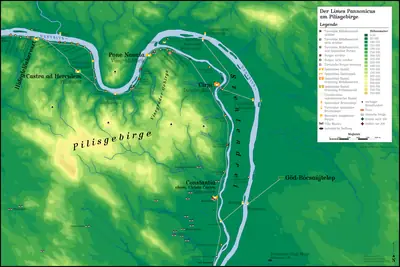
The remains of Visegrád-Gizellamajor reveal a late Roman fortlet that once guarded the Danube frontier. Known locally as the Római őrtorony romja, the site formed part of the Pannonian Limes, the Roman border that followed the river in this region.
Unlike many archaeological sites where only fragments can be seen, the fortlet has been excavated and its layout is visible. Its shape, size and internal structure make it unique among the known sites of this type along the Pannonian Limes. The remains offer an early chapter in Visegrád’s history, long before the town became a royal centre.
The Royal Palace of Visegrád
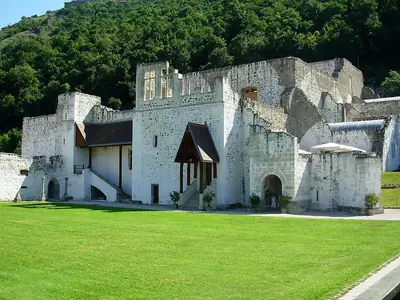
The Royal Palace of Visegrád was built between the 13th and 15th centuries as a permanent residence for the medieval kings of Hungary before later becoming a country residence. Its surviving ruins combine Gothic and Renaissance elements, reflecting the different stages of its construction and renovation.
The palace is also associated with the Congress of Visegrád and the Peace of Visegrád, signed in 1335. Later, the complex formed part of a defensive line destroyed during the Ottoman occupation of Hungary, which explains why the royal residence survives mainly as a ruin today.
The site houses the King Matthias Museum, a branch of the Hungarian National Museum. A visit therefore combines the palace remains with museum exhibits about Visegrád’s royal past.
Salamon Tower
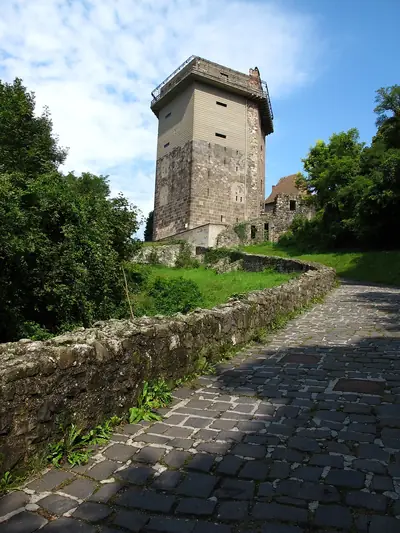
Salamon Tower is one of the most recognisable parts of Visegrád’s lower castle. This imposing residential tower dates from the 13th century and forms the centre of the medieval fortifications in the lower part of town.
Today, the tower contains a branch of the Matthias King Museum. Archaeological finds and historical objects help explain the development of Visegrád and its role in medieval Hungary. Its position also makes it a natural stop between the riverside area and the higher castle.
Visegrád Castle and the citadel
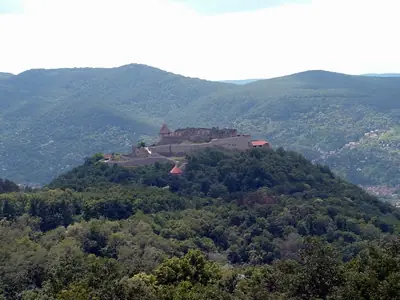
Visegrád Castle occupies a dramatic position above the Danube Bend, extending from a rocky peak in the Visegrád Mountains down towards the river. Its elevated setting provided both broad views and a strong defensive advantage, helping the fortress become one of the most important royal sites in medieval Hungary.
The castle was once among the wealthiest royal palaces in the kingdom. It served not only as a representative residence but also had political and military importance, a role it retained until the end of the 17th century.
The complex consists of two main sections: the lower castle and the upper castle, also called the citadel. The lower castle lies beside main road number 11, while the upper citadel can be reached via Panoráma road or by marked tourist trails. The climb adds another dimension to the visit, with views across the town and the winding Danube Bend.
A Visegrád self-guided walking tour
The main historic sights can be connected in a single walk, making a Visegrád self-guided walking tour a practical way to explore the town. Starting with the Roman fortlet and continuing through the Royal Palace, Salamon Tower and Visegrád Castle, the route follows the story of the area from the Roman frontier to the medieval Hungarian royal court.
This sequence also shows how Visegrád’s location shaped its history. The Danube provided a natural frontier and route of communication, while the surrounding hills offered protection and commanding positions for the later fortifications.
Visegrád is part of Hungary, and it pairs naturally with other historic destinations in the country, including nearby Esztergom.
Explore Visegrád with Neywo
Download Neywo and explore Visegrád with the free audio guide. The city currently has 1 walking tour:
- Kings, Romans and the Danube Bend: 3.67 km, 81 minutes and 4 narrated stops
The walk includes the Római őrtorony romja, the Royal Palace of Visegrád, Salamon Tower and Visegrád Castle. The app tells the story of each place as you reach it, at your own pace, with no group and no schedule.
Places with an audio guide in Visegrád
4 places in Visegrád with a Neywo audio guide. Each one starts telling its story as you reach it.
Self-guided tours in Visegrád
1 tour in Visegrád, free in the Neywo app. Each stop tells its story as you reach it.
- Walk
Kings, Romans and the Danube Bend
Visegrád is the place where the Danube bends and Hungarian kings held court. Begin at a Roman fortlet on the river frontier, walk to the Gothic and Renaissance royal palace, then to the stout Salamon Tower, and finish by climbing to the citadel for the view over the bend.
Római őrtorony romja · Royal palace of Visegrád · Salamon torony · Visegrád Castle
Open this tour: Kings, Romans and the Danube Bend
Walk Visegrád with Neywo
Neywo turns Visegrád into a self-guided audio tour. Stories arrive as you reach the place they belong to, and the route reshapes when you wander off it.

