What to See in Isfahan, Iran: Free Audio Guide
Things to Do in Isfahan: What to See in Iran’s Historic City
The best things to do in Isfahan include exploring Naqsh-e Jahan Square, visiting Safavid mosques and palaces, discovering Armenian churches in New Julfa, and walking beside the Zayandeh Rud. The city brings together monumental architecture, historic bridges, gardens and religious heritage across several distinct neighbourhoods. Neywo’s free Isfahan audio guide covers 90 narrated places, helping you understand what you are seeing as you explore.
What to See in Isfahan
Naqsh-e Jahan Square
Naqsh-e Jahan Square, also known officially as Imam Square, is the historic heart of Isfahan. Created between 1598 and 1629 during the reign of Shah Abbas the Great, it forms a Safavid-era ensemble recognised as a UNESCO World Heritage Site.
Each side leads to a different part of the city’s history. The Shah Mosque, now also called Imam Mosque, stands to the south; Sheikh Lotfollah Mosque is on the eastern side; Ali Qapu Palace occupies the west; and Qeysarie Gate opens north towards the Grand Bazaar of Isfahan. The square brings together monumental buildings, commerce and public life in one setting.
Shah Mosque
On the southern side of the square, the Shah Mosque is one of Isfahan’s major historic landmarks. Construction began in 1611 on the orders of Shah Abbas the Great, and the work was completed around 1630, with later decoration and additions continuing under his successors.
The mosque is known for its architecture, tilework and woodwork. Its design was led by Ali Akbar Isfahani, while several calligraphers created its inscriptions. The building has carried different names over time, including Shah Abbasi Mosque, Shah Mosque and Imam Mosque.
Sheikh Lotfollah Mosque
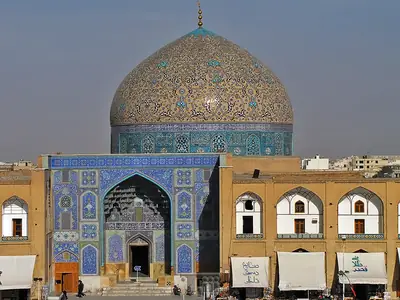
Facing Ali Qapu Palace on the eastern side of Naqsh-e Jahan Square, Sheikh Lotfollah Mosque is one of the defining works of Safavid architecture. Construction began in 1602 or 1603 and was completed in 1618 or 1619 during the reign of Shah Abbas the Great.
The mosque is particularly distinctive because it has no minaret. Its dome, precise proportions and detailed tilework give the building an elegant appearance, while the interior prayer hall contains a richly tiled mihrab, floral designs, calligraphy and intricate ceiling decoration.
Ali Qapu Palace
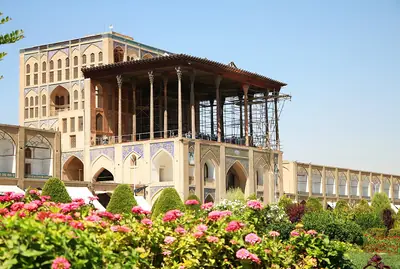
Ali Qapu Palace stands on the western side of Naqsh-e Jahan Square, opposite Sheikh Lotfollah Mosque. Its name means “Grand Gate”, and the building originally marked the entrance to the Safavid royal complex.
The palace rises 48 metres across six floors, reached by narrow spiral staircases. Its appearance changes depending on the viewpoint: two levels are visible from the front, three from the sides and five from the rear. The columned veranda was added by Shah Abbas II and offered a place from which Shah Abbas could watch polo matches, military exercises and horse racing in the square.
The highest level is known as the Music Hall, or Sound Room. Its rounded wall niches were designed to contribute to the acoustics as well as the decoration.
Isfahan Grand Bazaar and Jameh Mosque
Qeysarie Gate leads from Naqsh-e Jahan Square into the Grand Bazaar of Isfahan. The bazaar connects with the city’s long history of craftsmanship and commerce, while its far end reaches the Jameh Mosque in the Imam Ali Square area.
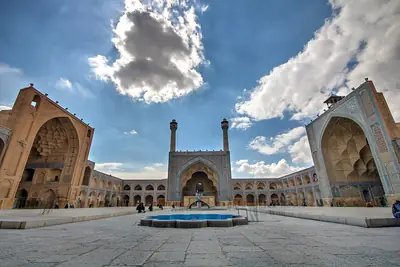
The Jameh Mosque, also known as the Atiq Mosque or Friday Mosque, is a UNESCO World Heritage Site and one of Iran’s important monuments of Islamic architecture. Its history reaches back to the eighth century, and the building developed through continual construction, rebuilding, additions and restoration.
Its most influential transformation took place during the Seljuk period, when builders introduced four large iwans—vaulted halls facing the four sides of the courtyard. This four-iwan arrangement became a defining feature of the Iranian mosque style.
Chehel Sotun
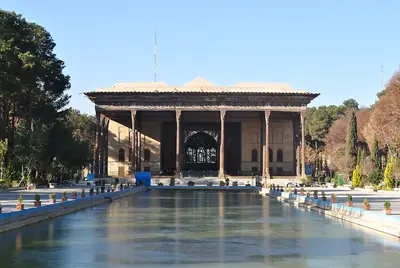
Chehel Sotun, or the “Forty Columns”, is a palace pavilion set within a garden and approached across a long pool. It was created for royal entertainment, receptions and the arrival of important guests and ambassadors.
The complex began with a small pavilion placed in the garden during the reign of Shah Abbas the Great and was completed under Shah Abbas II. The later additions included the Mirror Hall, the Hall of Twenty Columns, side porches and the pool in front of the main hall. Paintings, mirrors and tilework decorate the palace, while murals in the central hall depict Safavid ceremonies and historic battles.
Hasht Behesht Palace
Hasht Behesht means “the Eight Heavens”. This seventeenth-century palace stands in a large garden on Charbagh Street and was built during the Safavid period as a private pavilion.
The two-storey building follows the Isfahani style of architecture. Its pavilion and garden form a carefully composed setting, and the palace later took on an educational role: at the request of Zill al-Sultan to Nasir al-Din Shah, the first modern-style school in Isfahan was established here in 1298 in the Islamic calendar.
Chaharbagh Palace and Rashk-e Janan
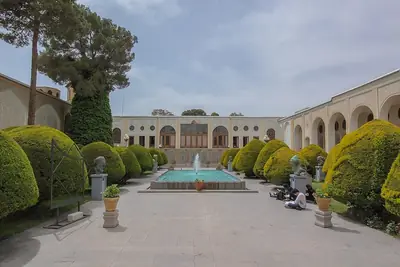
Chaharbagh Palace is one of the historic buildings in Isfahan’s old fabric. Built during the reign of Shah Abbas the First, it has served different functions over time, including the residence of Isfahan’s governor and the city’s civil registration office. It is now connected with Isfahan’s museums of decorative and contemporary art.
Nearby Rashk-e Janan, also known as Rashk Palace, dates from the Safavid and Qajar periods and serves as the seat of the Isfahan governor’s office. Together, these buildings show how historic architecture continues to be part of the city’s public life.
Si-o-se Pol
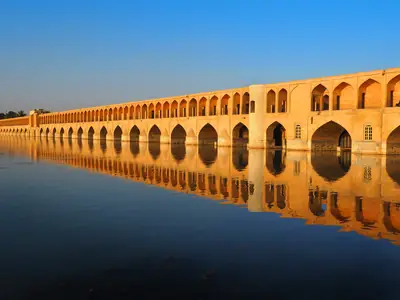
Si-o-se Pol, also known as the Allahverdi Khan Bridge, crosses the Zayanderud and is one of Iran’s celebrated works of bridge architecture. Its name means “the bridge of thirty-three”, referring to its 33 spans. The bridge is about 295 metres long and roughly 14 metres wide.
Built in the early seventeenth century, Si-o-se Pol functioned as both a bridge and a dam. It connects Chaharbagh Abbasi with Chaharbagh Bala and includes two walking passageways: one above the bridge and another covered route within its lower supports.
Khaju Bridge
Khaju Bridge crosses the Zayandeh Rud between the Khaju quarter and the Zoroastrian quarter. Built in its present form in 1650, it served as a crossing, a weir, a public building and a meeting place.
The bridge is about 110 metres long and a little more than 20 metres wide along most of its course. Its lower level contains arches, while the upper level has niches where pedestrians could gather. Decorated recesses, passageways, arches and tilework give the structure its distinctive rhythm.
Vank Cathedral and New Julfa
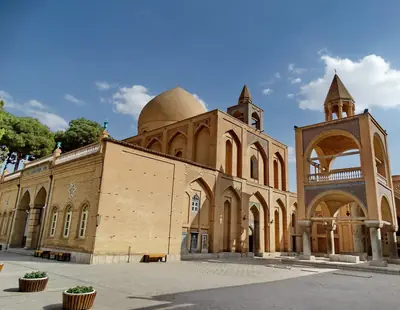
New Julfa is Isfahan’s historic Armenian Christian quarter. Its best-known landmark is Vank Cathedral, also called the Holy Savior Cathedral or Surb Amenaprkich Vank. Built during the reign of Shah Abbas the Second, it is recognised as an Iranian national heritage site and stands on Jolfa Street.
The district also includes Saint Nerses Church, an Armenian Apostolic church built in 1666 in the Kocher neighbourhood. Exploring New Julfa adds another important layer to Isfahan’s religious and architectural history.
Monar Jonban
Monar Jonban, or the Shaking Minarets, is a mosque and mausoleum built over the grave of the Sufi ascetic Amu Abdullah Suqla. The monument began during the Ilkhanate era and was completed during the Safavid period.
Its two minarets are famous for moving when one of them is shaken. The effect is understood as a result of structural knowledge and resonance rather than a miracle: the movement of one structure can cause the other to sway as well.
Other historic mosques
Isfahan’s religious heritage extends beyond its best-known monuments. Ali Qoli Agha Mosque is a Safavid-style mosque completed in 1710 or 1711, with an attractive courtyard, geometric tilework and a decorated prayer hall.
Rukn al-Molk Mosque, beside the Takht-e Foulad cemetery, dates from the Qajar era. Built by Mirza Soleyman Khan Shirazi, it is constructed from square bricks and follows a plan inspired by Hakim Mosque and Seyyed Mosque.
Explore Isfahan with Neywo
Download Neywo and explore Isfahan with four walking tours, one bus route and one bike route. The walks range from 1.66 to 3.26 km and from 59 to 115 minutes, with five or six narrated stops each. The 8.4 km bus route lasts 36 minutes and has six stops, while the 1.2 km bike route lasts six minutes and has three stops.
Choose the walk through Naqsh-e Jahan Square and the bazaar, the route through Safavid gardens and palaces, the New Julfa churches tour or the walk across the bridges of the Zayandeh Rud. You can also follow the BRT route from Imam Ali Square to the Armenian Quarter or cycle along Chaharbagh Avenue.
The app tells the story of each place as you reach it, at your own pace, with no group and no schedule. Narration is available in 11 languages, so you can turn an independent visit into a guided exploration while discovering Iran and its historic cities.
Places with an audio guide in Isfahan
8 places in Isfahan with a Neywo audio guide. Each one starts telling its story as you reach it.
Self-guided tours in Isfahan
6 tours in Isfahan, free in the Neywo app. Each stop tells its story as you reach it.
- Bike ride
Chaharbagh Avenue by Bike: Forty Columns to Enqelab Square
Pedal south down the Safavid Chaharbagh avenue on its cycle lane, starting at the Forty Columns garden, passing the great madrasa named for the Shah's mother and ending at Enqelab Square, the gateway to the bridges of the Zayandeh Rud.
Chehel Sotun · Chaharbagh Madrasa · Enqelab Square
Open this tour: Chaharbagh Avenue by Bike: Forty Columns to Enqelab Square - Bus ride
BRT Line 79: From Imam Ali Square to the Armenian Quarter
Isfahan's rapid-bus line 79 links the old bazaar district at Imam Ali Square with the Safavid avenue Chaharbagh and the Zayandeh Rud. Ride from the Jameh Mosque area past the royal palaces and Si-o-se-pol, then on to the Armenian churches of New Julfa for the price of a city fare.
Imam Ali Square · Chaharbagh Palace · Si-o-se Pol · Saint George Church (Isfahan) · Saint Gregory the Illuminator Church (Isfahan) · Saint Minas Church (Isfahan)
Open this tour: BRT Line 79: From Imam Ali Square to the Armenian Quarter - Walk
Image of the World: Naqsh-e Jahan Square and the Bazaar
Isfahan's great square was built by Shah Abbas to show off an empire. Climb Ali Qapu for the royal view, admire the tiled dome of a mosque with no minaret, stand under the Shah Mosque's portal and then follow the covered bazaar to the Friday Mosque, where Iranian mosque architecture took its shape.
Shah Mosque · Sheikh Lotfollah Mosque · Ali Qapu · Isfahan Grand Bazaar · Jameh Mosque of Isfahan
Open this tour: Image of the World: Naqsh-e Jahan Square and the Bazaar - Walk
Forty Columns and Eight Heavens: Safavid Gardens and Palaces
Stroll the historic Chaharbagh avenue past the royal pleasure grounds. See the Forty Columns pavilion reflected in its long pool, the painted halls of the old palace complex and the garden of the Eight Heavens, then finish at the madrasa Shah Sultan Husayn built for his mother.
Chehel Sotun · Ashraf Hall · Isfahan Museum of Decorative Arts · Hasht Behesht Palace · Chaharbagh Madrasa
Open this tour: Forty Columns and Eight Heavens: Safavid Gardens and Palaces - Walk
New Julfa: Armenian Churches of Isfahan
Shah Abbas settled Armenian merchants across the river in the 1600s and they built a quarter of churches. Walk between richly painted Armenian Apostolic churches, with Vank Cathedral as the centrepiece, and learn how a Christian community thrived in the Safavid capital.
Bethlehem Church (Isfahan) · Saint Mary Church (Isfahan) · Saint George Church (Isfahan) · Vank Cathedral · Saint Gregory the Illuminator Church (Isfahan) · Saint Stephen Church
Open this tour: New Julfa: Armenian Churches of Isfahan - Walk
Bridges of the Zayandeh Rud
Follow the river from the 33-arch Si-o-se-pol to the two-storey Khaju Bridge, which doubles as a weir and a meeting place. The narrow Jubi Bridge and two riverside Safavid palaces fill the walk between them.
Si-o-se Pol · Jubi Bridge · Haft Dast Palace · Ayneh Khaneh Palace · Khaju Bridge
Open this tour: Bridges of the Zayandeh Rud
Walk Isfahan with Neywo
Neywo turns Isfahan into a self-guided audio tour. Stories arrive as you reach the place they belong to, and the route reshapes when you wander off it.

