Jerusalem, Israel: Self-Guided Walking Tour
Things to Do in Jerusalem: A Self-Guided Guide to the City’s Sacred and Historic Places
Jerusalem is a city of major religious landmarks, archaeological museums, historic churches, synagogues, and viewpoints across its hills. The best things to do in Jerusalem include exploring the Old City, seeing the Temple Mount and its monuments, visiting memorials and museums, and walking through places shaped by Jewish, Christian, and Muslim traditions. Neywo offers a free audio guide for Jerusalem with 99 narrated places.
What to See in Jerusalem
Yad Vashem
Yad Vashem is Israel’s official memorial for the Jewish victims of the Holocaust. Established by the Knesset in 1953, it brings together remembrance, documentation, research, education, and commemoration. The large complex includes the Holocaust History Museum, the Children’s Memorial, an archive, a library, a research institute, and the International School for Holocaust Studies.
The name Yad Vashem comes from the Book of Isaiah and expresses the idea of creating “a memorial and a name.” Alongside those who were murdered, the institution also honors people who resisted Nazi oppression or helped Jews in need.
Mount Scopus
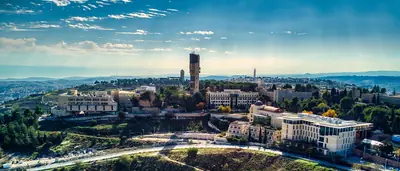
Mount Scopus is one of Jerusalem’s broadest viewpoints, looking across the city toward the Judean Desert and the Dead Sea. At 826 metres above the Mediterranean Sea, it rises about 100 metres above the Old City.
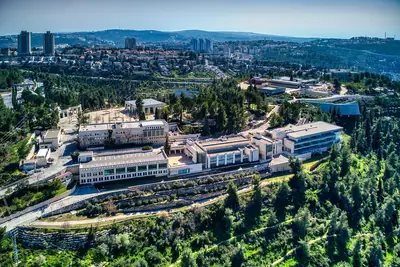
The mountain is home to the Hebrew University of Jerusalem and Hadassah Medical Center. Its botanical garden, established in the 1920s, contains nearly 1,000 species of wild plants from Israel and the Middle East, including orchids, sesame, saffron, almonds, and figs.
Mount Zion and Dormition Abbey
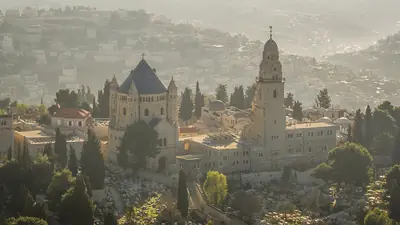
Mount Zion brings together several significant Christian landmarks. Dormition Abbey is a Catholic Benedictine church associated with the tradition of Mary’s dormition, or falling asleep and death before her resurrection to heaven.
Its conical roof makes the building easy to recognize. Inside, mosaics and Byzantine-style artwork cover the church and its crypt, while the lower level contains an ivory sculpture of the resting Mary. The monastery was known as the Abbey of Hagia Maria Sion between 1998 and 2006 before returning to its original name.
Church of St. Peter in Gallicantu
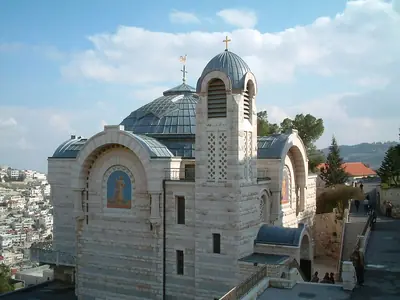
On the eastern slope of Mount Zion, just outside the Old City walls, the Church of St. Peter in Gallicantu stands on the site of earlier churches, including a Byzantine church from the fourth century. The present Roman Catholic church and monastery were founded between 1924 and 1931.
Its name refers to the Gospel episode in which Saint Peter wept after denying Jesus three times, before the rooster crowed. The surrounding area is also associated with Armenian history and culture. A museum nearby contains Roman and Byzantine mosaics, illuminated manuscripts dating in some cases to the tenth century, an early Middle Eastern printing machine, and photographs of nineteenth-century Jerusalem.
The Old City and the Church of the Holy Sepulchre
Jerusalem’s Old City is the essential place to explore on foot. Its streets bring together markets, religious buildings, archaeological remains, and the traditions of the Jewish, Muslim, Christian, and Armenian communities.
The Church of the Holy Sepulchre, also called the Church of the Resurrection, is traditionally associated with Golgotha, the place of Jesus’s crucifixion, and with his empty tomb. The church contains four stations of the Cross connected with the Via Dolorosa. Traditions dating to the fourth century identify the site with both the crucifixion and the tomb; the church and its rotunda were built under Constantine the Great, destroyed in 1009, reconstructed by 1048, and later modified after the Crusaders captured Jerusalem in 1099.
The Monastery of St Saviour
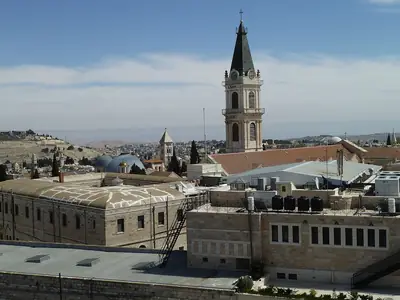
The Monastery of St Saviour is a Catholic Franciscan monastery in Jerusalem. The site was purchased in 1560 from the Georgian Orthodox Church with permission from Sultan Suleiman the Magnificent.
The church was built in 1885 and renovated in 1985. The complex includes a printing press, organ workshop, library, Catholic school, friars’ residences, workshops, and a winery, showing how the monastery has functioned as both a religious and working community.
The Armenian Quarter and Monastery of Saint Mark
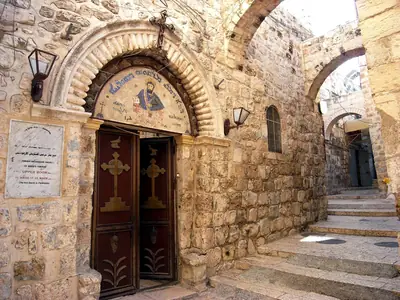
The Monastery of Saint Mark is also known as St. Mark’s Monastery or the Syriac Church of St. Mark. Located in the Armenian Quarter, it is the centre of the Syriac Orthodox Church in the country and the residence of its Archbishop of Jerusalem.
The complex includes the main church and a chapel dedicated to Saint Behnam. Syriac Orthodox tradition associates the site with the house of Mary, the mother of John-Mark, and with Jesus’s stay there and the Last Supper. The tradition also considers it the location of the first church in Christianity.
The Temple Mount
The Temple Mount is one of Jerusalem’s most important sacred places, revered in both Jewish and Muslim traditions. The mainly flat stone plaza is surrounded by retaining walls and covers about 144 dunams.
The site includes the Qibli Mosque of al-Aqsa and the Dome of the Rock. Herod the Great built the retaining walls and expanded the Second Temple area; later additions came during the Byzantine, early Muslim, Mamluk, and Ottoman periods. For Judaism, the mount is linked to the First and Second Temples. For Muslims, it forms part of the Al-Aqsa mosque compound.
The Dome of the Rock
The Dome of the Rock stands near the centre of the Al-Aqsa mosque compound. Built under the Umayyad Caliphate on the orders of Abd al-Malik in 691–692 CE, it was designed as a monument framing the rock at its centre.
Its octagonal plan and original mosaic decoration reflect the influence of Byzantine churches and palaces. The original dome collapsed in 1015 and was rebuilt in 1022–23. During the Ottoman period, blue-and-white Iznik-style tiles were added to the exterior, while the roof was gold-plated in 1959–64.
Al-Aqsa Mosque and the Dome of the Prophet
Al-Aqsa Mosque is the main prayer hall within the Al-Aqsa mosque compound, along the southern wall of the Temple Mount. In Islamic tradition, the site is associated with the Prophet Muhammad’s Night Journey to “the farthest mosque” and his ascent to heaven with the angel Gabriel.
Nearby, the Dome of the Prophet is a free-standing Ottoman dome and a symbolic monument rather than a religious building. It was first built in 1538 on the order of Muhammad Bey, governor of Gaza and Jerusalem, and rebuilt by Sultan Abdülmecid I in 1845.
The Temple Institute and Nachalat Yaakov Synagogue
The Temple Institute operates a museum in the Jewish Quarter and is dedicated to the idea of establishing the Third Temple. Founded in 1984, it is headed by Rabbi Israel Ariel. A representation of the Temple Menorah stands outside.
Outside the Old City, Nachalat Yaakov Synagogue dates from 1873 and is known as the first Ashkenazi synagogue built beyond the Old City walls in Jerusalem. Its one-floor layout includes a central prayer hall, women’s sections, a mikveh, and rooms that can also serve as a study hall.
The Rockefeller Museum
Near Herod’s Gate, the Rockefeller Museum presents archaeological finds from excavations in Jerusalem and across the land of Israel. The building, designed by British architect Austen Harrison, is arranged around a central courtyard and combines Neo-Gothic principles with Byzantine and Islamic decorative motifs.
The museum once housed the Dead Sea Scrolls, from their discovery in 1947 until 1967, when they were moved to the Israel Museum in West Jerusalem. Today, the Rockefeller Museum is managed by the Israel Museum and houses the head office of the Israel Antiquities Authority.
The Center for Human Dignity
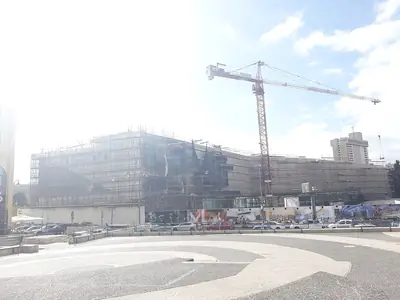
The Center for Human Dignity, home to the Museum of Tolerance Jerusalem, is a downtown complex combining a museum, convention centre, and entertainment venue. The project was led by Larry Mizel and took more than 21 years to complete. The museum was set to open on 15 May 2023 with an exhibition of 120 works by internationally renowned photographers connected to the 75th anniversary of Israel.
Explore Jerusalem with Neywo
Neywo has eight walking tours, one bus route, and one bike route in Jerusalem. The walks range from 0.87 to 5.49 km and from 33 to 202 minutes, with narrated stops throughout the city. The bus route covers 3.5 km in 15 minutes and includes six stops, while the bike route covers 1.7 km in eight minutes and includes three stops.
Choose a walk through Mount Zion, the Armenian Quarter, and the Church of the Holy Sepulchre; follow the Western Wall and Temple Mount; explore the Mount of Olives and Gethsemane; or discover downtown, Nachalat Shiva, Yemin Moshe, and the Sultan’s Pool. There are also routes through Givat Ram, along the Via Dolorosa and Damascus Gate, and by bus or bike.
Download Neywo and explore Jerusalem at your own pace. The app tells the story of each place as you reach it, with narration available in 11 languages—no group and no schedule. You can also continue exploring Israel or plan visits to Tel Aviv, Haifa, and Nazareth.
Places with an audio guide in Jerusalem
8 places in Jerusalem with a Neywo audio guide. Each one starts telling its story as you reach it.
Self-guided tours in Jerusalem
9 tours in Jerusalem, free in the Neywo app. Each stop tells its story as you reach it.
- Bike ride
Museum Mile on Wheels: Cross Monastery to the Bloomfield Science Museum
A short ride on Jerusalem's cycle paths through the Valley of the Cross: a fortress-like Georgian monastery, the Bible Lands Museum and the hands-on Bloomfield Science Museum.
Monastery of the Holy Cross · Bible Lands Museum · Bloomfield Science Museum
Open this tour: Museum Mile on Wheels: Cross Monastery to the Bloomfield Science Museum - Bus ride
Superbus Line 2: A Loop Through the Old City's Southern Gates
A public minibus line that runs from the Mamilla promenade and Jaffa Gate around the Armenian and Jewish Quarters, out past Zion Gate and on to the Sultan's Pool. Ride past the Tower of David, the Armenian cathedral of St James, Zion Gate and the Temple Institute, and see how the Old City's walls and quarters fit together without climbing a single hill.
Mamilla Mall · Tower of David · Cathedral of St. James, Jerusalem · Zion Gate · The Temple Institute · Sultan's Pool
Open this tour: Superbus Line 2: A Loop Through the Old City's Southern Gates - Walk
Givat Ram: the Israel Museum and the Knesset
Five and a half kilometres in the western government quarter — the Israel Museum with the Dead Sea Scrolls and the model of Second Temple Jerusalem, the Bible Lands and Islamic art museums, the Knesset menorah, and the Crusader-era Monastery of the Cross.
International Convention Center · Knesset Menorah · Bloomfield Science Museum · Israel Museum · Bible Lands Museum · Monastery of the Holy Cross …
Open this tour: Givat Ram: the Israel Museum and the Knesset - Walk
The Western Wall and the Temple Mount
A kilometre, and the most contested ground on earth. The Western Wall plaza and its tunnels, the Little Western Wall in the Muslim Quarter, and the Haram al-Sharif with the Dome of the Rock at its centre. Check opening hours and dress accordingly.
Dung Gate · The Temple Institute · Western Wall Plaza · Western Wall Tunnel · Monastery of Saint Mark · Cotton Merchants' Gate …
Open this tour: The Western Wall and the Temple Mount - Walk
The Mount of Olives and Gethsemane
Out of the Lions' Gate and down the valley: the Church of All Nations over the rock of the agony, the teardrop-shaped Dominus Flevit, the gold onion domes of Mary Magdalene, and the tomb of the Virgin.
Islamic Museum · Al-Aqsa Mosque · Huldah Gates · Tomb of Benei Hezir · Church of All Nations · Dominus Flevit Church …
Open this tour: The Mount of Olives and Gethsemane - Walk
The Via Dolorosa and the Damascus Gate
The processional route through the Muslim Quarter, the Lutheran Redeemer church you can climb for the best view of the Old City, out through the Damascus Gate to the Garden Tomb and the Rockefeller Museum.
Zedekiah's Cave · Damascus Gate · Garden Tomb · Arch of Ecce Homo · Via Dolorosa · Church of St. Alexander Nevsky, Jerusalem …
Open this tour: The Via Dolorosa and the Damascus Gate - Walk
Downtown: Zion Square and Nachalat Shiva
West Jerusalem's centre — the 1885 synagogue in the Nachalat Shiva lanes, the Russian Compound cathedral, and Ben Yehuda Street, which is where the city goes out.
Center for Human Dignity · Holy Trinity Cathedral, Jerusalem · Nachalat Yaakov synagogue, Jerusalem · Cadim Gallery · Zion Square · Ben Yehuda Street
Open this tour: Downtown: Zion Square and Nachalat Shiva - Walk
Yemin Moshe and the Sultan's Pool
Under a kilometre in the first neighbourhood built outside the walls, above the Hinnom valley reservoir the Sultan repaired in 1536 and Jerusalem now uses for concerts.
Train Theater · Yemin Moshe · Sultan's Pool · St Andrew's Church, Jerusalem
Open this tour: Yemin Moshe and the Sultan's Pool - Walk
Mount Zion, the Armenian Quarter and the Holy Sepulchre
In through the Jaffa Gate past the Tower of David, with the Armenian cathedral of St James, the Dormition Abbey on Mount Zion, and the church built over what Constantine's mother identified as the tomb.
Umberto Nahon Museum of Italian Jewish Art · Nachalat Yaakov synagogue, Jerusalem · Center for Human Dignity · Pontifical Biblical Institute · Train Theater · Jerusalem Khan Theatre …
Open this tour: Mount Zion, the Armenian Quarter and the Holy Sepulchre
Walk Jerusalem with Neywo
Neywo turns Jerusalem into a self-guided audio tour. Stories arrive as you reach the place they belong to, and the route reshapes when you wander off it.

