Visiting Acre, Israel: Top Sights on Foot
Things to do in Acre: a self-guided walk through its layered Old City
The best things to do in Acre are concentrated in and around its historic Old City, where Crusader halls, Ottoman mosques, churches, museums and ancient fortifications reveal the city’s many layers. Acre is worth visiting for the contrast between its medieval foundations, active places of worship and Mediterranean port setting. Neywo offers a free audio guide for Acre with 20 narrated places.
What to see in Acre
Acre’s historic centre is compact enough to explore on foot, but its landmarks tell very different stories. These are some of the most significant places to include in a visit.
Museum Treasures in the Walls
The Treasures in the Walls Museum is built directly into the thick stone ramparts of the Old City. Its ethnographic collection focuses on daily life and craftsmanship in Acre and the surrounding Galilee from the late nineteenth century to the 1970s.
Inside, exhibits include locally made furniture, traditional clothing, cooking pots, eating utensils, workshop tools and handicrafts. The setting makes the visit especially distinctive: the museum’s rooms occupy the city’s own historic walls.
Hall of the Crusader Knights
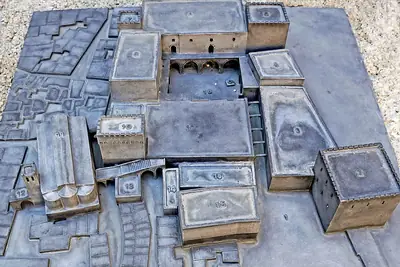
Below the Acre Citadel are the vast vaulted halls that once formed the headquarters of the Hospitallers, the military order that cared for sick pilgrims and protected them in the Holy Land. Their compound stood in the northwestern corner of the city, beside the northern wall.
The halls are part of a larger historical layering. The Ottoman fortress was built above the Crusader complex and later became a British prison, bringing together eight centuries of history in one site.
Church of St John the Baptist
Acre has two places associated with a Church of St John the Baptist, each revealing a different period of the city’s history.
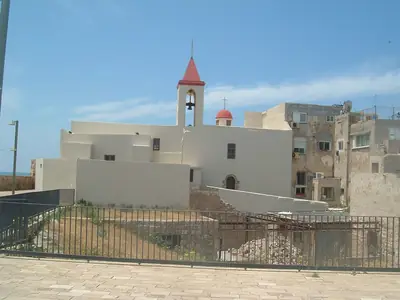
The church on the old city wall dates from 1737. The Franciscans of the Holy Land Custody built it on the foundations of an earlier church dedicated to Saint Andrew, reportedly with financial support from French merchants. Its position places the Latin-rite Catholic parish church directly beside the Mediterranean. It was renovated in 1947.
Elsewhere, beneath the Ottoman Citadel, lies the site of the principal church of the Knights Hospitaller during the Crusader period. The original church formed part of the order’s underground headquarters and is now hidden beneath later Ottoman construction.
Cathedral of the Holy Cross and Jezzar Pasha Mosque
The Cathedral of the Holy Cross once stood at the centre of Acre’s Latin Christian community. It was the main Latin cathedral of the Diocese of Acre in the Kingdom of Jerusalem until the Crusader presence ended in 1291.
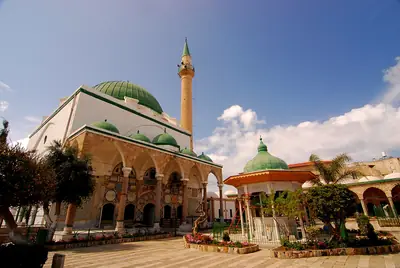
In 1781, Ottoman governor Ahmad Pasha al-Jazzar ordered a mosque to be built over the cathedral’s remains. The Jezzar Pasha Mosque, also known as the White Mosque of Acre, now dominates the site. Its great dome, slender minaret and courtyard are important examples of Ottoman architecture in the Old City.
Hammam al-Pasha
Hammam al-Pasha is a preserved Turkish bathhouse at the northern edge of the Old City, south of the fortress. Ahmad Pasha al-Jazzar built it at the end of the eighteenth century, when Acre was developing into a thriving port.
Originally called the New Hammam, it later took the name Hammam al-Pasha in tribute to al-Jazzar. Today, the building is a museum where vaulted chambers illustrate the setting and routines of Ottoman bathhouse life.
Akko El Shazliya Mosque
The El Shazliya Mosque occupies the southwestern corner of the Akko Citadel, beside the historic Hammam al-Basha bathhouse. During the Crusader period, a tower belonging to the Hospitallers’ quarter stood on this site.
The mosque reflects one of Acre’s defining features: military and religious buildings repeatedly occupying the same ground. Its walls sit closely against the ancient citadel, making the transition from Crusader fortress to later place of worship especially visible.
El-Majdila Mosque
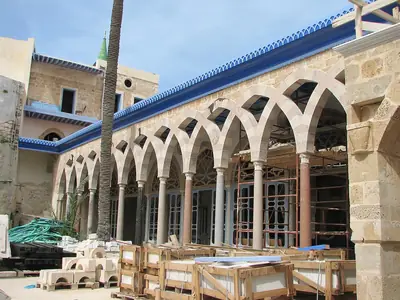
Built between 1809 and 1810 by Ali Agha, deputy to Acre’s governor Suleiman Pasha, El-Majdila Mosque stands next to the builder’s former residence. Its name refers to residents of the quarter who had come from a village called Majdal, although the precise village is uncertain.
The mosque contains a prayer hall with two adjoining rooms and a trapezoidal courtyard. Along the courtyard side, an arcade is topped by three domes.
El-Zituna Mosque
El-Zituna Mosque is an active place of worship in the heart of the Old City. It faces a quiet plaza and takes its name from the Arabic word for olive, zaytun. Local tradition connects the name with olive trees that once grew in the courtyard.
Four palm trees now stand in front of the entrance, providing a simple landmark within Acre’s dense historic streets.
St. George Greek Orthodox Cathedral
In the southwestern corner of the Old City, the St. George Greek Orthodox Cathedral serves as the seat of the Bishop of Galilee for the Greek Orthodox Church of Jerusalem. A monastery is attached to the church, where the clergy live.
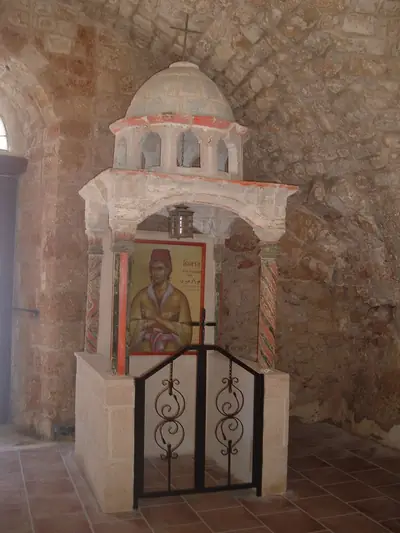
The building dates from the sixteenth century and was erected on the ruins of an earlier Byzantine church. Inside, carved wooden wall coverings give the interior a richly detailed character. A marble monument records the names of two British marine officers who died during the battles of Acre in 1799 and 1840.
Al-Muallaq Mosque and Ramchal Synagogue
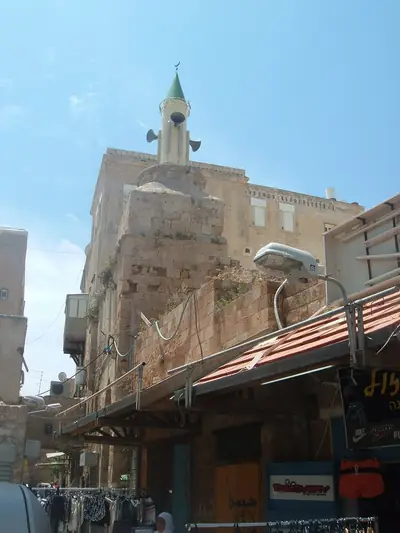
The Al-Muallaq Mosque is also known as the Hanging Mosque or the Mosque of Daher al-Umar, after the Galilee ruler who governed Acre in the mid-eighteenth century. The complex combines two adjacent buildings and rises above the surrounding street, explaining its name.
One of those buildings previously housed the Ramchal Synagogue, confiscated by the authorities in 1758. Hebrew inscriptions and the former location of the Holy Ark remain visible in the older hall. The mosque’s original minaret was demolished in 1950 after becoming unstable; its base survives, while the slender tower was reconstructed in the early 2000s.
El-Bahr Mosque
Beside Acre’s old port, the El-Bahr Mosque is also called the Port Mosque or Sinan Pasha Mosque. It is the city’s oldest Muslim house of worship. Sinan Pasha first built it in 1515, and Sulayman Pasha al-Adil ordered its complete reconstruction in 1816.
The Ottoman building has a large dome over the prayer hall, a second dome above the entrance and a preserved minaret. Its position beside the port connects the mosque directly with Acre’s maritime history.
Or Torah Synagogue
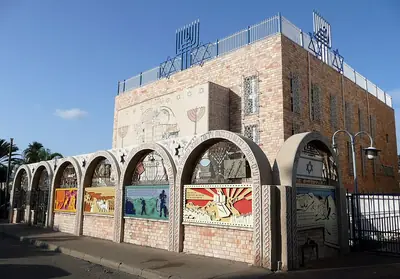
The Or Torah Synagogue, also known as the Tunisian, Djerba or Jariva Synagogue, stands on Kaplan Street. Jewish immigrants from Tunisia built it in 1955 to recreate the character of the El Ghriba synagogue on the island of Djerba.
The building is covered with natural-stone mosaics, including its walls, ceiling, dome and exterior façades. The work took more than 54 years to complete. Inside, 140 stained-glass windows add coloured light to scenes depicting the history of the Jewish people.
Other places of worship in Acre
The Old City also includes the Maronite Church, the spiritual home of Acre’s Maronite community, and the El Shazliya Mosque. Together with the Latin, Greek Orthodox, Muslim, Jewish and Bahá’í sites, they show how many religious traditions are part of Acre’s historic landscape.
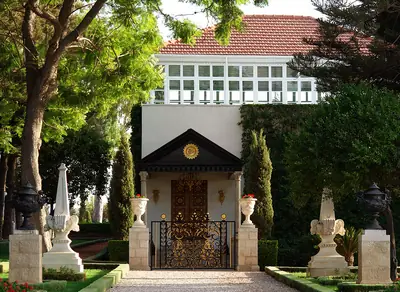
Just north of the city, the Shrine of Bahá’u’lláh stands in the gardens of Bahjí. Bahá’u’lláh, founder of the Bahá’í Faith, spent the final years of his life at the Mansion of Bahjí and died there on 29 May 1892. His shrine is the Qiblih, the direction faced by Bahá’ís in prayer, and lies within a circular garden divided into four sections.
Explore Acre with a free audio guide
Neywo’s Acre audio guide includes two walking tours, with 20 narrated places available across the city. The walks are:
- Knights, Pashas and the Citadel: Crusader and Ottoman Acre — 1.03 km, 55 minutes and 8 narrated stops.
- Faith Lanes of Old Acre: Churches, a Port Mosque and a Mosaic Synagogue — 1.59 km, 66 minutes and 8 narrated stops.
The app tells the story of each place as you reach it, at your own pace, with no group and no schedule. Narration is available in 11 languages, making it a practical way to explore Acre’s historic streets independently.
Planning a wider trip through the Northern District or Israel? You can also discover nearby destinations such as Haifa, Nazareth and Migdal with Neywo.
Places with an audio guide in Acre
8 places in Acre with a Neywo audio guide. Each one starts telling its story as you reach it.
Self-guided tours in Acre
2 tours in Acre, free in the Neywo app. Each stop tells its story as you reach it.
- Walk
Knights, Pashas and the Citadel: Crusader and Ottoman Acre
Acre was the last great Crusader capital, and its Hospitaller halls still lie under the Ottoman citadel. Walk from a museum built into the sea walls through the Knights' halls, then past the White Mosque, a Turkish bathhouse and three small neighbourhood mosques, all within the dense Ottoman town that rose on the Crusader ruins.
Museum Treasures in the Walls · Hall of the Crusader Knights · Church of St John the Baptist · Cathedral of the Holy Cross, Acre · Hammam al-Pasha, Acre · Akko El Shazliya Mosque …
Open this tour: Knights, Pashas and the Citadel: Crusader and Ottoman Acre - Walk
Faith Lanes of Old Acre: Churches, a Port Mosque and a Mosaic Synagogue
Christians, Muslims and Jews have worshipped side by side in this walled port for centuries. Follow the seafront from the Franciscan and Maronite churches to the Hanging Mosque and the old port mosque, cross the market to the Franciscan Terra Sancta church, and finish at a synagogue whose walls are covered entirely in stone mosaics.
St. John Baptist Church · Maronite Church, Akko · St. George church, Acre · Al-Muallaq Mosque · Ramhal Synagogue · El Bachar mosque …
Open this tour: Faith Lanes of Old Acre: Churches, a Port Mosque and a Mosaic Synagogue
Walk Acre with Neywo
Neywo turns Acre into a self-guided audio tour. Stories arrive as you reach the place they belong to, and the route reshapes when you wander off it.

