Things to Do in Nazareth, Israel: Walking Guide
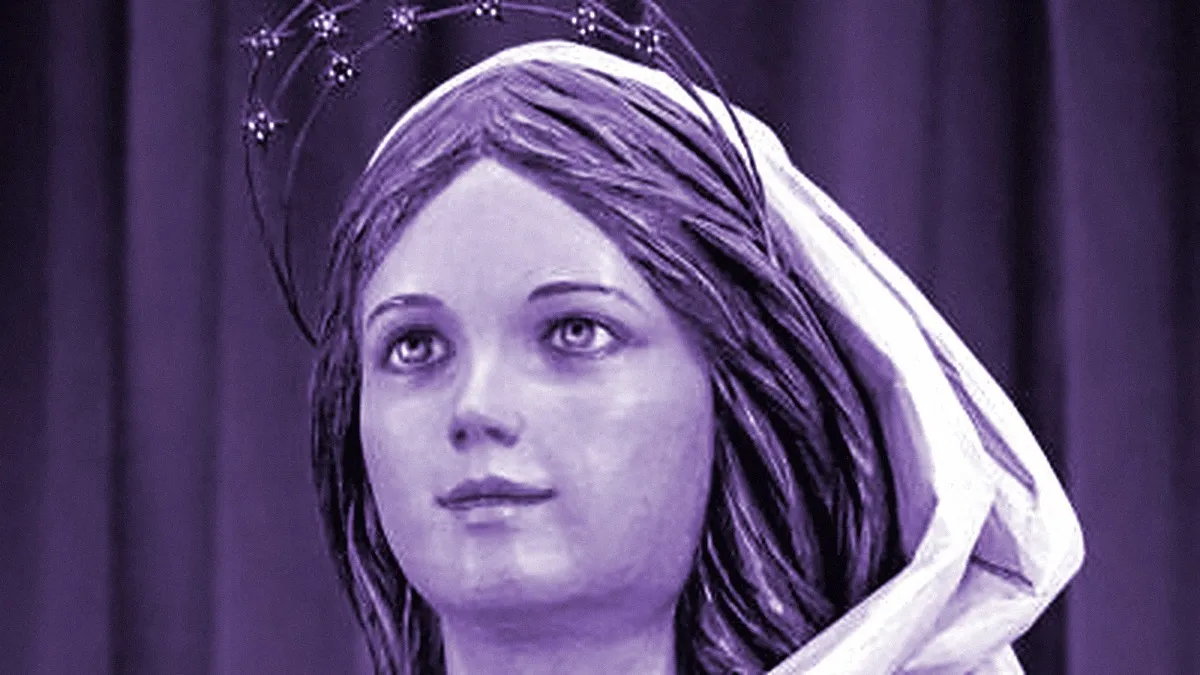
Things to do in Nazareth: what to see in the historic city
Nazareth is a historic city in Israel’s Northern District, known especially for its connection with the Annunciation and the childhood of Jesus. Its churches, mosques, old quarters and hilltop viewpoints reveal a city where Christian, Muslim and local traditions have developed side by side. Neywo has a free audio guide for Nazareth with 22 narrated places, helping you explore independently as you walk.
What to see in Nazareth
Basilica of the Annunciation
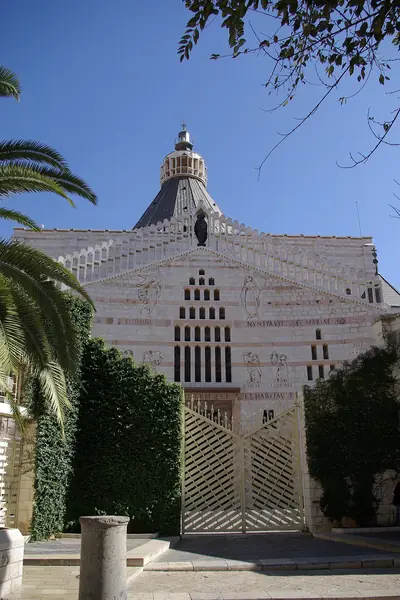
The Basilica of the Annunciation is Nazareth’s most prominent landmark, recognisable by its large grey conical dome and lighthouse-shaped lantern. For Catholic Christians, it marks the place where the Archangel Gabriel announced to Mary that she would become the mother of Jesus.
The present basilica was inaugurated in 1969 and designed by Giovanni Muzio with Yitzhak Moshe Levkovitz. Archaeological excavations beneath the modern building uncovered remains of three earlier churches, as well as houses, wells and storage buildings. The lower part contains the Grotto of Mary, traditionally identified as the place of the Annunciation in Catholic tradition.
St. Joseph’s Church
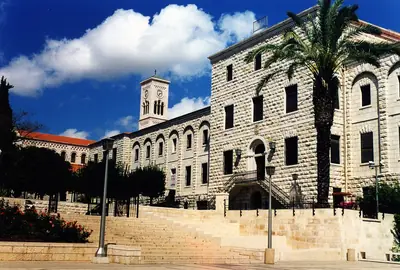
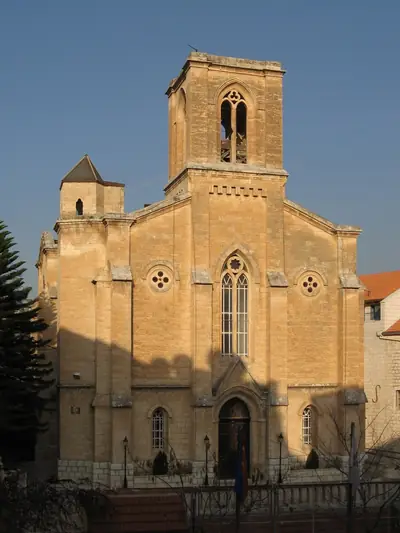
Within the Basilica of the Annunciation complex, St. Joseph’s Church is traditionally associated with Joseph, Mary and the place where Jesus grew up. The present Romanesque Revival church was built in 1914 over the remains of earlier churches, including a Crusader church and a seventeenth-century Franciscan church.
Inside, stained-glass windows and paintings depict episodes from Joseph’s life, including his wedding to Mary, family scenes, his work as a carpenter and the Dream of Joseph. The church is also known as the Church of Nutrition and the Church of Joseph’s Carpentry.
Franciscan Monastery
The Franciscan Monastery forms part of the same important religious complex. Established in 1620, it is home to the Franciscan community and is described as one of the largest and most spacious monasteries in the Levant.
It stands between the Basilica of the Annunciation to the south and St. Joseph’s Church to the north, making it a natural part of a visit to both churches.
Greek Orthodox Church of the Annunciation
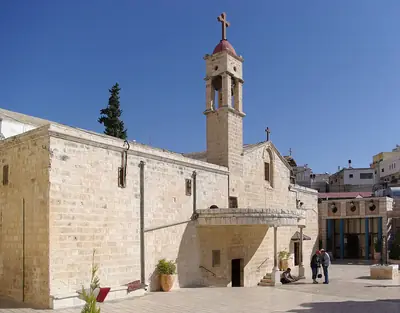
The Greek Orthodox Church of the Annunciation is one of Nazareth’s two traditional sites associated with the Annunciation. Eastern Orthodox tradition identifies it as the place where the Archangel Gabriel appeared to Mary while she was drawing water.
A place of worship has stood here since at least the Byzantine era. The present church took shape in the eighteenth century under Zahir al Umar, the Arab governor of the Galilee. Known locally as Kniset el Rûm, or the Church of the Romans, it combines an eighteenth-century prayer hall with a medieval lower chapel containing ancient Armenian tilework. An arched passage leads down to the spring beneath the altar area.
Mary’s Well and the Ancient Bath House
In the plaza below the Greek Orthodox Church of Saint Gabriel stands the structure known as Mary’s Well or the Ancient Bath House. It is one of Nazareth’s symbols and is connected with centuries of Christian and local tradition.
The well structure was reconstructed in 1967 and again in 2000. Although the well has been dry since the 1990s, it was once fed by an aqueduct connected to a spring. The name Mary’s Well refers to several places associated with the same tradition, including the spring beneath the Greek Orthodox Church and presumed springs beneath the Basilica of the Annunciation.
White Mosque
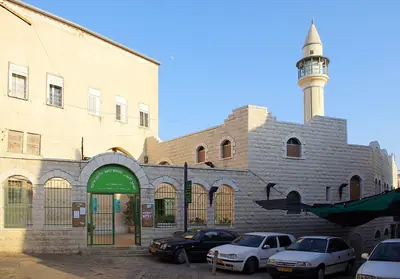
The White Mosque stands in Harat Alghama, the Mosque Quarter, within Nazareth’s Old Market. Built between 1804 and 1808 during the Ottoman period, it is the city’s oldest mosque and remains an important place of worship and community life.
Its cream-coloured walls, green trim, green dome and pencil-shaped minaret give it a distinctive appearance. The mosque was financed by Sulayman Pasha al-Adil, the Egyptian Ottoman ruler, and takes its name from Sheikh Abdullah’s vision of a new era associated with purity, light and peace. It also houses a museum documenting Nazareth’s recent past.
Nabi Saeen Mosque
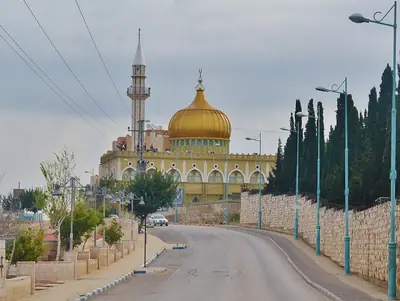
On top of Nabi Saeen Hill, the Nabi Saeen Mosque offers wide views across Nazareth and the surrounding landscapes. Its bright-green upper floor has a façade arranged around five arches, while the octagonal minaret has a tall tower and distinctive grey spire.
The mosque was restored in 1989 under a local committee led by Haj Ahmad Hammoudeh al-Zu’bi. Its second floor was later added through an expansion, and the minaret was raised in 2009, the year it also underwent extensive renovation.
Misgad HaShalom
East of Nazareth’s Old City, Misgad HaShalom is also known as the New Mosque. Its name means Mosque of Peace. Established in the early 1960s, it was inaugurated on November 22, 1963, a date recorded in an inscription above the entrance.
The stone building has a tall, slender minaret with two circular balconies, four clocks and a pointed grey roof. Inside, twenty-two hexagonal windows illuminate the square prayer hall, whose features include a red carpet, a reddish-marble mihrab and minbar, and a green interior dome with a gilded exterior.
Christ Church
Christ Church, also known as the Church of the Savior or the Church of Christ, is an Anglican church dedicated to Jesus Christ as Savior. It stands in the heart of Nazareth, close to the Basilica of the Annunciation.
Financial difficulties prevented its completion by 1871, leaving it without its intended spire. The spire was finally added in 2014.
Mensa Christi Church
Mensa Christi Church is a Roman Catholic Franciscan church that is no longer active but remains linked to pilgrimage traditions. Its name means “Table of Christ”, referring to the large limestone table inside. Tradition identifies the table as the place where Jesus and his disciples ate together.
Pilgrims came here because of the stone table as early as the seventeenth century. The church was rebuilt in 1861, and its interior includes illusionistic wall paintings, stucco work and a marble altar in an Italian style.
Other churches and religious landmarks
Nazareth’s religious heritage extends beyond its best-known churches. The Coptic Church of the Annunciation was built in 1952 through the voluntary work of the local Coptic community. The Greek Catholic Church of Nazareth, also known as the Greek Catholic Church of the Annunciation, stands in the centre of the city, while the Maronite Church of the Annunciation represents another Christian tradition associated with the Annunciation.
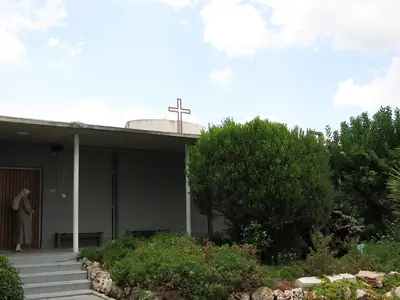
The Monastery of Saint Clare, also known as the Convent of Mary’s Fear, is connected with the Poor Clares and a history reaching back to 1884. The community left the Ottoman Empire during the First World War, returned to Nazareth in 1949 and later moved to newer facilities on the northern slope of Tremor Hill.
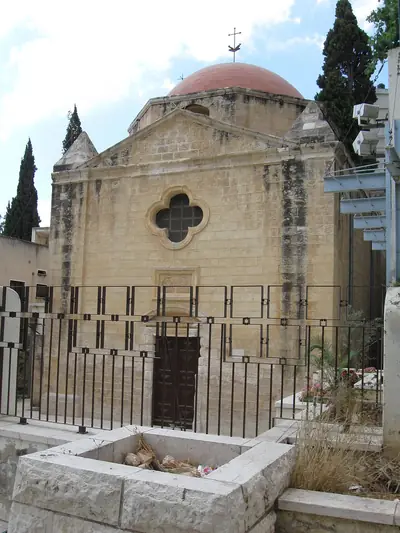
Near the municipal market, Makan shaab aldin is a small domed shrine identified as the tomb of Shihab al-Din, described as Saladin’s nephew. Its green dome stands opposite Khan al-Basha, and the roof serves as a mosque.
Explore Nazareth with a self-guided walking tour
A Nazareth self-guided walking tour is a practical way to connect the city’s religious landmarks and historic streets without following a group. Neywo offers two walking tours in Nazareth:
- Nazareth Old City: In the Footsteps of the Annunciation covers 1.65 km in about 78 minutes and includes 11 narrated stops, from Nazareth Village and Christ Church to the Basilica of the Annunciation, St. Joseph’s Church, the White Mosque and Mensa Christi Church.
- Fountain Square to the Hilltop Basilica covers 1.64 km in about 51 minutes and includes 6 narrated stops, including Misgad HaShalom, the Coptic Church of the Annunciation, the Greek Orthodox Church of the Annunciation, the Basilica of Jesus the Adolescent and Nabi Saeen Mosque.
Download the Neywo audio guide for Nazareth
Download Neywo and explore Nazareth with two walking tours and 22 narrated places. The app tells the story of each place as you reach it, at your own pace, with no group and no schedule. Narration is available in 11 languages, making it easy to turn a visit into your own free walking tour of Nazareth.
Nazareth is part of Israel’s Northern District. You can also continue exploring the country with guides to Israel, Acre, Haifa, Jerusalem or Tel Aviv.
Places with an audio guide in Nazareth
8 places in Nazareth with a Neywo audio guide. Each one starts telling its story as you reach it.
Self-guided tours in Nazareth
2 tours in Nazareth, free in the Neywo app. Each stop tells its story as you reach it.
- Walk
Nazareth Old City: In the Footsteps of the Annunciation
Start in a reconstructed first-century village, then wind through the Old City's market lanes past the Basilica of the Annunciation, St Joseph's, the Ottoman Seraya and the White Mosque. Churches, a mosque and a Saladin-era shrine sit within a few steps of each other, and the Synagogue Church and the Mensa Christi stone table end the walk.
Nazareth Village · Christ Church · Makan shaab aldin · Basilica of the Annunciation · St. Joseph's Church · Franciscan Monastery …
Open this tour: Nazareth Old City: In the Footsteps of the Annunciation - Walk
Fountain Square to the Hilltop Basilica
A second Nazareth, away from the main pilgrim trail: the New Mosque of Peace, the Coptic church, the Greek Orthodox church built over Mary's spring and the Russian pilgrims' hostel of Moskobiya. Then climb to the Salesian basilica and the Nabi Saeen mosque for the best views over the city and the Jezreel Valley.
Misgad HaShalom · Coptic Church of the Annunciation · Greek Orthodox Church of the Annunciation · Moskobiya · Basilica of Jesus the Adolescent · Nabi Saeen Mosque
Open this tour: Fountain Square to the Hilltop Basilica
Walk Nazareth with Neywo
Neywo turns Nazareth into a self-guided audio tour. Stories arrive as you reach the place they belong to, and the route reshapes when you wander off it.

