Things to Do in Liepāja, Latvia: Walking Guide
Things to Do in Liepāja: What to See in Latvia’s Coastal City
Looking for things to do in Liepāja? This coastal city in Courland, Latvia, brings together Baltic seaside landscapes, distinctive churches, museums, music, and the traces of a complex past. Neywo has a free audio guide for Liepāja with 18 narrated places, so you can explore the city while its stories play at the places where they happened.
What to See in Liepāja
Liepāja’s sights range from ornate religious buildings and cultural venues to memorials and museums. The following route through the city brings together some of the most important places to see.
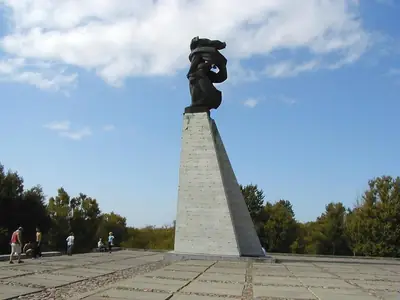
Monument to the Sailors and Fishermen Lost at Sea
At the end of Kūrmājas Prospect, in the seaside park, the Monument to the Sailors and Fishermen Lost at Sea looks towards the Baltic Sea. A bronze woman stands on an 11-metre-high V-shaped pedestal covered with Saaremaa dolomite, one hand raised above her eyes as if searching the horizon.
Installed in 1977, the monument was designed by architect Gunārs Asaris and sculptor Alberts Terpilovskis. A plaque carries Latvian folk-song lines about quiet winds, waves, and loved ones lost beneath the sea. A second plaque, added in 2000, commemorates American airmen whose aircraft was shot down over the Baltic Sea west of Liepāja.
Liepāja Museum
Liepāja Museum, or Liepājas muzejs, brings together the history of Liepāja and South Kurzeme through archaeology, ethnography, art, and temporary exhibitions. Founded on 30 November 1924, it has been housed in its present building since 1935.
The collection contains more than 130,000 objects, including archaeological finds and a detailed group of ethnographic objects from Kurzeme. Exhibitions cover Liepāja’s early history and the ethnography of South Kurzeme, alongside displays about woodcarver Miķelis Pankoks and a collection of tinware.
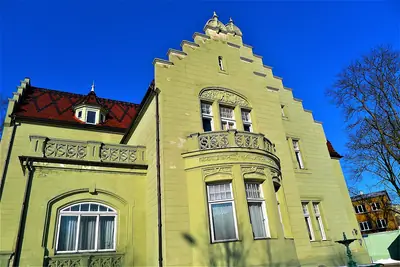
The building itself deserves attention. Constructed in 1901 by Paul Max Bertschy from sketches by Berlin architect Ernest von Ihnen, it has a Neo-Gothic façade and interiors that combine Gothic, German Renaissance, Baroque, and Rococo elements.
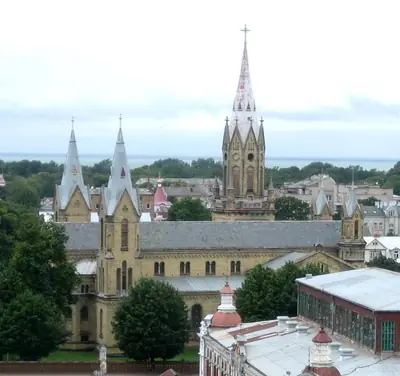
Liepāja Saint Joseph Roman Catholic Cathedral
Saint Joseph’s Cathedral is the cathedral of the Roman Catholic Diocese of Liepāja and the largest Catholic church in Kurzeme. Its present building was constructed between 1894 and 1900, incorporating part of an earlier church consecrated in 1762.
The cathedral is recognized as a nationally significant architectural monument and a monument of cultural history. Its long connection with an earlier place of worship makes it an important religious landmark in the city.
Liepāja Great Choral Synagogue Memorial
A memorial sign now marks the former site of Liepāja’s Great Choral Synagogue. The synagogue stood here from 1873 until 1941 and was built in the Neo-Renaissance style, following the model of the synagogue on Oranienburger Straße in Berlin.
In July 1941, the Nazis ordered its demolition. Because explosives were considered dangerous in the city centre, Jewish people were forced to dismantle the building by hand. A residential building was later constructed on the site. The memorial sign, unveiled in 2014, was created by artist Raimonds Gabaliņš.
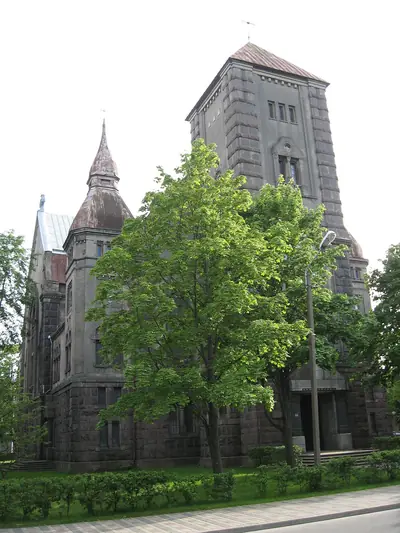
Churches of Saint Anne and Luther
The Church of Saint Anne is a Lutheran church belonging to the Evangelical Lutheran Church of Latvia. It is also recognized as a state-level architectural monument and remains the home of the Liepāja Saint Anne Evangelical Lutheran congregation.
The Church of Luther in Liepāja is another recognized Latvian cultural monument. Together, these churches form part of the city’s important Lutheran heritage and are included in Neywo’s routes through central Liepāja.
Rožu laukums
Rožu laukums, or Rose Square, is one of the central places connected with Liepāja’s urban and cultural life. It provides a natural point between several of the city’s principal sights, including the churches, the Great Amber Concert Hall, and Holy Trinity Cathedral.
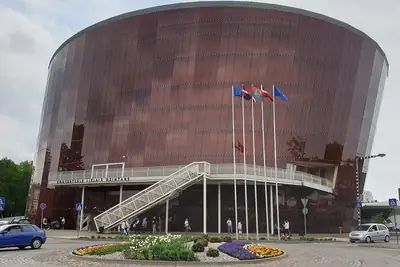
Great Amber Concert Hall
The Great Amber Concert Hall, known in Latvian as Lielais Dzintars, is one of Liepāja’s most recognizable modern buildings. Its cone-shaped structure is enclosed by a tilted glazed façade, creating an unusual silhouette in the city centre.
Designed by Austrian architect Volker Giencke in collaboration with Latvian architect Juris Poga, the building rises 30 metres over eight storeys and covers 14,126 square metres. It is home to the Liepāja Symphony Orchestra and includes several spaces for music and the arts.
The Great Hall seats 1,000 people, while the Chamber Hall seats 200 and the Experimental Stage 120. The building also contains the Civita Nova art space, a mirror hall, an art gallery, and the Liepāja Music, Art and Design Secondary School.
Holy Trinity Cathedral
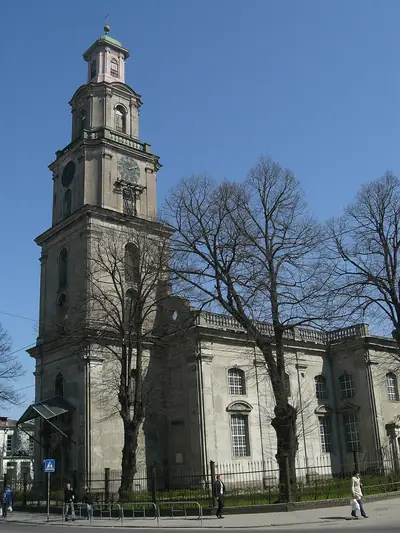
Holy Trinity Cathedral, or Svētās Trīsvienības Baznīca, is a Lutheran cathedral and the seat of the Bishop of Liepāja. It is the principal church of the Diocese of Liepāja.
Its architecture combines late Baroque and Classical features, while the interior is richly decorated in the Rococo style. Highlights include the 13-metre-high altar, an ornate confessional and pulpit, and the gallery of the Dukes of Courland. Elaborate woodcarving and gilding give the interior a particularly detailed character.
The cathedral is especially famous for its organ, described as the world’s largest unaltered mechanical organ. It has more than 7,000 pipes and 131 stops, and is the only organ where pipes made by Heinrich Andreas Contius can still be heard. Visitors can also climb the tower for views across Liepāja.
Liepāja Theatre
Liepāja Theatre, or Liepājas teātris, is one of the city’s long-standing cultural landmarks. Founded in 1907, it is described as the oldest still-existing Latvian professional theatre. The theatre has operated under several names and has used its present name since 1998.
Performances are presented in Latvian. Its location on Teātra Street places it close to several central sights and makes it part of Liepāja’s enduring theatrical life.
Naval Cathedral of St. Nicholas
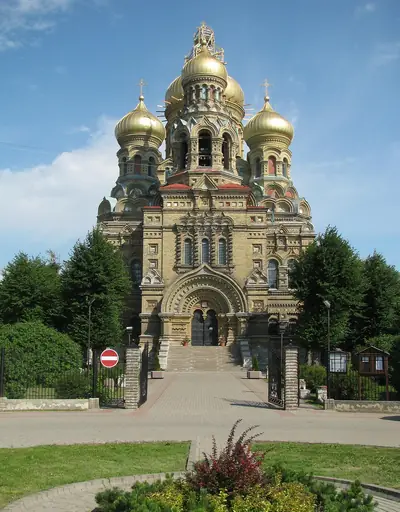
In Karosta, the Naval Cathedral of St. Nicholas is a major Orthodox landmark. Also known as Karosta Cathedral, it is a Russian Orthodox church built in the Byzantine style at the beginning of the twentieth century.
It is the largest Orthodox church in Latvia and one of the country’s four Orthodox cathedrals. Its location connects it with Karosta, the former military-port district in the northern part of Liepāja.
Karosta Prison
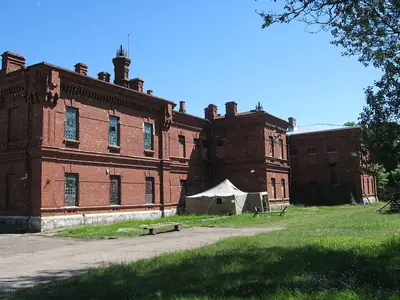
Karosta Prison is a former military detention site that now functions as a museum. The building was originally constructed at the beginning of the twentieth century as one of the hospitals serving Karosta.
After the sailors’ mutiny of 1905, every authority that controlled the building used it for military personnel serving disciplinary sentences. The museum uses the building and its history to convey the atmosphere of its former role.
Other Religious and Memorial Sites
Liepāja’s collection of historic places also includes the Church of the Holy Trinity, an Orthodox parish church belonging to the Riga Eparchy of the Latvian Orthodox Church. Saint Meinard Roman Catholic Church is a parish church of the Liepāja Diocese within the Roman Catholic Riga Metropolitan Archdiocese, while St. Dominic Roman Catholic Church stands at Jelgavas Street 17.
Outside the central sequence of sights, the Šķēde Memorial—also known as the Memorial to the Jews of Liepaja, victims of the Holocaust from 1941 to 1945—is an important place of remembrance in Latvia.
Explore Liepāja with a Self-Guided Audio Tour
Neywo lets you turn your visit into a Liepāja self-guided walking tour without joining a group or following a schedule. The app tells the story of each place as you reach it, at your own pace, with narration available in 11 languages.
Liepāja currently has:
- 1 walking tour: From the Baltic Shore to the Rose Square — 4.25 km, 119 minutes, and 11 narrated stops.
- 1 bus route: Through the Heart of Liepāja to Karosta — 2.6 km, 11 minutes, and 4 narrated stops.
- 1 bike route: Liepāja Centre by Bike: Amber, Cathedral and Roses — 2.5 km, 12 minutes, and 4 narrated stops.
Download Neywo and explore Liepāja with the city’s stories unfolding around you—no group, no schedule, and no need to rush from one stop to the next.
Places with an audio guide in Liepāja
8 places in Liepāja with a Neywo audio guide. Each one starts telling its story as you reach it.
Self-guided tours in Liepāja
3 tours in Liepāja, free in the Neywo app. Each stop tells its story as you reach it.
- Bike ride
Liepāja Centre by Bike: Amber, Cathedral and Roses
A short, flat ride on the city's cycle lanes from the Lutheran church in the north down to the old centre. Pass the cone-shaped Great Amber concert hall and the Holy Trinity Cathedral with its record-breaking organ, and finish at the Rose Square.
Church of Luther in Liepāja · Great Amber Concert Hall · Holy Trinity Cathedral, Liepāja · Rožu laukums
Open this tour: Liepāja Centre by Bike: Amber, Cathedral and Roses - Bus ride
Bus 4: Through the Heart of Liepāja to Karosta
City bus 4 runs from Siena tirgus through the centre and north up Atmodas bulvāris towards Karosta. Ride it past St Anne's, the Rose Square and the Holy Trinity Cathedral to the Lutheran church in the north.
Church of Saint Anne in Liepāja · Rožu laukums · Holy Trinity Cathedral, Liepāja · Church of Luther in Liepāja
Open this tour: Bus 4: Through the Heart of Liepāja to Karosta - Walk
From the Baltic Shore to the Rose Square
Begin at the bronze woman gazing over the Baltic, then walk inland through Liepāja's old centre: a Neo-Gothic museum, the lost Great Synagogue, three very different churches and the cone-shaped Great Amber concert hall. A seaside town where the sea, music and faith all meet.
Monument to the sailors and fishermen perished in the sea · Liepāja Museum · Jānis Čakste Square · Liepāja Saint Joseph Roman Catholic Cathedral · Liepāja Great Choral Synagogue · Church of Saint Anne in Liepāja …
Open this tour: From the Baltic Shore to the Rose Square
Walk Liepāja with Neywo
Neywo turns Liepāja into a self-guided audio tour. Stories arrive as you reach the place they belong to, and the route reshapes when you wander off it.

