Visiting Jēkabpils, Latvia: Top Sights on Foot
Things to Do in Jēkabpils: Historic Churches, Krustpils Castle and Two Banks of the Daugava
The best things to do in Jēkabpils centre on its historic churches, riverside setting and the heritage of the two towns that grew on opposite banks of the Daugava. The city combines the former Jēkabpils and Krustpils, creating a destination where medieval castle history, religious architecture and local memorials can be explored at an unhurried pace. Neywo has a free audio guide for Jēkabpils with 15 narrated places, available in 11 languages.
Jēkabpils is part of Semigallia, one of Latvia’s historic regions, and offers a different experience from larger Latvian cities. Its story is closely linked to the Daugava, river transport and the castle settlement on the opposite bank.
What to see in Jēkabpils
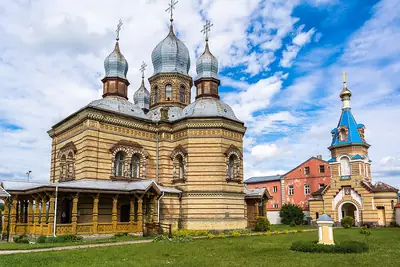
Jēkabpils Vecticībnieku baznīca
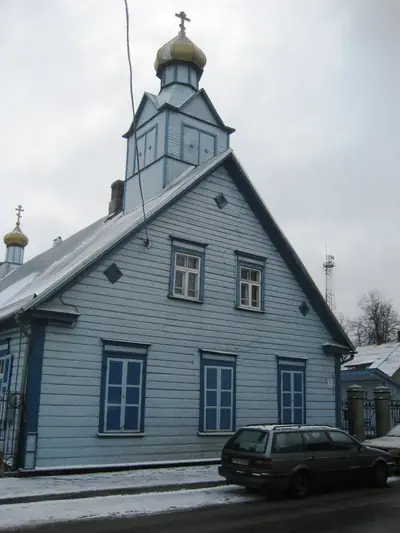
Begin on the left bank at Jēkabpils Vecticībnieku baznīca, at 15 Viestura Street. Founded in 1862, the church is part of the city’s religious and cultural history.
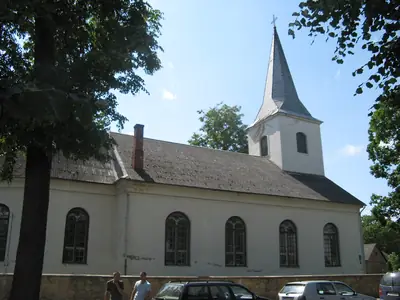
Nearby, the Church of Saint Michael, also known as Jēkabpils Evangelical Lutheran Church, dates from 1807. It stands at 123 Brīvības Street, close to the city council building, and is included on Latvia’s list of architectural monuments.
Monastery of the Holy Spirit
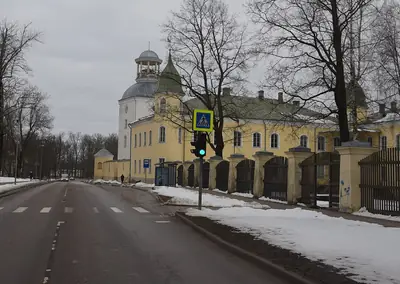
The Monastery of the Holy Spirit is an Orthodox monastery at 200 Brīvības Street, on the left bank of the Daugava. Founded at the end of the seventeenth century, it has continued for more than three centuries as an important Orthodox site in Jēkabpils.
The monastery is also one of the landmarks represented in the Jēkabpils city logo, together with Krustpils Castle. These two sites reflect the city’s two historic settings and its most recognisable heritage.
Church of the Sanctuary of Holy Mother of God
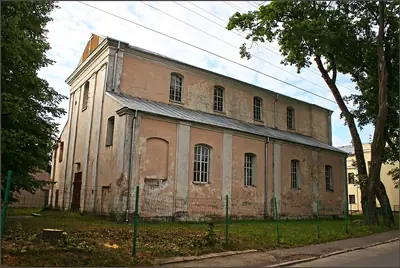
Near the Old Town Square on Brīvības Street stands the Church of the Sanctuary of Holy Mother of God, historically known as the Uniate Church. This Orthodox church is one of Jēkabpils’s largest houses of worship and a state-significance architectural monument. It is being restored through donations collected by the Orthodox congregation.
Other churches add to the city’s varied religious landscape. The Baptist Church, known as Lūgšanas nams, was built in 1930 on Zaļā iela, opposite Jēkabpils State Gymnasium. In historic Krustpils, the Church of the Holy Trinity is one of the city’s two Catholic churches.
Oskara Kalpaka Square and Strūves Park
Oskara Kalpaka Square is a public space on the left bank, between Brīvības Street and Jēkabpils Gymnasium. It is named after Oskars Kalpaks, a Latvian colonel and the first commander of Latvia’s National Guard Latvian units.
Across Brīvības Street is Strūves Park. The area provides a useful point from which to understand the relationship between Jēkabpils’s public spaces, historic buildings and the Daugava.
The Struve Geodetic Arc points
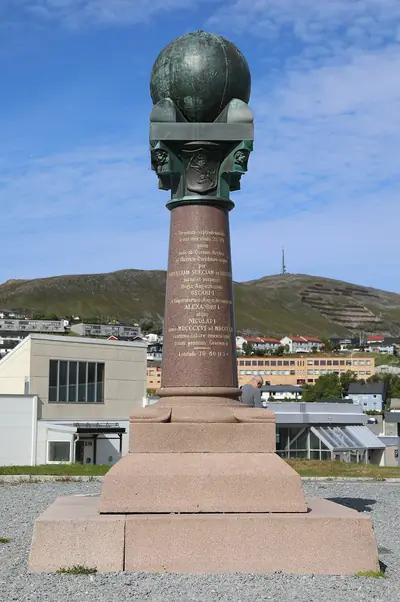
Jēkabpils is connected to the Struve Geodetic Arc, a nineteenth-century surveying project created between 1816 and 1855 under the direction of astronomer Friedrich Georg Wilhelm Struve. The arc stretches for more than 2,820 kilometres from Hammerfest in Norway to the coast of the Black Sea, crossing what are now ten countries, including Latvia.
The survey used a chain of triangles to measure the Earth’s shape and size. The World Heritage property now includes 34 of the original 265 measuring points. Across the arc, these surviving points are marked in different ways, including drilled marks, stone cairns, memorial plaques, iron crosses and obelisks.
Brīvības piemineklis
Opposite Krustpils Castle on Rīgas Street, Brīvības piemineklis stands on a broad terrace dedicated to soldiers from the Krustpils congregation who died in Latvia’s fights for freedom. The monument was unveiled on September 27, 1925.
Its architectural ensemble includes two semicircular terraces made from rough Daugava dolomite quarried near Asote. A granite section in the centre shows the head of an ancient Latvian warrior, crossed swords and traditional ornaments. The inscription commemorates those who fell for their homeland between 1918 and 1920.
The monument was damaged during the Soviet period, including the destruction of its upper section and the covering of its inscriptions. It was later restored during Latvia’s National Awakening using old photographs.
Krustpils Castle and the Jēkabpils History Museum
On the right bank of the Daugava, Krustpils Castle is one of the essential places to visit in Jēkabpils. Also known as Krusta Castle, it is a medieval fortress whose origins reach back to the thirteenth century, when it was built beside the river.
Its position was strategic: the castle stood near the road linking Riga, Daugavpils and Polotsk, as well as near a crossing of the Daugava. The castle’s location helps explain the growth of Krustpils and its lasting importance in the history of the city.
Krustpils Castle is also the main home of the Jēkabpils History Museum. Based here since 1996, the museum preserves more than 45,000 objects relating to everyday life, work, education, religion, art, and the political and military events that shaped Jēkabpils and its surrounding area.
Permanent exhibitions explore the history of Jēkabpils and Krustpils, the lives of local people and important regional events. The museum also presents art and themed exhibitions. The restored gate tower is open to visitors and offers a view over Jēkabpils.
Krustpils Lutheran Church
The Krustpils Lutheran Church is regarded as the oldest house of worship in Jēkabpils. Its present form was rebuilt in a restrained Empire style, and the church is a state-protected monument.
It is also considered the best-maintained monument of national importance in the surrounding municipality. Its history is linked to the Little Bridge of Love, which once connected the church with the Krustpils parsonage on the opposite side of the Donaviņa River.
Mīlestības tiltiņš, the Little Bridge of Love
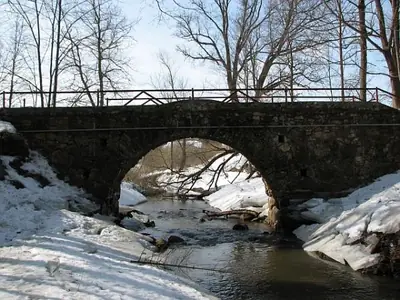
Mīlestības tiltiņš is a small pedestrian bridge on the right bank, in the historic Krustpils area near Krustpils Lutheran Church. It crosses the Donaviņa River, formerly known as the Dzirnupīte.
Built at the end of the nineteenth century, the bridge is a single-span arched structure made from dolomite masonry. It is recognised as a monument of industrial heritage and offers a close-up look at the area’s nineteenth-century engineering.
Krustpils St. Nicolaus Orthodox Church
On Zīlānu Street, Krustpils St. Nicolaus Orthodox Church is a Byzantine-style church consecrated in 1910 in honour of Saint Nicolaus.
The building suffered severe damage during the First World War: only its walls remained, while the clergy house was reduced to its foundations. Restoration began after Father Vladimir Borozdinski returned from Russia in 1920. Regular services resumed in 1922, and a new icon screen was installed in 1928.
Kapeles kapi
Near Zvaigžņu Street, beyond Krustpils railway station, Kapeles kapi is one of Jēkabpils’s oldest cemeteries. The burial mound already existed before 1787, when the owner of Krustpils Castle, Korff, built a chapel for deceased members of his family.
A second chapel was built about a century later for the estate’s lords. Both chapels are local architectural monuments. The cemetery also preserves nineteenth-century crosses, several of which are listed as artistic monuments.
A city shaped by two historic towns
Jēkabpils developed from two distinct settings divided by the Daugava. On the right bank, settlement grew beside Krustpils Castle, built in 1237. On the left bank, the town expanded through the work of rafters and river transport workers.
In 1670, Duke Jacob granted the settlement city rights and gave it the name Jēkabmiests, known in German as Jakobstadt. The city retained that name until 1924, when it became Jēkabpils. Jēkabpils and Krustpils remained separate cities for a time before being united in 1962.
This history makes crossing between the two banks part of the sightseeing experience. The city’s character comes from the contrast between the castle side, the former rafters’ town and the river that connects them.
Explore Jēkabpils with Neywo
Neywo’s free Jēkabpils audio guide includes one walking tour: Two Banks, One City: Jēkabpils from Rafters’ Town to Krustpils Castle. The walk covers 3.79 km, lasts 114 minutes and includes 6 narrated stops: Jēkabpils Vecticībnieku baznīca, the Church of Saint Michael, the Monastery of the Holy Spirit, the Struve Geodetic Arc points, Krustpils Castle and Mīlestības tiltiņš.
Download Neywo and explore Jēkabpils at your own pace. The app tells the story of each place as you reach it, with no group and no schedule.
Places with an audio guide in Jēkabpils
7 places in Jēkabpils with a Neywo audio guide. Each one starts telling its story as you reach it.
Self-guided tours in Jēkabpils
1 tour in Jēkabpils, free in the Neywo app. Each stop tells its story as you reach it.
- Walk
Two Banks, One City: Jēkabpils from Rafters' Town to Krustpils Castle
Once Jēkabpils and Krustpils were separate cities divided by the Daugava. Walk the old rafters' town on the left bank, with its Old Believers', Orthodox and Lutheran churches, a monastery and a UNESCO-listed Struve survey point, then cross the river to the thirteenth-century castle and the little Bridge of Love.
Jēkabpils Vecticībnieku baznīca · Church of Saint Michael in Jēkabpils · Monastery of the Holy Spirit in Jēkabpils · Strūves ģeodēziskā loka punkti Latvijā · Krustpils Castle · Mīlestības tiltiņš
Open this tour: Two Banks, One City: Jēkabpils from Rafters' Town to Krustpils Castle
Walk Jēkabpils with Neywo
Neywo turns Jēkabpils into a self-guided audio tour. Stories arrive as you reach the place they belong to, and the route reshapes when you wander off it.

