Visiting Alūksne, Latvia: Top Sights on Foot
Things to Do in Alūksne: What to See in Latvia’s Vidzeme Region
Looking for things to do in Alūksne? This lakeside town in Latvia’s Vidzeme region combines medieval ruins, historic churches and landscapes shaped by Lake Alūksne. Its most distinctive sights include a castle island, an ancient hillfort and several buildings that reflect the area’s Catholic, Lutheran and Orthodox heritage.
Neywo offers a free audio guide for Alūksne with 5 narrated places, available in 11 languages. For more ideas across the region, explore Vidzeme or discover more of Latvia.
What to see in Alūksne
Temple Hill
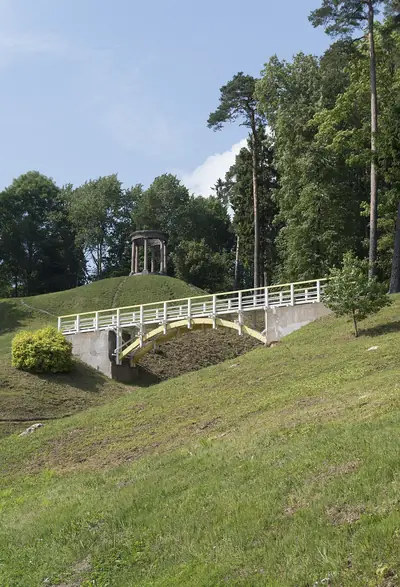
Temple Hill is the highest point in Alūksne, rising on a peninsula that extends into Lake Alūksne from the southwestern shore. The site was once a fortified settlement of the Latgalians, one of the ancient Baltic tribes.
The summit plateau measures about 80 by 40 metres. Its defensive earthworks are still visible: an eastern rampart reaches three metres in height, while two more ramparts run towards the northeast before continuing as terraces down the western slope. A wide outer moat once protected the northern side, and a smaller rampart closed off the western edge.
Temple Hill offers an introduction to Alūksne’s history before the town’s medieval castle was built. Its position beside the lake also helps explain the strategic importance of this landscape.
Alūksne Castle
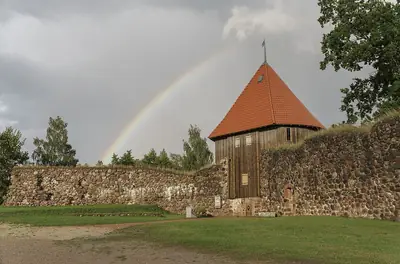
Alūksne Castle stands on a small island in the middle of Lake Alūksne. Built in 1342 by the Livonian Order, the northern branch of the Teutonic Knights, it was known in German as Marienburg, or Mary’s Castle.
The island location placed the fortress on the eastern frontier of the order’s territory. For more than three centuries, the castle served as the administrative centre of the Alūksne district and the residence of the local commander, or komtur. It was also one of the Livonian Order’s largest and most important border fortresses facing Russia.
The castle was destroyed in 1702 during the Great Northern War. Today, its weathered stone walls remain as a cultural monument, surrounded by the waters of Lake Alūksne. An open-air stage has also been built among the ruins, adding a modern use to the historic site.
Alūksne Lutheran Church
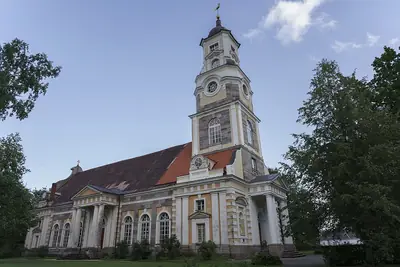
Alūksne Lutheran Church stands on Pils Street and dates from the second half of the eighteenth century. Its design was entrusted to the architect Kristofs Hāberlands, who gave the building a simple and sturdy appearance.
The church is one of the older surviving Lutheran buildings in the region. Its clean façade and restrained form fit naturally into the surrounding streetscape, making it a worthwhile stop while exploring the historic centre.
Alūksne Catholic Church
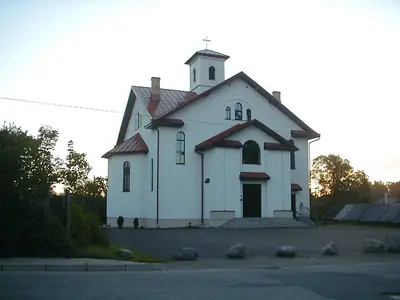
Alūksne’s Roman Catholic church was consecrated in 2001 by Archbishop Jānis Pujats. Before its construction, the local Catholic congregation gathered in institutional halls and private homes, so the building marked an important stage in the community’s history.
The church has a modern layout rather than the traditional nave arrangement often associated with Latvian churches. Inside, the altarpiece depicts the Holy Family, accompanied by a figure of Saint Boniface. The German Catholic organisation Bonifatius Werk helped fund the construction, explaining the presence of the organisation’s patron saint.
Alūksne Orthodox Church
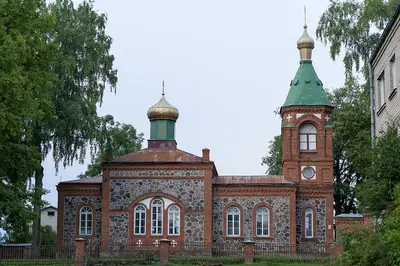
The Holy Trinity Orthodox Church reflects another part of Alūksne’s religious and cultural history. The town’s Orthodox congregation dates back to 1845, and within a few years more than 1,600 local residents had joined the faith.
The present church was completed in 1895 on land donated by Baroness Helena von Fittinghof in 1873. Built from fieldstone and brick, it combines Neo-Romanesque and Byzantine influences. The result is a solid and distinctive building that has been protected as a local architectural monument since 1998. It remains an active place of worship.
An Alūksne self-guided walking tour
The most practical way to experience these sights is with an Alūksne self-guided walking tour. Neywo’s route, Alūksne: Castle Island and the Lakeside Town, covers 2.46 kilometres and takes around 60 minutes. It includes five narrated stops: Temple Hill, Alūksne Castle, Alūksne Lutheran Church, Alūksne Catholic Church and Alūksne Orthodox Church.
The tour brings together the town’s main historical landmarks in a compact route, from the ancient hillfort and medieval castle to the churches that show Alūksne’s religious diversity. If you are continuing through Vidzeme, you can also compare Alūksne with Gulbene, Cēsis, Sigulda or Valmiera.
Download Neywo and explore Alūksne at your own pace
Download Neywo for a free walking tour in Alūksne. The city has 1 walking tour: a 2.46-kilometre route lasting 60 minutes, with 5 narrated stops.
The app tells the story of each place as you reach it, at your own pace, with no group and no schedule. Choose your language from the 11 available for the narration, start walking and let the route guide you through Alūksne’s castle island, hillfort and historic churches.
Places with an audio guide in Alūksne
5 places in Alūksne with a Neywo audio guide. Each one starts telling its story as you reach it.
Self-guided tours in Alūksne
1 tour in Alūksne, free in the Neywo app. Each stop tells its story as you reach it.
- Walk
Alūksne: Castle Island and the Lakeside Town
Climb the ancient Latgalian hill fort, cross to the ruined castle of the Livonian Order on its island, then walk into town to see three churches that show Alūksne's mix of Lutheran, Catholic and Orthodox communities.
Temple Hill in Alūksne · Alūksne Castle · Alūksne Lutheran church · Alūksne Catholic church · Alūksne Orthodox Church
Open this tour: Alūksne: Castle Island and the Lakeside Town
Walk Alūksne with Neywo
Neywo turns Alūksne into a self-guided audio tour. Stories arrive as you reach the place they belong to, and the route reshapes when you wander off it.

