Visiting Jelgava, Latvia: Top Sights on Foot
Things to Do in Jelgava: A Self-Guided Walk Through Palaces, Churches and History
The best things to do in Jelgava include visiting Jelgava Palace, exploring historic churches and museums, and following the story of the former capital of the Duchy of Courland and Semigallia. The city combines royal architecture with traces of buildings lost during the Second World War and a setting between the Lielupe and Driksa rivers. Neywo offers a free audio guide for Jelgava with 17 narrated places.
Jelgava is in Semigallia, in southern Latvia. Its historic name, Mitau, reflects the city’s earlier role as the capital of the Duchy of Courland and Semigallia, which existed from the sixteenth century until 1795.
What to See in Jelgava
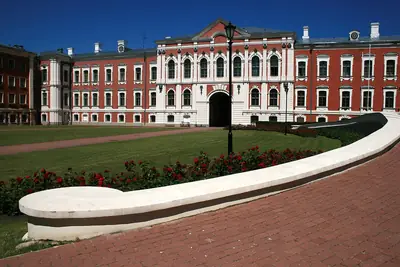
Jelgava Palace
Jelgava Palace, or Jelgavas pils, is the essential place to see in Jelgava. The palace stands on an island between the Lielupe River and its branch, the Driksa. Designed by Bartolomeo Rastrelli and built in the eighteenth century, it was the residence of the Dukes of Courland and Semigallia in their capital.
It is regarded as the largest Baroque palace in the Baltic states and, by area, the largest palace in Latvia. Jelgava was heavily destroyed during battles in the summer of 1944, but the palace is one of the few buildings from the former ducal capital to have been restored in its original appearance. Its history is therefore inseparable from both the city’s eighteenth-century grandeur and its wartime destruction.
Jelgavas vēstures un mākslas muzejs
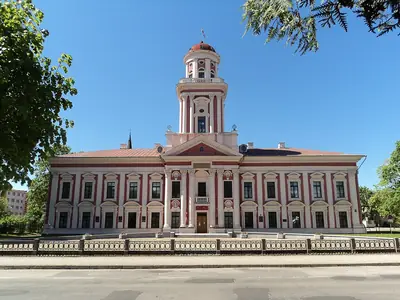
The Ģederts Eliass Jelgava History and Art Museum occupies a building with its own important past. Before becoming a museum, it housed Academia Petrina, founded in 1775 by Duke Peter von Biron in what was then Mitau.
Academia Petrina is regarded as the oldest higher educational establishment in Latvia. It operated until 1806, later becoming Gymnasium illustre and then Jelgava Men’s Gymnasium in 1837. Almost completely destroyed during the Second World War, the building was later restored. A visit connects Jelgava’s museum collections with the city’s long educational history.
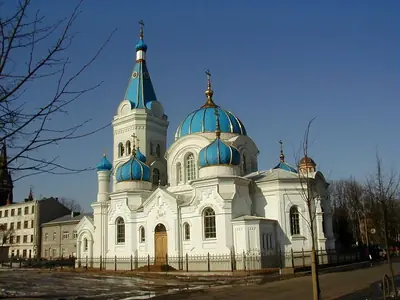
St Simeon and St Anne’s Cathedral
St Simeon and St Anne’s Cathedral is one of Latvia’s four Orthodox cathedrals. Known in Latvian as Jelgavas Svētā Simeona un Svētās Annas pareizticīgo katedrāle, it belongs to the Latvian Orthodox Church and is an important Orthodox place of worship in Jelgava.
Church of Saint Anne
The Church of Saint Anne is one of Jelgava’s historic landmarks and the oldest church in the city. This Evangelical Lutheran church is known in Latvian as Jelgavas Svētās Annas evaņģēliski luteriskā baznīca.
Its long history makes it a useful stop for understanding Jelgava’s religious and architectural heritage. It is included in both the city’s main historical walk and its quieter route through churches and spires.
Holy Trinity Church Tower
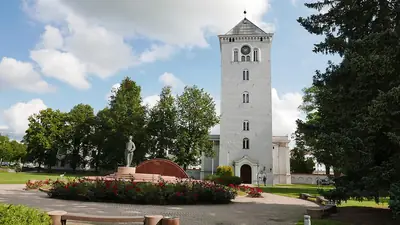
The tower of Holy Trinity Church is one of Jelgava’s most distinctive landmarks. The church itself was built in the early seventeenth century in the Baroque style and was regarded as the first stone church in Courland and Semigallia. It was also Jelgava’s oldest place of worship and oldest masonry building.
The church was heavily damaged during the bombing of the Battle of Jelgava, and its ruins were finally blown up in 1954. The tower is now the only surviving part. Archaeological excavations have revealed part of the original nave, while preserved exterior walls beside a lowered forecourt help show the scale of the vanished church. The tower also contains historical exhibitions, a tourism information centre, a restaurant and a viewing platform on the ninth floor.
Jelgava Immaculate Virgin Mary Roman Catholic Cathedral
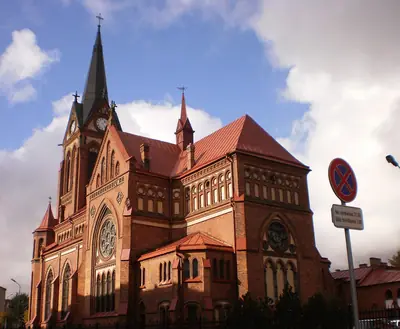
The Jelgava Immaculate Virgin Mary Roman Catholic Cathedral serves the Diocese of Jelgava and is the residence of its bishop and deanery. It is a monument of national architectural importance and one of the city’s largest religious buildings.
The present neo-Gothic cathedral was built in 1906 on the site of an earlier church, to a design by architect K. E. Stradmanis. It was originally consecrated to Saint George before being renamed the Church of the Blessed Virgin Mary. The Catholic history of the site reaches back to the seventeenth century, and Jelgava was home to the residence of the Bishop of Livonia between 1783 and 1798.
The cathedral suffered serious damage during the Second World War but was fully restored by 1992. The Diocese of Jelgava was established in 1995.
Ādolfs Alunāns Memorial Museum and Theatre
The Ādolfs Alunāns Memorial Museum is dedicated to Ādolfs Alunāns, a figure closely connected with Jelgava. He spent his childhood and school years in the city and developed his love of theatre there.
His theatrical legacy can also be followed at the Ādolfs Alunāns Theatre. In 1896, Alunāns created a small professional theatre company in Jelgava and led it until 1904. The troupe performed in Jelgava as well as in other towns and rural centres.
Jelgava Castle and Medem Palace
Jelgava Castle is another historic reference point in the city. The former castle invites visitors to consider the layers of Jelgava’s architectural past alongside the better-preserved palace.
Medem Palace has a different story: the two elegant town houses built for the Medem family in 1783 and 1787 have disappeared. Designed by Severīns Jensens, they stood on Upes Street. The newer house was considered by art historian Jānis Siliņš the finest example of classicism among Jelgava’s manor houses.
Both houses were destroyed during the battles for Jelgava in August 1944 and were never rebuilt. The Technical Faculty of the Latvia University of Agriculture now occupies the site of the older house, while a parking area stands on the site of the newer one.
Former Castle Theater
The former Castle Theater, or Pils teātris, stood on Castle Island near the Driksa Bridge and Jelgava Palace. Built in 1914 in the Art Nouveau style, it was used mainly for cinema screenings and later served as a school gymnasium.
The building was destroyed during the Second World War. Its story is one of the reminders that Jelgava’s cultural landscape includes not only surviving landmarks, but also important places that have vanished.
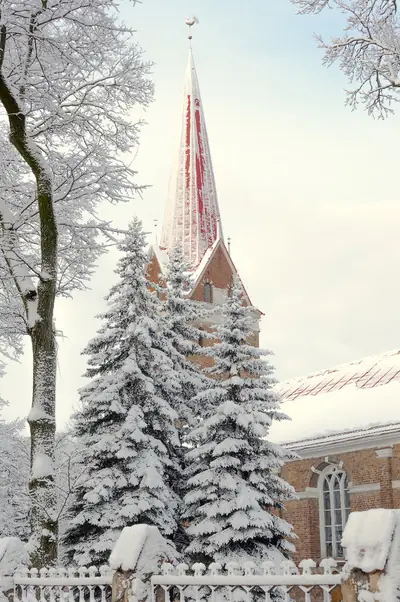
Church of Saint John
The Church of Saint John, or Jāņa baznīca, is one of Jelgava’s newer churches. The Evangelical Lutheran Church of Saint John was built between 1845 and 1847 and offers a quieter stop among the city’s religious landmarks.
New Synagogue of Jelgava
Near the Driksa River, at the meeting of Ūdens Street and Jānis Čakste Boulevard, stood Jelgava’s New Synagogue. Built in 1877, it was especially recognizable by its green dome and became a familiar feature of the waterfront.
Designed by Latvian architect Oskars Bārs, the synagogue stood beside the older Great Synagogue, which was located in a garden behind it. On July 3, 1941, the New Synagogue was set on fire along with all the city’s Jewish places of worship. Its remains were removed that autumn. The site is an important part of Jelgava’s history, even though the building itself no longer survives.
Seventh-day Adventist Church
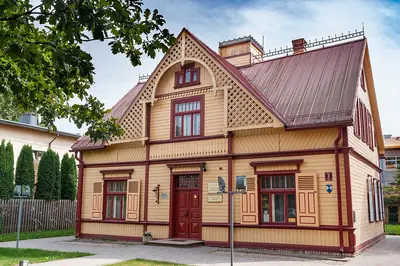
The Seventh-day Adventist Church in Jelgava is recognized as Latvian cultural monument number 5167. It forms part of the city’s protected cultural heritage and is included on Neywo’s walking routes.
Jelgava’s Duchy and War History
Jelgava was the former capital of the Duchy of Courland and Semigallia, known at the time as Mitava. The duchy shaped the history of Courland, Semigallia and Selonia for more than two centuries.
It began in the sixteenth century as a vassal state of the Grand Duchy of Lithuania, later coming under the Polish Crown and the Polish-Lithuanian Commonwealth. In 1795, during the Third Partition of Poland, it was annexed by the Russian Empire. Attempts to restore the duchy were made in 1812 and again in 1918, while a short-lived duchy connected with Courland, Semigallia and Piltene appeared in 1812 during the period of Napoleon Bonaparte.
The destruction of Jelgava during the Second World War is central to the city’s present appearance. Restored buildings such as Jelgava Palace and the museum stand alongside churches, towers and sites that survive only in fragments or historical memory.
Explore Jelgava with Neywo
Neywo gives you a Jelgava self-guided walking tour experience without a group or fixed timetable. The app has two walking tours in the city:
- Mitau Reborn: Dukes, Ruins and Rebuilt Spires covers 3.07 km in 113 minutes and includes 9 narrated stops.
- Cemetery Parks and Spires: Jelgava’s Quieter Side covers 2.05 km in 52 minutes and includes 4 narrated stops.
Across Jelgava, Neywo offers 17 narrated places. Each story plays as you reach the place, at your own pace, with no group and no schedule. Download Neywo and explore Jelgava through its palaces, churches, ruins and riverside history.
Places with an audio guide in Jelgava
8 places in Jelgava with a Neywo audio guide. Each one starts telling its story as you reach it.

Self-guided tours in Jelgava
2 tours in Jelgava, free in the Neywo app. Each stop tells its story as you reach it.
- Walk
Mitau Reborn: Dukes, Ruins and Rebuilt Spires
Jelgava was once Mitau, capital of the Duchy of Courland and Semigallia, and in 1944 it was almost wiped off the map. Walk from Rastrelli's vast Baroque palace on its river island through a surviving church tower, an academy that tried to lure Kant, and the sites of lost synagogues and rebuilt cathedrals.
Jelgava Palace · Jelgavas Svētās Trīsvienības baznīcas tornis · New Synagogue of Jelgava · Jelgavas vēstures un mākslas muzejs · St Simeon and St Anne's Cathedral, Jelgava · Jelgava Immaculate Virgin Mary Roman Catholic Cathedral …
Open this tour: Mitau Reborn: Dukes, Ruins and Rebuilt Spires - Walk
Cemetery Parks and Spires: Jelgava's Quieter Side
Away from the river, Jelgava's rebuilt Catholic cathedral, a Lutheran church from the 1840s and the oldest church in town stand among parks laid out over the old city cemeteries. A short, calm loop through the neighbourhoods that the 1944 fighting left half-intact.
Jelgava Immaculate Virgin Mary Roman Catholic Cathedral · Church of Saint John in Jelgava · Seventh-day Adventist Church in Jelgava · Church of Saint Anne in Jelgava
Open this tour: Cemetery Parks and Spires: Jelgava's Quieter Side
Walk Jelgava with Neywo
Neywo turns Jelgava into a self-guided audio tour. Stories arrive as you reach the place they belong to, and the route reshapes when you wander off it.

