Visiting Cancún, Mexico: Top Sights on Foot
Things to Do in Cancún: Beaches, Maya Sites, and Local Markets
Looking for things to do in Cancún beyond the beach? The city combines Caribbean scenery with Maya archaeological sites, museums, lively markets, and parks where you can experience everyday life in downtown Cancún. Neywo has a free audio guide for Cancún with 9 narrated places.
What to See in Cancún
Museo de Sitio and Zona Arqueológica El Rey
The Museo de Sitio at the Zona Arqueológica El Rey introduces one of the most important Maya archaeological sites on Cancún Island. The original Maya name of El Rey is unknown. Its present name, meaning “the king”, comes from an anthropomorphic sculpture discovered in 1909 by the English travellers Channing Arnold and Frederick Frost. They interpreted the figure as a monarch or noble.
El Rey’s history reaches back to the early Classic period, between 250 and 600 AD. Its first houses were built on platforms from organic materials, which have not survived. Between 200 and 1200 AD, the inhabitants were involved in fishing and salt extraction. The site became more important between 1300 and 1500 AD, when people arrived from the interior of the Yucatán Peninsula and built many of the structures visible today. The arrival of the Spaniards in the sixteenth century led to the site’s abandonment.
Museo Maya de Cancún
Set in tropical forest, the Museo Maya de Cancún offers a different perspective on the city’s history and culture. The museum opened in 2012 to add a major cultural attraction to a destination often associated mainly with beaches and nightlife.
Mexican architect Alberto García Lascurain designed the building with a modern form and hurricane-resistant elements. Its three exhibition halls are reached by a spiral outdoor staircase inspired by the Maya snail shell, a symbol of rebirth.
Two halls display the permanent collection, which contains more than 3,500 artefacts, with about 400 on view at a time. The third is used for temporary Maya-themed exhibitions, including objects such as painted pottery, jewellery, funerary masks, and stone monuments. One of the museum’s highlights is La Mujer de las Palmas.
Yamil Lu’um
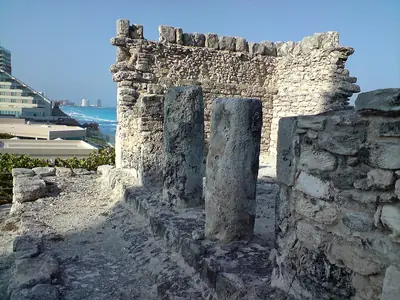
Yamil Lu’um is a small Maya archaeological site on the beach coast of Quintana Roo, within Cancún’s Hotel Zone. It belongs to the Maya region known as the East Coast of Quintana Roo and developed during the Late Postclassic period.
The site preserves the remains of two temples on a raised platform. One was associated with a carved scorpion motif and became known as the Scorpion’s Temple, or Templo del Alacrán. It is also believed to have served as a pre-Columbian lighthouse facing the ocean. The other was identified by a handprint impressed into the stucco and became known as the Temple of the Handprint. Those features are no longer visible, but they explain the temples’ traditional names.
The American explorer and diplomat John Lloyd Stephens documented Yamil Lu’um in 1842. Today, the site is maintained as part of the surrounding resort property.
Mirador Playa Delfines
Mirador Playa Delfines is one of Cancún’s most open beach viewpoints, with fewer tall hotels interrupting the scenery. Playa Delfines means “Dolphin Beach”, a name connected to dolphin pods that were once commonly seen here. Sightings are now rare, although early mornings may still offer the possibility of seeing them from the viewing point.
The viewpoint, also called El Mirador, is easy to recognise by the large “Cancún” sign, a popular place for photographs. From here, the view takes in turquoise water, pale sand, and the distant high-rise resorts. The beach itself is broad, gently sloping, and equipped with free thatched-roof shades. A small playground nearby also makes it a practical stop for families.
Mercado 23
Mercado 23 is the oldest in a series of markets in Cancún and has retained much of the character it had when it began in the 1970s. Its open-air flea-market atmosphere extends across indoor stalls and spaces around the edges.
The market sells everyday goods such as household products, school supplies, piñatas, sweets, and party items, alongside pet food, grains, pottery, and handcrafted objects. Fresh flowers, herbs, aromatic vegetables, and fruits add a food-market dimension. Cooked dishes are another attraction: vendors from different regions of Mexico prepare recipes connected to their hometowns and states.
Mercado 28
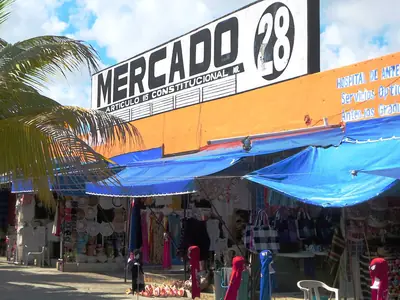
Established in the 1980s, Mercado 28 is one of downtown Cancún’s best-known commercial and cultural landmarks. Its wider main passages provide an overview of the market before narrower aisles lead to craft stalls.
Visitors can browse hammocks, embroidered textiles, decorative pieces, leather goods, and fashion accessories. Similar products appear in different sections, so walking between the aisles helps with comparisons. The market is best explored slowly, and early in the day the passages are often less crowded.
Mercado Coral Negro
In the Hotel Zone, Mercado Coral Negro—also known as the Coral Negro Flea Market—is arranged as a network of narrow walkways lined with small stalls. Its merchandise includes embroidered cotton clothing, T-shirts, hats, hammocks, charro-style accessories, masks, decorative crafts, sweets, and souvenirs.
Bargaining is part of the market’s informal rhythm. Further inside, air-conditioned shops specialise in jewellery, including silver pieces and colourful stones. Hair braiding and temporary henna tattoos are also available as quick, visual souvenirs.
Las Palapas
Las Palapas Park is one of downtown Cancún’s most popular gathering places and a good setting for observing local daily life. Food stalls line the walkways, serving tacos, empanadas, marquesitas, fresh juices, and other casual dishes.
The park’s open areas are used by children, while adults sit, talk, and gather around the stage. In the evening, food stalls become busier and the central area fills with people eating or watching performances.
Parque del Artesano
Parque del Artesano is an open-air artisan park where stalls focus on locally made crafts and souvenirs. Handmade jewellery, often featuring colourful natural stones, is especially prominent, while other stalls sell decorative items and keepsakes at a range of prices.
The park also has a small playground with swings and a slide. A small stage hosts local bands from time to time; when music is playing, visitors often stay to enjoy the relaxed atmosphere.
Explore Cancún with a Self-Guided Audio Tour
Neywo’s Cancún audio guide lets you explore the city independently. The app currently offers one walking tour: Downtown Cancún: the markets of El Centro. The route covers 1.86 km, takes about 43 minutes, and includes 4 narrated stops: Mercado 23, Parque del Artesano, Las Palapas, and Mercado 28.
The app tells the story of each place as you reach it, at your own pace, with no group and no schedule. Narration is available in 11 languages. Download Neywo and turn a visit to Cancún into a self-guided walking tour through the markets of El Centro.
Cancún is part of Quintana Roo, on Mexico’s Caribbean coast. For another nearby destination, continue to Playa del Carmen or Cozumel.
Places with an audio guide in Cancún
2 places in Cancún with a Neywo audio guide. Each one starts telling its story as you reach it.
Self-guided tours in Cancún
1 tour in Cancún, free in the Neywo app. Each stop tells its story as you reach it.
- Walk
Downtown Cancún: the markets of El Centro
Cancún is a hotel strip and this is the only part of it that walks: two kilometres round the downtown markets and the Palapas square, where the city's own residents shop and eat. The Maya sites are a bus ride away.
Mercado 23 · Parque del Artesano · Las Palapas · Mercado 28
Open this tour: Downtown Cancún: the markets of El Centro
Walk Cancún with Neywo
Neywo turns Cancún into a self-guided audio tour. Stories arrive as you reach the place they belong to, and the route reshapes when you wander off it.

